

By CrowdSent Blog Team
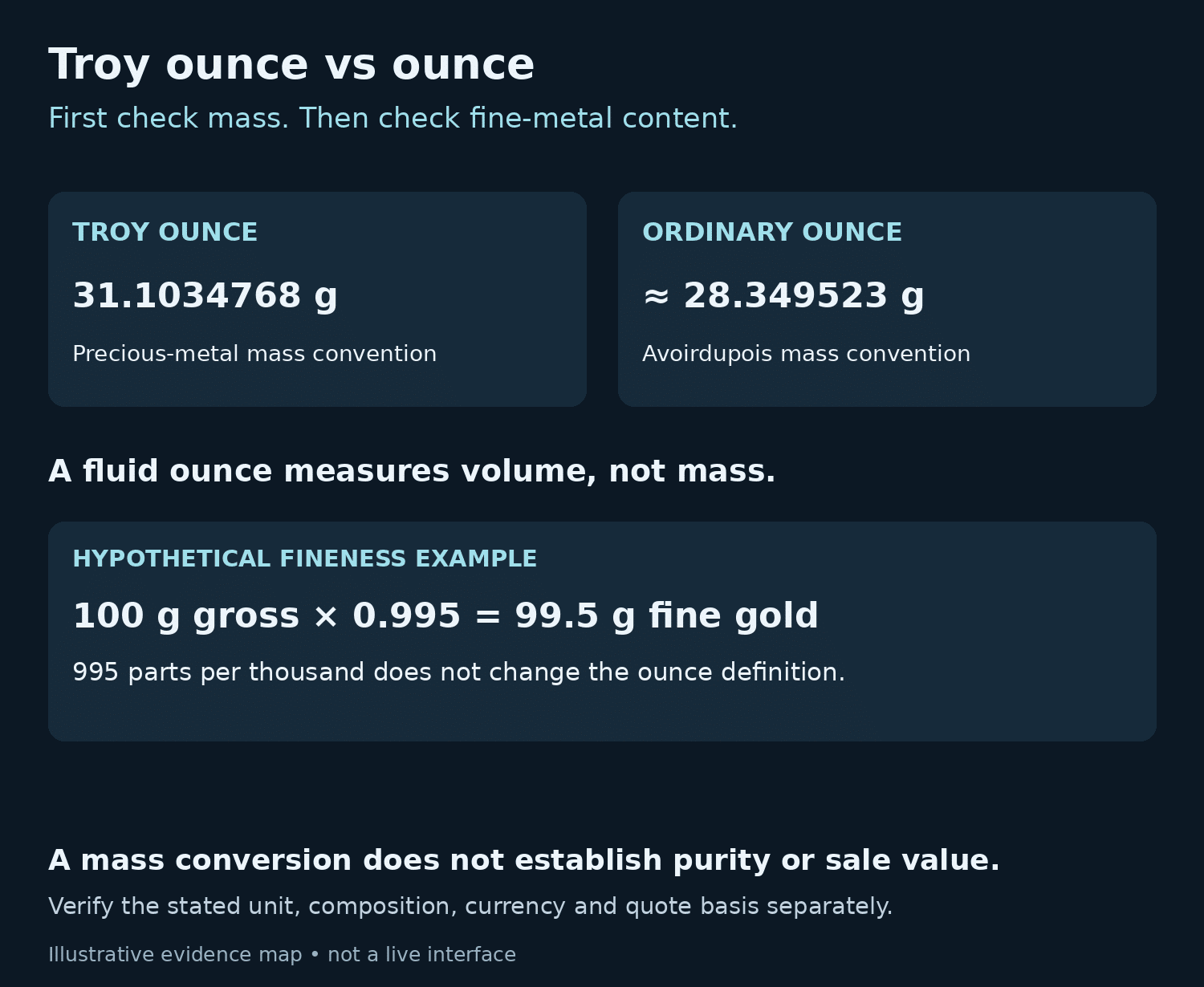
A troy ounce and an ordinary ounce describe different masses. A troy ounce is 31.1034768 grams; an ordinary avoirdupois ounce is about 28.349523 grams. Confusing them changes a precious-metal comparison before any price movement, currency conversion or dealer premium enters the calculation.
This guide follows one hypothetical metal quote through three checks: the unit of mass, the amount of fine metal, and the price denominator. The examples are educational, not live prices, product valuations or instructions to buy metal.
Troy ounce vs ounce: establish the denominator first
The NIST conversion tables distinguish avoirdupois and troy ounces. Both are units of mass. A fluid ounce, by contrast, is a volume unit and cannot be substituted into a metal-weight calculation.
Write “grams per troy ounce” beside 31.1034768. A bare number in a spreadsheet is easy to misread later. Labels such as oz, ozt and oz t can help, but a provider’s specification matters more than an abbreviation copied from another screen. If a listing says only “one ounce,” retain the uncertainty until its mass convention is clear.
One troy ounce contains approximately 1.09714 ordinary ounces. That is about 9.714% more mass than one ordinary ounce. The comparison runs the other way if the question is what fraction of a troy ounce an ordinary ounce contains: approximately 0.91146. The percentage difference depends on which quantity is the denominator.
Reconcile a quote without changing the metal value
Suppose a fictional reference is USD 3,000 per troy ounce of fine gold. Converting to a per-gram reference means dividing USD 3,000 by 31.1034768 grams per troy ounce. The result is approximately USD 96.45224 per gram. Ten grams of fine gold at that same reference correspond to approximately USD 964.52.
Now imagine a worksheet divides by 28.349523 instead. It reports about USD 105.82189 per gram. Nothing happened to the market: the worksheet used the mass of the wrong ounce. Its ten-gram result is about USD 1,058.22, roughly USD 93.70 above the correctly converted fictional reference.
A useful independent check is to multiply the per-gram result by 31.1034768. The answer should return to the original USD 3,000 per troy ounce, allowing for rounding. This round-trip test catches the unit mismatch without requiring a second price provider.
Do not infer a dealer overcharge merely because a retail item costs more than this reference. The calculation has not included fabrication, distribution, taxes, premiums or the particular product’s terms. It diagnoses the arithmetic, not the fairness of a transaction.
Gross weight and fine metal answer different questions
Gross metal weight describes the whole item. Fine metal content isolates the relevant precious metal within it. Fineness expressed as 995 parts per thousand corresponds to a fraction of 0.995. The LBMA price guide explains the fine-metal basis of its gold quotation and the use of fineness in parts per thousand.
Consider an invented 100-gram item with stated fineness of 995. Its calculated fine-gold content is 100 multiplied by 0.995, or 99.5 grams. Dividing by 31.1034768 gives approximately 3.198999 fine troy ounces. The item’s gross mass is approximately 3.215075 troy ounces. Both numbers can be correct because they describe different quantities.
At the fictional USD 3,000 reference, 3.198999 fine troy ounces correspond to approximately USD 9,597.00 before product-specific adjustments. Multiplying the gross 3.215075 ounces by that fine-metal reference would instead produce approximately USD 9,645.22. The approximately USD 48.23 difference is attributable to the assumed purity adjustment, not an exchange-rate movement.
This example assumes the mass and fineness are known. A printed label, spreadsheet entry or photograph does not independently establish an item’s composition. Keep source, stated precision and uncertainty alongside the calculation.
Separate mathematical conversion from settlement conventions
The LBMA weight-list guidance uses 0.0311034768 kilograms per troy ounce and describes its own gross-to-fine conversion procedure. Specific wholesale weighing and rounding conventions should not be silently applied to every coin, jewellery item or online quote.
For a research worksheet, retain extra decimal places in intermediate calculations and round the final display consistently. For an actual statement or contract, use the documented convention governing that record. If two totals differ slightly, compare rounding rules before assuming a substantive disagreement. If they differ by roughly the ordinary-versus-troy-ounce factor, investigate the unit itself.
Keep India and Pakistan comparisons explicit
A local quote may use grams, ten grams or a stated tola convention. Record the exact weight basis rather than assuming that a local unit name supplies every conversion detail. Also distinguish INR from PKR: an “Rs” label alone is insufficient for a cross-country worksheet.
Convert mass and currency in separate steps so that each can be checked. First express the same fine-metal amount in a common mass unit. Then apply a documented exchange-rate observation with its direction and timestamp. Retain purity and price-side differences separately. Our gold-price context guide develops the currency and market-driver side of that comparison.
A reusable unit-check record
For each observation, save the source, observation time, currency, price per unit, gross or fine basis, fineness if relevant, and the conversion factor used. Add the original unconverted amount. This makes the result reproducible even if a provider later changes its display format.
For two metals, the gold-silver ratio requires matching price units. For a trading instrument, contract size and lots introduce an additional quantity layer. Neither comparison should inherit an ounce definition from an unrelated instrument.
The pound comparison runs in the opposite direction
The heavier troy ounce does not imply that every troy unit is heavier than its ordinary counterpart. NIST’s conversion table lists a troy pound at approximately 373.2417 grams and an avoirdupois pound at approximately 453.5924 grams. The troy pound is lighter, even though the troy ounce is heavier. Moving from an ounce label to a pound label without checking the system can therefore reverse the comparison.
You can see the different groupings arithmetically. Twelve troy ounces at 31.1034768 grams each make 373.2417216 grams. Sixteen ordinary ounces at 28.349523125 grams each make 453.59237 grams. These are unit relationships, not evidence about the purity or value of any item. Avoid a worksheet rule that multiplies every field labelled ounces by sixteen to create pounds.
The NIST mass-conversion entries provide an independent check. Match the complete unit name, not just the shared word pound or ounce. A historical document or an inherited inventory sheet can mix conventions that a modern reader would not expect.
Combining items requires a weighted metal total
Now consider a fictional inventory containing two items of the same metal. Item A has a stated gross mass of 200 grams and fineness of 900 parts per thousand. Item B has a stated gross mass of 50 grams and fineness of 999 parts per thousand. Assume both measurements are valid for this exercise, with no packaging included. This is not an assay or a description of a retail product.
Item A contains 200 × 0.900 = 180 grams of fine metal. Item B contains 50 × 0.999 = 49.95 grams. The combined gross mass is 250 grams, while the combined fine-metal amount is 229.95 grams. Those two totals answer different questions and should occupy separate columns.
A simple average of 900 and 999 gives 949.5 parts per thousand. Applying that average to the whole 250 grams would imply 237.375 grams of fine metal, overstating the worked total by 7.425 grams. The error arises because the smaller, purer item receives the same weight as the larger item. The mass-weighted fineness is instead 229.95 ÷ 250 × 1,000 = 919.8 parts per thousand.
For a troy-ounce total, divide the verified 229.95 fine grams by 31.1034768. Preserve the item-level calculation so the total can be reconstructed. If one item is recorded in ounces and another in grams, convert both gross masses to a common unit before computing a weighted fineness. Weighting unlike numerical units directly would invalidate the comparison. A summary label such as “mixed gold, 250 grams” does not preserve the information needed for that fine-metal conversion. If one item’s fineness is unknown, leave its fine-metal contribution unresolved rather than averaging it into a falsely complete total.
Separate an exact conversion factor from uncertain input measurements
An exact unit relationship does not make a measurement exact. Suppose a fictional inventory display shows 20.0 grams but does not document the scale’s resolution, calibration or rounding convention. Converting the displayed number to many decimal places in troy ounces creates a longer number, not new evidence about the actual mass.
Keep the original display and its stated precision beside the converted result. If a source gives a measurement interval, convert both endpoints using the same positive factor. If it gives only a rounded display, do not invent an uncertainty interval without knowing how that display was produced. Distinguish uncertainty about the mass from uncertainty about fineness; resolving one does not establish the other.
The LBMA weight-list guidance provides a specific wholesale-record context for gross and fine quantities. Its documented conventions belong to that context. An educational spreadsheet should not silently claim that a jewellery receipt, home scale or photograph meets the same measurement and record requirements.
A strong final note therefore contains both a numerical result and a boundary: “Converted from the supplier’s stated mass and fineness; composition and weighing procedure not independently verified.” That wording keeps a valid calculation from becoming an unsupported claim about the physical item.
Frequently asked questions
1. How many grams are in a troy ounce?
A troy ounce is 31.1034768 grams. A display rounded to 31.1035 is often sufficient for a rough educational comparison, but retain the full factor when reconciling intermediate arithmetic.
2. Is a regular ounce smaller than a troy ounce?
Yes. An avoirdupois ounce is about 28.349523 grams. Compare both in grams before calculating a percentage difference; calling both “one ounce” hides the mismatch.
3. Does a troy ounce say how pure a metal is?
No. It identifies mass, not composition. A fine-metal amount additionally requires the relevant purity basis. One gross troy ounce of an alloy need not contain one troy ounce of gold.
4. Why divide a per-ounce price by grams per ounce?
The division changes the denominator while preserving the reference value. In the fictional example, USD 3,000 per troy ounce becomes about USD 96.45 per gram, not USD 3,000 multiplied by 31.1034768.
5. Can I compare two prices labelled per ounce directly?
Only after confirming the same ounce convention, metal basis, currency and observation time. Product terms or bid-versus-offer differences may still make the quotes unsuitable for a direct comparison.
6. Is a fluid ounce useful for weighing gold?
Not as a substitute mass unit. A fluid ounce describes volume. Converting a volume to mass would require additional information about the material and conditions.
7. Is a ten-gram retail price just the benchmark multiplied by ten?
Not necessarily. Convert the benchmark to a compatible per-gram and purity basis first. A retail amount can then include additional charges and product-specific pricing that the metal reference does not measure.
8. What should I do with a quote per tola?
Record the provider’s stated mass convention and convert from it. Do not guess the weight, purity or currency simply because the listing uses a familiar local unit.
9. Why can rounded conversions fail to return the starting number?
Rounding early discards precision. Retain the unrounded intermediate values and compare the final difference against the display precision before treating it as an error.
10. Does this conversion determine what an item can be sold for?
No. It produces a comparable metal-value reference under stated assumptions. Actual sale proceeds depend on the item, verification, counterparties, price side, charges and terms.
Build clearer market research
Keep unit checks beside the sources in your market-research journal. Explore CrowdSent and review the current membership information if its market-intelligence approach fits your research needs.
Educational information only, not financial advice. Hypothetical examples do not describe live prices or returns.