

CrowdSent Blog Team · Gold and silver research
The gold-silver ratio compares the price of gold with the price of silver using the same currency and weight unit. Divide the gold price by the silver price. A result of 100 means that one unit of gold has the same quoted reference value as 100 equivalent weight units of silver, under the comparison’s stated conditions.
The division is easy. Choosing compatible inputs takes more care. A gold jewellery quotation per 10 grams, a silver reference per kilogram and a futures price from another time can produce a precise-looking number that answers no clear question. This guide explains what is being compared, how to preserve the arithmetic and where a ratio’s interpretation stops.
For English-language readers in India and Pakistan, currency codes and local weight conventions deserve particular attention. Every numerical market example below is hypothetical. None describes current prices, a fair-value estimate or an instruction to exchange one metal for the other.
1. Define what your gold-silver ratio measures
Write the formula in words before entering numbers: gold price per chosen weight divided by silver price per the same weight. If both prices are dollars per troy ounce, the currency and common weight basis cancel. The result is a relative-price number. It has no currency label of its own, although its source prices still need theirs.
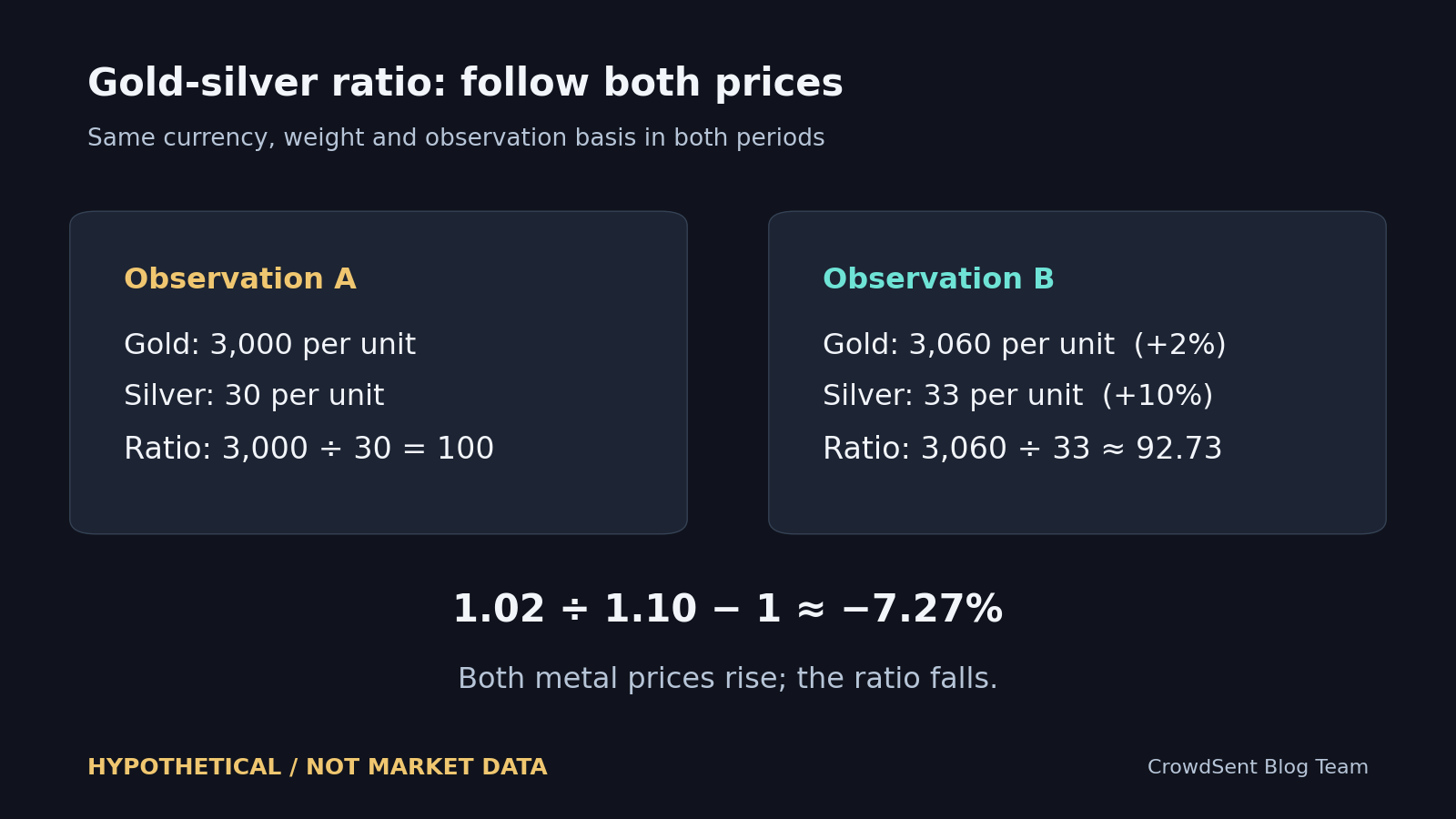
Hypothetical starting point: gold is USD 3,000 per troy ounce and silver is USD 30 per troy ounce at the same observation time. The gold to silver ratio is 3,000 divided by 30, or 100. This statement describes two reference values. It does not establish how many silver bars a dealer would actually supply for a gold item.
Record the intended use beside the formula. You might be checking a published calculation, comparing two dates in one dataset or investigating why two websites display different ratios. Those are different tasks. The first needs the original inputs; the second needs a consistent series; the third needs both providers’ definitions.
A ratio also leaves out absolute scale. Hypothetical pairs of 3,000 and 30, or 3,600 and 36, both give 100. The second pair has higher prices for both metals. Keep the two underlying series alongside the calculated result whenever the research question concerns what changed.
2. Match the source, time and quote type
Create a small record for each input: provider, instrument, currency, weight, purity basis, observation time, time zone and quote type. Add the collection time separately. Saving a screenshot at noon does not establish that the price shown was observed at noon.
The LBMA explanation of daily auction prices provides a useful real-world reminder: its gold and silver benchmarks use specified dollar-per-troy-ounce conventions, but their auctions take place at different London times. A shared calendar date therefore does not automatically mean a simultaneous observation. No benchmark values are reproduced here.
Choose the time convention before calculating. If the research question requires a same-instant comparison, use compatible timestamped observations. If you deliberately compare named daily benchmarks, label that convention and retain their different observation times. Avoid describing a daily-reference ratio as an exact snapshot of a single instant.
Quote type matters too. A dealer’s asking price, a buying price, a midpoint and an exchange settlement each have a different meaning. Mixing a gold asking price with a silver midpoint introduces a mismatch that currency conversion cannot repair. Use the same side where possible, or state explicitly why your question requires different sides.
For futures, retain the exchange and contract month. A gold contract and a silver contract can have different delivery terms even when their month labels match. The ratio you calculate belongs to those specified references. Do not silently merge it with a spot-reference series.
When a ratio arrives through a headline or social post, first follow the market-news verification checklist. A chart without visible input definitions is a lead to investigate, rather than a complete calculation to reuse.
3. Calculate once, then check the units independently
Use unrounded inputs in the calculation and round the result only for presentation. In a hypothetical second observation, gold is 3,060 and silver is 33 in the same currency per the same weight. Dividing gives approximately 92.7273; reporting 92.73 is sufficient for this illustration.
Check the result by multiplying it back. Silver at 33 multiplied by the unrounded ratio should recover gold at 3,060, allowing for displayed rounding. This catches common transcription errors, such as entering 330 for silver or swapping the numerator and denominator.
A second check is dimensional. Write the full units beside each input. If the numerator says currency per 10 grams and the denominator says currency per kilogram, the units do not cancel as intended. Convert both to a common weight first. Never solve this by removing the labels from the worksheet.
The LBMA explanation of the troy ounce gives its mass as 31.1034768 grams. If you use that conversion, retain adequate precision through the calculation. Converting both prices with the same exact factor leaves the ratio unchanged. Different conversion factors or premature rounding can introduce an artificial discrepancy.
A useful error check is to ask what would happen if both prices doubled. The ratio should remain the same. If your spreadsheet produces twice the ratio, a cell reference, unit conversion or formula is wrong. This simple test checks the calculation without needing any historical market data.
4. Reconcile INR, PKR and different weight quotations
Hypothetical Indian quotation exercise: a fine-gold reference is INR 90,000 per 10 grams, while a fine-silver reference is INR 100,000 per kilogram. Assume identical observation times and compatible reference terms. Gold becomes INR 9,000 per gram; silver becomes INR 100 per gram. The comparable ratio is 90.
Dividing the two displayed headline numbers, 90,000 by 100,000, would produce 0.9. That answer compares a ten-gram gold amount with a thousand-gram silver amount. It is mathematically valid division of the displayed numbers, but it is not the intended equal-weight gold-silver ratio.
Hypothetical Pakistani quotation exercise: gold is PKR 300,000 per stated tola and silver is PKR 3,750 per the same stated tola, with matched fineness and reference terms. The ratio is 80. Here the common weight cancels. If only one quotation uses tola, obtain its stated gram equivalent before comparing it with a per-gram reference.
Purity needs its own check. Suppose a hypothetical ten-gram gold item has fineness 0.900 and costs 81,000 currency units before any separately identified charges. Its fine-gold content is nine grams. Dividing 81,000 by nine gives 9,000 per fine gram. Using the gross ten grams instead would understate that calculated fine-content reference.
This arithmetic does not remove unitemised fabrication charges, product premiums or other commercial differences. If the gold number is a complete jewellery price while the silver number is a metal-only reference, label the comparison accordingly. Do not invent a charge deduction to make the resulting ratio look familiar.
Currency conversion can be tested separately. Multiplying both dollar metal references by the same local-currency-per-dollar factor leaves their ratio unchanged: the factor cancels. If different exchange rates, observation times or commercial conversions are used, cancellation no longer describes the actual inputs. Spell out INR or PKR rather than using the ambiguous abbreviation “Rs.”
5. Explain a ratio change without predicting either metal
The ratio changes according to the relative changes of both prices. For positive prices, divide one plus the gold percentage change, expressed as a decimal, by one plus the silver percentage change. Subtract one to obtain the ratio’s percentage change. This is exact arithmetic under matched input definitions.
In the hypothetical chart, gold rises from 3,000 to 3,060, an increase of 2%. Silver rises from 30 to 33, an increase of 10%. The ratio moves from 100 to approximately 92.73, a decline of about 7.27%. Both metals rise in this example even though the ratio falls.
Subtracting 10% from 2% gives negative eight percentage points, which is the difference between the two price changes. It is not the exact percentage change of their ratio. The denominator adjustment matters: 1.02 divided by 1.10 equals about 0.92727.
A rising ratio also permits multiple stories. Gold might rise while silver is unchanged; both might fall with silver falling more; or both might rise with gold rising more. Inspect the two legs before attaching a narrative. The ratio alone cannot tell you which path occurred.
Separate three statements in your note: the calculated relative change, the observed movements in each input and the proposed explanation for those movements. Only the first follows directly from division. An explanation about industrial demand, currency conditions or investor behaviour needs additional evidence tied to the chosen period.
When online discussions interpret the same number differently, use a structured check of community discussions to identify assumptions and missing sources. Popularity of an interpretation does not determine whether its two price records are comparable.
Investigate what affects gold prices and what drives silver prices separately when explaining the two price movements.
6. Build a reproducible historical comparison
A gold silver ratio history should use a declared series definition across the entire study window. Record the start and end dates, frequency, time convention, missing-data policy and any source changes. A long chart can hide many small inconsistencies if the underlying inputs are not retained.
Choose whether to calculate a ratio for each observation and then average those ratios, or divide the average gold price by the average silver price. These operations generally produce different answers. Neither should be labelled simply “the average ratio” without explaining the method.
Hypothetical two-observation example: gold stays at 3,000 while silver is 20 in the first observation and 40 in the second. The two ratios are 150 and 75, averaging 112.5. Dividing average gold, 3,000, by average silver, 30, gives 100. The discrepancy comes from the calculation rule, not an error in division.
Set your missing-data rule in advance. If one metal has no observation, leave the ratio missing or explicitly document a justified matching method. Carrying forward yesterday’s silver value against today’s gold value creates a different time convention. A visually smooth chart should not conceal that choice.
Keep a compact audit note using the market research journal template: input identifiers, raw figures, conversions, output, unresolved mismatches and revision date. If a provider corrects a historical observation, preserve your earlier result and record what changed when you recalculate.
Close with a bounded conclusion. For example: “Under the stated hypothetical equal-weight, same-currency references, the ratio fell from 100 to 92.73 because silver’s percentage increase exceeded gold’s. This calculation does not establish why the prices changed or where either price will move next.” That is a complete and useful research result.
Frequently asked questions
Does a ratio of 100 mean I can exchange one ounce of gold for 100 ounces of silver?
It means the selected reference prices have that relative value. An actual exchange would involve specific products, buying and selling quotations, weights, purity and commercial terms. Check those separately. A ratio constructed from two reference midpoints cannot establish the amount a counterparty would offer for a particular item, even when the arithmetic is correct.
Can I calculate the ratio using grams instead of troy ounces?
Yes, provided both prices are expressed per the same gram basis and refer to comparable metal content. Converting both from troy ounces to grams with the same conversion factor leaves the ratio unchanged. Keep the original units in your record so another reader can see that the common factor was applied to both inputs rather than only one.
Why do two websites show different gold-silver ratios on the same day?
Compare their observation times, quote types, instrument definitions and rounding. One may use daily auction references while another uses continuously refreshed indications. A shared date does not resolve those differences. Recalculate each website’s number from its own inputs before deciding that either is wrong; missing source details may leave the discrepancy unresolved.
Should local jewellery quotations be used in a benchmark ratio?
Only if the question explicitly concerns those product quotations, with their limitations visible. Jewellery prices can contain components beyond fine-metal content. A comparison with a wholesale silver reference would therefore describe unlike commercial records. For a metal-reference ratio, seek comparable references instead of estimating undisclosed deductions from the jewellery price.
Does changing from USD to INR or PKR change the ratio?
Using exactly the same currency-conversion factor for both compatible metal prices leaves the ratio unchanged. A local comparison may still differ because the quotations have different timestamps, weight conventions, purity or included charges. Work through those fields before attributing a discrepancy to the currency itself. INR and PKR should always be identified separately.
Can the ratio fall when silver also falls?
Yes. In a hypothetical example, gold falls 6% while silver falls 2%. The ratio changes by 0.94 divided by 0.98, minus one, or approximately negative 4.08%. Both underlying prices fall. A lower ratio therefore describes gold’s weaker relative movement over that interval, without establishing that silver rose in absolute terms.
Is the reciprocal called the same thing?
The reciprocal compares silver’s price with gold’s price. A gold-silver ratio of 100 corresponds to a silver-to-gold ratio of 0.01 under the same definitions. Label the numerator and denominator explicitly, particularly when importing a spreadsheet or image. Reversing a ratio changes its numerical scale and the percentage changes calculated from it.
How should I handle a zero or missing silver input?
Do not calculate a ratio from a missing value, and do not replace it with zero. Division by zero is undefined. A displayed zero may be a data placeholder or an error that needs investigation. Preserve the original record, mark the output unavailable and explain which source observation is needed before the calculation can be completed.
Does a historical average identify a fair ratio?
A historical average describes a selected dataset and averaging rule. It does not establish a fair-value level or a future destination. Changing the sample window, frequency or input series can alter the statistic. If you report an average, state those choices and preserve the observations so readers can reproduce the descriptive result.
What is the minimum evidence needed to publish a ratio calculation?
Include both source references, their observed prices, currencies, weight and purity bases, observation times, quote types and the formula. Identify any conversion or unmatched field. Report enough precision to reproduce the rounded result. If one input’s timing or definition remains unknown, say so next to the result rather than hiding the limitation in a distant footnote.
Source documentation checked 7 October 2026. Educational research guidance from the CrowdSent Blog Team. All hypothetical examples are invented and are not current market data. This article does not provide investment recommendations.