

CrowdSent Blog Team · Silver research
To investigate what drives silver prices, separate industrial consumption, mine and recycled supply, investment demand, financial conditions and the currency of the quote. Then ask which part of the story has changed. A headline about growing solar installations, for example, needs another check: how much silver goes into each unit of production?
Silver research becomes more useful when broad claims are turned into specific questions. This guide shows how to inspect a demand forecast, interpret a supply deficit and compare local quotes without turning incomplete evidence into a price prediction. It includes an invented manufacturing example you can reproduce in a simple note or spreadsheet.
1. Name the silver-price claim and its timescale
Begin by copying the essential claim into your own words. “Factories will use more silver next year” is a forecast about consumption. “The price rose after a release” is a timing observation. “A shop is out of a particular coin” describes a product at one seller. Each needs a different set of supporting evidence.
Give the claim a category before collecting links. This simple editorial checklist helps keep unrelated facts from being assembled into an apparently complete explanation:
- Industrial: output, technology mix and silver used per unit.
- Supply: operating mine production, refining and recycling.
- Stock: recorded metal held at a defined place and date.
- Financial: documented flows, rates, currencies and investment demand.
- Local quote: weight, purity, currency, timestamp and product terms.
Write the claimed period beside each item. An annual forecast can provide background for today’s discussion, but it cannot by itself identify the cause of a five-minute change. If an article blurs those periods, narrow the claim before trying to assess it.
2. Measure industrial demand as output multiplied by metal use
For a manufacturing story, inspect both the number of units produced and the silver required per unit. Ask whether the report concerns installed capacity, completed production, shipments or actual silver consumption. These are useful measures for different questions, and they should retain their original labels.
The Silver Institute’s April 2026 survey release gives a dated example: it describes photovoltaic manufacturers reducing silver use and substituting materials, alongside growth in other industrial applications. It reports weaker industrial demand for 2025 overall. Growth in a technology category therefore needs to be checked against the metal actually consumed.
A hypothetical factory calculation
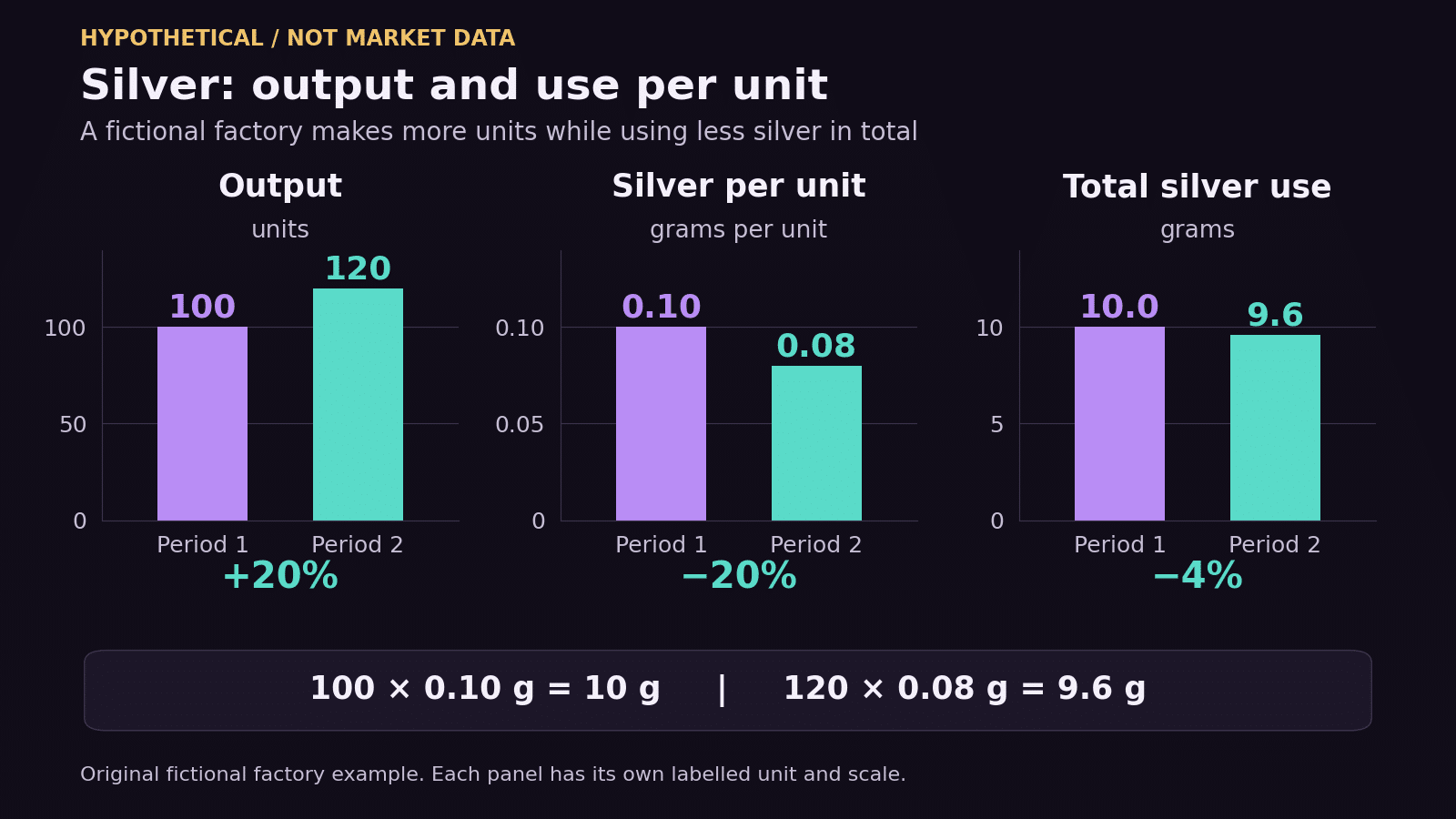
All figures in this example are invented. A fictional factory produces 100 units, each using 0.10 grams of silver. Its total use is 10 grams. In the next period, output grows to 120 units, but each unit uses 0.08 grams. Total silver use becomes 9.6 grams.
Production increased 20%, while silver consumption fell 4%. The calculation does not establish anything about actual solar manufacturing. It shows why a demand argument needs both inputs. For a real comparison, also ask whether the product mix changed and whether both observations cover the same factories.
Verify the original report using the market news verification checklist. If a headline turns a forecast into an accomplished result, restore the forecast date and assumptions in your note. Retain the evidence that could reverse the estimate, including revised output or a different material-use assumption.
3. Inspect the route from mining activity to usable silver
A silver-supply claim should name the stage it measures. An exploration announcement, a resource estimate, mined material, refined silver and delivered product are separate observations. Before describing an announcement as extra supply, find the document that identifies the relevant quantity and timing.
The US Geological Survey’s 2026 silver summary records silver from dedicated US silver mines and from base- and precious-metal operations where it is a byproduct or coproduct. It also reports recycling separately. This US example illustrates why counting only dedicated silver mines can leave out relevant supply; its domestic figures should not be presented as global shares.
When assessing a particular producer, check which operation and reporting period the number covers. Does a planned increase refer to ore processed, recovered metal or silver sold? If the company reports several metals, avoid treating growth in total revenue as a measured increase in silver output.
For recycling, ask what material was recovered and whether the figure describes collection, processing or refined output. Keep anticipated capacity apart from demonstrated throughput. A useful research note names the missing stage rather than assuming every announced tonne has already reached the market.
4. Read supply deficits alongside the definition of stocks
A reported deficit compares defined supply and demand flows over a stated period. Read the methodology before interpreting the result. Which categories are included? Are they estimates? Does the balance cover a calendar year, and which version of the figures is being quoted?
Keep a flow balance distinct from a stock measurement. A flow describes activity during a period; a stock describes an amount at a point in time. An annual deficit figure does not, on its own, state how much metal every holder has, where it is located or whether a specific product is available locally.
An invented balance that leaves important questions open
Hypothetical example: a fictional report defines annual supply as 100 units and demand as 110 units. Under those definitions, the gap is 10 units. That arithmetic still leaves questions about existing inventories, timing, location and the report’s treatment of stock movements. It does not establish when any individual seller will run out.
Apply the same care to warehouse headlines. Identify the facility, category and reporting date, then read what an increase or decrease means under that report’s definitions. Do not label every recorded movement as consumption or assume a published stock figure is an offer to sell.
If two credible summaries disagree, compare their definitions and vintages before deciding one must be false. Keep the disagreement explicit. A revised estimate can change the calculated gap even if no new physical event occurred on the date the revision appeared.
5. Connect the silver benchmark to the quote you actually need
The LBMA’s daily auction documentation identifies a silver benchmark set in London in US dollars per troy ounce. It is a defined global reference, rather than a statement of every local product price. Record the source and timestamp when using it for comparison.
For an Indian quotation in INR per kilogram, retain the kilogram label throughout the calculation. For a Pakistani quotation in PKR per tola or per 10 grams, confirm the stated weight before comparing it with an ounce-based reference. Write INR or PKR in full in your notes; “rupees” alone is insufficient.
Normalise both quotations to the same weight and purity, using the exchange rate appropriate to the observation. A troy ounce is about 31.1035 grams, and a kilogram is 1,000 grams. Keep a record of the conversion factors rather than adjusting numbers from memory each time.
Then inspect what each quote includes. A finished silver article, a particular coin and a metal benchmark describe different objects. Record separately disclosed fabrication, seller or other charges without assuming a universal premium. Check whether you are reading a seller’s asking price or a buyback quotation.
This approach is useful even when your question concerns no purchase. It can explain why two screenshots cannot be compared directly, and it prevents a currency or weight difference from being misreported as a sudden change in silver’s underlying value.
6. Review financial conditions and the language around the claim
Alongside the physical story, inspect any evidence offered about rates, currencies or investment flows. For each, keep the actual series, period and publication time. If a commentator says a rate expectation changed, ask which observation supports that statement rather than substituting an unchanged policy rate.
Online discussion can help you identify the dominant narrative: industrial growth, limited supply, currency concerns or something else. Count repeated versions of the same claim separately from independent supporting evidence. A widely repeated production forecast remains one forecast, however many posts repeat it.
Our guide to sentiment score meaning explains why a language classification needs its sample and context. Apply that distinction when assessing silver commentary. Enthusiasm describes the collected conversation; it does not verify the demand balance or guarantee that the price will follow the discussion.
Complete a market research journal entry with three short findings: what you verified, what you calculated and what remains an inference. Add the next original source you would need. This leaves a useful record even when the evidence supports only part of the initial headline.
Frequently asked questions about what drives silver prices
Is silver mainly an industrial metal or a precious metal?
Both descriptions can be relevant, but a research question should identify the activity it measures. Factory consumption, jewellery fabrication and investment-related buying are separate categories. Inspect the report’s definitions and period before combining them. A finding about one category should not be presented as a complete account of all silver demand.
Do more solar installations necessarily mean more silver consumption?
No. The fictional factory calculation shows why output and metal use per unit must be considered together. For an actual solar claim, check the technology mix and whether the source measures manufacturing or installations. The amount installed during a period may also differ from the amount produced during that period.
Why does byproduct production matter when reading silver mining news?
It broadens the operations you need to examine. The cited USGS summary includes silver arising from operations that also produce other metals. When reading company results, isolate the silver measure and its reporting basis. An announcement about another metal cannot be translated into additional silver production without supporting operational information.
Does a silver supply deficit guarantee a price increase?
A defined annual gap is one piece of evidence, not a price guarantee. Start by checking its components and whether it is historical or forecast. Then ask what other information is needed about stocks, location, timing and financial conditions. A credible balance estimate still does not answer every question about a particular price interval.
Are mineral resources, reserves and annual production interchangeable?
No. Retain the exact term used in the original technical document and read its definition. A reported quantity in the ground is not the same measurement as metal produced during a year. For a claim about near-term supply, look for the operating and timing evidence rather than relying on the largest resource number.
Does a warehouse withdrawal show that silver has been consumed?
The movement alone does not establish its destination or use. Read the warehouse report’s categories and look for evidence about the transfer. A narrower description such as “recorded holdings in this category declined” may be all the source supports. Avoid turning a location-specific observation into an undocumented global shortage claim.
What can the gold-to-silver ratio tell me?
It compares a gold price with a silver price when both use the same currency and weight unit. Save the two observations and their timestamps before calculating it. The ratio describes relative prices; selecting a past ratio does not establish a fair value, a required future level or when any change might occur.
How should I compare an INR kilogram quote with a PKR silver quote?
First identify the weight and purity behind the PKR figure. Convert both observations to a common weight, currency and purity basis using documented, time-matched inputs. Keep product-specific charges separate. If the provider does not disclose a necessary field, mark the comparison incomplete rather than silently filling it with an assumption.
Why might strong silver sentiment coexist with an unconvincing demand claim?
The conversation may be reacting to a headline whose assumptions remain unchecked. Review which sources were collected, which posts repeat one another and whether the underlying publication supports the wording. A clear sentiment observation can coexist with weak factual evidence. Record those two judgments separately so one does not lend false certainty to the other.
How should I handle a revised silver demand forecast?
Keep the older estimate with its publication date, then append the new one and identify which assumptions changed. Separate a changed forecast from a newly measured outcome. If you previously quoted the old estimate as fact, correct that description explicitly. A dated comparison helps readers understand the revision without reconstructing the entire reporting history.

Source documentation checked 7 October 2026. Educational research guidance from the CrowdSent Blog Team. Examples labelled hypothetical are invented and are not current market observations. This article does not provide investment recommendations.