

CrowdSent Blog Team · Instrument-specification literacy
Pips, lots and contract size describe different parts of a market quotation. A pip is a named price increment under a currency quote convention. A lot is a quantity label defined for the instrument. Contract size tells you how many underlying units that label represents. You need all relevant definitions before turning a price movement into a monetary amount.
The same displayed number of lots can represent different underlying quantities on different symbols. A decimal place on a screen also need not equal a pip or the minimum permitted price change. These distinctions matter when checking a research note, an instrument description or a calculator’s output.
This guide uses seven checks and original hypothetical examples for currencies, gold and silver. None is a recommendation about how much to trade. The India and Pakistan references illustrate currency conversion only, with no claim about local product availability, permissions or current market conditions.
1. Check pips, lots and contract size in the specification
Record the full symbol, provider or exchange, contract identifier where relevant and specification date. A familiar asset label does not establish the calculation rules. A spot reference, an exchange future and another contract referring to the same asset may use different quantity definitions and settlement conventions.
MetaTrader 5’s Market Watch documentation explains how to open a symbol’s Specification view. It lists broker-set fields including contract size, calculation method and margin and profit currencies. Treat the platform as a way to inspect the actual symbol parameters, rather than assuming that every symbol on that platform has identical terms.
Create a short specification record before doing arithmetic: price units, underlying units per lot or contract, minimum price increment, stated tick value, quantity limits and quantity step. If a field is absent, mark it unknown. Do not replace an unknown contract size with a number remembered from another instrument.
Save the source and retrieval date with the record. If a calculator and a specification disagree, compare the exact symbol, account context and parameter dates first. The discrepancy may come from a wrong assumption rather than a multiplication error.
When a claim about an instrument appears in a post or screenshot, use the source-verification checklist to find the underlying specification. A screenshot showing only a lot number and a monetary result does not contain enough information to reproduce the calculation.
2. Separate pips, display points and ticks
A pip must have a stated price-unit definition in your calculation. A display point describes a unit associated with the displayed precision, while the minimum tick describes a permitted price increment for the instrument. These values can coincide, but that should be checked rather than assumed.
The MQL5 symbol-property reference provides separate fields for point size, minimum tick size, contract size, tick values and volume steps. Their separation is useful evidence that these quantities serve different roles. Read the relevant field definitions before copying one into a formula intended for another.
Hypothetical specification: a fictional FX symbol is priced in USD per base-currency unit. Its display point is 0.00001, its defined pip is 0.0001 and its minimum tick is 0.00005. An invented move from 1.08345 to 1.08405 is a price difference of 0.00060.
Under those assumptions, that difference equals 60 display points, six pips or 12 minimum ticks. Each description refers to the same price difference using a different increment. Calling it “60 pips” would introduce a tenfold error in this example.
Check the scale by converting back: six multiplied by 0.0001 gives 0.00060; 12 multiplied by 0.00005 gives the same result. A unit-labelled reverse calculation is more reliable than judging whether a number looks familiar. Keep the price difference itself in the worksheet as the common reference.
3. Convert lots into underlying units
For a contract defined by underlying units per lot, multiply the number of lots by that contract size. The units should read “lots multiplied by underlying units per lot,” leaving underlying units. A label such as standard, mini or micro is insufficient unless the exact product definition is attached.
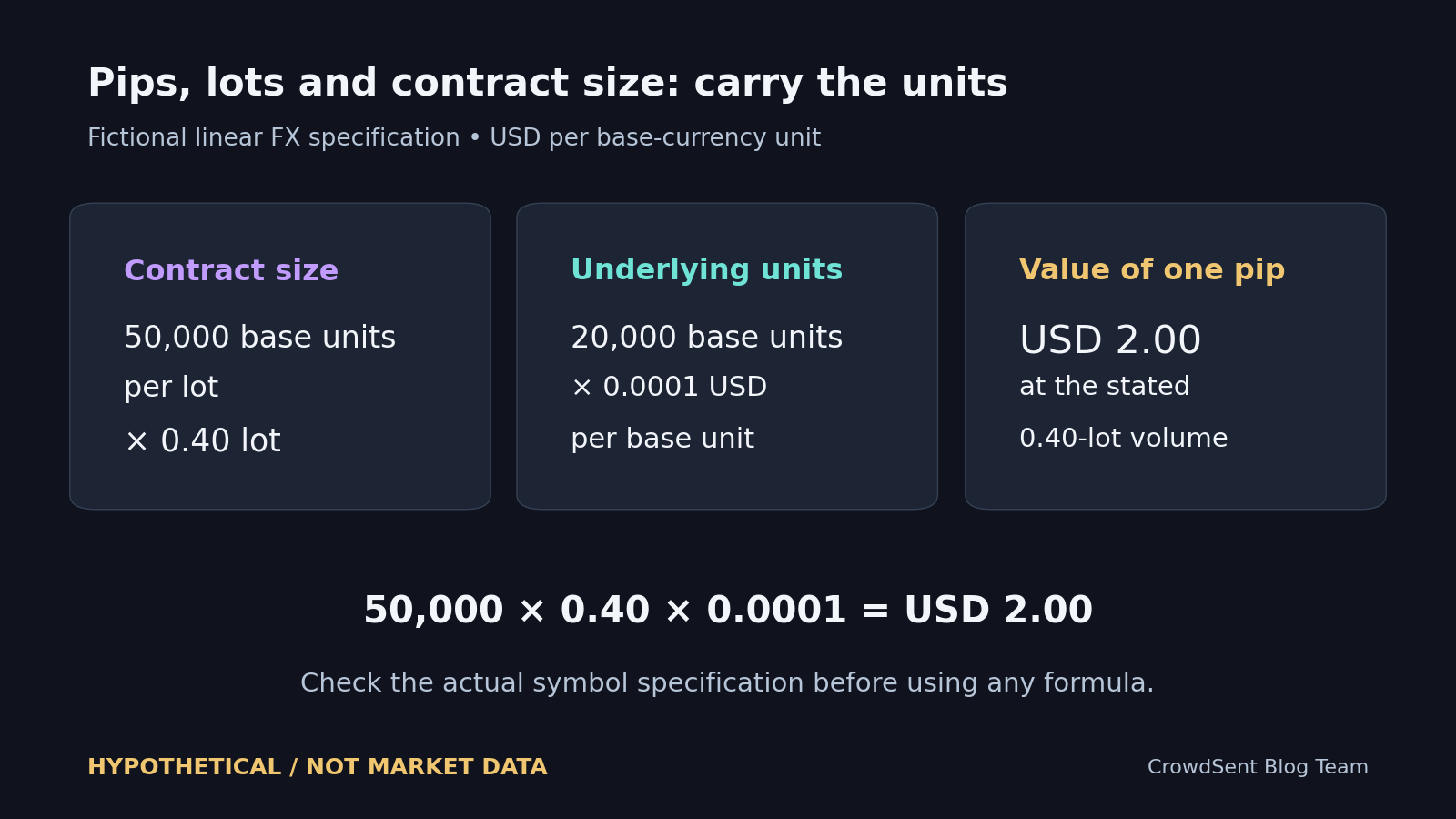
Hypothetical FX contract: one lot represents 50,000 units of the base currency. A recorded quantity of 0.40 lot therefore represents 20,000 base-currency units. This deliberately specified example is not a claim that a forex lot universally contains 50,000 units.
Now compare a second fictional contract whose lot represents 10,000 base units. The same 0.40-lot display represents 4,000 base units. The two lot labels match, while the underlying quantities differ by a factor of five. A comparison that keeps only the decimal lot amount would miss the difference.
Quantity steps are a separate check. Suppose a fictional instrument permits volumes from 0.05 lot in steps of 0.05 lot. A recorded 0.15 lot lies on that grid; 0.12 lot does not. This is a specification-validation exercise, not a suggestion to round an intended order to a different amount.
Also distinguish quantity from notional reference value. If the hypothetical 20,000 base units are valued at 1.08 USD per unit, their reference notional is USD 21,600. That number is different from a margin requirement, a transaction charge or the value of one pip.
4. Calculate pip value only under a matching model
For a simple linear FX contract quoted in currency per base unit, the monetary value of one defined pip at a given quantity is underlying units multiplied by pip size. The result is in the quote currency. This formula assumes the stated linear unit structure; it should not be transferred automatically to inverse or otherwise different contract models.
In the fictional 50,000-unit-per-lot contract, 0.40 lot equals 20,000 base units. With a defined pip of 0.0001 USD per base unit, the pip value is USD 2.00. The lot amount, contract size and pip definition all appear in the calculation: 0.40 multiplied by 50,000 multiplied by 0.0001.
Using the hypothetical 0.00005 minimum tick instead gives USD 1.00 per tick at that same quantity. Two of these ticks make the example’s one pip. Both results agree because they measure different increments of the same linear price scale.
For the earlier 0.00060 price difference, multiplying by 20,000 base units gives a USD 12 reference-value difference. Six pips multiplied by USD 2, or 12 ticks multiplied by USD 1, produce the same result. These are three equivalent checks of invented arithmetic before costs and execution effects.
Do not label that calculation a realised account outcome. The sign depends on the position direction and the chosen prices, while actual account calculations may include other terms. A research example can establish unit consistency without implying that a particular amount was earned or could be obtained.
5. Check gold lot size and silver lot size independently
A metals symbol needs its own weight and price basis. Record whether the quote uses a troy ounce, gram, kilogram or another defined unit, and identify the underlying weight represented by one lot. A gold lot size copied from one provider should not become a universal constant in a different provider’s calculation.
Hypothetical gold specification: one lot represents 20 troy ounces, and the minimum tick is USD 0.05 per troy ounce. A quantity of 0.30 lot represents six troy ounces. The value of one tick at that quantity is six multiplied by USD 0.05, or USD 0.30.
An invented USD 1.25-per-ounce difference equals 25 of those ticks. At six ounces, the reference-value difference is USD 7.50. Checking 25 multiplied by USD 0.30 produces the same amount. All quantities and increments in this example are fictional specification choices.
Hypothetical silver specification: one lot represents 2,000 troy ounces, and its minimum tick is USD 0.005 per ounce. A quantity of 0.15 lot represents 300 ounces. One tick at that quantity corresponds to USD 1.50; a USD 0.025-per-ounce difference spans five ticks and corresponds to USD 7.50.
The equal final amounts in these two exercises arise from different weights and increments. They do not make the instruments equivalent. Keeping the units visible prevents the similar dollar result from hiding the different contract structures.
CME Group’s explanation of tick movements directs readers to the relevant product specifications for minimum price fluctuations. Use that principle for each named contract. This article’s invented gold and silver specifications are not CME product specifications and should never be substituted for an actual instrument’s terms.
6. Keep monetary value, conversion and margin distinct
The currency of a calculated amount needs a label of its own. A value expressed in a quote or profit currency may require conversion before comparison with an account-currency display. The conversion rate, direction, timing and applicable calculation method must be identified separately.
Hypothetical INR conversion: take the fictional USD 2 pip value and assume INR 90 per USD solely for this exercise. The converted reference is INR 180 per pip at the stated quantity. Using a separate hypothetical PKR 300 per USD reference gives PKR 600. These are different currencies, not interchangeable “rupees.”
If the conversion reference changes while the underlying quantity and pip definition remain fixed, the local-currency reference value can change. Keep the original USD amount beside its converted amount so a reader can identify which component changed. Do not silently replace one with the other in a historical comparison.
Margin is another field. A margin requirement does not redefine the number of underlying units represented by a given contract quantity. Similarly, changing a leverage parameter does not by itself change a stated pip increment or contract size. Read the applicable margin method separately rather than inserting a leverage multiplier into the pip-value formula.
A complete account outcome can also involve bid-ask differences, commissions, financing terms and execution prices. These are not included in the simple unit examples. If your task is to reconcile an actual statement, obtain the relevant records for those components instead of assuming that the price-difference calculation accounts for everything.
7. Audit a calculation before interpreting its result
Build the worksheet from inputs to outputs: full instrument identifier, specification date, calculation model, price units, contract size, recorded quantity, increment size and currency conversion. Keep the original input fields separate from derived fields. This makes an incorrect assumption easier to locate than a single long formula with hidden constants.
Run a small test set. For the fictional linear FX model, zero price difference should give zero reference-value difference before costs. Doubling the underlying quantity should double the value of the same price increment. Converting the difference into ticks and back should recover the original difference within rounding tolerance.
Use a comparison case to expose a hard-coded lot size. Feed the worksheet the two hypothetical 50,000-unit and 10,000-unit specifications at the same 0.40-lot quantity. The results should reflect the fivefold quantity difference. If they do not, the formula probably ignores the contract-size field.
Do not repair a mismatch by changing the displayed answer manually. Check price direction, quantity units, decimal precision, tick definition and currency conversion in turn. If the product uses a different calculation model, stop applying the simple linear formula and consult that product’s documented method.
When reviewing someone else’s calculator explanation, use the community-discussion evaluation guide to separate disclosed inputs from unsupported claims. A neat screenshot cannot verify assumptions that are not shown.
Save the checked specification and calculations with the market research journal template. Finish with the arithmetic result, its units and the unresolved fields. A unit audit is complete when its reader can reproduce the number and understand its limits, without any recommendation about position size or future price movement.
Frequently asked questions
Is one lot always the same underlying quantity?
No universal quantity follows from the word lot alone. Read the exact instrument’s contract size and quantity conventions. In this guide’s fictional examples, 0.40 lot represents 20,000 base units under one specification and 4,000 under another. Keep the specification beside the lot amount whenever comparing calculations, rather than relying on a familiar label.
Is the last decimal place on a screen always one pip?
Displayed precision and a pip definition can differ. The hypothetical five-decimal symbol in this guide uses a 0.00001 display point and a 0.0001 pip, so ten display points equal one pip. Identify the actual convention before counting increments. More displayed digits do not, by themselves, establish the instrument’s named pip size.
How can a tick differ from a display point?
The screen can display a finer decimal unit than the permitted price increment. In the fictional example, the display point is 0.00001 while the tick is 0.00005, or five display points. Check the relevant specification fields rather than equating them. This distinction matters when validating price differences and reproducing a tick-value calculation.
What inputs are needed to calculate a linear FX pip value?
You need the recorded quantity, underlying units per lot, the defined pip size and the price currency, together with confirmation that the linear model applies. Multiply the underlying units by the pip increment to obtain the quote-currency value. Any conversion into another currency requires its own rate and direction. Missing inputs should remain marked as missing.
Can I use the same pip formula for every derivative?
No. The formula demonstrated here assumes a simple linear relationship between price difference and underlying quantity. Other contract structures can require a different documented method. Confirm the calculation model and monetary units first. A familiar symbol name or a matching decimal format does not prove that two instruments share the same valuation arithmetic.
Does leverage multiply the value of a pip at a fixed quantity?
Leverage and margin terms concern the funding or collateral calculation under the relevant arrangement. They do not, by themselves, alter the stated underlying quantity or price increment used in the simple example. Keep margin and pip-value calculations separate, and verify the actual contract method. Avoid adding a leverage multiplier merely because it appears elsewhere in the specification.
Why should gold and silver lot sizes be checked separately?
Their contracts can specify different weights, price increments and calculation methods. The two fictional metal examples produce the same final reference-value difference from very different quantities. A copied constant can therefore create a large error even when the arithmetic looks tidy. Read the exact weight per lot and price-per-weight basis for each symbol.
What if my quantity does not match the permitted volume step?
Mark the recorded quantity as inconsistent with that specification and verify the source. Do not silently round it and present the altered amount as the original calculation. A step mismatch may indicate a different symbol, an outdated specification or a transcription error. Resolving the discrepancy is a data-checking task, separate from choosing a quantity.
Why can an INR or PKR equivalent change while the USD pip value stays fixed?
The currency-conversion reference can change independently of the fictional contract’s quantity and pip definition. Keep the original USD value, the conversion direction and the local-currency result as separate fields. This helps identify the source of the change. The assumed conversions in this guide are educational examples, not current rates or account terms.
Does a correct tick-value calculation prove an account result is correct?
It checks one component of the arithmetic under the stated model. An account result may use different execution prices, currency conversions or separately recorded costs. Reconcile those records before drawing a conclusion about the whole statement. A checked price-increment calculation should retain its stated exclusions instead of being relabelled as a verified net outcome.
Source documentation checked 7 October 2026. Educational research guidance from the CrowdSent Blog Team. All hypothetical examples are invented and are not current market data. This article does not provide investment recommendations.