

A market order asks for execution at the available market prices, subject to the venue’s rules. A limit order adds a price boundary: a buy limit sets the highest acceptable execution price, while a sell limit sets the lowest. The limit does not guarantee that the requested quantity will execute.
The market order vs limit order distinction is therefore a distinction between instructions. It is not a promise about a chart price, a guarantee of an instant complete fill, or a rule that identifies the best choice for every situation.
This educational guide explains how to read order descriptions and execution records. It uses US securities guidance as a baseline and clearly identified venue examples. It does not instruct readers to trade, recommend a platform or make claims about local product availability.
Market order vs limit order: what each instruction controls
A market order prioritises obtaining available execution rather than setting a user-defined limit price. The final price can depend on the size of the order, the available opposing interest, changes during processing and any protections imposed by the venue.
A limit order constrains the permitted execution price. For a buy, an execution at or below the limit can satisfy the price condition. For a sell, an execution at or above the limit can satisfy it. Quantity, timing and allocation remain separate questions.
Investor.gov’s order-type explanation provides the basic US securities definitions and warns that the last-traded price is not necessarily the price at which a market order executes. That warning is central to interpreting the gap between a chart and a confirmation.
It is useful to describe the uncertainties explicitly. With a market instruction, the exact resulting price may be uncertain. With a limit instruction, whether and how much executes may be uncertain. System constraints, market interruptions and product rules can affect either.
An order being accepted means the system has accepted an instruction. It does not by itself establish that a trade occurred. The execution record is a separate piece of evidence.
A small order book makes the difference visible
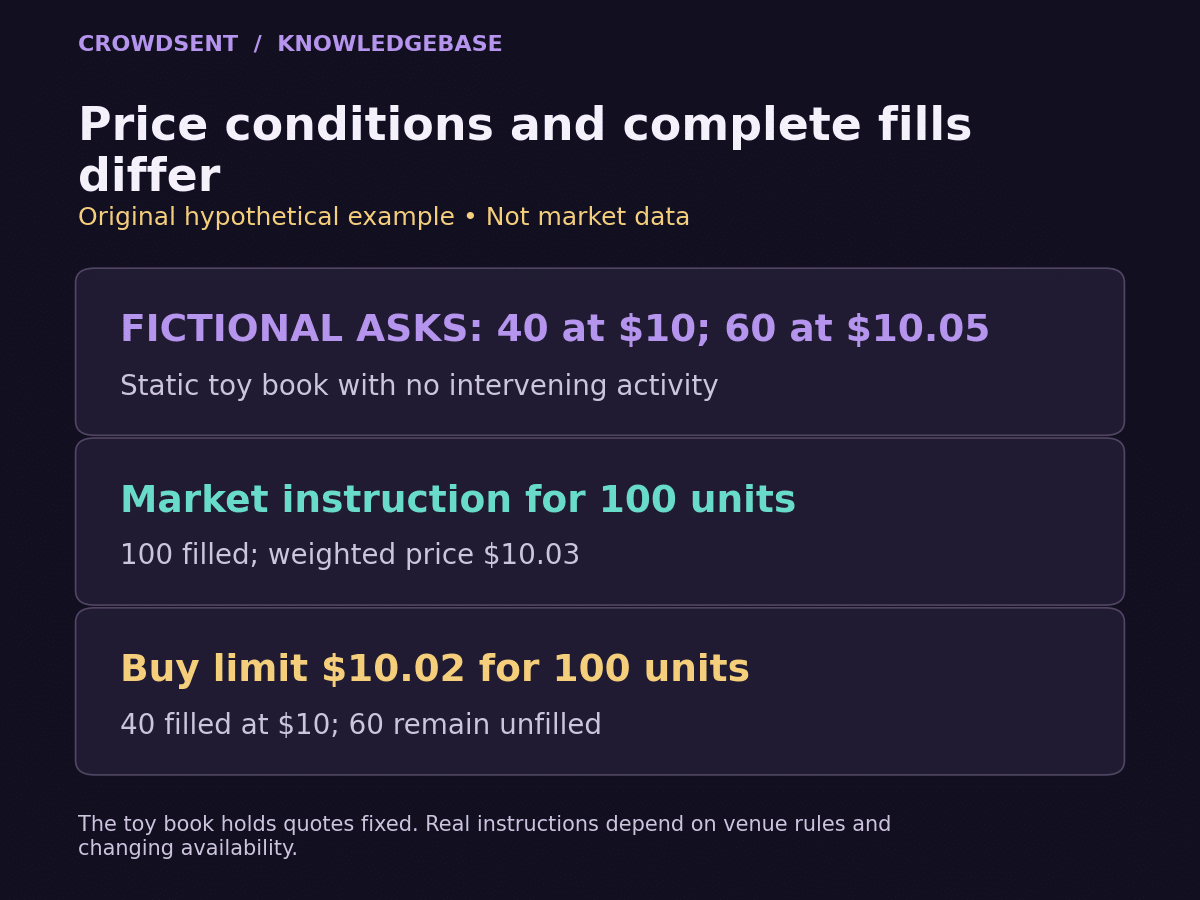
Imagine a fictional market with an unchanged order book for the duration of this example. Sellers offer 40 units at $10.00 and another 60 units at $10.05. Assume both price levels are available to the incoming order, there are no extra restrictions, and fees are excluded.
An illustrative market instruction to buy 100 units consumes those two levels. Forty units cost $400 and 60 units cost $603. Total execution value is $1,003. Dividing by 100 units gives a volume-weighted average execution price of $10.03.
The best displayed ask was $10.00, but only 40 units were available there. Reading the quote as a promise that all 100 units could execute at $10.00 would ignore the quantity attached to it.
Now apply a buy limit of $10.02 to the same 100-unit request under the same assumptions. The 40 units at $10.00 meet the price condition. The 60 units at $10.05 do not. The initial execution is therefore 40 units at $10.00, with 60 units unfilled.
What happens to those remaining units depends on the other instructions and venue rules. They might remain active awaiting suitable interest, or they might be cancelled. The price boundary alone does not answer that question.
Finally, a buy limit of $10.05 would permit both illustrated levels. A limit order can therefore execute immediately when it is marketable. “Limit” does not necessarily mean “wait below the current market.” These are independent fictional scenarios, not a sequence of orders or instructions to submit them.
A chart touch does not establish a fill
Suppose a chart shows a transaction at a limit price. That transaction proves that some quantity traded at that price in the chart’s source market. It does not prove that every order with the same price condition was eligible or received an allocation.
Consider a second original example. In an invented market using simple price-time priority, a 20-unit resting order has 100 units ahead of it at the same price. An incoming 60-unit match can be entirely allocated to earlier orders. The observed market trades at the price, but none of the 20-unit order fills.
Assume no cancellations or other changes. Forty earlier units remain ahead. A later 50-unit match can fill those 40 and then 10 units of the 20-unit order. The order is now partially filled, even though the price condition was met on both occasions.
This is a deliberately simplified queue illustration. Real allocation methods differ. NYSE’s parity and priority explanation describes a model that differs from a plain first-in, first-out queue at the same price. A researcher should therefore inspect the relevant venue rules rather than applying the fictional sequence everywhere.
The appropriate conclusion from a chart touch is narrow: a transaction occurred at that displayed price. A fill conclusion requires the order’s own execution record.
Why market execution may involve more than one fill
One order can match multiple counterparties or price levels. Its confirmation may therefore contain several fills, each with a quantity, price and timestamp. An average price summarises those fills but does not describe a single transaction unless only one occurred.
As a venue-specific example, Coinbase’s Advanced order documentation describes market orders that can fill partially at several prices. It also documents market-protection mechanisms that can stop execution and leave a partial fill. Exact thresholds and product applicability belong to the current venue documentation.
That example shows why a generic statement that a market order “always fills completely immediately” is too broad across markets and products. Marketable interest, operational status and venue rules still matter.
The bid–ask spread and available depth help explain the difference between a headline quote and the prices available for quantity. CrowdSent’s bid–ask spread guide explains quote sides, while the liquidity versus volume guide explains why recent turnover does not by itself establish present depth.
Time-in-force answers a different question
The price instruction describes acceptable execution prices. Time-in-force describes how long an order remains eligible or what happens to an unfilled remainder. These fields should be read together.
FINRA’s order-type guidance discusses common qualifiers such as day, good-till-cancelled, immediate-or-cancel and fill-or-kill. Their names give a useful starting point, but a platform’s supported combinations and specific conditions determine the actual behaviour.
In broad terms, an immediate-or-cancel instruction permits available immediate execution and cancels what remains. A fill-or-kill instruction requires the whole specified quantity to execute immediately or none of it. A day instruction has a session-related end, while good-till-cancelled can still be subject to a broker or venue’s maximum life and other cancellation rules.
Return to the fictional 100-unit limit order at $10.02. Under a permitted immediate-or-cancel combination, the illustrative 40-unit fill could occur and the remaining 60 units would be cancelled. Under an eligible resting instruction, the 60 units could remain open. Same limit, different remainder treatment.
This is why reading only “limit $10.02” is insufficient to reconstruct what an order was supposed to do. The time qualifier and session need to stay in the record.
Maker and taker describe execution behaviour
A limit order can add resting interest to an order book, or it can immediately match interest already there. These behaviours can be treated differently by a venue’s fee schedule. The presence of a limit price alone does not establish a maker fee.
A marketable limit order in our fictional book can immediately take the offered quantity while preserving its price ceiling. A resting limit order may instead wait for an incoming order. If a venue offers a post-only option, that adds another condition whose precise handling needs checking.
Do not infer a fee from the order label or assume that a quoted price boundary caps the entire cash debit. Fees are often separate line items. The current fee schedule, execution role and product determine their treatment.
A research comparison should therefore keep execution price, traded quantity and fees in separate fields. Combining them too early makes it difficult to tell whether a discrepancy concerns price, quantity or charges.
Read the final order record as a short ledger
A useful record contains the submitted instruction, acceptance status, individual fills, remaining quantity, final status and fees. Timestamps help distinguish an initial acknowledgement from a later update.
Use the earlier fictional limit example. Submitted quantity is 100 units; filled quantity is 40; the remainder is 60. The executed value is $400. If the example adds an invented $1 fee, the cash debit for that fill is $401, even though the execution price remains $10.00. The fee did not turn the per-unit execution into a breach of the $10.02 limit.
The remaining 60 units still require a status: open, cancelled, expired or another documented outcome. A partial fill is not the same as a failed order, and a cancellation request is not the same evidence as a confirmed final cancellation. Events may occur while messages are being processed.
For derivatives, one unit in the order interface may mean one contract rather than one unit of the underlying. The contract-size guide explains why quantity needs a unit label before any cash calculation is attempted.
Separate order mechanics from market predictions
Knowing how an instruction works does not determine whether the underlying asset will rise or fall. A perfectly understood execution can still be followed by an adverse price move. A limit boundary applies to execution, not to the asset’s future value.
For educational research, the most useful questions are factual: What instruction was accepted? What quantity was eligible? What liquidity was available? Which rules determined allocation? What actually filled? These questions can be answered from records without guessing whether the order type was a winning choice.
Avoid judging a missing fill solely from a screenshot or a later price chart. Those observations often omit the order’s arrival time, venue, queue position, session and remaining instructions. A clear explanation preserves those limits instead of inventing an execution failure.
Frequently asked questions
1. Does a market order guarantee the chart price?
No. The chart may show an earlier transaction or a different price type. Execution depends on available opposing interest when the order is processed, including the quantity available at each level and applicable venue rules.
2. Does a buy limit execute only at the exact limit price?
No. It can execute at the limit or a lower price. The limit is a maximum acceptable execution price for the buy instruction, not a requirement to pay that exact amount.
3. What price boundary does a sell limit set?
It establishes a minimum acceptable execution price. A higher price can satisfy that instruction. Whether an order actually executes also depends on eligible interest, quantity, timing and the other conditions attached to it.
4. Can a limit order execute immediately?
Yes. If its price condition permits matching available opposing interest, it is marketable. A limit label alone does not imply that the order will rest in the book or receive maker treatment.
5. Why can an order remain unfilled after the price touches its limit?
The displayed trade may involve earlier orders, another venue or insufficient quantity. A chart records market observations; the order’s own fill report records its execution. The two should not be treated as equivalent evidence.
6. Can a market order be partially filled?
Yes, depending on available liquidity and venue rules. For example, documented market-protection mechanisms can stop further execution. The final order status and fills establish the actual result.
7. Is a limit order the same as a stop order?
No. A limit imposes an execution-price boundary. A stop introduces a trigger condition and can activate another instruction, such as a market or limit order. Trigger behaviour and execution behaviour need separate explanations.
8. Does a limit price include every fee?
Not necessarily. Fees can be charged separately from execution value. A complete cash calculation needs quantity, execution price and applicable charges. The example’s $400 fill plus $1 fee demonstrates that distinction.
9. Does cancelled mean nothing executed?
Not necessarily. An order can be partially filled before the remaining quantity is cancelled. Read the filled quantity and final remaining status together rather than treating the word cancelled as a complete transaction history.
10. Is one order type always safer?
Each instruction leaves different uncertainties, and neither removes market risk. A limit controls an execution-price boundary while leaving fill uncertainty. A market instruction prioritises available execution while leaving price uncertainty and remaining subject to venue conditions.
Clear order research separates the instruction from the outcome and keeps the actual fills visible.