

CrowdSent Blog Team · Reviewed 25 October 2026 · Blockchain literacy
Layer 1 vs layer 2 describes a relationship between blockchain systems. A layer 1 is a base network with its own consensus rules. A layer 2 performs work outside that base network while using it to enforce important parts of the resulting history or state. The relationship matters more than whether a network advertises fast transactions.
Ethereum rollups provide a useful example. Transactions execute on the rollup, while Ethereum receives data and supports settlement under the rollup’s design. The resulting arrangement has several moving parts. “Secured by Ethereum” needs an explanation of those parts, their assumptions and their current implementation.
This overview focuses on what each layer does, how their records connect and why a quick confirmation can differ from a completed withdrawal. It does not rank networks or compare token prices. For the underlying network and native asset, begin with the Ethereum introduction.
Layer 1 vs layer 2: four different jobs
Execution applies transaction rules: checking an instruction, running the relevant code and calculating resulting balances or contract state. Consensus determines agreement on a network’s ordered history. Settlement establishes how disputed or proposed results become accepted under the system’s rules. Data availability concerns whether the information needed to check or reconstruct those results is accessible.
A base chain can combine these jobs. A rollup divides them across systems. Ethereum’s scaling documentation describes rollups as executing outside mainnet and publishing data to it. This is the central architectural distinction; a layer label alone does not describe every operational detail.
Consider an invented application that records a change of ownership. One question is whether its code calculated the new owner correctly. Another is where the transaction was ordered. A third is how a disputed result could be challenged or proven. A fourth is whether another participant can obtain the underlying information. A useful network description answers all four.
Keep the terminology tied to a specific system. Different ecosystems use “layer 2” with different boundaries. If a document uses the term broadly for any connected scaling network, record that definition before comparing it with a narrower rollup definition.
Layer 1 vs layer 2: how a rollup connects its records
A rollup commonly has a sequencer that orders transactions and produces an initial view of its blocks. Other components collect transaction information into batches and submit information to the base chain. A commitment summarizes a state or set of records; it does not mean every application action appears as a separate ordinary transaction on Ethereum.
The OP Stack transaction-flow documentation separates batching transaction data from publishing commitments to resulting state. That is a concrete implementation example. Other rollups can divide responsibilities differently, so component names should not be treated as universal.
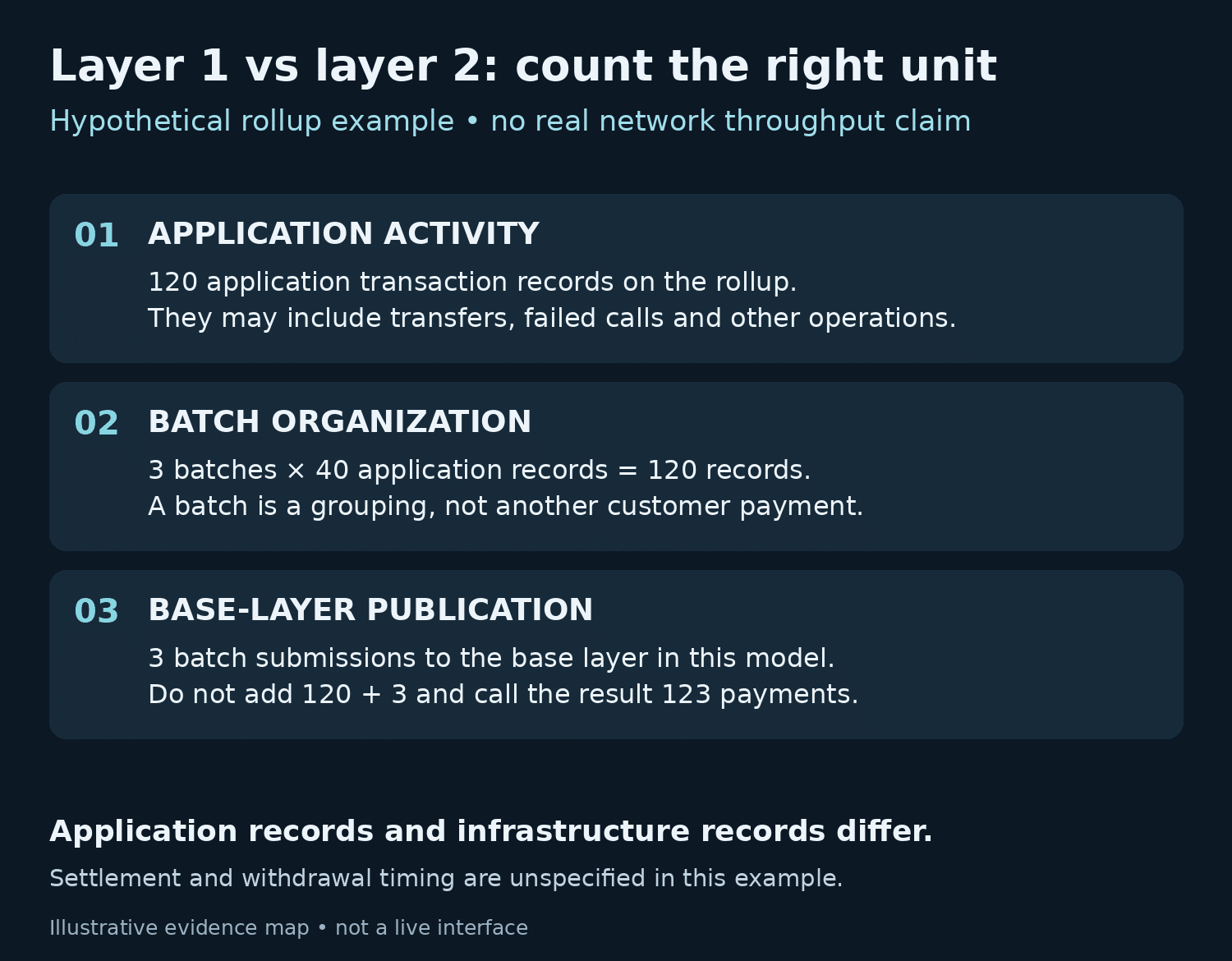
Imagine 120 invented application transactions grouped into three batches of 40. Under this simplified example, a researcher sees 120 rollup transaction records and three base-chain batch submissions. Adding them and reporting “123 customer payments” would mix application activity with supporting infrastructure records. The same count can be useful for workload analysis only if its mixed scope is explicitly stated.
Now imagine one batch contains transfers, failed calls and administrative operations. Even the 40 rollup transactions cannot automatically be called 40 payments. Layer identity solves one counting problem; transaction purpose remains a separate question. Preserve both labels in the dataset.
Optimistic and validity-proof approaches
An optimistic rollup publishes claims about state that can be disputed through its fault-proof process. Its security assumptions include the operation of that process and the ability of suitable participants to challenge incorrect claims. The optimistic-rollup explanation provides the conceptual model.
A validity-proof rollup uses a cryptographic proof checked by a verifier to establish that a proposed state change meets defined rules. These are often called zero-knowledge or ZK rollups. A proof’s use in scaling does not, by itself, mean ordinary transaction details are private.
The distinction answers how correctness is established. It does not supply a complete comparison of withdrawal time, upgrade control, software maturity or operator dependence. Two networks using validity proofs can still have different operational risks. Two optimistic rollups can have different dispute implementations and permissions.
For a short research note, write the actual mechanism rather than a verdict: “The documented design uses challenges during a defined dispute process,” or “The documented design verifies a proof before accepting the relevant update.” Then identify what must work for that statement to hold. An architectural description becomes misleading when its conditions are silently removed.
Why data availability deserves a separate line
A commitment can identify a particular result without revealing all the information needed to reconstruct it. Data availability addresses that missing-information problem. A researcher should therefore ask where the relevant data is published, which parties can retrieve it and how the system behaves when that information is unavailable.
Ethereum’s data-availability guide explains why independent verification requires access to underlying data. A validity proof and data availability address related but different questions. A valid computation does not automatically give a user all the data needed for an exit or a complete historical reconstruction.
Ethereum supports blob data used by rollups. Blobs have a distinct availability and fee design; they should not be described as ordinary permanent contract storage. The technical basis is documented in EIP-4844. An archival research task may consequently depend on additional historical data services.
For the invented three-batch example, record both the batch identifiers and the source of the decoded transaction list. If that list is absent, “120” cannot be independently reproduced from a screenshot of three submissions. This limitation concerns the evidence available to the researcher, even if the live network operated as designed.
A fast acknowledgement and a completed exit are different milestones
A wallet may display success after a sequencer includes a transaction. Later, the relevant data is included on layer 1 and the base-chain block reaches its finality condition. A withdrawal can require still more steps, including a proof, a dispute-related delay or a separate finalization transaction.
The OP Stack finality guide distinguishes unsafe, safe and finalized block states. Those are protocol labels with specific meanings. “Safe” here is not an endorsement of an application, and finalized transaction ordering does not mean every bridge withdrawal is immediately available.
Use a hypothetical timeline rather than a universal speed claim: at Observation A, the rollup includes a transaction; at B, its data is included on the base chain; at C, that base-chain block is finalized; at D, a requested withdrawal becomes executable. This example gives no fixed duration between observations. The relationship among milestones is the lesson.
If a comparison says one network “takes seconds” and another “takes days,” check the endpoints. It may compare an initial acknowledgement with a withdrawal delay. Those measurements can each be correct while producing an unfair comparison when placed in the same column.
Sidechains, fees and security boundaries
A sidechain can run compatible applications while relying on its own consensus rather than the rollup settlement relationship described above. Compatibility concerns software and interfaces. It does not establish identical security assumptions. Ethereum’s sidechain documentation makes this distinction explicit.
Lower execution costs also do not prove a particular architectural label. A comparison may need to include execution charges, the allocation of base-layer data costs and entry or exit operations. The existing Ethereum gas-fee guide explains ordinary mainnet fee units; its arithmetic should not be copied unchanged into every rollup’s fee model.
Finally, inspect who can upgrade contracts, pause functions or change important parameters. The OP Stack privileged-role documentation illustrates why administrative authority belongs in a security explanation. The existence of a proof mechanism does not erase the consequences of a separate upgrade power.
A concise comparison can therefore list: base chain, execution environment, data location, proof or dispute mechanism, transaction milestones, exit conditions and upgrade authority. Leave a field unresolved when documentation is incomplete. That is more informative than compressing the entire arrangement into “fast,” “cheap” or “inherits security.”
When comparing two architecture descriptions, make one dated record for each network. Name the execution environment, the place where data is published, the mechanism used to accept state updates and the milestone described as final. If a source leaves one field unclear, preserve that gap instead of importing the answer from a better-known network. This comparison card keeps a marketing label from becoming an unsupported claim that the two systems share the same dependencies.
Layer 1 vs layer 2: frequently asked questions
1. Is Ethereum a layer 1 or a layer 2?
Ethereum mainnet is a layer 1. A rollup that uses Ethereum for data publication and settlement operates as a separate layer-2 system. Name the actual network when discussing a balance or transaction; an ecosystem label is too broad to identify the record.
2. Does a layer 2 replace its base chain?
The relationship described here depends on base-layer functions. Moving execution elsewhere can reduce the work performed directly on mainnet, but the rollup still relies on its specified connection to that chain. A change to that connection can materially change the assumptions.
3. Are all layer 2 systems rollups?
No. State channels are another type of layer-2 construction. This article uses rollups because they make the division of execution, publication and settlement easy to examine. Do not apply a sequencer-and-batch diagram to every system called a layer 2.
4. Does a ZK rollup make transactions anonymous?
Validity proofs establish a computation-related claim. Privacy depends on what the particular protocol reveals and hides. The name “zero knowledge” is insufficient evidence that addresses, amounts or application activity are confidential in a deployed rollup.
5. Can the same address have different balances on two networks?
Yes. Similar address formats do not combine the networks’ state. An address shown on mainnet and a rollup can refer to separate balances and histories. Record the network and asset identifier alongside the address when reconciling a display. The network versus token guide explains why those identifiers answer different questions.
6. Does layer 2 mean there is a separate token?
A layer describes architecture, not a requirement to issue a new tradeable asset. Fee payment, governance and token issuance are design choices. Verify those independently rather than inferring them from the network’s name or its layer classification.
7. Why can a withdrawal take longer than a transaction?
The two operations can have different completion rules. The transaction may already be ordered while a bridge waits for a proof, dispute condition or finalization step. Measure each process from a named starting point to a named endpoint.
8. Does an audit eliminate layer-2 risk?
An audit examines a stated scope and version. It does not establish that every dependency, upgrade or application is free of defects. A useful research record includes the reviewed components, unresolved findings and the current deployed configuration.
9. How should transaction throughput be compared?
Match the observation period, transaction definition and network scope. Distinguish sustained observed activity from a test maximum. In the worked example, three layer-1 batch records represent infrastructure supporting 120 layer-2 records, not three interchangeable customer transactions.
10. Can I understand this architecture without bridging funds?
Yes. Public technical documentation and published network records support the comparisons in this guide. A wallet signature, token purchase or transfer is unnecessary. Start with a named architecture and explain each dependency before considering any practical use.
Keep learning with CrowdSent
Continue exploring the CrowdSent knowledge base, or review the current CrowdSent membership. Use the concepts here to ask clearer questions about sources, units and uncertainty. This educational article does not imply that CrowdSent operates a blockchain, wallet, bridge or oracle service.
Source documentation reviewed 25 October 2026. Examples are hypothetical and explain mechanisms rather than current market conditions. This article is educational and does not provide investment recommendations.