

CrowdSent Blog Team · Crypto research
What is Ethereum? Ethereum is a public blockchain network that supports applications built with smart contracts. Ether, abbreviated ETH, is its native asset. A headline about Ethereum may therefore concern the network, an application, a separate token or the market price of ETH. Those subjects are related, but they require different evidence.
This guide gives you seven ways to read Ethereum more clearly. It covers the essential vocabulary and then works through practical examples of application activity, asset quantities and quoted values. The purpose is to help you describe what happened and what remains uncertain, without treating every busy application or technical announcement as a forecast for ETH.
1. What is Ethereum: define the network before reading the headline
Ethereum provides a blockchain network and platform for applications. Examples of activity include digital-token transfers and interactions with application code. When reading about “Ethereum growth,” first ask which part of that broad environment the author measured.
A useful habit is to replace the word Ethereum in a draft sentence with the exact subject. “Ethereum increased” might become “the ETH/USD quotation increased,” “one application recorded more transactions” or “a provider added another network to its dataset.” The revised sentence tells you where verification should begin.
Hypothetical headline exercise: an article says “Ethereum use doubled” while its chart covers one game. The chart might accurately show that game’s recorded actions. Before extending the finding, inspect the application definition, observation window and whether the same users could create multiple actions. The broader headline requires broader evidence.
Create a short scope line at the top of your note: network, application, asset, metric and period. Leave a field blank when the source does not supply it. A blank field is valuable because it shows exactly what you need to learn next, instead of allowing an ambiguous headline to set the meaning of the research.
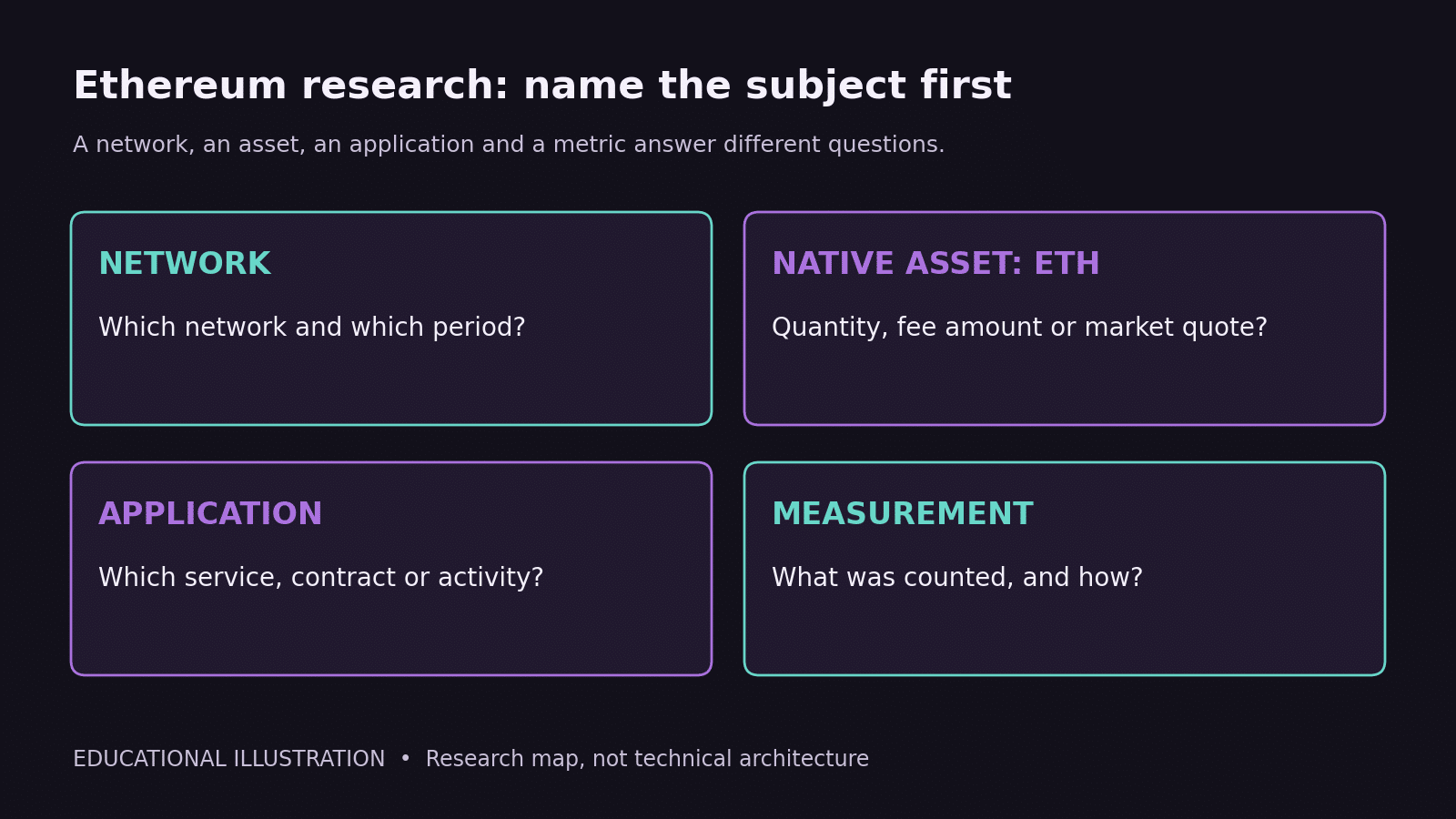
Read the illustration from the question you are investigating. It separates the network, native asset, applications and measurement layer. It is a research map rather than a technical architecture diagram; it does not imply that any one measurement captures the value or health of the whole system.
2. Identify ETH and the unit used to describe it
The Ethereum project’s ether guide identifies ETH as the network’s native cryptocurrency. It is used for network transaction fees and in proof-of-stake security. Other tokens can exist in the ecosystem, but a token’s activity and an ETH holding are different records.
Keep three quantities separate: the number of ETH, its quoted value and the amount of some other token. Do not combine them merely because a wallet or analytics page shows them together. A portfolio-style display can be a useful summary, but its total depends on the chosen valuation sources and time.
Hypothetical arithmetic: a research worksheet contains 2 ETH valued at an invented USD 1,500 per ETH. The calculated value is USD 3,000. If the reference becomes USD 1,800 while the quantity remains 2 ETH, the calculated value becomes USD 3,600. The 20% value increase does not establish that the recorded ETH quantity grew.
If the same worksheet contains 500 units of an application token, give that token its own row. Do not report “502 Ethereum” by adding incompatible units. Convert values only after identifying each asset, its pricing basis and any missing reference. Where a credible valuation is unavailable, mark it unavailable rather than forcing every row into a total.
For an India–Pakistan research discussion, use INR and PKR explicitly. A converted ETH value needs the original quote, the currency-conversion rate and both timestamps. The label “Rs” makes a shared note unnecessarily ambiguous, and a local-currency conversion should never be mistaken for evidence of an actual local trade.
3. Distinguish smart-contract code from the service around it
A smart contract is code and associated state at an address on the network. Transactions can invoke its functions. The Ethereum smart-contract anatomy guide explains this basic model. The word “smart” describes programmed behavior; it is not an assessment of whether an application is useful, well designed or appropriate for a particular person.
When you read an application claim, list the components being discussed: the public website, the contract, any external information it relies on and the people operating related services. A statement about one component should be evaluated at that level. An attractive interface or a technical-looking address does not supply the missing evidence for the others.
Hypothetical example: a demonstration app records entries in a public registry. The website claims it has verified every entry. A record showing that an entry was stored establishes storage under the application’s rules. To support the verification claim, the researcher must separately inspect how entries were checked and who performed that work.
This distinction is especially important when a screenshot combines an on-chain record with a familiar company logo. First establish the connection between the record and the claimed service using that service’s own documentation. A logo in a post does not authenticate the post, and a working contract does not authenticate every website referring to it.
You can perform an introductory review with public documentation. You do not need to connect a wallet or submit a transaction to decide whether an article supplied a contract address, described its scope and supported its claims. Keep the research task small enough that reading the evidence is sufficient.
4. Place proof of stake in its proper research category
Ethereum uses proof of stake. Validators commit ETH and participate in proposing and checking blocks; protocol rules include rewards and penalties. The Ethereum proof-of-stake overview describes this mechanism. A network-security explanation belongs in a different category from an offer made by a third-party service.
If a headline uses the word staking, identify whether it discusses protocol participation, a service arrangement or a statistic about the network. Those are separate research subjects. A protocol description cannot verify the terms of a particular provider, and a provider’s promotional percentage cannot summarize all participation arrangements.
Hypothetical review: two posts claim to report the same “staking rate.” One uses a number of active validator records; the other uses an amount of ETH. Before comparing either percentage, find its numerator, denominator, timestamp and exclusions. Different measures can both be internally correct while answering different questions.
A selected validator proposes a block containing transactions and their resulting changes to the network’s records, or state. Other validators check the block, including re-executing its transactions to verify those changes. They send attestations: signed votes used by the consensus system. These checks help participants agree on a shared history rather than simply trusting the proposer’s description.
Committed ETH gives validators value at stake under the protocol’s rules. Certain provable violations, such as conflicting attestations, can trigger slashing and loss of staked ETH. The proposal, checking and penalty mechanisms belong together in an explanation of network consensus. A third-party staking service adds its own arrangement, which this protocol description does not evaluate.
5. Check which network and application the dataset covers
“Ethereum ecosystem” is a broad label, so require a scope statement before comparing dashboards. Write down the named network, the application or contracts included, the metric definition and the reporting window. If a provider aggregates several networks, retain its inclusion rules and any method for avoiding repeated counting.
Hypothetical coverage example: Dataset A includes one network and reports 40,000 actions. Dataset B includes that network plus two additional networks and reports 70,000 actions. The difference of 30,000 cannot be called growth without matching their coverage and period. You have two differently scoped totals until the underlying rows can be reconciled.
Ethereum mainnet is the base network, also called layer 1. A rollup is a layer-2 system that executes transactions outside mainnet and posts data back to it, using Ethereum in its security design. The Ethereum scaling documentation explains this relationship. Each named rollup has its own transaction records, so specify which network a count describes.
The same discipline applies to addresses and users. If the dataset counts addresses, preserve that label unless its methodology supports a people-level interpretation. If it counts actions, describe actions. Do not upgrade the wording because “users” sounds more meaningful in a headline.
A batch submitted to mainnet can relate to many transactions processed on a rollup. Counting the mainnet submission and counting the underlying rollup transactions therefore answer different questions. A combined ecosystem total needs a stated counting rule. Otherwise, the same underlying activity may be described once as application use and again through its supporting mainnet record.
6. Test whether an activity claim is driven by quantity or valuation
Read a metric’s formula before interpreting its direction. A total quoted in dollars can change because quantities change, because the valuation references change or because the coverage changes. Start with the smallest available components instead of accepting one headline total as a complete explanation.
Hypothetical application balance: an invented dataset records 100 ETH at USD 1,500 each, producing a USD 150,000 reference value. Later it records 90 ETH at USD 2,000 each, producing USD 180,000. The dollar value rises 20% while the ETH quantity falls 10%. These two statements describe the same invented observations without contradiction.
The example does not tell you why the quantity changed or whether the application is improving. It tells you which claim the arithmetic supports. To investigate the cause, you would need the underlying flows, asset definitions and any relevant changes in the application’s records. Preserve that unresolved question separately from the calculation.
Discussion measures need their own treatment. More positive posts about an application are evidence about the sampled language. They may suggest a question worth investigating, but they do not directly establish increased assets, broader use or a future ETH price. The sentiment-score guide helps you keep that distinction explicit.
Write two lines under every comparison: “What this measure establishes” and “What this measure leaves open.” This small step catches many overclaims before publication. It also makes later updates easier, because you can add new evidence to the unresolved line without pretending the original observation was more complete than it was.
7. Turn Ethereum research into a bounded explanation
A strong beginner note can fit into a few paragraphs. Name the subject, report the observation, show the calculation if needed and explain the main limitation. Save the original evidence beside it. The market research journal template is useful for keeping those pieces together across later updates.
Hypothetical finished explanation: “The selected application’s recorded ETH balance fell from 100 to 90 while its dollar reference value rose from USD 150,000 to USD 180,000. The difference reflects the valuation assumptions used in this exercise. The data do not establish growth in the number of people using the application. The next check is the source’s account-counting method.”
Before sharing, read the headline against that paragraph. If the headline promises an explanation of the entire Ethereum network, narrow it. If it promises an ETH price forecast, remove the promise. A specific finding is easier to verify and more informative than a broader claim the underlying work cannot support.
Use the market-news verification guide when the research begins with an announcement. Preserve the exact release, its date and the difference between a proposal, a completed change and an interpretation. Finish when the original question has an evidenced answer or when the missing evidence is clearly identified.
Frequently asked questions
What is the difference between Ethereum and ether?
Ethereum names the network and its broader application environment. Ether, usually written ETH, names the native asset. In a research note, specify whether you are describing network operation, an application or an ETH quote. That choice determines which source and unit belong beside the claim and prevents one observation from being used to explain everything.
Are all tokens described as Ethereum tokens the same as ETH?
No. Identify the exact asset rather than relying on a broad ecosystem label. Preserve the network, token identifier and source of the description in your research. Treat a symbol or logo as a starting clue, then verify the asset against authoritative documentation. Similar names do not make separate balances or price series interchangeable.
What happens when an application calls a smart contract?
A read-only call can retrieve contract data without changing the blockchain’s recorded state. A state-changing interaction instead submits a transaction that invokes programmed functions. If execution succeeds and the transaction is included, its permitted changes become part of the recorded state. Reading a balance and requesting a token transfer are therefore different kinds of interaction; not every call changes state.
Does a smart contract make an application trustworthy?
A claim that code exists or executes does not complete a trust assessment. Ask what was reviewed, by whom, on which version and for what purpose. Keep the scope of any technical review visible. Avoid upgrading a narrow verification into a general endorsement of the application, its operators, its interface or every claim made about it.
Is Ethereum currently a mining network like Bitcoin?
Ethereum’s current consensus mechanism is proof of stake. Older descriptions of Ethereum mining should be read in their historical context. When comparing networks, define the specific mechanism or metric rather than relying on the word “crypto.” A current protocol reference is the right starting point for checking whether an explanation still applies.
Does growth in one Ethereum application prove ETH demand increased?
It does not establish that conclusion on its own. Define the application metric, identify its scope and explain the proposed connection to ETH with separate evidence. A count of actions, a quoted asset value and an ETH market observation are different records. Keep them separate until a defensible comparison supports a relationship.
Why can an application’s dollar value rise while its ETH balance falls?
The calculation contains both a quantity and a price reference. In the hypothetical example, a smaller ETH quantity is multiplied by a sufficiently higher dollar reference, producing a larger total. Show both inputs and timestamps. The arithmetic explains the valuation change without proving why the quantity moved or what users intended.
How should I compare Ethereum figures shared from different countries?
Preserve the original unit and add explicit currency codes such as USD, INR or PKR to any conversion. Align observation windows with timestamps and a stated time zone. Avoid translating only the displayed number while losing its provider, method or date. Local display conventions should help readers follow the evidence rather than change its meaning.
What is missing when a chart only says “Ethereum users”?
The chart needs a definition of user, its coverage, counting method and observation period. Ask whether it counts people, addresses, accounts or something else. If the author does not disclose the method, retain the label as their claim rather than treating it as verified. The missing definition is a substantive limitation worth recording.
Can I learn these basics without connecting a wallet?
Yes. The exercises here involve reading documentation, checking definitions and reproducing invented calculations. None requires a purchase, a signature or a transfer. If a page demands a wallet connection simply to reveal a basic research claim, look for the underlying public source instead of assuming the extra step is necessary to understand the topic.
Source documentation checked 7 October 2026. Educational research guidance from the CrowdSent Blog Team. Hypothetical examples are invented and are not current market observations. This article does not provide investment recommendations.