

By CrowdSent Blog Team
The distinction in crypto network vs token is straightforward: a network supplies the ledger and execution rules, while a token is an asset recorded within that environment. A familiar ticker does not identify both. Two balances with the same symbol can exist on different networks, depend on different contracts and be supported differently by a receiving service.
A useful identification record therefore has several fields: network, production or test environment, asset type, contract or other asset identifier, and the source that confirms those details. This guide shows how to read those fields without connecting a wallet, signing a message or initiating a transfer.
Crypto network vs token starts with two different questions
“Which ledger am I reading?” identifies the network. “Which asset does this balance represent?” identifies the asset. Ethereum mainnet is a network; ETH is its native asset. An ERC-20 token on Ethereum is tracked by a smart contract rather than by Ethereum’s native ETH balance field.
For background on those roles, see what Ethereum is and how ETH fits into its applications. Here the focus is narrower: distinguishing an asset’s identity from the name of the infrastructure on which it appears.
A wallet can display several networks in one interface. That does not combine their ledgers. A displayed total may be a software summary of separate balances, just as a banking app can show several accounts without merging their underlying account records.
Build a network and asset identity record
Begin with the network’s official name and whether the page describes mainnet or a test network. Ethereum’s network documentation distinguishes production Ethereum from testing environments. Test balances are useful for software experiments; a familiar ticker in a test environment does not establish a mainnet holding.
For EVM-compatible networks, a chain ID provides another identification field. It belongs in the record beside the network name, not in place of a trustworthy source. A page can print a real chain ID while linking to an unrelated contract. Chain identity and website authenticity still require separate checks.
Next, decide whether the asset is native to the network or issued through a token mechanism. For an ERC-20 asset, record the complete token contract address. For other networks, identity may instead involve an issuer plus currency code or a mint identifier. “Contract address” is not a universal label for every blockchain asset.
Keep the source URL and the date checked. These details make a later comparison reproducible and help expose an outdated support page or a token migration. They do not guarantee that the source is correct, but they show where each conclusion came from.
Why the same ticker can identify different things
Symbols and names help people recognize assets. They are not a global registry of unique ownership rights. The ERC-20 specification describes optional name, symbol and decimals metadata alongside the token’s balance and transfer interface. A symbol alone is therefore insufficient evidence of identity.
An issuer may deploy its asset on several networks. A bridge may create a representation of an existing asset elsewhere. An unrelated contract may copy a popular symbol. Those cases can look similar in a wallet list, although their issuers, backing arrangements and redemption conditions differ.
For a concrete source format, Circle’s USDC contract directory groups asset identifiers by blockchain and separates mainnet from testing information. The useful habit is checking a current issuer directory, rather than memorizing an address from an article.
A matching logo adds little independent evidence. Neither a familiar icon nor a prominent position in search results establishes that a token is issuer-recognized. The contract-and-network pair should agree with a source reached through the project’s established official site.
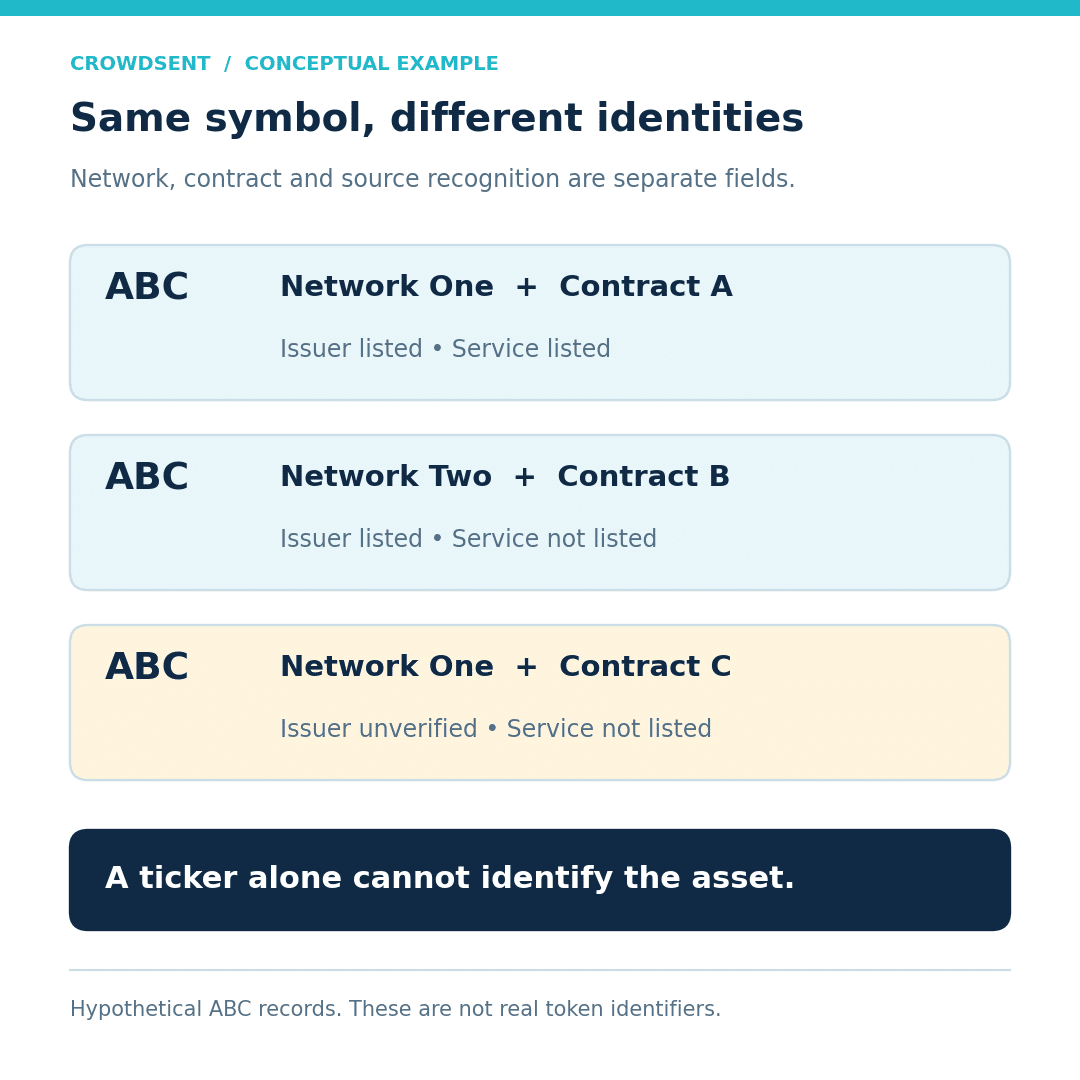
Hypothetical example: three balances called ABC
Imagine a research worksheet containing three fictional ABC entries. The first lists Network One and contract A. The second lists Network Two and contract B. The third lists Network One and contract C. These names are placeholders, not real assets or destinations.
An official issuer directory identifies A and B as its deployments. Contract C is absent. The supported conclusion is that A and B match the issuer’s published directory, while C remains unverified. The shared ABC label does not connect C to that issuer.
Now suppose a service’s deposit documentation names only Network One and contract A. The worksheet cannot establish support for B merely because the issuer recognizes it. Issuer recognition and service compatibility answer different questions. The service would need to identify the exact additional deployment it supports.
This example also shows why a balance total can be misleading. Adding 20 ABC on one network to 30 ABC on another may be mathematically simple, but the combined figure hides differences in access, transferability and asset representation.
Addresses, decimals and balances need context
Many EVM networks use the same address format. Seeing the same hexadecimal account address on two networks does not establish that the balances or deployed contracts are the same. The ledger context belongs beside every address in a research note.
Decimal metadata changes how a raw token balance is displayed. Hypothetically, 1,500,000 base units with six decimals display as 1.5 tokens. With eighteen decimals, that same integer displays as a much smaller quantity. Decimal precision describes units; it does not establish authenticity or monetary value.
Native ETH needs no ERC-20 token contract address on Ethereum. Some applications use a placeholder address to represent native currency internally. Such a software convention should not be mistaken for a deployed ETH token contract.
Fees are another separate field. A network’s native fee asset and the token being displayed may differ. CrowdSent’s Ethereum gas fee guide explains the cost vocabulary without making the token’s ticker stand in for network information.
A practical read-only checklist
- Record the exact network name and mainnet or testnet status shown by the source.
- Identify the asset as native currency, issuer-created token or a representation of another asset.
- For a contract-based token, compare the full contract address with a current official issuer or protocol reference.
- Check the same network in the relevant explorer. Note the contract, decimals and observation time.
- Read any receiving service’s current asset-and-network support description separately from the issuer’s directory.
- Write down unresolved differences instead of treating a ticker, logo or similar address as confirmation.
These checks involve public information. They do not require a recovery phrase, private key, token approval or wallet signature. A request for any of those is outside a simple identity check.
What the checklist can and cannot establish
A matching contract record can establish that two sources are referring to the same deployment. It does not establish that the contract is secure, that its administrator cannot change it, or that a service will credit a particular deposit. Those questions require additional evidence with a different scope.
Likewise, technical identity does not settle valuation. If a market-data page aggregates several deployments under one asset, read its supply methodology before combining figures. Crypto market cap versus price explains why a quoted price and an aggregated supply measure answer different questions.
The useful final output is a precise description: “This balance is asset X, identified by Y, on network Z, checked against source S on this date.” That sentence is more informative than “I have the token with this symbol.”
Frequently asked questions
Is a crypto network the same thing as a cryptocurrency?
No. A network is the ledger environment. Its native cryptocurrency is one asset associated with it. The network may also support many separately issued tokens, each with its own identity and rules.
Can two legitimate tokens use the same symbol?
Yes. Symbols are not globally unique identifiers. Even legitimate deployments need network and asset identifiers to distinguish them. An identical ticker does not show that two contracts share an issuer or redemption arrangement.
Does the same wallet address work identically on every EVM network?
The address format can be shared, but balances and contract state belong to each network. Contract availability can differ too. An identical address string is therefore insufficient evidence of identical functionality or service support.
Does adding a token to a wallet move it to another network?
A display entry tells the wallet which asset record to show. It does not itself change the network on which that asset exists. Interface visibility and on-chain movement are different events.
What if a token has no ERC-20 contract address?
Determine its asset model first. Native ETH has no ERC-20 contract address. Other blockchains may identify issued assets with different fields. Use the official documentation for that network instead of forcing every asset into an Ethereum template.
Does an explorer’s verified-contract label prove a token is genuine?
Such a label generally concerns a source-code verification process. It does not by itself prove issuer affiliation, economic backing or investment quality. Read the explorer’s definition and compare the deployment with official issuer records.
Can mainnet and testnet balances be added together?
They should remain separately labeled. A testnet balance belongs to a testing environment and does not establish possession of the production asset. Similar symbols do not make the environments economically interchangeable.
Why might an issuer list several contract addresses?
The issuer may support multiple networks or versions. Read the accompanying network and migration notes. Several published addresses do not imply that every service accepts every deployment or that the addresses can be used interchangeably.
Can a token contract address change?
A project can introduce a new deployment or migration. That makes dated source records useful. A new announcement should be checked against established official channels; an unsolicited message alone does not establish a legitimate migration.
What should I do when official records disagree?
Preserve both URLs, their dates and the exact mismatch, then seek clarification through the issuer or service’s verified support channel. The read-only conclusion is “unresolved,” rather than an assumption that one familiar-looking label must be correct.
Keep learning with CrowdSent
To explore the workspace and its membership options, open CrowdSent.
Educational note: This article explains concepts and evidence checks. It is not investment, legal, tax or personalized transaction advice. Examples are hypothetical, and protocol features and service policies can change.