

CrowdSent Blog Team · Crypto research
Ethereum gas fees pay for network work. Understanding a fee requires separating the amount of gas used, the price paid for each unit and the currency used to display the result. A fee shown in dollars can change even when the underlying ETH amount stays the same.
This guide explains ordinary Ethereum mainnet execution fees, including the common EIP-1559 fee fields. It gives you six checks for reading estimates and completed transaction records, with invented calculations you can reproduce. Specialized data fees, layer-2 charges and service charges need their own scope checks. None of the examples is a current fee quote or a suggested transaction setting.
1. Read Ethereum gas fees as units multiplied by a price
Gas measures the computational work of network operations. ETH is the payment asset; gwei is a denomination equal to one-billionth of an ETH. For an ordinary execution-fee calculation, multiply gas used by the effective gas price, then convert the denomination if needed. The Ethereum gas documentation describes these fundamentals.
Keep “gas used” and “gas price” in different columns. A number without its label is easy to misread: 55,000 gas units, 32 gwei per gas and 0.00176 ETH are three different measurements. In a completed-record exercise they can describe the work, its rate and the resulting fee for the same transaction.
Hypothetical calculation: assume the record shows 55,000 gas used and an effective price of 32 gwei per gas. Multiplication gives 1,760,000 gwei. Dividing by 1,000,000,000 gives 0.00176 ETH. Write the units throughout so that another reader can check both the arithmetic and the decimal placement.
Do a quick reasonableness check before interpreting the result. If you double the assumed units while leaving the rate unchanged, the calculated amount should double. If your spreadsheet instead produces a thousandfold increase, inspect the units and conversion rather than inventing a network explanation.
The amount being transferred is a separate field from the fee. In your notes, label the transaction value and the execution charge individually. That keeps an example about a small payment from accidentally becoming a claim that every transaction of the same monetary size requires the same work.
2. Separate the base fee, priority fee and maximum fee
EIP-1559 transactions specify maximum total and priority prices per gas. The effective priority component is limited by what remains below the total cap after the block’s base fee. The base fee is burned; the priority component goes to the block producer. The EIP-1559 specification documents the accounting and the base-fee adjustment mechanism.
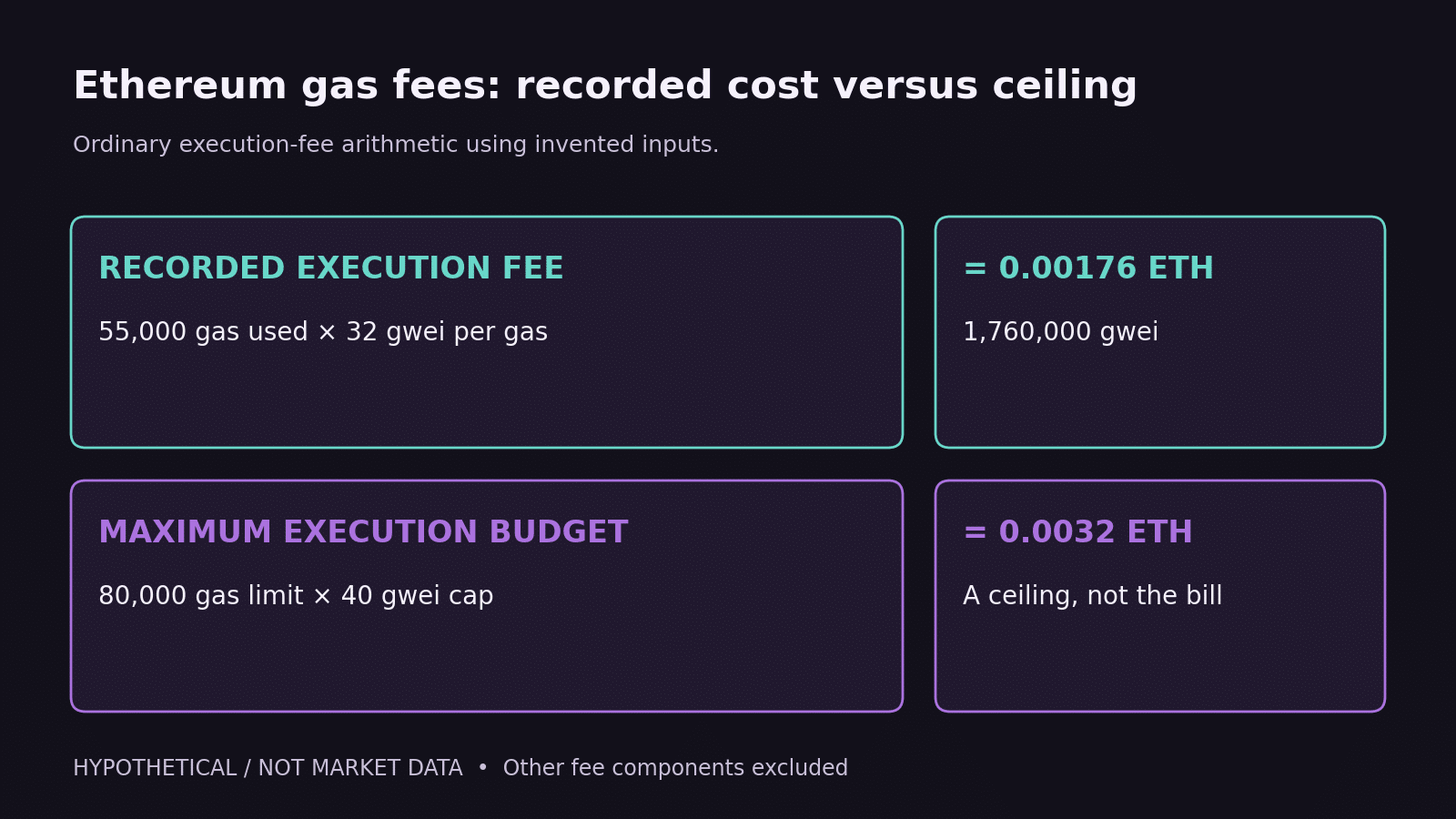
Hypothetical field audit: use a base fee of 30 gwei, a maximum priority fee of 2 gwei and a maximum total fee of 40 gwei per gas. In this exercise the effective price is 32 gwei. The 40-gwei field is a ceiling, so multiplying every used unit by 40 would overstate this example’s actual charge.
For the same invented record, suppose the gas limit is 80,000 and actual gas used is 55,000. The maximum execution-fee budget is 80,000 × 40 gwei, or 0.0032 ETH. The recorded charge remains 55,000 × 32 gwei, or 0.00176 ETH. The difference is unused budget in the comparison, not a financial return.
Now change only the hypothetical total cap to 31 gwei while retaining the 30-gwei base and 2-gwei priority cap. The available priority amount is 1 gwei, producing a 31-gwei effective price. This arithmetic explains why reading one fee field in isolation can misdescribe the result. It is not advice to set a particular cap.
In a real investigation, work from the exact transaction type and included block. Do not replace a completed record with a screenshot of an earlier estimate. Preserve both if the question is why the estimate and receipt differ; they describe different stages of the process.
3. Compare the estimate with the completed record
A gas limit describes a permitted amount of work, while gas used describes the recorded consumption. Ethereum’s transaction documentation identifies the relevant transaction fields and distinguishes submission from later block inclusion. For fee research, the stage of the record is part of its meaning.
Build a simple audit trail containing the network, transaction identifier, observation time, status, gas used, effective gas price and calculated execution fee. Preserve the estimate separately with the time it was shown. An exact calculation using the wrong record can still produce a misleading answer.
Hypothetical comparison: an interface initially displays 0.0024 ETH as an estimate. A completed record later supports the 0.00176 ETH calculation above. The difference is 0.00064 ETH. Before describing the interface as wrong, check whether the earlier display was an estimate, maximum or another fee category, and whether the assumed conditions changed.
Also inspect outcome status. A transaction included in a block can consume gas even if its intended execution reverts. A request that was never included is a different case. A wallet error message alone is therefore insufficient to explain an on-chain charge; identify the actual network record before making that claim.
Keep a service’s own charges in a separate row if they appear. A withdrawal charge or application charge is not automatically identical to the network execution fee. Use the provider’s stated definition and the transaction evidence to determine what was counted. If those details are unavailable, report the limitation instead of forcing the amounts to match.
4. Explain why an ETH fee and a currency display can move differently
Once you have a fee in ETH, a dollar or rupee display adds a valuation step. Preserve the ETH amount before applying that conversion. Otherwise, a reader may interpret a change in the display as evidence of a change in the network’s per-unit fee when the arithmetic has another explanation.
Hypothetical display example: keep the execution fee fixed at 0.00176 ETH. At an invented USD 1,500 per ETH reference, its value is USD 2.64. At an invented USD 2,000 reference, its value is USD 3.52. The fee in ETH is unchanged, while the displayed dollar value rises by one-third.
A local-currency display adds another multiplier. Using a fictional INR 80 per USD, USD 3.52 becomes INR 281.60. Using a fictional PKR 250 per USD, it becomes PKR 880. These values are arithmetic illustrations, exclude other charges and do not describe current exchange rates, service availability or a payable quote.
For a before-and-after comparison, inspect the gas units, effective gas price, ETH conversion reference and any local-currency conversion separately. You can then explain which changed in the calculation. Do not attribute the entire movement to “congestion” until the network evidence supports that explanation.
Choose the valuation time deliberately. A receipt viewer might show a historical reference or a current display conversion; verify which one it uses. Retain both when they serve different questions, but label them clearly. A research note should allow a reader to reproduce the same result using the same inputs.
5. Match the network, transaction type and observation window
A generic “Ethereum fee” screenshot needs context. Record whether it concerns mainnet execution, a layer-2 network, a specialized data charge or a service’s own estimate. The distinction matters before you compare amounts. Ethereum’s optimistic-rollup documentation describes processing outside mainnet and posting data back to it, illustrating why a rollup fee needs its own explanation.
Do not apply the ordinary mainnet calculation in this article as a universal formula for every displayed layer-2 total. Read the named network’s fee documentation and retain the components it specifies. Likewise, a record with a separate blob-data charge needs that component accounted for beyond an ordinary execution-only comparison.
Hypothetical comparison: Screenshot A shows an execution-only estimate. Screenshot B shows a combined service total. Even if both display ETH, subtracting them does not isolate a network-fee difference. First list what each figure includes. Only compare the overlapping component when the supporting records make that possible.
Aggregation is another source of confusion. A mean across a mixed set of operations answers a different question from the median for one operation type. If a report’s typical fee rises, check whether its transaction mix changed before claiming that the same action became more expensive by that amount.
Suppose an invented sample shifts from mostly simple operations to mostly complex operations. Its average total charge can rise even with an unchanged price per gas. The research question is then partly about composition. Preserve the operation categories and sample sizes so the arithmetic can be inspected.
When a fee spike is tied to an announcement, use the market-news verification guide to check the event and its timing. When comparing longer windows, use the same discipline as historical sentiment research: consistent scope, explicit dates and visible method changes.
6. Turn the fee observation into a limited research conclusion
A fee observation can tell you about the recorded cost under specified conditions. Explaining why it changed requires more evidence; using it to predict ETH’s market price requires a separate argument. Keep those steps visible rather than moving directly from a high-fee screenshot to a broad investment story.
Hypothetical finished note: “For the selected completed transaction, 55,000 gas at an effective 32 gwei per gas gives a 0.00176 ETH execution fee. An earlier 0.0024 ETH display was labelled an estimate. The current calculation is reproducible from the receipt. It does not establish the cause of network demand or imply a direction for ETH’s price.”
Use the market research journal template to retain the original record and your calculation. Add the specific missing field when you cannot reconcile a discrepancy. “Need the estimate timestamp” is more useful than a vague conclusion that fees are unpredictable.
If discussion becomes part of your research, separate the sampled reaction from the fee record. The sentiment-score explanation helps clarify what language-based measurements can establish. A strongly positive or negative response to fees is information about the conversation, not an additional transaction receipt.
Finish with a short check: correct network, correct status, correct units, correct fee components and correct valuation time. If all five are documented, you have a sound basis for explaining the observed charge. You can leave the broader market interpretation open when the evidence does not answer it.
Frequently asked questions
Are gas and ETH the same unit?
Gas measures work, while ETH is the asset used to pay the execution fee. Keep gas units, gwei per gas and ETH totals in separate fields. In the example, 55,000 multiplied by 32 is meaningful only because the units are attached. Removing those labels makes a correct number much easier to misunderstand.
What does gwei mean in a fee calculation?
One gwei is one-billionth of an ETH. When a rate is quoted in gwei per gas, multiply by gas used before converting the result to ETH. For the invented 1,760,000-gwei result in this guide, division by one billion produces 0.00176 ETH. Check decimal placement before adding any currency valuation.
Does setting a higher gas limit mean the full limit is charged?
Read the limit and actual consumption separately. The hypothetical limit of 80,000 units differs from the 55,000 units recorded as used. For a completed ordinary execution-fee calculation, use the receipt’s charged gas and effective price. A limit-only screenshot cannot establish the amount ultimately paid or whether the operation completed as intended.
Is the maximum fee per gas the same as the effective price?
It can differ. In the invented 40-gwei-cap example, the effective price is 32 gwei because the assumed base and priority components add to that amount. Preserve the cap and effective figure as distinct fields. This lets you explain a difference without treating the unused ceiling as a charge or a saving guaranteed in advance.
Can an unsuccessful transaction still have a fee?
An included transaction whose execution reverts can still consume chargeable gas. Identify the network record and status before interpreting the word “failed” in an interface. A submission problem, an unconfirmed request and a reverted included transaction need different explanations. Also separate any provider charge from the on-chain execution fee being investigated.
Why did a displayed dollar fee rise when the ETH fee stayed fixed?
A currency display multiplies the ETH amount by a valuation reference. In this guide’s hypothetical example, the same 0.00176 ETH becomes USD 2.64 or USD 3.52 under different invented ETH/USD references. Record the conversion timestamp and source so that a display change is not mistakenly attributed entirely to network conditions.
Can I compare a mainnet fee directly with a layer-2 total?
Only after matching what each total includes. Identify the network and read its fee-component definitions. A mainnet execution amount and a layer-2 or service total may cover different work and charges. Describe the scope of both records, and leave the comparison unresolved if the source does not provide a compatible breakdown.
Does a high gas fee show that ETH’s price will rise?
The fee record does not establish a future market price. Start with the observed network cost, then inspect the evidence for any proposed economic connection separately. A confident explanation in a discussion thread adds a claim to verify. It does not change the evidentiary scope of the original fee calculation.
What should an India–Pakistan research note include for fee comparisons?
Use explicit currency codes, retain the original ETH fee and show each conversion rate’s direction and time. Use UTC for aligning observations when that helps, while preserving the original timestamps. INR and PKR amounts should be labelled as calculated references when they are conversions, with other charges and exclusions stated clearly.
How can I check a fee claim without submitting a transaction?
Use an existing public record or an invented calculation like the examples here. Identify the network, gas used and effective price, then reproduce the multiplication and denomination conversion. Compare the result with the claimed amount. You can investigate a fee explanation without connecting a wallet, selecting settings or spending funds.
Source documentation checked 7 October 2026. Educational research guidance from the CrowdSent Blog Team. Hypothetical examples are invented and are not current market observations. This article does not provide investment recommendations.