

By CrowdSent Blog Team
An Ethereum nonce helps explain the ordering of transactions from an account. A pending Ethereum transaction has not yet been included in the chain as seen by the source you are checking. Understanding it starts with three separate questions: which transaction was submitted, where it sits in the sender’s sequence, and whether a receipt exists. A spinning wallet indicator answers none of those questions reliably on its own.
This article concerns ordinary Ethereum account transactions. It explains public records and status labels, not a method for speeding up, replacing or cancelling transactions. Smart-account operations and exchange withdrawals may involve additional systems with their own identifiers.
Read an Ethereum nonce as part of a sequence
An ordinary externally owned account uses a transaction nonce as an ordering counter. An Ethereum nonce belongs to its sender on a particular network. It is not a global queue position, a time estimate or a number shared by every wallet.
Transactions from that sender must fit the account’s required nonce sequence when executed. A later nonce cannot simply skip a missing earlier one. This explains why a later transaction may wait even when its fee fields look competitive.
Ethereum’s transaction documentation describes the nonce and the other transaction fields. If the account model is unfamiliar, CrowdSent’s introduction to Ethereum and its application activity provides the broader context.
Pending is an observation, not a promise
A transaction pool is a node’s collection of transactions it knows about before inclusion. Nodes need not have identical pools. A transaction sent through a private route may also be absent from a public explorer until a later stage.
Geth’s transaction-pool reference distinguishes transactions ready for processing from those queued for future processing. Its transaction-pool documentation also allows multiple transaction records for the same account and nonce. A displayed pending label therefore needs the source and observation time beside it.
“Not found” is weaker evidence than “failed in a block.” It can reflect a wrong network, an indexing delay, a submission that did not reach that source, or a record the source no longer retains. None of those possibilities can be selected confidently from the missing result alone.
Ethereum nonce sequence: a hypothetical example
Suppose a fictional account’s next required ordinary transaction nonce is 42. A reader sees transaction A with nonce 42 and transaction B with nonce 43. Both appear pending in an explorer.
B depends on the sequence advancing through 42. The fact that B was submitted later does not create a separate route around A. Other accounts can continue transacting while this account’s sequence remains unresolved.
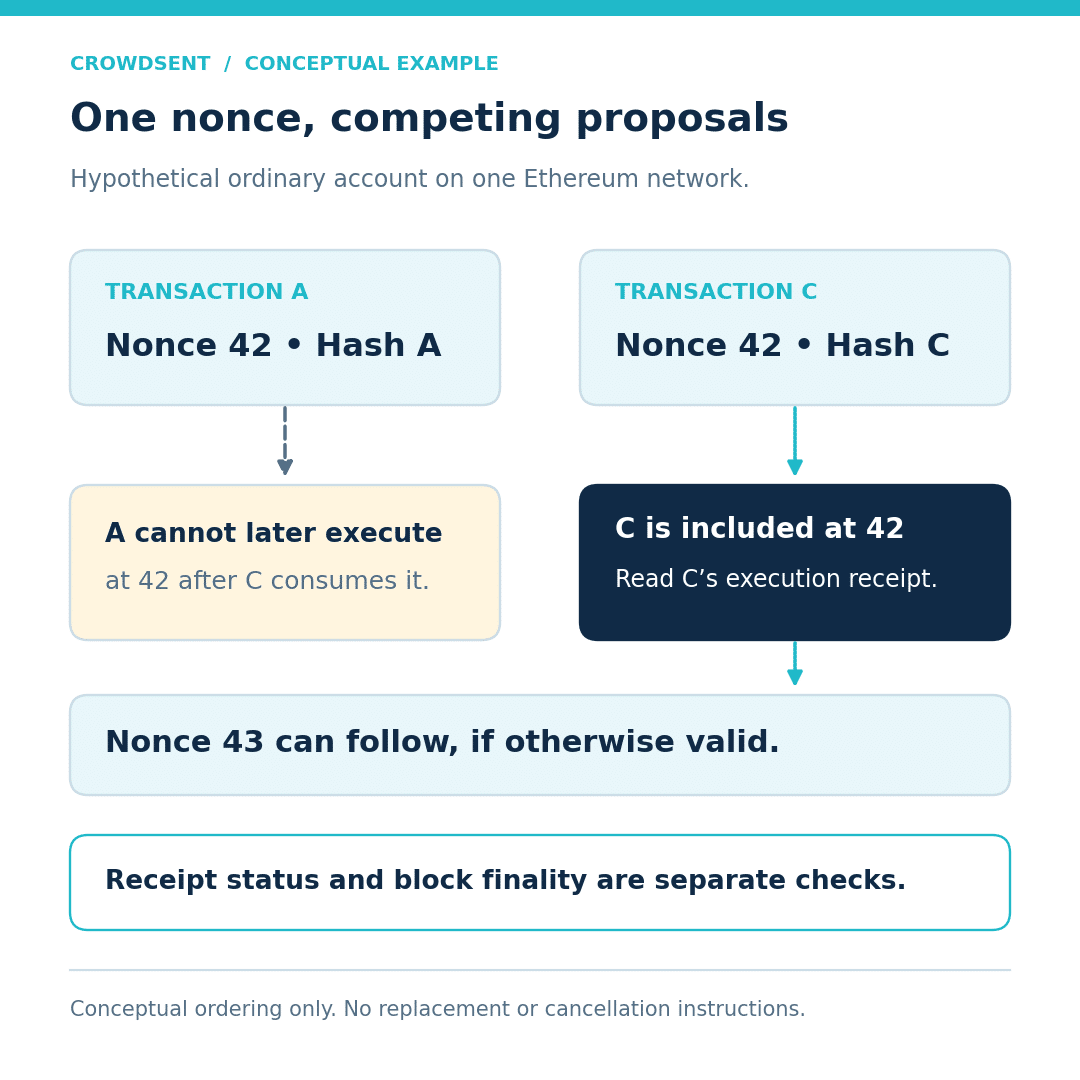
Now suppose transaction C appears from the same sender, on the same chain, also with nonce 42. C has a different hash because its signed transaction data differ. If C is included in the canonical chain at nonce 42, A cannot later execute there as a second ordinary transaction using that consumed nonce.
The reader should inspect C’s receipt and contents before describing the outcome. C might represent the original intended action, a different action or a failed execution. The shared nonce proves competition for an ordering position; it does not prove that the intended payment occurred.
Replacement and cancellation labels need interpretation
A wallet may call a same-nonce alternative a replacement or cancellation. These are interface descriptions of a new proposed transaction. They do not erase a previously finalized transaction, and a cancellation label alone does not establish an on-chain outcome.
Transaction-pool replacement acceptance is client policy, with fee and other checks that can vary. Inclusion also depends on network conditions and the transaction’s validity. There is no universal delay or guaranteed outcome that follows from a “speed up” button.
This guide deliberately stops at interpretation. Changing nonces, signing alternatives or altering fee settings can have consequences beyond the record being investigated. Public inspection does not need those actions.
Use the receipt to separate inclusion from execution
An included Ethereum transaction has a receipt containing execution-related fields. Ethereum’s JSON-RPC reference documents receipt retrieval and notes that receipts are unavailable for pending transactions. A null result still needs context: it is not proof that a particular transaction was never broadcast.
For modern Ethereum receipts, status 1 indicates success of the top-level execution and status 0 indicates failure. A failed included transaction is no longer simply waiting. Its ordinary transaction nonce has been consumed, and gas charges can still apply.
Success also has a boundary. It does not establish that an exchange credited an account, that an application displayed the result correctly, or that a token transfer matched the reader’s intent. Inspect the relevant contract, event logs and destination details before interpreting the business outcome.
Inclusion and finality are separate observations. A transaction may be included before its containing block is finalized. A receipt on a recently observed chain should not be described as finalized unless the source supplies evidence for that stronger statement.
Fee fields explain one possible delay
For an EIP-1559 transaction, the maximum fee per gas must accommodate the block’s base fee for inclusion. A fee cap below the applicable base fee can make the transaction ineligible for that block. Other factors, including earlier nonces and transaction-pool policy, may still matter.
A gas limit is a computation allowance, not a promise of faster inclusion. The maximum fee field is also not the same thing as the fee ultimately charged. Keeping those units separate avoids misreading a large limit as evidence of priority.
See Ethereum gas fees and their units for the cost framework. Here fees are one explanatory field in a status investigation, not a recommendation to change wallet settings.
A read-only Ethereum nonce and receipt checklist
- Record the network, transaction hash, full sender address and observation time.
- Check whether the source shows a block number and receipt, rather than relying only on a wallet label.
- Record the nonce and look for earlier unresolved ordinary transactions from that same sender.
- If a replacement is reported, compare the original and replacement hashes, sender, nonce and chain.
- For the included transaction, distinguish successful execution, failed execution and finality.
- Keep any service deposit or withdrawal status separate from the chain’s transaction status.
Use an explorer reached through a known official network resource. No seed phrase or private key belongs in this worksheet. Do not publish a screenshot containing unrelated account details simply to explain one transaction.
When the available evidence remains incomplete
A concise support record might say: “At this time, source X shows hash A pending on Ethereum mainnet, from sender B, nonce C, with no receipt.” That is more useful than “the network lost my payment” because it identifies what was actually observed.
For a custodial withdrawal, the service may still be processing the request before any on-chain transaction exists. An internal withdrawal reference is not automatically an Ethereum transaction hash. The service’s verified support channel can clarify that stage without requiring wallet secrets.
Finally, do not carry Bitcoin confirmation assumptions into this account-sequence problem. Bitcoin’s network model differs from Ethereum’s ordinary nonce ordering. The right evidence depends on the network and transaction type being examined.
Frequently asked questions
Does pending mean that Ethereum has taken the funds?
A pending record indicates a proposed transaction known to that source, not successful execution. Wallets may reserve or display balances differently while waiting. Check the on-chain receipt and account record separately from the interface’s balance presentation.
Can nonce 43 execute before nonce 42 from the same ordinary account?
Not when 42 is the account’s next required transaction nonce. Sequential validity applies to that sender on that chain. Transactions from other accounts have their own sequences and can proceed independently.
Why do two hashes sometimes share one nonce?
Different signed transaction proposals can compete for the same sender-and-nonce position. Their hashes differ because their transaction data differ. Once one consumes that nonce in the canonical chain, the competing ordinary proposal cannot also execute there at that nonce.
Does a failed transaction consume its nonce?
An included ordinary transaction whose execution fails still consumes its transaction nonce. Its receipt records failure, and execution charges can apply. That differs from a transaction rejected before inclusion or merely absent from one explorer.
Is a transaction without a receipt definitely dropped?
No. Receipt absence can be consistent with pending status or a source that does not know the transaction. Confirm the network and source timing. A missing receipt alone does not identify the cause or guarantee that the proposal cannot appear later.
Does a success receipt prove an exchange deposit is credited?
No. The receipt describes on-chain execution. An exchange has separate asset-support, routing and account-crediting processes. Compare its status with the chain record rather than treating one system’s success label as the other system’s result.
Can clearing a wallet’s activity list cancel an on-chain transaction?
A local display change does not remove a broadcast transaction from every node or undo inclusion. The chain record should be checked independently. This guide does not recommend resetting a wallet or altering transaction settings.
Why does another explorer show a different status?
Explorers can differ in indexing time, pending-transaction visibility and labeling. Record both observation times and compare included-block evidence. A newer receipt may explain the difference, but conflicting pending labels alone do not establish a final outcome.
Does this nonce explanation apply to every smart wallet?
No. Account-abstraction systems can use user-operation identifiers and nonce structures that differ from ordinary account transactions. A bundled operation may also have an outcome distinct from its containing transaction. Consult the wallet’s documented execution model.
What evidence is useful for a support inquiry?
Network, public transaction hash, sender, nonce, timestamps and the exact visible status are usually useful starting points. Use a verified support channel and disclose only relevant information. Recovery phrases and private keys are never needed to interpret a public receipt.
Keep learning with CrowdSent
To explore the workspace and its membership options, open CrowdSent.
Educational note: This article explains concepts and evidence checks. It is not investment, legal, tax or personalized transaction advice. Examples are hypothetical, and protocol features and service policies can change.