

CrowdSent Blog Team · Crypto research
What is Bitcoin? Bitcoin is a peer-to-peer monetary network, and bitcoin, usually written BTC in market quotes, is its native asset. Understanding the difference helps you read a headline accurately: a change in a BTC price, a change in network activity and a change in online opinion describe different things.
This guide explains the basic mechanism, then gives you six practical checks for researching Bitcoin without turning every statistic into a price prediction. You will learn to identify units, trace a transaction claim, compare observations and record a conclusion that another reader can reproduce. No wallet connection or purchase is needed for these research exercises.
1. What is Bitcoin: separate the asset, network and quote
Start by writing which meaning of Bitcoin a claim uses. “BTC rose” concerns a market quotation. “Bitcoin processed more transactions” concerns a network measure. “More people are talking about Bitcoin” concerns a sample of discussion. Each sentence needs different supporting evidence, even when all three appear in the same article.
The Bitcoin project vocabulary distinguishes the network from its currency unit. BTC denotes bitcoin, and one BTC contains 100,000,000 satoshis. A satoshi is a denomination, so a balance written in satoshis can describe exactly the same quantity as a balance written in BTC.
Hypothetical unit example: a worksheet contains 0.002 BTC in one row and 200,000 satoshis in another. Multiplying 0.002 by 100,000,000 produces 200,000. These rows represent equal quantities. A mistaken comparison of the raw numbers would make a change of notation look like a huge change in holdings.
Add a third column for the monetary value only if you have a named quotation and timestamp. Quantity and value should remain visible separately. The quantity can stay constant while its quoted value changes, and a new conversion rate can change the local-currency display without changing the BTC amount.
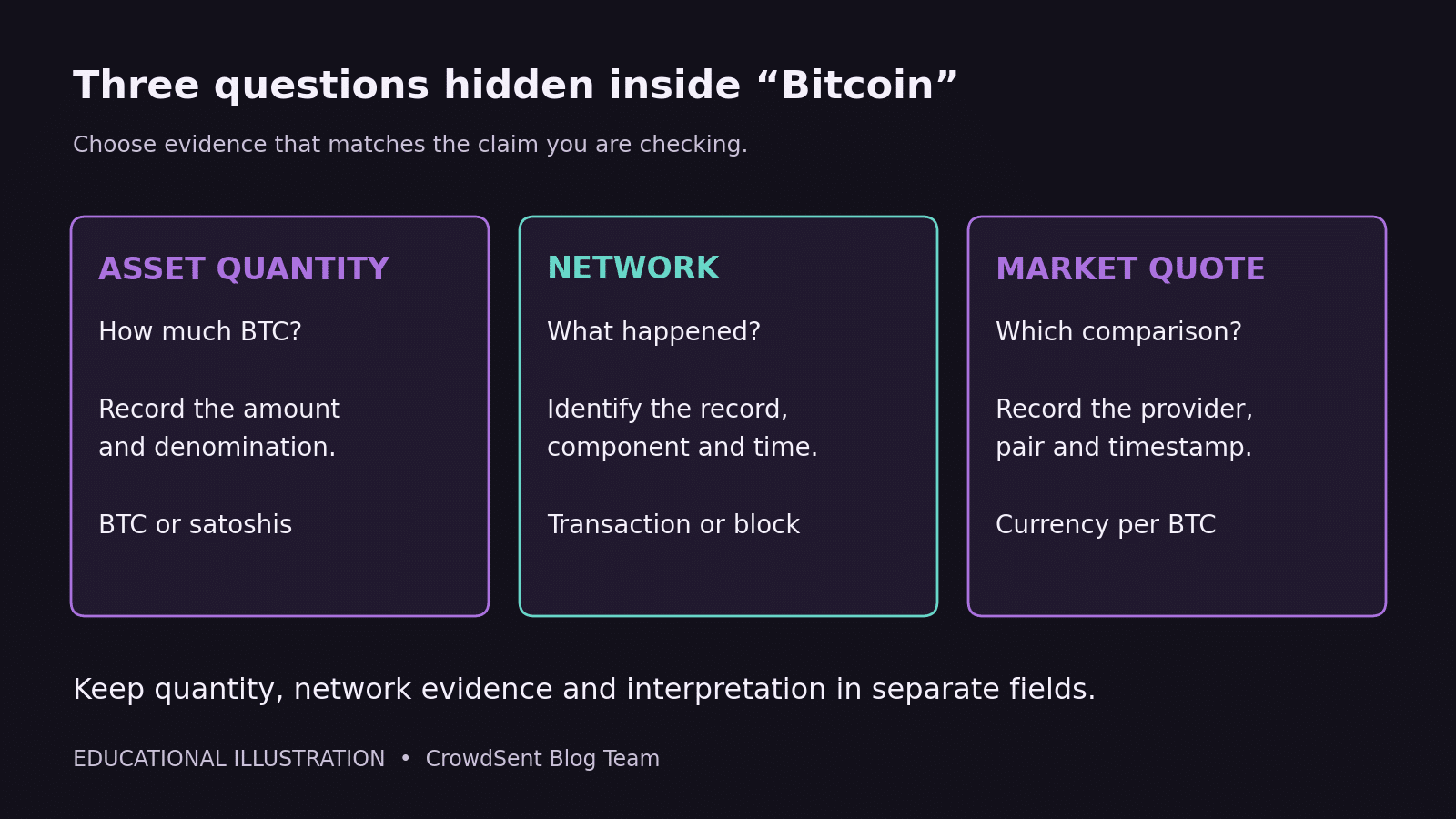
The diagram organizes the questions rather than ranking their importance. For an introduction, learn the asset and network vocabulary. For a price comparison, identify the quote. For a headline investigation, follow the claim back to the type of evidence it actually requires. One accurate definition is more useful than a page of unexplained tickers.
2. Follow how Bitcoin works without confusing the participants
Bitcoin’s shared ledger records confirmed transactions. Wallet software helps authorize spending with cryptographic signatures. Miners assemble transactions into candidate blocks and compete through proof of work; validating nodes check the rules. The Bitcoin project’s mechanism overview provides a concise starting point for these roles.
Use those roles to ask precise questions. If a report describes an exchange interruption, first identify the exchange and its statement. If it describes a wallet display problem, identify the software. If it claims a network-wide change, look for evidence about the network. A report can be serious while still applying to a narrower component than its headline suggests.
Hypothetical headline exercise: a screenshot says “Bitcoin stopped” after one website displayed an error for twelve minutes. The screenshot establishes a website problem at the recorded time. To support the broader wording, the researcher would need independent evidence about block production and transaction processing during that window. The size of the claim determines the verification work.
Follow an ordinary transaction through the network: the wallet signs spending instructions and broadcasts them. Receiving nodes check authorization and whether the inputs are available to spend under their view of the ledger. Passing those checks makes the transaction eligible for further processing; broadcasting alone does not put it into a confirmed block.
Miners assemble candidate blocks and search for a valid proof of work. Other nodes independently check the proposed block and its transactions before accepting it. The work makes replacing accepted history costly; validation rejects spending that breaks the rules. Inclusion supplies the first confirmation, and later blocks add confirmation depth. This process does not promise an exact waiting time or make reversal mathematically impossible.
3. Read transaction evidence before assigning an economic story
Bitcoin transactions consume existing outputs and create new outputs. An unspent transaction output, or UTXO, is available to be spent later when its spending conditions are satisfied. The Bitcoin developer transaction guide explains this structure. The structure matters when a screenshot labels every output as a separate purchase.
Hypothetical transaction example: imagine an input worth 0.010 BTC, an output of 0.004 BTC to a recipient and a change output of 0.0059 BTC. The difference is 0.0001 BTC. The arithmetic balances: 0.004 + 0.0059 + 0.0001 = 0.010. This invented example illustrates inputs, outputs and the fee difference; it does not describe a real address or transaction.
From those amounts alone, you cannot establish whether the recipient sold a product, received a gift or belongs to the sender. Even a correct transaction record has limits as evidence about economic purpose. Separate the visible movement from any identity label or motive attached to it by a commentary source.
If a report says “a large holder sold,” ask which part is observed and which part is inferred. Is there a transaction identifier? Is the destination label documented? Is there evidence of a completed sale, or only a transfer? Keep those questions in the note even when the explanation sounds plausible.
Choose a claim small enough to verify. “The cited transaction contains the stated output” is narrower than “an investor abandoned Bitcoin.” For a practical process, use the guide to verifying market news to preserve the original claim, source and missing evidence. Research quality improves when the wording stops exactly where the evidence stops.
4. Label currencies, amounts and observation times
A useful quote record contains the instrument, venue or provider, currency, unit, observation time and quote type. Specify whether you are using a last trade, an indicative reference or another clearly defined series. The label “Bitcoin price” leaves too much unstated for a comparison that another reader should be able to check.
For English-language notes shared between India and Pakistan, write INR and PKR rather than “Rs” alone. Keep BTC quantities separate from local-currency amounts. If you convert a dollar reference, retain the exchange-rate source, direction and timestamp. A display conversion should be described as a conversion rather than presented as a directly observed local transaction.
Hypothetical value example: assign an invented reference of USD 40,000 per BTC and a quantity of 0.002 BTC. Multiplication gives USD 80. Using an invented rate of INR 80 per USD gives INR 6,400; using an invented rate of PKR 250 per USD gives PKR 20,000. These deliberately fictional rates illustrate units only and exclude charges or other adjustments.
The three monetary figures describe one quantity under three chosen units of account. They do not establish where it could be bought, sold or transferred at those amounts. In a research note, show the multiplication and state the exclusions so that a reader can replace an assumption without rebuilding the entire calculation.
Time labels need the same care. Record observations in UTC if sources use different time zones, then add a local display if useful. Preserve the original timestamp too. A chart labelled “today” can refer to a different window from a post written after midnight locally, so compare actual start and end times rather than the word “daily.”
5. Separate measurements from explanations and opinions
Before interpreting a number, identify what was counted. A count of transactions, a quoted trading volume and a count of posts can all rise for different reasons. The word “activity” does not make them interchangeable. Ask for the unit, collection window, coverage and calculation method before using the number in a conclusion.
Hypothetical discussion sample: a researcher sees 120 posts in one week and 180 in the next. That is a 50% increase in the collected posts. If 70 of the second week’s posts repeat one announcement, the observation still describes the collection, but it needs that concentration note. Calling it a 50% increase in adoption would require a different dataset and definition.
Write the simple observation first, then list plausible explanations and the evidence each would need. A useful three-line entry reads: “Measured change: more collected posts. Possible explanation: repeated coverage of one announcement. Unresolved: whether participation broadened.” This leaves room for correction without forcing a premature answer.
The sentiment-score explanation can help when the measure summarizes language rather than transactions. Use the community-discussion checklist when a few persuasive voices dominate your sample. Neither a score nor a popular explanation substitutes for verifying the original event.
Comparisons also need a stable denominator. If one dataset covers a single venue and another covers many, do not describe their difference as growth without adjusting the scope. If the provider changes its method, mark the break. A clean chart can hide a messy comparison unless the research note explains what stayed consistent.
6. Finish with a short, reproducible Bitcoin research note
Begin with a question that can be answered from observable evidence. “What did this transaction show?” is manageable. “What will Bitcoin do next?” asks for an outcome that these checks cannot establish. A focused question makes it easier to choose sources, stop searching and explain the result to someone else.
Use a compact record: question; dated observation; exact source; unit and coverage; interpretation; alternative explanation; missing evidence. The market research journal template gives you a place to preserve that distinction. Keep the original version when adding a correction, so later readers can see what changed and why.
Hypothetical finished note: “The sampled discussion count rose from 120 to 180 across two equal seven-day windows. The second sample contains 70 posts about one announcement. This supports a rise in sampled attention. It does not establish broader adoption or explain a separate BTC price move. Next check: inspect distinct contributors and verify the announcement.”
For a network observation, replace the discussion details with the relevant transaction or block evidence. For a quote comparison, replace them with the provider, pair and timestamps. The structure stays short because the subject is specific. The aim is a note that can be checked, rather than a universal explanation for Bitcoin.
Finally, keep research separate from handling funds. Bitcoin’s user cautions describe custody responsibilities, public transaction history and the difficulty of recovering from mistakes. You do not need a private key or recovery phrase to read public documentation. Never include either in a research file, screenshot or discussion post.
Frequently asked questions
Is Bitcoin the same thing as BTC?
BTC is the common unit and ticker used for bitcoin. Bitcoin can also refer to the network or protocol. In your notes, use “BTC quantity” for an amount, “BTC quote” for a market observation and “Bitcoin network” for a technical claim. That small wording change helps a reader identify which evidence belongs beside the sentence.
How can a small BTC amount contain many satoshis?
A satoshi is a smaller denomination. The conversion is 100,000,000 satoshis per BTC, so moving between the units changes the written number while preserving the quantity. Keep the unit next to every amount and convert both rows to the same denomination before comparing them. More digits do not indicate a larger economic value.
What does a Bitcoin wallet actually help someone do?
Wallet software helps manage the information used to authorize transactions and display relevant balances. A research article should identify whether it is discussing wallet software, a custodial account or the network. A screenshot of a balance alone does not establish the custody arrangement or prove that an unfamiliar service will honor a withdrawal.
Does every visible Bitcoin transfer represent a sale?
A transfer record alone does not establish a sale. To use that word, identify evidence for the exchange of assets or consideration, rather than relying only on an address label. When the purpose remains unknown, report the observed transaction and preserve the uncertainty. This avoids turning incomplete information into a story about someone’s intentions.
Why do two Bitcoin price screenshots disagree?
First compare the provider, pair, quote type, timestamp and display delay. A screenshot may also use another currency or observation window. Reproduce the comparison with matching fields before explaining the difference. If one field is missing, describe the screenshots as insufficient for a like-for-like comparison rather than declaring either figure incorrect.
Can I translate a dollar BTC reference directly into INR or PKR?
You can calculate a reference conversion when you specify a compatible exchange rate and timestamp. Retain the original dollar amount and show the rate direction. Label the result as calculated, and state what it excludes. The calculation itself does not establish a local executable quote, a service’s availability or the total cost of a transaction.
Does a busier conversation mean Bitcoin use increased?
It establishes more conversation only within the measured sample and method. Check repeated posts, the number of distinct contributors and whether collection coverage changed. A claim about use needs a defined usage measure. Keep discussion, network records and market quotations in separate columns before investigating whether there is a supported relationship between them.
What should I check when someone says a transaction is confirmed?
A transaction receives its first confirmation when it is included in a block on the accepted chain. Each later block adds another confirmation, expressing how deeply that inclusion sits in the chain. Check the reported count and observation time. Greater depth makes reversal harder, but a count does not guarantee an exact waiting time or absolute irreversibility.
Is Bitcoin transaction information private?
Bitcoin’s transaction history is public, and additional information can connect addresses to people or organizations. Treat identifiers carefully when sharing research. Prefer an invented example when real identifiers are unnecessary, and never include secrets such as recovery phrases or private keys. Public visibility also does not mean that every third-party identity label is accurate.
What is a sensible first Bitcoin research exercise?
Choose one claim that can be checked without moving funds: a unit conversion, a quote comparison or a transaction description. Write the source, date and exact question before reviewing commentary. Finish with what you established and one remaining uncertainty. Completing that small exercise is a better foundation than collecting unrelated statistics without a clear purpose.
Source documentation checked 7 October 2026. Educational research guidance from the CrowdSent Blog Team. Hypothetical examples are invented and are not current market observations. This article does not provide investment recommendations.