

Circulating supply, total supply and max supply answer three different questions about a cryptoasset: How much is counted as publicly circulating? How much currently exists? What ceiling does the applicable definition describe? A dashboard can show three accurate figures that differ substantially because their boundaries differ.
Reading the labels is only the beginning. Supply figures also depend on the token’s rules, the reporting provider’s methodology, excluded wallet balances and the observation date. This guide builds a simple supply ledger so those boundaries stay visible.
It covers token accounting and data interpretation. Valuation comparisons are covered separately in CrowdSent’s crypto market cap versus price guide. No supply number alone establishes whether a token is attractive, scarce in an economic sense, or likely to rise in price.
Circulating supply vs total supply: where max supply fits
Circulating supply is an estimate of units a provider considers available in the public market. It is not necessarily every unlocked unit, every unit sitting on an exchange, or every unit that moved recently. The method determines which project-controlled, restricted or otherwise excluded balances are deducted.
Total supply commonly describes units already created, after subtracting recognised permanent burns. It can include units that exist but are locked or retained for future allocation. Unminted units are outside that present total.
Max supply usually describes a ceiling on supply under the relevant protocol or token rules. Some assets have no predetermined fixed ceiling. Also, data providers may apply different adjustments to the field, so a displayed maximum should not automatically be treated as the original coded issuance limit.
CoinGecko’s supply methodology gives definitions and examples of excluded wallets. It treats circulation as a classification of available supply and includes exclusions that can remain relevant even after a technical lock ends.
The first useful habit is to attach a short meaning to every number: “circulating under Provider A’s method, at this timestamp,” rather than “the number of coins.” That small change prevents several common errors later.
Build a hypothetical supply ledger
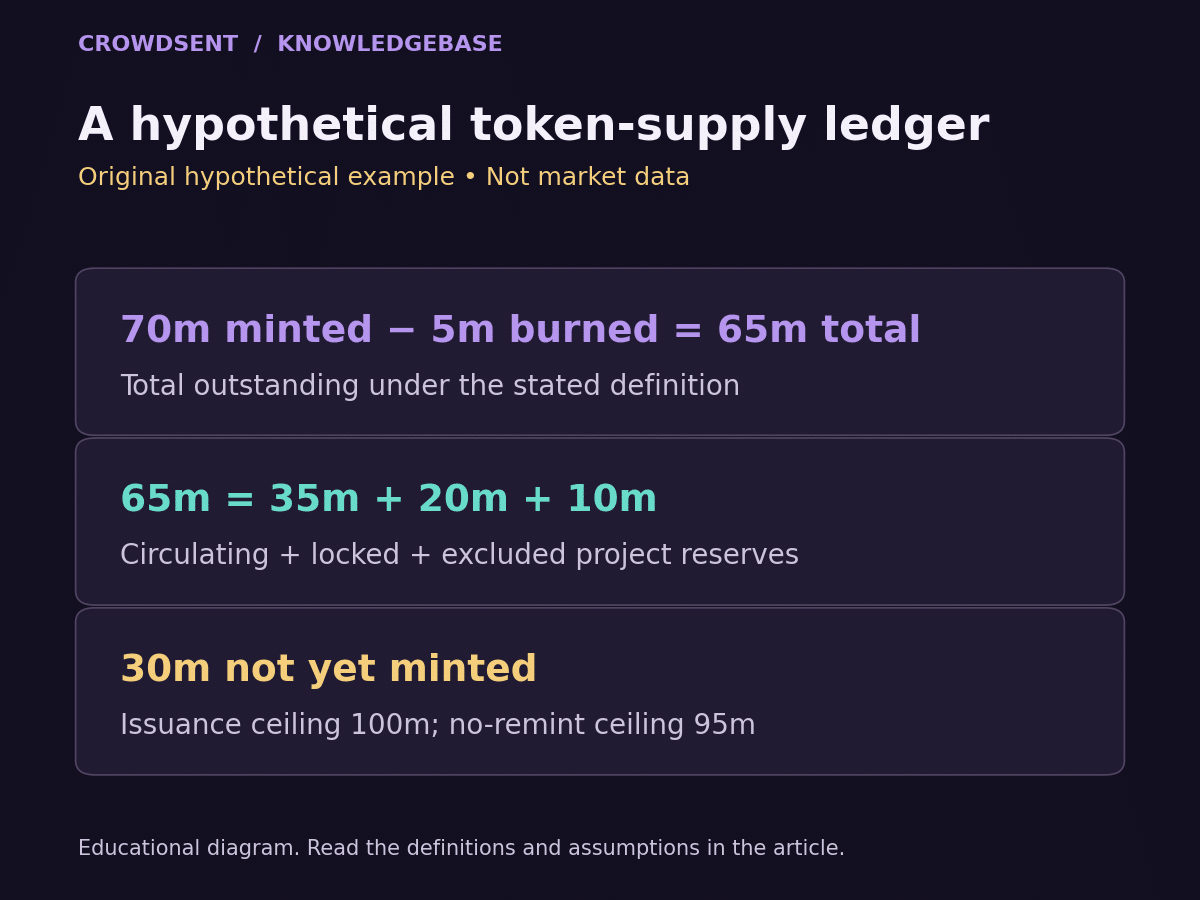
Consider an invented token, Example Unit. Its documented original issuance ceiling is 100 million units. At the observation time, 70 million have been minted. Of those, 5 million have been permanently burned. The current total under our example’s net-of-burn convention is therefore 65 million.
Now identify three non-overlapping buckets inside that 65 million:
- 20 million units in time-locked allocation contracts
- 10 million unlocked units in project reserves that the example provider excludes from circulation
- 35 million units counted as circulating under that provider’s method
The arithmetic is 70 million minted minus 5 million burned equals 65 million total. Then 65 million total minus 20 million locked minus 10 million excluded reserves equals 35 million circulating.
The 30 million units that have never been minted sit outside current total supply. The 5 million burned units also sit outside the current total, but for a different reason. They once existed and were removed; the unminted units have not been created.
For this example, assume the issuance rules do not allow burned units to be reminted. The original issuance ceiling can still be described as 100 million historically, while the maximum potentially outstanding after those burns is 95 million. Those two descriptions are not interchangeable. A data field must identify which one it means.
This ledger deliberately separates accounting events from classifications. Minting creates units. A recognised burn removes units. A lock changes availability. A provider may classify an unlocked project reserve as non-circulating without claiming those units do not exist.
What changes after an unlock?
Continue the same fictional example. Suppose 4 million units leave the locked bucket and become publicly circulating under the provider’s method. No new units are minted and none are burned.
Total supply remains 65 million. The locked bucket falls from 20 million to 16 million. Excluded project reserves remain 10 million. Circulating supply rises from 35 million to 39 million. The complete ledger still adds up.
Now change one assumption: the 4 million units unlock but remain in a project-controlled wallet that the provider excludes. The technical lock has ended, but the provider may leave circulating supply unchanged. A headline stating “four million tokens unlocked” is therefore insufficient to calculate the reported circulation change.
Neither version tells us how much was sold. Unlocking, becoming classified as circulating, moving to another wallet and executing a sale are separate events. Establishing one event does not establish all four.
A careful research note records the scheduled event, the actual on-chain event and the provider’s classification separately. If only a calendar announcement is available, label it as a schedule rather than reporting a completed supply change.
Burns, lost keys and dormant balances have different evidence
A recognised burn requires evidence that the units are permanently removed under the relevant method. Depending on the token, that may involve a contract operation or another verifiable mechanism. A transfer labelled “burn” by a social account is a claim to investigate.
An old wallet balance has a different evidence problem. Years without movement do not prove that nobody can access it. A holder may simply be inactive. Estimated lost-key supply should therefore be identified as an estimate with assumptions, rather than silently deducted from a standard supply field.
The same caution applies to inaccessible balances held at an intermediary. An account-access problem does not automatically mean the underlying tokens have been destroyed. Ownership, transferability and protocol existence are separate questions.
To make a burn note reproducible, record the chain, token contract, transaction or protocol event, quantity, date and treatment in the chosen methodology. Then check whether the headline number is gross issuance or already net of burns. Deducting a burn twice creates a false supply reduction.
Why two providers can report different supply
One source may use an original protocol cap, while another adjusts a maximum-supply field for permanent burns. One may exclude an unlocked insider balance from circulation while another has different wallet evidence or classification rules. Refresh times can also differ.
CoinMarketCap’s supply documentation describes its verification process and distinguishes circulating supply from unlocked supply. Its maximum-supply definition also refers to verifiably burned coins. This is a useful reminder that matching field names do not guarantee identical boundaries across services.
When two figures disagree, do not average them immediately. Compare their timestamps, asset identifiers, units, definitions and excluded balances. Averaging different concepts can produce a number that neither source intended to measure.
A good reconciliation note might say: “Provider A excludes the project reserve; Provider B’s published figure has not yet been reconciled to that wallet list.” If the evidence is insufficient, keep the discrepancy open. Unsupported precision is less useful than a clearly bounded uncertainty.
The goal is not to declare one universal figure correct for every purpose. It is to identify the figure that answers the question being asked and preserve enough provenance for another reader to reproduce it.
Multichain tokens need an extra counting check
A token represented on two chains can create an apparent increase if both balances are added without understanding the transfer mechanism. Native issuance on multiple chains, lock-and-mint bridging and burn-and-mint transfers require different reconciliation logic.
CoinGecko’s supply update FAQ explains its treatment of these cases. In a lock-and-mint arrangement, the locked original and the corresponding representation should not automatically be counted as two independent economic units in an aggregate total.
For an original miniature example, imagine 100 units on Chain A. A bridge locks 15 and creates 15 corresponding representations on Chain B. A raw addition of visible balances may suggest 115. A consolidated ledger should identify the 15 backing units and 15 claims together, rather than treating the operation as unexplained new native issuance.
That illustration assumes a functioning one-for-one arrangement. It does not assess the bridge’s security or establish that every wrapped token is redeemable. Supply consolidation and the reliability of the bridge are separate research tasks.
Record both the network and contract identifier. A shared ticker is not enough to establish that two entries belong in the same supply calculation.
Fixed ceilings and changing issuance are different designs
A fixed issuance schedule and a supply process with ongoing issuance and burning answer different accounting questions. Neither design makes the circulating supply equal to the maximum by definition.
For Ethereum, the official explanation of ETH issuance and burning describes the forces that add and remove ETH. The direction of net supply change depends on those flows; a burn mechanism alone does not establish a permanently falling supply. CrowdSent’s Ethereum introduction gives broader network context.
Bitcoin’s issuance schedule provides a different setting for thinking about units that already exist and units yet to be issued. Its periodic subsidy changes concern new issuance over time. The Bitcoin halving guide covers that schedule without treating a supply event as a price forecast.
For either design, record the current rules and avoid treating a future projection as an observed balance. A schedule, model and present ledger have different evidentiary status.
A six-line supply note that stays useful
A reusable note can contain six short lines: exact asset identity; observation date; provider and methodology; minted and burned quantities; excluded balance categories; and unresolved differences. Keep the raw numbers with their units, especially when one interface uses millions and another displays complete token counts.
For the fictional Example Unit, the note would preserve the 100 million original ceiling, 70 million minted, 5 million burned, 65 million total and the three availability buckets. It would also preserve the no-remint assumption rather than hiding it inside a calculated maximum.
When a field is blank, leave it blank until its meaning is established. No reported maximum may mean an uncapped design, unavailable data or a provider limitation. The missing data versus zero guide explains why replacing an absent value with zero can break an otherwise careful comparison.
Frequently asked questions
1. Can circulating supply exceed total supply?
Under consistent definitions, scope and timing, circulating units are part of total existing supply. An apparent excess is a reason to check timestamps, units, chain coverage or definitions. It should not be accepted as a meaningful ratio until the mismatch is resolved.
2. Does total supply include locked tokens?
Common net-of-burn definitions include existing locked units. Locking changes whether units can move or how they are classified; it does not by itself uncreate them. Check whether the displayed total follows that convention.
3. Are all unlocked tokens circulating?
No universal rule says so. Providers may exclude unlocked team, treasury or strategic holdings. “Unlocked” describes a transfer restriction, while “circulating” describes a methodology’s classification of public supply.
4. Does an unlock increase total supply?
In the example where already minted tokens simply leave a lock, total supply is unchanged. Circulation may increase depending on classification. If a project uses “unlock” loosely to describe new minting, the actual mechanism must be inspected.
5. Does burning always change max supply?
It depends on the token’s issuance rules and the field’s definition. An original issuance cap may remain historically unchanged, while a provider reports an adjusted maximum outstanding figure. Record which quantity is being discussed.
6. Does a blank maximum mean zero tokens can exist?
No. An empty value may indicate no fixed ceiling, missing information or an unsupported field. Zero is a numerical claim with a different meaning. The documentation must resolve the ambiguity.
7. Should dormant wallets be removed from supply?
Inactivity alone is insufficient proof of permanent loss. A research estimate of inaccessible units can be useful if its assumptions are stated, but it should remain separate from a reported standard supply measure unless that method explicitly incorporates it.
8. Are staked units always excluded from circulation?
Treatment depends on the provider, ownership, withdrawal restrictions and the asset’s design. Do not apply one staking rule across every network. Check the methodology rather than assuming the staking label resolves availability.
9. Can a supply increase prove that holders sold?
No. Issuance or reclassification can increase the reported number without proving a sale. Sales require transaction or market evidence. Supply data describes units and boundaries, not every holder’s decision.
10. What is the most important supply comparison habit?
Keep the definition attached to the number. Two figures are comparable only when the asset, unit, timestamp and accounting boundaries align. A short provenance note often prevents more mistakes than extra decimal places.
Clear supply research starts with a ledger and visible assumptions.