

CrowdSent Blog Team · Bitcoin supply research
A Bitcoin halving reduces the block subsidy: the scheduled new BTC allowed in each block. The rule is tied to block height, and its immediate effect concerns issuance. Existing balances do not automatically shrink when the boundary is reached. A useful explanation keeps that mechanism separate from transaction fees, miners’ business results and claims about future market prices.
This guide gives you eight checks for understanding the event and evaluating commentary about it. You will read a height-based schedule, compare a hypothetical pair of block rewards and build an evidence record that remains useful after a countdown expires. It includes no predicted Bitcoin price or guessed date for the next halving.
1. Identify what a Bitcoin halving changes
Bitcoin Core’s versioned subsidy calculation starts from 50 BTC and reduces that amount according to the number of completed halving intervals. The calculation determines the subsidy permitted by the rule. Reading a fixed software version makes the reference reproducible; it is not a claim that this is the newest software release.
Keep the term “subsidy” in your note whenever that is the quantity you mean. “Reward”, “revenue” and “supply” can become ambiguous when used interchangeably. A headline about a reward being cut needs a follow-up question: does it mean the scheduled subsidy, the total associated with one block, or money received by a particular mining business?
A helpful research sentence names the quantity and its unit: “The permitted subsidy changes from X BTC per block to Y BTC per block at height H.” That sentence can be checked directly. “Bitcoin becomes twice as valuable” substitutes a market conclusion for a supply observation and requires entirely different evidence.
2. Read the block-height schedule before any calendar date
The main-network settings in Bitcoin Core’s versioned chain parameters set the halving interval at 210,000 blocks and the target block spacing at ten minutes. Block height supplies the schedule’s counting unit. Calendar time is an estimate built around how blocks arrive, rather than the trigger for the subsidy calculation.
Applying the documented rule gives the familiar sequence: 50 BTC before the first boundary, 25 BTC from height 210,000, 12.5 BTC from 420,000, 6.25 BTC from 630,000 and 3.125 BTC from 840,000. These are rule-derived subsidy levels, not a list of observed transaction fees or market prices.
Write out one boundary calculation to see how the classification works. Height 839,999 lies below 840,000. Height 840,000 reaches four completed intervals of 210,000 blocks. Repeatedly halving 50 four times gives 3.125. The boundary block itself uses the reduced amount, so shifting the change to the following block would misclassify that observation.
When comparing screenshots, confirm that they refer to Bitcoin’s main network and the same type of record. A testing environment, a forecast and a historical main-network block are different evidence categories. Save the height and source description before copying a prominent number into your research note. A recognizable Bitcoin logo does not resolve the context.
3. Separate the subsidy from transaction fees
The Bitcoin developer guide’s block explanation distinguishes the subsidy from transaction fees in the block reward. It also explains that block height alone is not a globally unique block identifier; the block hash identifies the particular block. These details matter when you inspect an individual event record rather than a general schedule.
Create separate fields for permitted subsidy, fees and total reward. If the page reports only one combined amount, check its definition before treating the number as new issuance. Fees associated with included transactions should not be counted again as newly created BTC. A large fee total can make a combined block figure look unusual without changing the scheduled subsidy.
The incentive discussion in the original Bitcoin white paper describes new coins and transaction fees as sources of the block incentive, with resource expenditure involved in mining. It is useful background for separating components. It does not provide a contemporary miner’s electricity bill, equipment cost or financial outcome.
For a mining-company story, ask what the reported measure includes. BTC associated with blocks, accounting revenue, cash received and earnings after expenses answer different questions. Even if a source carefully measures one of them, that result should not be relabelled as another. Keep the reporting period and the company’s own definition beside the figure.
4. Distinguish new issuance from the existing stock
A flow measures what is added over an interval. A stock measures what exists at a point in time. This distinction makes a halving easier to discuss accurately. Reducing an addition changes the path of accumulation; it does not imply that the amount previously accumulated has been removed.
The familiar 21 million BTC limit can be understood through an idealised calculation: sum 210,000-block intervals with subsidies of 50, 25, 12.5 BTC and continuing halvings. The series approaches 21 million. This is a mathematical upper-bound explanation; it is not an observation of current circulating supply or a claim that every permitted unit has been issued.
Hypothetical classroom model: a container starts with 100 counters. An imaginary process adds eight counters on each of three steps, reaching 124. It then adds four counters on each of three more steps, reaching 136. The addition per step has halved, while the total continues increasing. The counters are a teaching analogy, not a calculation of Bitcoin’s actual supply.
In a real research note, define what a supply series counts. A protocol-based cumulative figure, an estimate of accessible coins and a quantity offered on a particular venue need not describe the same thing. Do not replace one series with another simply because a chart labels both “supply”. Record the publisher’s method and any exclusions you can verify.
The same care applies to percentages. “New issuance fell by half” names a change in a flow. “The stock fell by half” names a different calculation with a different denominator. Before repeating a percentage, write out the numerator, denominator and measurement window. That often reveals the ambiguity before a dramatic interpretation takes hold.
5. Calculate a hypothetical block reward comparison
This is an invented teaching comparison, not a record of actual blocks. It uses the protocol subsidy amounts on either side of the 840,000 boundary and hypothetical fee totals. Assume the permitted subsidy is fully claimed in both illustrative blocks. Label the records “Before” and “After” rather than assigning them invented hashes or observation times.
- Before: subsidy of 6.25 BTC plus invented transaction fees of 0.25 BTC gives a total of 6.50 BTC.
- After: subsidy of 3.125 BTC plus invented transaction fees of 0.75 BTC gives a total of 3.875 BTC.
- Subsidy comparison: the reduction is 3.125 BTC, which is 50% of 6.25 BTC.
- Combined comparison: the reduction is 2.625 BTC, approximately 40.4% of 6.50 BTC.
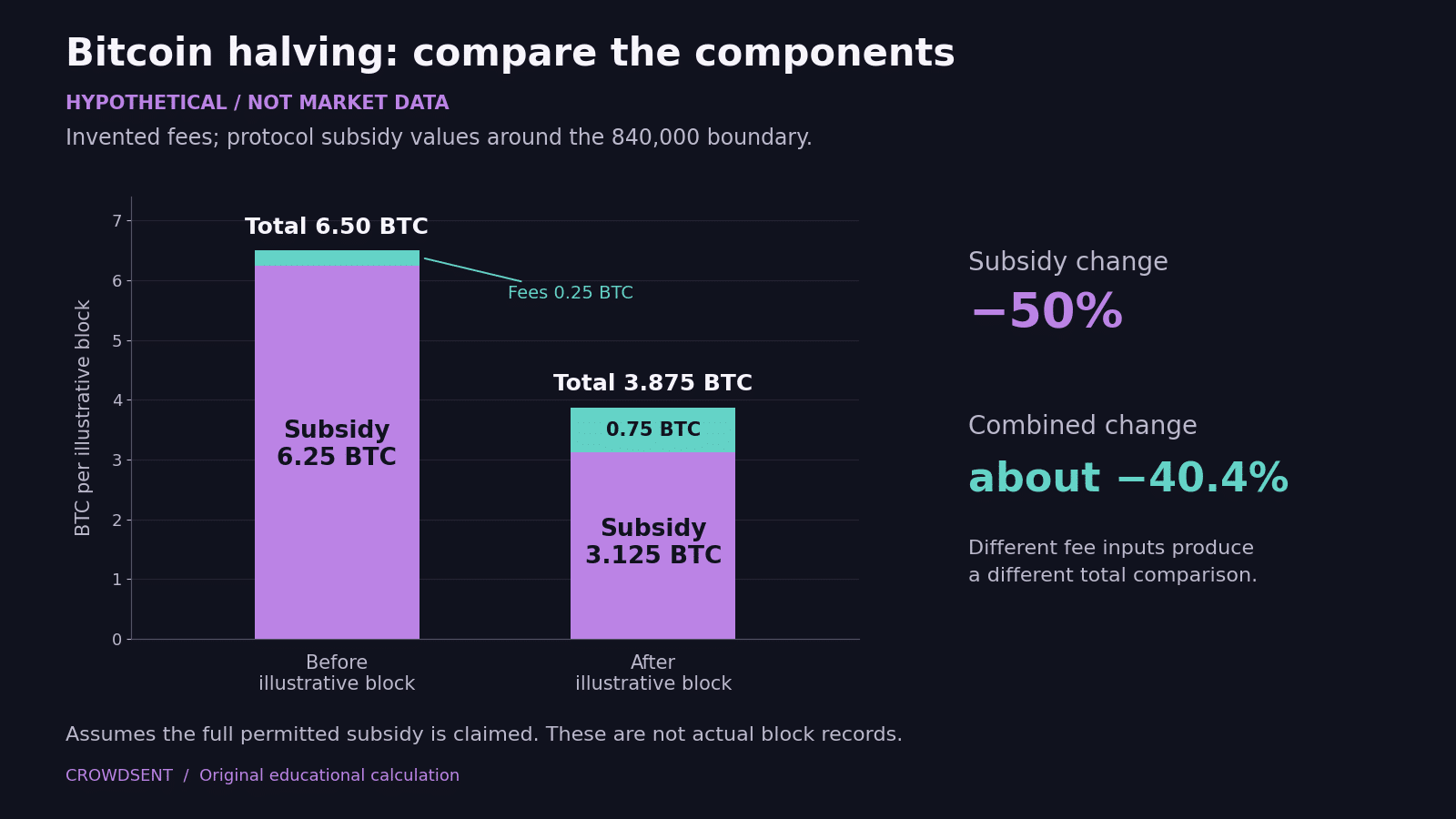
The arithmetic supports two different percentage changes because the measurements contain different components. The fee input rises in this invented example; no claim is made that it did so at an actual event or would do so at a later one. Holding the fees constant instead would produce another combined result. The protocol rule alone does not select the fee input.
Extend the example only when the units stay clear
Now imagine a hypothetical study window containing ten blocks at the earlier subsidy and ten at the reduced subsidy. If the full permitted subsidy is claimed in each, the newly issued amount in the window is ten multiplied by 6.25, plus ten multiplied by 3.125: 93.75 BTC. Fees are excluded because the question concerns issuance.
Using twenty blocks multiplied by 3.125 would give 62.5 BTC and wrongly apply the later rate to the whole window. Using twenty multiplied by 6.25 would give 125 BTC and wrongly retain the earlier rate. A daily or hourly interval that crosses a boundary must be split according to the blocks it actually contains.
6. Treat countdowns as estimates with visible assumptions
A countdown translates remaining blocks into estimated elapsed time. Inspect the current height used, its observation time and the assumed average interval. Two countdowns can differ because they use different update times or estimation windows. A precise-looking timer does not remove uncertainty from those inputs.
Hypothetical timing exercise: suppose a teaching model has 120 blocks remaining. At an assumed average of ten minutes per block, the estimate is 1,200 minutes, or twenty hours. At twelve minutes, it is twenty-four hours. Neither arithmetic result is a promised arrival time. This example makes no claim about the number of blocks remaining today.
For an event record, retain UTC and add a local display time only when useful. Under the stated offsets, 18:00 UTC corresponds to 23:30 in Asia/Kolkata and 23:00 in Asia/Karachi on the same date. If an event falls near midnight, include the resulting local date rather than copying the UTC date automatically.
Keep a block’s recorded timestamp separate from when a website first displayed it and when you checked that website. Each can serve a purpose, but they are not interchangeable evidence. When you encounter a predicted date in an older article, preserve its publication date and describe it as an estimate made then. Do not silently promote it into a verified event time.
7. Test claims about prices, miners and online attention
A protocol mechanism can be established while a broader explanation remains unresolved. A price claim needs a named market series, quote currency, observation window and a method for evaluating competing explanations. A mining claim needs an appropriate operating or financial measure. A discussion claim needs a defined sample of messages.
Suppose a fictional post says, “The halving caused everything that happened this week.” Break that into smaller propositions. Which outcome is being described? Did the author specify the observation period before seeing the result? What other events occurred during the same window? What evidence would weaken the explanation? These questions turn an impressive sentence into a checkable research task.
Use the market news verification guide to follow a claim back to the original record. If several articles repeat one source, note that shared origin. Repetition does not expand the sample of independent evidence. Preserve qualifications that disappear when a headline is shortened for a social post.
Historical comparisons need the same discipline. Choose consistent windows and document differences in the available records. The historical sentiment guide helps when comparing discussion across periods. A conversation becoming more enthusiastic is an observation about the sampled conversation. It should not be substituted for issuance data or a demonstrated explanation of price.
8. Build a Bitcoin halving research record you can revisit
Use one compact record for protocol facts and a separate part for observations. The market research journal template provides a useful structure for keeping evidence and interpretation apart. Begin with a narrow question, such as whether a displayed block total includes fees or whether a supply interval spans the boundary.
- Rule reference: the named network, source version and relevant subsidy interval.
- Event identity: block height, block hash and the source used to inspect them.
- Measurements: subsidy, fees and combined amount in BTC, with definitions.
- Time record: observation, publication and retrieval times with timezones.
- Research conclusion: verified result, unresolved question and evidence needed next.
Save your original inputs before correcting a mistake. If a later source clarifies that a chart measured fees rather than issuance, add a dated correction and recalculate the affected result. That preserves why the conclusion changed. An accurate revision is more useful than a research file that hides its earlier assumptions.
Finally, inspect how a community claim handles uncertainty using the discussion-evaluation guide. Prefer a claim with defined quantities and traceable records over one that relies on urgency. Finish the note when you can state what is known and what remains untested, rather than extending it until it produces a confident market story.
Frequently asked questions about Bitcoin halving
What is a Bitcoin halving in simple terms?
It is the scheduled reduction in the subsidy allowed for a new block. For research, keep the unit “BTC per block” beside the figure and distinguish it from fees or market prices. That definition gives you a concrete mechanism to verify before considering any larger claims made around the event.
Does a halving reduce the Bitcoin already in my wallet?
The subsidy change does not instruct existing balances to halve. If an article suggests otherwise, ask what balance-changing action it claims will occur and where that claim is documented. Avoid allowing the word “halving” to replace an explanation of what quantity is actually being divided.
Why is the event associated with roughly four years?
The block-count interval and target spacing create that rough calendar description. The rule itself uses height, so a calendar estimate depends on assumptions about block arrival. When precision matters, retain the height and the estimation method instead of treating a rounded year count as an appointment in a calendar.
What happens at the boundary block itself?
Use the subsidy appropriate to the new interval for the boundary block. In the illustrated 840,000 boundary, assigning the earlier amount to that block would shift the classification incorrectly. When auditing a calculation, inspect the observations immediately before and at the boundary rather than relying only on a daily chart label.
Is the total block reward guaranteed to fall by exactly half?
A combined reward includes more than the subsidy. Identify the fee component before calculating its change. In this article’s hypothetical example, different fee totals make the combined reduction about 40.4%, while the subsidy reduction is 50%. The example shows why a definition matters, without claiming a typical real-world result.
Can I estimate daily issuance by multiplying one subsidy by 144?
That gives a model using an assumed 144 blocks in a day. Label it an estimate rather than an observed total. For an actual interval, count the applicable blocks and use their relevant subsidy levels. If the interval crosses a boundary, divide the calculation into the appropriate parts.
Do transaction fees create additional new Bitcoin?
Keep fees out of a calculation intended to measure new issuance. A combined block total answers a different question from a subsidy total. Before using an explorer’s prominent reward figure, read its field definition and separate the components, as in the worked example, so the same BTC is not misclassified as newly created.
Does the supply change guarantee a particular price response?
A supply-mechanism statement does not establish a future quotation. Price research needs its own observations, currency, interval and method. You can verify the rule without endorsing a forecast. If a source presents certainty, ask which evidence supports that additional claim and what conditions could make its interpretation fail.
How can I check an old halving article?
Separate claims that describe the protocol from claims tied to the article’s publication date. Verify the named boundary and any event records independently, and preserve the dates attached to countdown estimates. A sound explanation of the mechanism can coexist with an outdated forecast, stale screenshot or poorly defined market comparison.
What should a useful halving research note leave unresolved?
It should explicitly retain questions the evidence cannot settle, such as the reason for a particular price move or a miner’s undisclosed costs. Name the missing record and why it matters. This gives you a clear reason to revisit the note if new evidence appears, without filling today’s gaps with confident speculation.
Source documentation checked 7 October 2026. Educational research guidance from the CrowdSent Blog Team. Hypothetical examples are invented and are not current market observations. This article does not provide investment recommendations.