

By CrowdSent Blog Team
A blockchain node is a running participant in a blockchain network; a validator is a more specific consensus role. The labels overlap in some conversations, but they do not answer the same question. Running software that checks network data does not automatically mean proposing blocks, signing votes or earning staking rewards.
Ethereum provides a useful concrete example. Its terminology is not a universal diagram for every blockchain. This guide separates software, running infrastructure, consensus duties and data access, then uses a fictional historical query to show why those distinctions matter.
Start with the difference between software and a running blockchain node
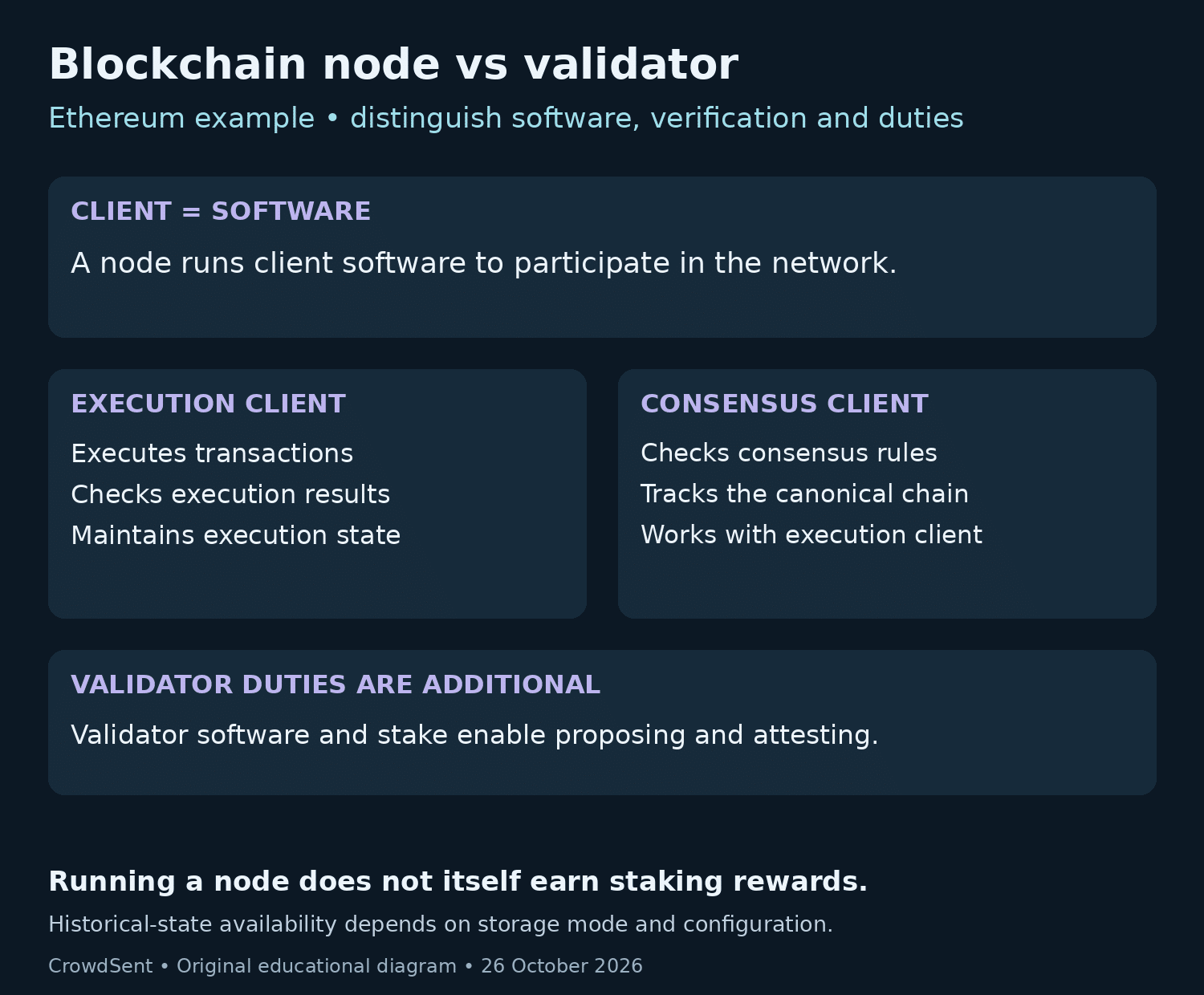
A client is a software implementation. A blockchain node is a running instance participating in the network. Downloading a client package does not, on its own, establish that a computer is synchronised, connected to suitable peers or serving usable data.
Ethereum’s nodes and clients documentation describes a full node’s execution and consensus clients. Together they let an operator independently follow and check the chain. Validator software adds a distinct role. This division helps explain why a person can operate a non-staking node.
The Ethereum introduction covers the network and ETH more generally. Here the immediate question is narrower: what exactly does a particular machine, software process or service do?
A role matrix prevents ambiguous claims
| Label | Question it answers | What it does not establish |
|---|---|---|
| Client implementation | Which software is being used? | Whether a running instance is healthy |
| Execution component | How are transactions and state processed? | That a validator is signing duties |
| Consensus component | How is the accepted chain followed? | That its operator has staked |
| Validator | Which participant performs assigned consensus duties? | Unlimited historical data access |
| remote procedure call (RPC) endpoint | Where does an application send a data request? | One exclusive underlying machine |
The Ethereum node architecture documentation assigns transaction execution to the execution client and chain-following logic to the consensus client. Validator software performs duties such as attestations and block proposals. Rewards, penalties and slashing concern that validator participation, not simply the existence of an online machine.
For research, rewrite “the node validated it” into a more precise statement. Did software check transaction validity? Did a validator attest? Did a service return a database result? Those are different observations, even when an interface groups them under one product label.
Storage choices are separate from consensus roles
Full-node operation should not be interpreted as a promise that every possible historical query will be served. A blockchain node’s validation function and its retained data are related but distinct. Client configuration, pruning, synchronisation method and available storage affect what can be retrieved.
An archive setup supports historical state access beyond the recent state normally retained for ongoing operation. Ethereum’s archive-node documentation explains this distinction. Historical state means a past snapshot of values such as account balances or contract storage, rather than merely evidence that an old transaction appeared in a block.
The word archive still needs a scope. Which network? Which client? How far back? Which query methods? An endpoint advertised for historical use may have limits, and a dataset beginning at a particular block cannot support an earlier snapshot merely because its service name contains “archive.”
Work through an old-transaction versus old-state question
Imagine a fictional Ethereum-style network with a current height of 25,000,000. A researcher asks about an address at block 12,000,000. Endpoint A can return a transaction record from that block but reports that the historical state required for a balance query is unavailable. Endpoint B can serve that state and returns 4.2 native units.
There is no necessary contradiction. “Show this recorded transaction” and “give the account balance after this particular block” request different evidence. The first result does not guarantee that the endpoint retains everything required to answer the second.
Write the result as a small evidence ledger: network identifier, block number and hash, requested field, endpoint, retrieval time and response. Record A’s answer as unavailable, not zero. Record B’s 4.2 as a returned value at the specified block, not the address’s current balance.
Now suppose a third endpoint returns 4.7. Before concluding that the chain is inconsistent, check whether it used the same network and block, whether it interpreted the request as latest state, and whether its units match. A disagreement becomes useful only after the requests have been made comparable.
This illustration uses invented heights and balances. It makes no claim about any provider’s retention policy, service quality or actual address. The blockchain explorer guide explains how interfaces add another presentation layer above underlying records.
Light clients require a specific implementation claim
A light-client design seeks to verify selected information using less local data and computation than a full node. That category must not be turned into a claim that every network or wallet already offers the same mature light-client path.
Ethereum’s light-client documentation discusses the approach and its trade-offs. Check the actual software, network support and verification model. A wallet connected to a remote RPC service is not automatically a light client simply because the wallet itself is small.
For a comparison, describe what is verified locally, what data comes from another party, and what happens if that party supplies no answer. “Lightweight” as a marketing adjective does not resolve any of those technical questions.
Describe the dependency before judging the result
An application may call an RPC endpoint that routes requests to several machines. Counting public endpoints therefore does not count independent operators, and counting validator identities does not count physical computers. Ownership, software and hosting dependencies need their own evidence.
Similarly, one endpoint’s failed request is not proof that the blockchain stopped. It may reflect a missing method, unavailable historical data, a service limit or a local connection problem. Establish the scope of the failure before writing a network-wide conclusion.
Keep consensus comparisons with the proof-of-work versus proof-of-stake guide. Keep pending-transaction behaviour with the Bitcoin mempool guide. A blockchain node description is most useful when it identifies the exact role and evidence boundary rather than trying to explain every blockchain mechanism at once.
Frequently asked questions
Does every blockchain node earn rewards?
No. A non-staking node can check and follow Ethereum without performing validator duties. Payment for a commercial data service would be a separate business arrangement, not proof of protocol staking rewards.
Does client mean a customer?
Not in this context. It means software implementing the relevant protocol. A hosting company’s customer and a node’s software client are different uses of the same word.
Can a validator also provide historical data?
It can use infrastructure with that capability, but validator status alone does not establish it. Ask about retained state, supported methods and the requested historical range separately.
Is a full node necessarily an archive node?
No. Independent verification does not imply that every past state is retained for immediate querying. The historical-data requirement needs a more specific storage and retrieval description.
Does a missing historical balance mean the balance was zero?
No. Unavailable is a statement about evidence access. Zero is a numerical result. In the fictional example, Endpoint A provides no balance value and should not be entered as zero in a comparison.
Why record a block hash as well as its number?
A height identifies a position, while a hash identifies a particular block. Keeping both makes the observation more precise when checking which historical record a service used.
Is an RPC endpoint one blockchain node?
Not necessarily. It is an address for requests. The service behind it may use several nodes, databases or routing layers, so the endpoint count cannot establish the machine count.
Is a browser wallet automatically a light client?
No. A wallet may rely on a remote service without performing the verification expected of a particular light-client design. Check its documented implementation rather than inferring architecture from its appearance.
Does an offline endpoint prove a network outage?
No. First distinguish an endpoint failure from a network-wide inability to progress. Independent observations and clearly defined timestamps are needed before making the broader claim.
What belongs in a reproducible node-data note?
Keep the network, software or service, method, parameters, block reference, timestamp, units and exact result or error. This makes later disagreement diagnosable without guessing what the original request meant.
Explore CrowdSent and its current membership options for more information about the service.
Educational information only, not investment, accounting or tax advice. Sources checked 26 October 2026.