

CrowdSent Blog Team · Blockchain literacy
A blockchain explorer is an interface for searching and reading blockchain records, including blocks, transactions, addresses and, on supported networks, contract activity. It makes technical data easier to inspect, but the explanation attached to a record can contain both on-chain facts and the explorer’s own labels.
A successful transaction with a displayed value of zero can still move tokens. A large transfer can have an unknown economic purpose. A verified contract label can refer to source-code matching without certifying the application’s safety. Those are reasons to inspect the fields behind a summary.
This guide uses an invented Ethereum-style token transfer and a few Bitcoin comparisons. No real transaction hash, address, wallet connection or signature is needed. The aim is a reproducible reading of evidence, rather than an instruction to move funds.
Choose the right blockchain explorer and network
Start with the network named in the original claim. Bitcoin mainnet, Ethereum mainnet, test networks and individual layer-2 networks have distinct records. An address-like string or familiar asset symbol does not identify the correct chain by itself.
The Ethereum block-explorer guide outlines the categories of data an explorer can present. Treat the interface as an indexed view of records with its own update times and display conventions. A missing search result may reflect the wrong network or incomplete indexing rather than proof that no transaction exists anywhere.
Identify what you are searching for: a transaction hash, a block hash, a block height, an address or a token contract. They answer different questions. An address page is a collection of associated activity; it is not itself the receipt for one specific transfer.
For a practical reading exercise, write “Network: Example Ethereum mainnet record; object: Transaction T” at the top of a note. T is a teaching label here. In a real investigation, preserve the exact public identifier privately as needed and avoid publishing unrelated personal associations.
If the original claim merely says “on Ethereum,” use the Ethereum network guide to distinguish the asset, application and network before deciding which record to inspect.
Check identity, inclusion and execution separately
A transaction page should let you identify the transaction and its containing block when included. Record the block hash, height and observation time. Recent inclusion and the network’s settlement or finality status are separate questions, even if the explorer places both near a green icon.
For Ethereum, receipt status describes the execution outcome. The Ethereum JSON-RPC reference specifies success and failure status values and receipt fields such as logs, gas used and effective gas price. A pending transaction does not yet have the same completed receipt evidence.
Success means the top-level transaction execution did not fail under that status test. It does not certify that every human intention was fulfilled or that an application is trustworthy. Some contract functions can signal their own outcomes, so the relevant state changes and events still need inspection.
An included failed transaction can still consume chargeable gas. Its failed execution and the existence of a fee are therefore compatible. Avoid describing every wallet error as an on-chain failure, however: a submission rejected before inclusion is a different case.
Record the field’s exact meaning in plain language. “Included, execution status successful, token movement verified below” is more informative than copying only the explorer’s colour or badge.
Read a zero-ETH token-transfer example
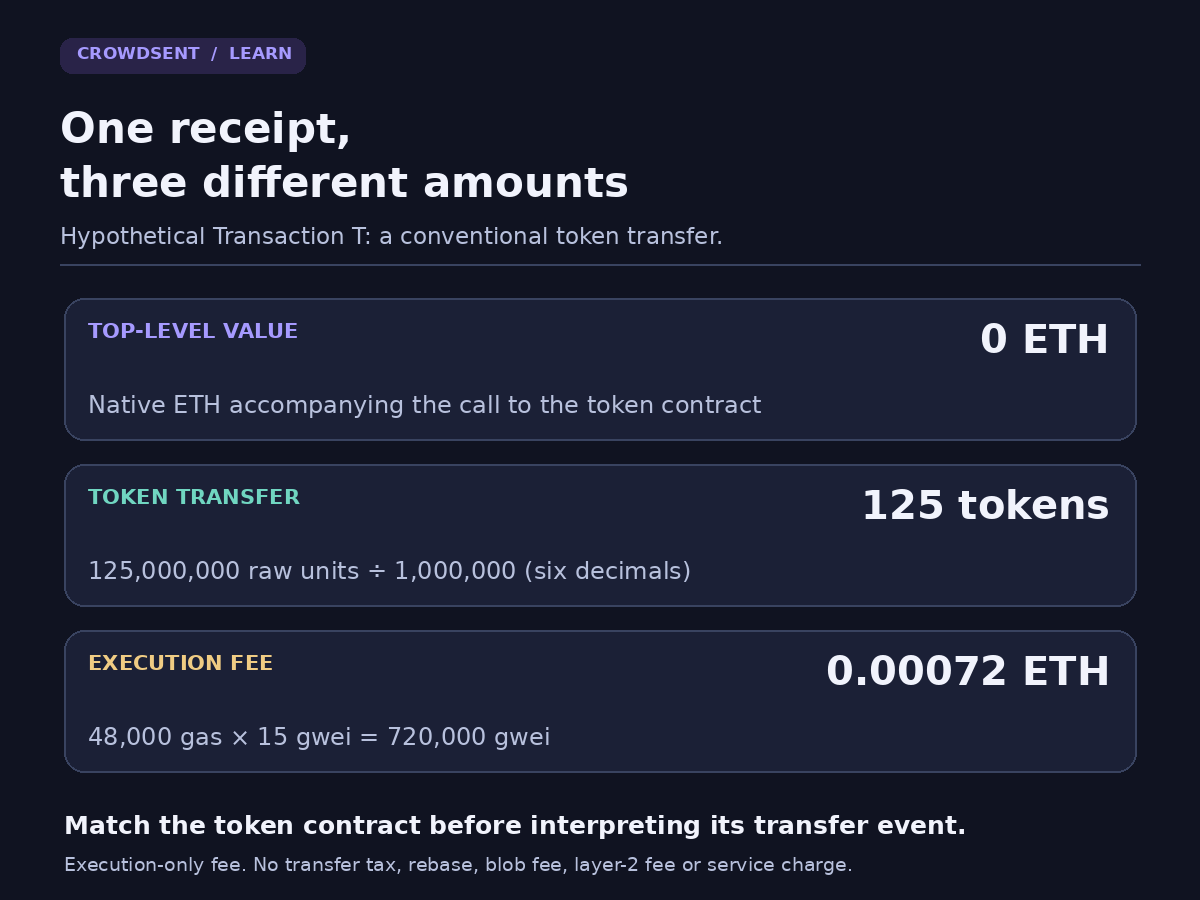
Imagine Transaction T is an ordinary execution-only transaction interacting with the contract for a fictional asset called Example Token. Its top-level value field is 0 ETH. A relevant transfer event from the verified Example Token contract records 125 tokens moving from Address A to Address B.
The token uses six decimal places, and the event’s raw integer amount is 125,000,000. Dividing by 1,000,000 converts the raw amount to 125 displayed token units. This example assumes conventional transfer behaviour, with no transfer tax, rebase or other balance adjustment.
The top-level destination is the token contract that received the call. Address B is the recipient named in the token-transfer record. Confusing those two destinations would make a valid contract interaction look as though the tokens had been sent to the wrong recipient.
The ETH value field answers how much native ETH accompanies the top-level call. The token event answers a different asset question. In this example, 0 ETH of top-level value and 125 tokens transferred are simultaneously correct. ETH used for the network fee remains a separate amount.
The ERC-20 token standard defines token interfaces, decimal-display conventions and transfer events. It does not make a token’s name or symbol unique. Match the emitting contract to the intended token before interpreting its event.
Reconcile the fee with the record
Continue Transaction T’s invented receipt. It shows 48,000 gas used and an effective gas price of 15 gwei per gas. Their product is 720,000 gwei, equal to 0.00072 ETH. The arithmetic concerns the execution fee, not the 125-token transfer quantity.
There is no contradiction between top-level value 0 ETH and an ETH fee of 0.00072. A compact worksheet should put native value, token quantity and execution fee on separate lines. Combining the numbers into “total sent” without stating units would produce an uninterpretable result.
This example deliberately excludes blob-data fees, layer-2-specific components and service charges. A live record with any of those needs the appropriate additional fields. The Ethereum gas-fee guide explains the execution calculation and the difference between a cap, an estimate and a completed charge.
The Ethereum transaction documentation provides the transaction-field context. An estimate shown before submission is not a replacement for the completed receipt. Keep both when the research question is why the interface’s earlier estimate differed.
You do not need a market price to establish this example’s fee in ETH. A dollar, INR or PKR display would add a valuation source and timestamp. Leaving that conversion out keeps this evidence exercise focused on the recorded network amounts.
Distinguish logs, internal calls and balance changes
An explorer may show several layers of a contract interaction: the top-level transaction, emitted event logs, token-transfer summaries and internal execution traces. These views are related, but they should not be counted as independent transactions without understanding the interface’s definitions.
A token-transfer summary is commonly decoded from logs. An internal-call view describes actions within execution. One user-signed transaction can cause multiple such actions. A count of five displayed rows therefore does not necessarily mean five separately signed submissions.
Event interpretation requires the correct contract identity and code behaviour. A misleading contract can use familiar names or emit familiar-looking events. Seeing an event called Transfer is insufficient to establish that the intended genuine token moved. Check which contract emitted it and whether the resulting state supports the claim.
An approval is another common source of confusion. A token allowance authorises a spender under the token’s rules; it is not itself the same event as transferring the allowed amount. Read the operation and relevant state instead of assuming every prominent number is a completed movement.
For Transaction T, the bounded finding combines the correct contract, transfer record and supported balances under the example’s stated assumptions. The exercise does not require clicking a contract’s write controls or asking a wallet to sign anything.
Treat names and economic stories as extra claims
Address labels can be useful pointers, but their provenance matters. A service name may be supplied by an explorer, a project or an external attribution dataset. Preserve who supplied it and how it was verified. The label is not automatically a statement recorded by the blockchain itself.
Even an accurately attributed transfer does not, on its own, establish a purchase, sale, donation or change of beneficial ownership. Internal reorganisations, operational movements and other explanations may fit the same visible transfer. The economic purpose needs additional evidence.
On Bitcoin, inputs and outputs introduce a further distinction. An output can return change to the spender, so treating every output as a new payment to an unrelated person can overcount the economic activity. State which output supports the claim and what remains unknown about control.
Source-code verification also has a limited meaning. Where an explorer has matched supplied source code to deployed code under a stated process, that improves inspectability. It does not establish that the logic is harmless, that upgrades cannot alter behaviour or that the website using it is authentic.
Use the market-news verification process when someone attaches a larger narrative to a transaction. Preserve the observed movement separately from the proposed explanation.
Finish with a short evidence note
For the worked example, the note reads: “Transaction T on the named network has successful execution. Its top-level ETH value is zero. The intended token contract records a 125-token transfer from A to B, using six decimals. The execution fee is 48,000 × 15 gwei = 0.00072 ETH. All values are hypothetical.”
Add what the note does not establish: the real identities behind A or B, any sale, any INR or PKR valuation, and any service’s internal crediting outcome. These are specific unresolved claims rather than reasons to discard the useful on-chain evidence.
Before saving, check network, object type, inclusion, execution, asset identity, quantity units and observation time. A second compatible source can help reconcile a discrepancy. Neither source should ask for private recovery information simply to read public transaction evidence.
Frequently asked questions
1. What can a blockchain explorer show?
Depending on the network and service, it can show blocks, transactions, addresses, contract activity and token records. Some interface fields are decoded summaries or third-party labels. Identify which underlying record supports the claim instead of assuming every displayed line has the same evidentiary status.
2. Why can a token transfer show zero ETH value?
The top-level value field measures native ETH accompanying the call. A token contract can update token balances without that value being positive. In the example, the receipt supports 125 transferred tokens and an ETH execution fee while the call’s native value remains zero.
3. Why is the top-level recipient a contract?
A token transfer can be requested by calling the token contract. The token recipient then appears in the call’s data, event or resulting state. Distinguish the contract receiving the request from the recipient of the token quantity before concluding that an address is wrong.
4. Does successful status guarantee the intended outcome?
It establishes the transaction’s execution status under the receipt definition. The application’s intended result still needs the relevant state or event evidence. A validly executed interaction can perform an operation the reader misunderstood, or involve a different token than the one expected.
5. Why do I divide a raw token amount by a power of ten?
Token decimals define the display conversion when that metadata is provided. With six decimals, the example’s 125,000,000 raw units become 125 tokens. Use the actual token’s definition; assuming every token has eighteen decimals can create a large numerical error.
6. Are internal transactions separate signed transactions?
Explorer terminology varies, but internal-transaction views commonly represent actions within a top-level execution. They are not automatically additional independently signed submissions. Check the service’s definition and preserve the parent transaction when describing or counting them.
7. Does a verified contract mean it is safe?
Code verification concerns a defined match between source material and deployed code. It does not replace a security review or establish the authenticity of every related service. Inspect the verification scope, implementation and relevant upgrade arrangements before interpreting the badge.
8. Can a failed transaction still cost ETH?
An included transaction can use chargeable gas even when execution fails. A failure message before network inclusion is a different situation. Find the completed receipt, if one exists, and distinguish its fee from any separate charge shown by an application or intermediary.
9. Does a transfer to an exchange-labelled address prove a sale?
The transfer and the label are pieces of evidence with different sources. Neither alone proves a completed trade or its terms. Report the observed transfer, evaluate the attribution and retain the sale claim as unresolved unless additional records support it.
10. Must I connect a wallet to read these records?
Basic public record inspection requires no signing authority. This guide uses only documentation and invented amounts. A request to connect, sign, approve spending or enter recovery material is a separate action and is unnecessary for the learning exercise described here.
Prepared 9 October 2026. Examples are invented for education and contain no real wallet identifiers. This article explains evidence and terminology; it does not provide investment recommendations.