

CrowdSent Blog Team · Blockchain literacy
Proof of work vs proof of stake is a comparison of how blockchain participants support agreement on a shared transaction history. Proof-of-work designs use evidence of computational work. Proof-of-stake designs give protocol influence to committed stake and define rules for participation and penalties.
The useful comparison goes beyond saying one system has miners and the other has validators. Ask who proposes a block, who checks it, how competing histories are handled and what makes a transaction settled under the particular network’s rules.
Bitcoin and Ethereum provide concrete examples. The Bitcoin introduction and Ethereum introduction cover their wider purposes. This guide focuses on consensus mechanics and the evidence needed to interpret them, without ranking assets or staking services.
Proof of work vs proof of stake: the shared problem
A public network cannot establish an honest majority by counting screen names. One participant may create many identities. The design needs rules that make influence depend on something more meaningful than the number of accounts or machines someone claims to operate.
Consensus has several jobs. Participants must reject invalid transactions, choose an ordering for valid ones and resolve competing views of recent history. They also need a way to determine how firmly a particular history is established. These jobs are related, but a single word such as “secure” hides their differences.
Imagine two valid candidate blocks that both attempt to extend the same parent. Both might contain individually valid transactions, yet the network still needs to select a history. Checking transaction rules answers whether a block is acceptable. Chain-choice rules answer which acceptable history to follow.
Keep that distinction in view throughout the comparison. A participant’s ability to propose or influence ordering does not give it permission to ignore validation rules. A diagram that sends every proposed block straight into permanent history skips an important part of the process.
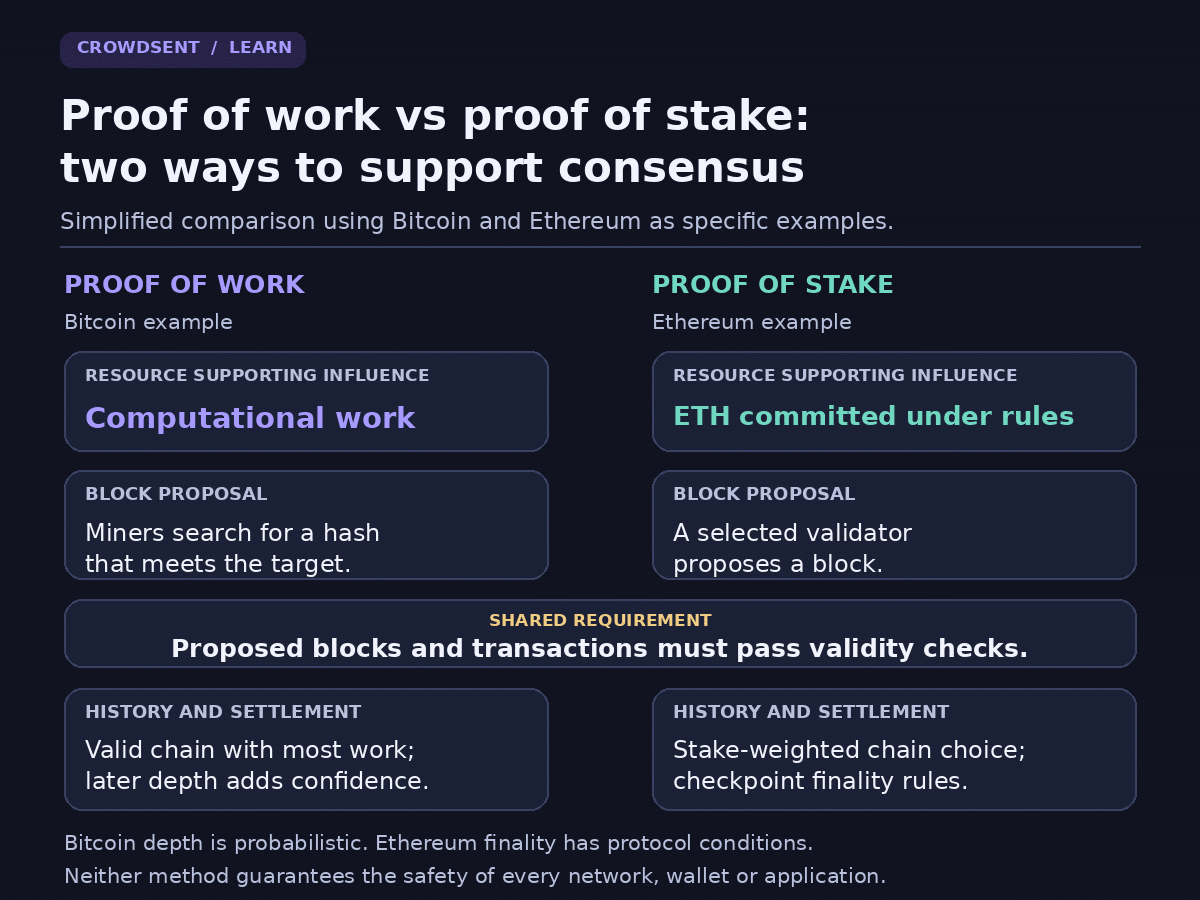
The comparison below separates the resource supporting influence, the block-proposal process and the rules used to settle a history. Both examples still require independent validity checks.
How proof of work supplies evidence
In Bitcoin, miners construct candidate blocks and repeatedly hash candidate headers while seeking a result that satisfies the network’s target. Finding a qualifying result involves computational effort; checking the resulting proof is much easier. Validating nodes also check the block’s transactions and other consensus requirements.
The Bitcoin white paper describes the proof-of-work history and why replacing it requires additional work. In contemporary explanations, “most accumulated work among valid chains” is more precise than treating the greatest raw block count as the complete rule.
For a research comparison, record what a mining statistic measures. Hash rate estimates work attempted per second. A count of mining devices describes equipment. A pool’s share of observed blocks describes one sample of results. None can be substituted for the others without a stated method and period.
A pool label also does not establish that every contributing machine has the same owner. To make a claim about control, inspect what role the pool performs and what the underlying data actually attributes. A neatly coloured chart can be clear about block attribution while incomplete about ownership.
How proof of stake supplies evidence
Ethereum’s proof-of-stake design uses validators with ETH committed under protocol rules. Selected participants propose blocks, while validators send attestations that express votes used by consensus. Their role includes checking that the proposed block and its state changes are valid.
The Ethereum proof-of-stake documentation describes proposal, checking and attestation duties. It also explains that specified contradictory behaviour can be punishable through slashing. The important distinction is between a cryptographically attributable protocol violation and a vague accusation that a participant behaved badly.
Ordinary downtime and slashable violations are different categories. Their treatment depends on the network’s current rules and conditions. Avoid describing every missed duty as slashing or assuming every proof-of-stake network has Ethereum’s penalty design.
When reading a staking statistic, identify the denominator. Amount of effective voting weight, number of validator records, number of operators and number of people are different quantities. A percentage becomes meaningful only after the dataset tells you which one it counted.
Likewise, a service marketing a product as staking introduces a separate custody or operating arrangement. Protocol documentation explains consensus participation; it does not verify that service’s claims or establish the terms of its product.
Work through a weighted-vote example
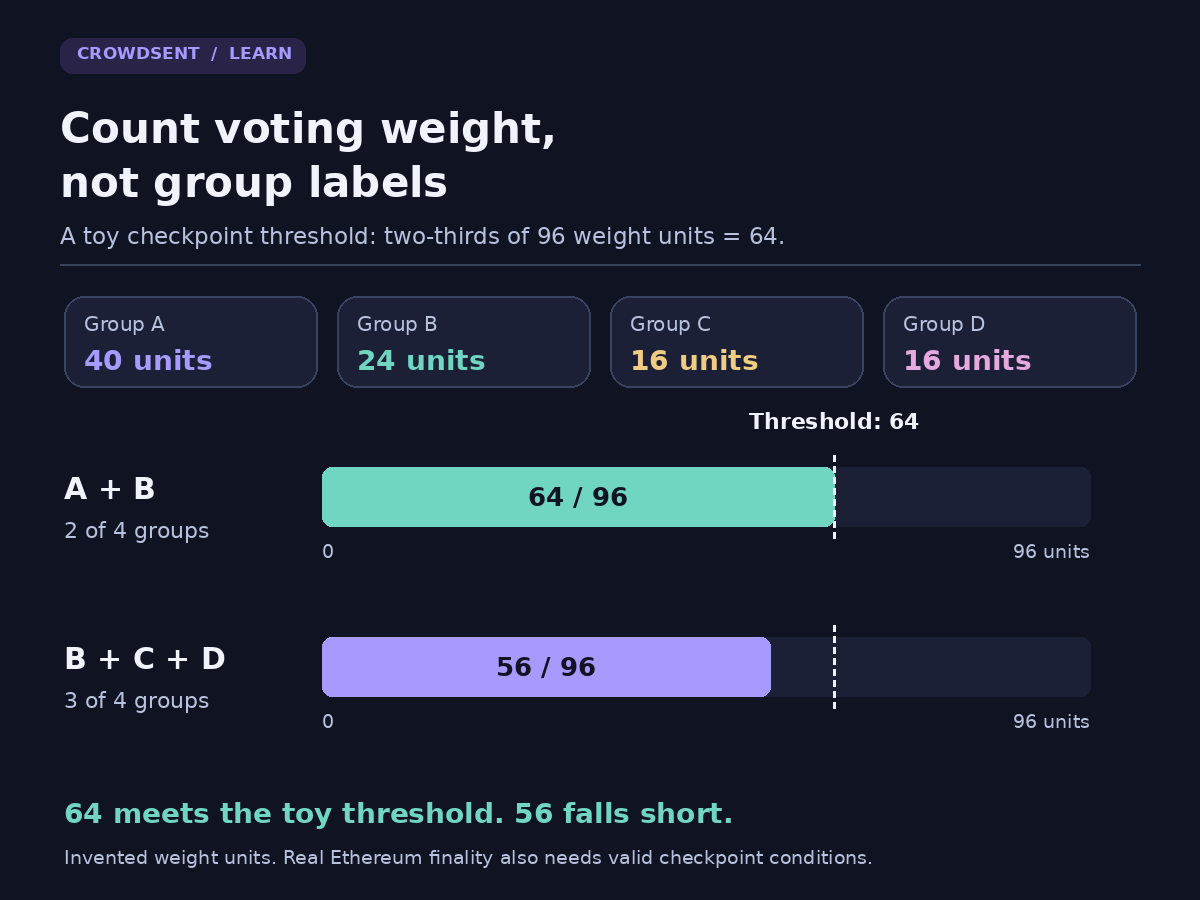
Consider a deliberately simplified checkpoint-vote exercise with 96 units of effective voting weight. Group A has 40 units, B has 24, C has 16 and D has 16. The example uses a two-thirds weight threshold, which is 96 × 2 ÷ 3 = 64 units.
If A and B support the same qualifying vote, their combined weight is 40 + 24 = 64. That is two-thirds of the toy total, even though only two of the four labelled groups participated. If B, C and D participate instead, their weight is 24 + 16 + 16 = 56. Three-quarters of the group labels represent only 58.33% of the weight.
The exercise shows why counting visible participants can answer the wrong question. “Three of four groups voted” and “the weight threshold was met” are different statements. The first can be true while the second is false.
This is an arithmetic illustration, not a simulation of Ethereum. Real finality also depends on which checkpoints were voted for, valid source-and-target relationships and the rest of the protocol. The four groups are invented labels, not real validators, companies or individuals.
Compare chain choice and finality carefully
Bitcoin’s growing proof-of-work depth supports a probabilistic settlement interpretation. Later blocks increase the work needed to replace the containing history under the relevant assumptions. An observed block count belongs with the current accepted chain and the time it was checked.
Ethereum also has rules for choosing the chain head, plus checkpoint-based justification and finalisation. Its Gasper explanation describes the role of supermajority stake-weighted votes. A block being newly included and a checkpoint becoming finalised are distinct stages.
Avoid translating these different systems into an unsupported universal statement such as “N blocks always mean the same security.” A screenshot may expose a count without exposing the consensus condition the reader actually cares about. Confirm the field’s definition before making a cross-network comparison.
Also separate safety from liveness. In this context, safety concerns avoiding incompatible accepted outcomes; liveness concerns the system continuing to make progress. A period without finalisation and a confirmed case of conflicting finalisation describe different failures. Evidence for one should not be casually relabelled as the other.
A responsible explanation names its assumptions. It does not present either probabilistic depth or economic finality as a guarantee that every wallet, application and intermediary using the network is free of risk.
Compare resources without declaring a universal winner
Proof-of-work participation involves a competitive computational process with hardware and energy costs. Ethereum’s proof-of-stake transition removed that mining competition from its consensus process. Its proof-of-stake comparison explains the energy distinction and other design trade-offs.
Energy, decentralisation and throughput still require separate definitions. A network-wide energy estimate differs from dividing estimated energy by transaction count. That division gives an allocation ratio; it does not demonstrate the marginal energy caused by one extra transaction.
Similarly, faster block production is not a complete measure of application capacity. Block limits, execution design, network communication and scaling systems also matter. A claim that changing the consensus label automatically fixes all fees or congestion needs evidence about those other components.
For concentration research, ask what can be concentrated: hardware production, mining-pool coordination, stake ownership, validator operations, software clients or hosting. One percentage rarely measures them all. If a report counts operators, do not silently turn its result into a claim about unique owners.
This approach keeps trade-offs inspectable. It replaces an unexplained “better” with a defined question, such as what resource supports influence or what assumptions underlie a finality claim.
Write a comparison that preserves its boundaries
Use five headings in a research note: proposal method, validity checks, chain-choice evidence, settlement condition and concentration measure. Add the network, documentation date and unresolved assumptions. These headings make it easier to spot when two sources are discussing different parts of consensus.
For the toy vote, a finished finding is: “Groups B, C and D hold 56 of 96 weight units, below the 64-unit threshold.” It is a complete arithmetic result. Adding a claim about a real chain’s health or future price would require evidence the toy exercise does not contain.
The guide to verifying market news is useful when a consensus claim begins with an upgrade announcement. Establish whether the change is proposed, activated or merely described in an old article. In English-language research shared across India and Pakistan, retain the same network names, units and dated sources rather than relying on translated promotional labels.
Frequently asked questions
1. What is the simplest difference between proof of work and proof of stake?
Proof of work uses evidence of computational effort in its consensus design. Proof of stake uses committed stake and protocol-defined participation rules. The labels identify broad approaches; the exact proposal, chain-choice and penalty mechanisms must still be read for the named network.
2. Do validators simply trust the block proposer?
In Ethereum, participating nodes check proposed blocks and re-execute transactions to verify state changes. Attestations operate within that validation process. A proposal is an input for checking, rather than an automatic instruction that every other participant must accept.
3. Is Ethereum still mined like Bitcoin?
Ethereum uses proof of stake. Historical Ethereum mining material describes a previous consensus design. Date the source before using its operating instructions or statistics in a current comparison. Bitcoin’s mining model should not be copied into an explanation of current Ethereum participation.
4. Why is counting validators sometimes misleading?
Validator records can carry different effective weight, and multiple records can be operated or controlled through related arrangements. A count needs a definition and purpose. If the question concerns a weighted threshold, calculate the relevant weight rather than treating every visible record as an equal vote.
5. Does missing a duty always mean slashing?
No. Networks distinguish categories of inactivity and provable violations under their own rules. For Ethereum, conflicting proposals or attestations can be slashable behaviour. A missed duty should not be called slashing without evidence of the applicable condition and outcome.
6. Can majority influence make an invalid transaction valid?
Consensus influence does not remove the validation rules enforced by nodes. An attack on ordering, censorship or history is a different claim from forging someone’s authorisation or changing rules accepted by independent nodes. State the specific threat rather than using “majority attack” as an explanation for every possible loss.
7. Does proof of stake guarantee cheap transactions?
Consensus is only one component of a network. Execution limits, demand and scaling design also affect transaction costs. A proof-of-stake label does not supply a fee quote or demonstrate that a particular operation will remain inexpensive under changing conditions.
8. Does the 64-unit example prove Ethereum finality?
It demonstrates a two-thirds calculation under deliberately simplified assumptions. Real checkpoint finality requires additional protocol conditions. The example helps detect a denominator error; it cannot verify a live network event or replace its checkpoint and attestation records.
9. Can two groups meet the threshold while three fail?
In the example, A and B hold 64 units, while B, C and D hold 56. Different group sizes make this possible. Count the weight attached to the selected groups and compare it with the same 96-unit denominator before interpreting the fraction.
10. Does the consensus method determine which asset to buy?
This guide establishes technical distinctions and evidence requirements. A consensus label alone cannot determine a suitable purchase or forecast a market price. Keep network-mechanism research separate from financial decisions and from promotional claims about an asset or service.
Prepared 9 October 2026. Examples are invented for education and contain no real wallet identifiers. This article explains evidence and terminology; it does not provide investment recommendations.