

By CrowdSent Blog Team
Treasury shares are a company’s reacquired own shares that it holds rather than immediately cancels. Retired shares have been cancelled. The distinction matters because a repurchase can reduce outstanding shares before any later cancellation changes the issued-share count.
This guide uses one fictional ordinary share class and a count ledger. It does not claim that a buyback creates value, raises the market price or is legally available to every company. Holding, reissuing and cancelling own shares are subject to jurisdiction-specific company and securities law.
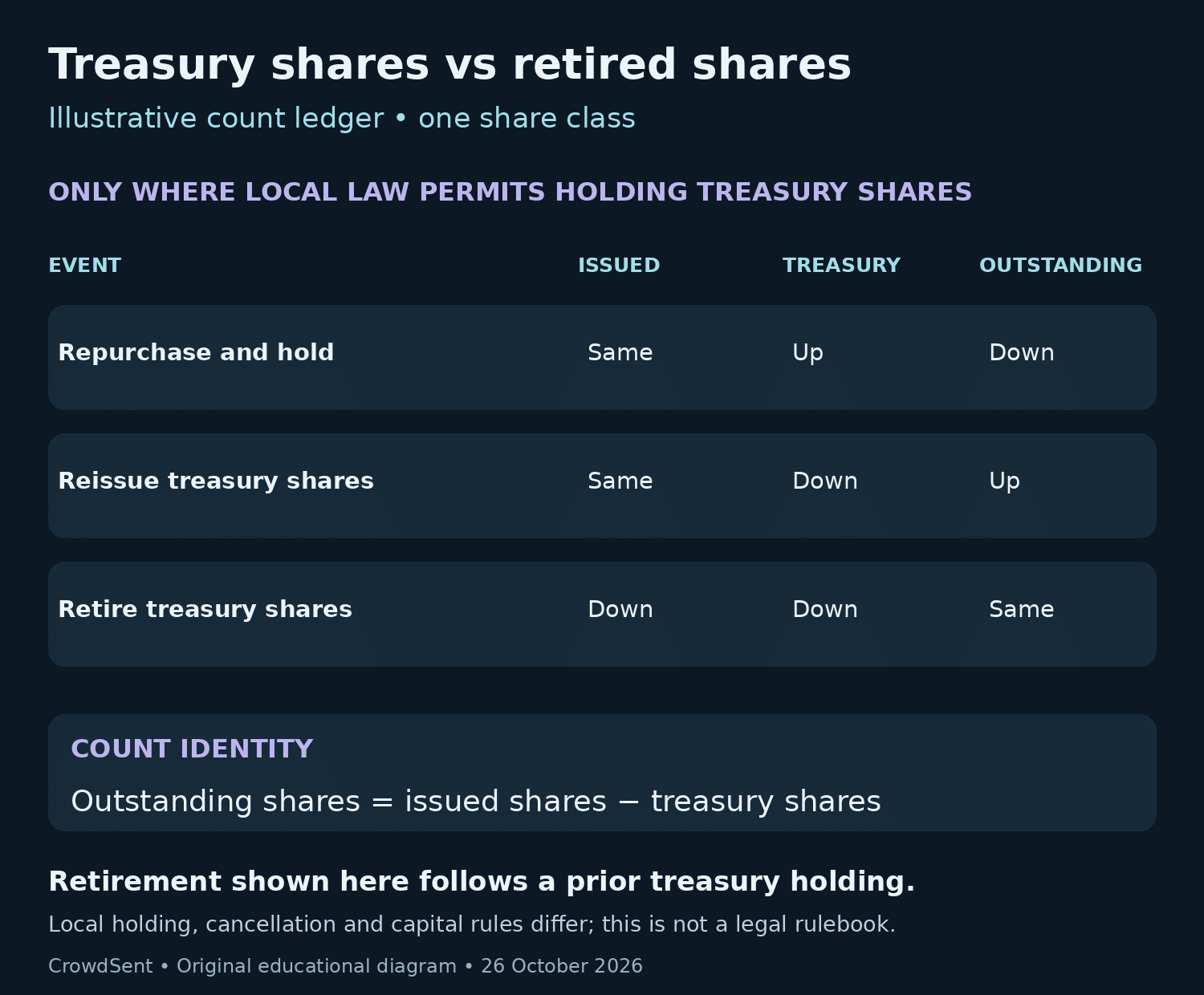
Treasury shares: separate the three count columns
In the simplified convention used here, issued shares include shares still held in treasury. Outstanding shares exclude those treasury shares. Therefore, issued shares minus treasury shares equals outstanding shares. Read the company’s terminology carefully before applying that equation to its disclosures.
Retirement reduces issued shares because the relevant shares are cancelled. If the shares were already held in treasury, their cancellation reduces both the issued and treasury columns equally. The outstanding count does not fall a second time for the same shares.
Authorised capital is a separate legal concept where applicable. It is not another name for outstanding shares, and this example does not assume cancellation automatically increases or decreases any legal issuance capacity. That requires the company’s governing documents and local rules.
Keep units visible. A note headed “shares in thousands” and an announcement quoting individual shares can describe the same movement at different scales. Align them before deciding that the figures contradict each other.
Follow one repurchase, one reissue and one retirement
Fictional Harbor begins with 12 million issued ordinary shares, no treasury shares and 12 million outstanding shares. Assume local rules permit the illustrated transactions, all shares have identical rights, and there are no other issuances, conversions, splits or cancellations.
Harbor buys back 1.5 million shares and holds them in treasury. It later reissues 0.4 million of those shares. Finally, it cancels 0.6 million treasury shares. Work through each event rather than subtracting every announced number from the original outstanding count.
Step one: acquire shares into treasury
After the repurchase, issued shares remain 12 million. Treasury shares rise to 1.5 million, leaving outstanding shares of 12 − 1.5 = 10.5 million. Holding the shares has changed the outstanding count without yet cancelling any issued shares.
Assume Harbor pays USD 8 per share, with no fees or taxes in this example. The cash paid is 1.5 million × USD 8 = USD 12 million. Record that monetary movement separately from the share-count movement; “12 million cash” and “12 million issued shares” happen to share a number but not a unit.
Step two: reissue some of the holding
Harbor then reissues 0.4 million treasury shares. Issued shares remain 12 million, treasury shares fall to 1.1 million and outstanding shares rise to 10.9 million. Existing issued shares have returned to outside ownership in the convention used here.
If the reissue receives USD 9 per share in cash, proceeds are USD 3.6 million. That amount is not sales revenue. The count ledger establishes how many shares are outside the company; the equity statement separately explains the monetary accounting.
Step three: cancel shares already in treasury
Harbor cancels 0.6 million of the remaining treasury shares. Issued shares fall to 11.4 million and treasury shares fall to 0.5 million. Outstanding shares remain 10.9 million, because 11.4 − 0.5 = 10.9.
Subtracting another 0.6 million from outstanding shares would count the earlier repurchase twice. Cancellation changes the legal and issued-share position, but these particular shares had already left the outstanding population when Harbor acquired them.
- Opening: issued 12.0 million; treasury zero; outstanding 12.0 million.
- After repurchase: issued 12.0 million; treasury 1.5 million; outstanding 10.5 million.
- After reissue: issued 12.0 million; treasury 1.1 million; outstanding 10.9 million.
- After cancellation: issued 11.4 million; treasury 0.5 million; outstanding 10.9 million.
The ending outstanding movement is minus 1.5 million plus 0.4 million, or minus 1.1 million overall. The later retirement does not add another outstanding-share reduction. This independent movement check matches the closing columns.
Own equity instruments are not an ordinary investment asset
Under the general IAS 32 treasury-share treatment, reacquired own equity instruments are deducted from equity. Purchases, reissues and cancellations do not create a gain or loss in profit or loss simply from trading those own instruments. The IFRS Foundation’s published IAS 32, paragraph 33 sets out that principle.
Thus the hypothetical USD 1 difference between repurchase and reissue prices is not a trading profit to insert into Harbor’s operating result. The relevant consideration belongs within equity accounting. Detailed allocations among equity components require the applicable reporting and legal rules.
The example concerns ordinary own-share transactions, not specialised exceptions or every arrangement involving an entity’s own shares. The IAS 32 overview provides the broader financial-instrument classification context.
Do not substitute an ending count for every denominator
The 10.9 million ending count is a snapshot. Earnings per share generally uses a period-weighted denominator, with additional requirements for diluted EPS. Transaction dates therefore matter even when the closing share ledger is perfectly reconciled. See basic versus diluted EPS for that separate calculation.
Employee awards may later change the count too. A treasury holding does not establish whether awards have vested, what expense has been recognised or how settlement will occur. The stock-based compensation guide separates those stages.
A split is another distinct event. It changes units and per-share relationships differently from buying shares from outside holders. Keep the mechanics in the stock-split guide separate rather than labelling every reduction or increase a buyback.
Read the evidence before interpreting the announcement
A repurchase authorisation is not proof that all authorised shares were purchased. Match executed transactions, holding balances and cancellation notices to their dates. A year-end count may precede a later announcement, so apparent inconsistencies can reflect different observation dates.
For each movement, save the effective date, share class, count units, cash amount where relevant and the note explaining its treatment. Identify transactions after the reporting date separately. If the company uses a different issued-share convention, reproduce its reconciliation before translating the terms.
Whether a transaction improves shareholder value is a further question involving price, funding, alternatives and business prospects. The book value versus market value guide examines valuation measurements; the count ledger alone cannot answer that investment question.
Frequently asked questions
1. Are treasury shares and retired shares interchangeable?
No. Treasury shares remain held under the convention illustrated here, while retired shares are cancelled. Both may be absent from outstanding shares, but their issued-share treatment differs.
2. Does a buyback always reduce issued shares immediately?
Not when the company holds the acquired shares in treasury as Harbor does. Its initial issued count stays at 12 million. An immediate cancellation would require a different issued-share entry.
3. Why does later retirement not reduce outstanding shares again?
The shares were already excluded while held in treasury. Cancelling 0.6 million reduces both issued and treasury balances, leaving their difference unchanged at 10.9 million.
4. Does reissuing treasury shares increase outstanding shares?
In this example, yes. Harbor’s 0.4 million reissue reduces the treasury holding and restores those shares to outside ownership, raising outstanding shares without increasing the issued column.
5. Is a higher reissue price operating profit?
No under the ordinary IAS 32 own-equity treatment described here. Cash consideration is reflected in equity accounting; a price difference should not be inserted into revenue or a trading-profit line.
6. Can the company hold treasury shares in every country?
Do not assume so. Permitted holdings, cancellation requirements and transaction procedures depend on local law. This ledger assumes permission and makes no claim about a particular jurisdiction.
7. Does a buyback authorisation establish the closing count?
No. Authorised capacity and executed purchases are different evidence. Use actual movements and their dates, then reconcile them with the reported share note.
8. Can the ending count be used directly for annual EPS?
Not automatically. A year-end snapshot ignores how long shares were outstanding during the earnings period. The applicable weighted-average calculation needs the transaction timing.
9. Is a lower share count proof of a better investment?
No. The ledger does not evaluate repurchase price, funding costs or future business performance. A mechanically smaller denominator is not a guaranteed economic improvement or market-price forecast.
10. What catches the most common counting mistake?
Recalculate issued minus treasury at every step, then independently bridge opening outstanding shares to closing outstanding shares. A later cancellation of already-held shares should not appear as a second repurchase.
Educational note: All companies and figures are fictional. This IFRS-focused explanation is not investment, legal or tax advice. Local requirements and the reporting framework must be checked separately.