

By CrowdSent Blog Team
Book value vs market value compares two different measurements of equity. Book value comes from recognised assets minus liabilities in financial statements. Market value uses a quoted share price and the relevant outstanding share count. One can change while the other stays unchanged.
This guide focuses on company common equity, not the purchase cost shown for an investment in a brokerage account. Using one fictional company, it connects the total and per-share calculations, then follows a share-price movement, an accounting loss and a share repurchase.
Book value vs market value: choose the same ownership boundary
The SEC’s financial-statements introduction explains the balance-sheet relationship: assets equal liabilities plus shareholders’ equity. Rearranging it gives book equity = assets − liabilities. These are recognised accounting amounts at the reporting date.
For a simple company with only ordinary shares and no non-controlling interests, that equity belongs to the ordinary shareholders. More complex companies require adjustments to identify the equity attributable to the ownership group being compared. Do not compare total consolidated equity with the market value of only the parent’s common shares without checking the boundary.
Market value of common equity, usually called market capitalisation, equals the common share price multiplied by the matching outstanding share count. FINRA’s investment-value explanation describes this distinction and the related price-to-book ratio. Market capitalisation is different from enterprise value, which extends beyond a common-equity-only comparison.
Calculate total and per-share values together
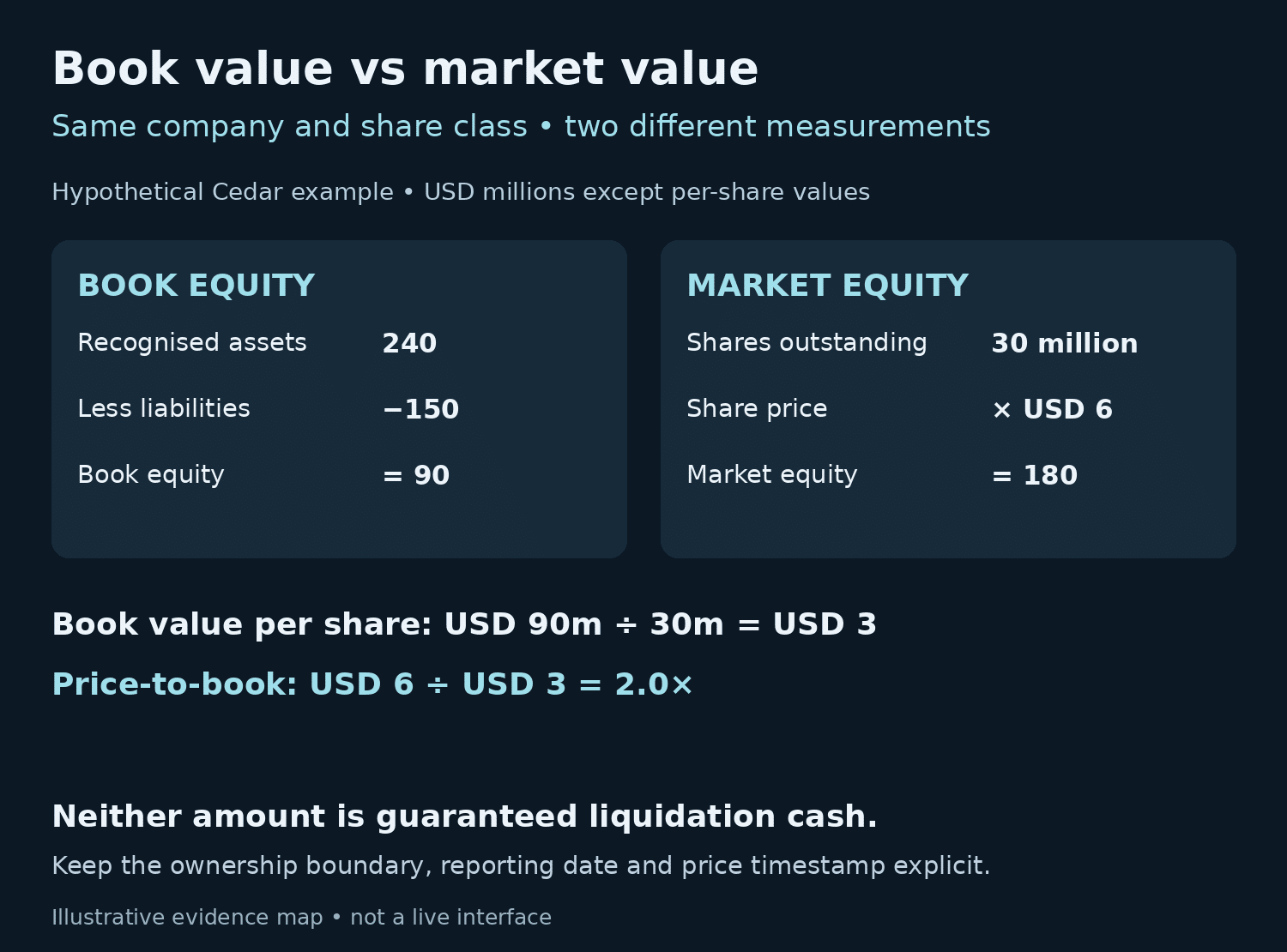
Fictional company Cedar has USD 240 million of recognised assets and USD 150 million of liabilities. It has one ordinary share class, 30 million shares outstanding, no preferred equity and no non-controlling interests. Book equity is 240 − 150 = USD 90 million.
With a quoted share price of USD 6, market equity is 30 million × 6 = USD 180 million. Book value per share is USD 90 million ÷ 30 million = USD 3. Price-to-book, or P/B, is therefore 6 ÷ 3 = 2.0 times.
The totals give the same answer: USD 180 million market equity ÷ USD 90 million book equity = 2.0. Keeping both calculations visible catches errors such as dividing a company-wide value by a per-share amount.
| Measure | Calculation | Result |
|---|---|---|
| Book equity | 240 − 150 | USD 90 million |
| Market equity | 30 million shares × USD 6 | USD 180 million |
| Book value per share | USD 90 million ÷ 30 million shares | USD 3 |
| Price-to-book | USD 6 ÷ USD 3 | 2.0× |
The share count is a point-in-time outstanding count, not automatically the weighted-average count used in earnings per share. The basic versus diluted EPS guide explains why those earnings denominators serve a different purpose.
Follow a price change without changing the accounts
Suppose Cedar’s share price falls from USD 6 to USD 4.50, with its share count and reported balance sheet unchanged. Market equity falls to USD 135 million. Book equity remains USD 90 million, book value per share remains USD 3, and P/B becomes 1.5.
The USD 45 million decline in quoted market equity does not mean USD 45 million left Cedar’s cash account. The calculation reprices the outstanding equity using a lower reference price. A transaction between shareholders is distinct from the company receiving or paying cash.
At a hypothetical USD 2.40 share price, market equity would be USD 72 million and P/B would be 0.8. That is a market price below reported book value, not proof that the shares are a bargain. Expectations about future performance or asset recoverability can differ from recorded accounting amounts.
Follow an accounting change without predicting the price
Return to the original USD 90 million book equity. Suppose an asset impairment reduces recognised assets by USD 18 million and reduces equity by the same amount. Ignore taxes and other simultaneous entries for this deliberately simplified scenario. Book equity becomes USD 72 million.
With 30 million shares unchanged, book value per share becomes USD 2.40. If the market price were held at USD 6 solely to isolate the arithmetic, P/B would rise from 2.0 to 2.5. This does not predict how a real share price would respond to an impairment announcement.
The example shows how a higher multiple can arise from a smaller accounting denominator. Explain both components before interpreting a P/B change as improved business prospects. The financial-statements overview provides the wider context for changes in equity.
Why book equity is not a liquidation quotation
Book equity is neither a current appraisal of every asset nor guaranteed cash available to shareholders. Asset carrying amounts reflect accounting recognition and measurement rules. A sale can produce different proceeds, and obligations, timing and selling costs matter.
Intangible assets make the distinction especially important. The IFRS Foundation’s IAS 38 summary explains that internally generated brands and goodwill are not recognised as intangible assets, while qualifying development expenditure can meet recognition conditions. It would therefore be wrong to claim that all intangibles are missing from accounts or that all business value appears on the balance sheet.
Two companies with similar commercial activities can have different recognised asset histories. Acquired and internally developed resources may enter their statements differently. A direct book-value comparison needs that context, especially when comparing asset-heavy businesses with companies whose economics depend heavily on unrecognised capabilities.
Test the per-share effect of a repurchase
Start again with USD 90 million book equity and 30 million shares. Suppose Cedar uses USD 18 million of existing cash to repurchase and retire 3 million shares at USD 6 each. Assume no fees, taxes or other changes. Cash and book equity each fall by USD 18 million.
Book equity becomes USD 72 million and shares outstanding become 27 million. Book value per share is 72 ÷ 27 = approximately USD 2.67, below the original USD 3. The shares were repurchased above book value per share, so equity fell proportionally faster than the share count.
That arithmetic is not a judgement about whether the repurchase was economically sensible. It demonstrates why a falling share count does not always increase book value per share. Nor does it tell us what market price will prevail after the transaction.
Keep dates and definitions in the comparison
A current share price paired with last quarter’s book equity produces a mixed-date ratio. Record both dates and check intervening share issuance, repurchases or major accounting events. Missing information should remain visible rather than being treated as zero.
For reproducibility, retain the asset total, liability total, ownership adjustments, share count, price timestamp and resulting calculations. A properly labelled comparison explains the relationship between two measurements. It does not determine an appropriate investment decision.
Frequently asked questions
Is book value the same as the original cost of my shares?
Not in this article. Here it means company accounting equity. Some account statements use “book value” for investment cost, so identify which meaning the document uses.
Can market value be below book value?
Yes. A positive-equity company can trade below its recorded book value. That relationship describes the calculation; it does not prove the price is wrong or that the assets are readily saleable at carrying value.
Is book value equal to cash?
No. It is the residual after recognised liabilities are deducted from recognised assets, which can include equipment, inventory and receivables as well as cash.
Does a share-price fall reduce reported equity?
A change in the company’s own quoted share price alone does not mechanically rewrite its book equity. Separate transactions and accounting events may affect equity during the same period.
Why use the same share count in both per-share calculations?
It keeps the ownership claim consistent. Mixing outstanding shares with an EPS weighted-average count can make the per-share comparison disagree with the total-value ratio.
What if book equity is negative?
A negative P/B can be calculated when price is positive and book equity negative, but ordinary positive-multiple comparisons become unhelpful. Explain the deficit and underlying balances instead.
What if book equity is zero?
Price-to-book is undefined because its denominator is zero. Do not replace it with a very large multiple or treat a missing ratio as a valuation conclusion.
Are all intangible assets excluded from book value?
No. Recognition depends on the asset and accounting rules. Some acquired or qualifying developed intangibles are recognised, while internally generated brands may not be.
Does a buyback always increase book value per share?
No. In Cedar’s example, retiring shares purchased above book value per share reduces that measure from USD 3 to about USD 2.67, under the stated assumptions.
Is book value an estimate of intrinsic value?
Book value is an accounting measurement. An intrinsic-value estimate depends on a valuation method and assumptions about future economics. Neither should be silently substituted for a quoted market price.
Educational note: All companies and worked figures are fictional. This article explains financial reporting, not investment recommendations. A ratio or accounting comparison cannot predict a share price or guarantee a financial outcome.
Continue exploring company-reporting concepts with CrowdSent and its current membership information. Keep original company filings alongside your research notes.