

By CrowdSent Blog Team · Sources checked 25 October 2026
A stock split changes the number of shares representing a holding. In a proportional split, the shareholder owns the same percentage of the company immediately after the mechanical adjustment. A lower quoted price per share does not, by itself, make the whole holding worth less or the business cheaper.
The useful check is a ledger containing your share count, the company’s outstanding shares, the reference price and the date. This guide builds that ledger, then introduces a separate market-price movement. All worked figures are fictional and assume one share class with unchanged rights.
Read the stock split ratio before doing arithmetic
A three-for-one split means three resulting shares for every one old share. The multiplier is 3 ÷ 1 = 3. Someone with 40 old shares ends with 120, an increase of 80 shares. It does not mean receiving three additional shares on top of each existing share.
The Investor.gov stock-split definition explains the proportional increase without dilution of existing ownership. Keep that proportional condition explicit: a separate capital raising, acquisition or employee share issuance is a different event, even if it happens near the split date.
For any stated ratio, write “new shares per old share” beside the fraction. A three-for-two split has a multiplier of 1.5; a one-for-five consolidation has a multiplier of 0.2. This notation avoids reversing the calculation when the wording changes.
Follow a shareholder ledger through a three-for-one split
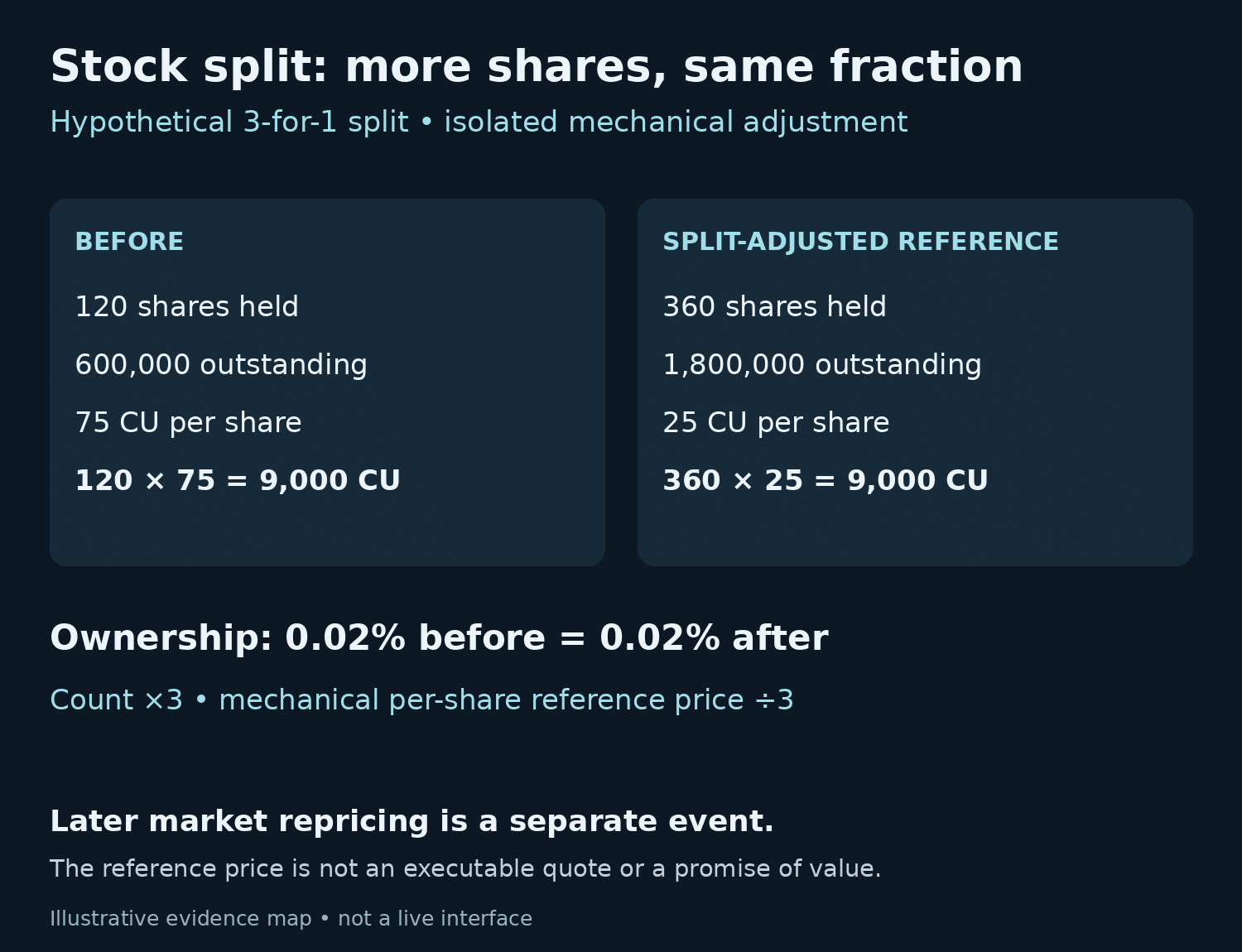
Suppose Cedar Example has 600,000 shares outstanding. You own 120 shares, and the reference price is 75 currency units per share. Your ownership is 120 ÷ 600,000 = 0.02%. Your holding’s reference value is 120 × 75 = 9,000. The company’s corresponding equity market capitalization is 600,000 × 75 = 45 million.
- Your new count: 120 × 3 = 360 shares.
- Company’s new outstanding count: 600,000 × 3 = 1,800,000 shares.
- Mechanical reference price: 75 ÷ 3 = 25.
- Your resulting reference value: 360 × 25 = 9,000.
- Your resulting ownership: 360 ÷ 1,800,000 = 0.02%.
Both ownership fractions describe the same interest. Multiplying the numerator and denominator by the same factor leaves the fraction unchanged. Market capitalization also remains 45 million at the mechanical reference point: 1,800,000 × 25.
This is an isolated adjustment, not a promise about the next transaction price. No customer orders, factory capacity, debt or cash have changed in this example. The split alone has introduced no new operating earnings to support a different business valuation.
Keep market repricing in a separate row
Now suppose the shares subsequently trade at 26. The 360-share holding is worth 9,360, or 360 more than its split-adjusted reference value. The comparable movement is 26 ÷ 25 − 1 = 4%. Company equity market capitalization is now 46.8 million.
Comparing 26 directly with the old 75 would mix two different share units and manufacture a large apparent fall. Conversely, attributing the extra 360 to the split would confuse the mechanical conversion with the later price movement. A market price may move upward or downward for many reasons; the split arithmetic does not establish the cause.
For a record that someone else can reproduce, retain three rows: the last pre-adjustment reference, the theoretical split-adjusted state and the observed later quote. Label timestamps and currency. Do not present the middle row as an executed market trade.
Check event dates and the issuer’s instructions
The historical NVIDIA 2024 split FAQ illustrates why event dates need separate labels. Its ten-for-one split identified June 6 as the record date, distribution after the June 7 close and split-adjusted trading on June 10. It described nine additional shares for each old share, producing ten in total.
That schedule belongs to that particular action. Do not copy it to another issuer or assume the record date alone answers what happens to a transaction around the event. Read the exchange notice, issuer announcement and broker instructions together. Preserve the exact security identifier and account reference when asking about a discrepancy.
Reverse splits and fractional entitlements need their own check
A one-for-five reverse split changes a hypothetical 250 shares at 4 into 50 shares at a mechanical reference price of 20. Both states represent 1,000. Investor.gov’s reverse-split explanation also cautions that later trading-price fluctuations can cause losses. A higher nominal share price is not proof that the business improved.
Whole-share arithmetic can leave a remainder. For example, 103 old shares multiplied by one-fifth produces a mathematical entitlement of 20.6 new shares. That calculation does not establish whether the account receives a fraction, cash instead of the fraction or another treatment. Use the actual action documents and the intermediary’s processing rules; do not invent a universal rounding convention.
Record the whole-share quantity and any fractional or cash adjustment separately. If cash is substituted, the final ownership comparison needs that adjustment rather than a blanket claim that every account retains precisely the same percentage.
Reconcile a split with the transactions around it
A share-count comparison becomes harder when a purchase or sale occurs near the adjustment. Use an independent fictional account holding 80 shares at a raw reference price of 60 currency units before a two-for-one split. The starting value is 4,800. Assume the account is entitled to the split on all 80 shares, with no fractional interests, charges or other corporate actions.
Label the snapshots by event order rather than relying on a dashboard’s latest total. Snapshot A is the final pre-split account record: 80 shares. Snapshot B follows the completed split posting: 160 shares. Snapshot C follows a later sale of 30 post-split shares: 130 shares. The reconciliation is 80 × 2 − 30 = 130, not (80 − 30) × 2 = 100. The transaction’s share unit determines where it belongs.
Assume the sale executes at 31 and the remaining shares are marked at the same price immediately afterward. Sale proceeds are 30 × 31 = 930; the remaining holding is 130 × 31 = 4,030. Together they equal 4,960. Comparing only 4,030 with the original 4,800 would overlook the shares converted into cash by the sale.
The difference from 4,800 is 160, attributable in this isolated example to the price moving from the split-adjusted reference of 30 to 31 across 160 shares. The sale changes the composition between shares and cash. It does not create a second gain of 930. Actual account performance needs all relevant flows and costs, which this demonstration deliberately excludes.
The posting description matters too. In this fictional ledger, an “80 additional shares” credit takes the balance from 80 to 160. A “160 resulting shares” summary describes the completed balance; adding it again would incorrectly produce 240. Record whether each entry is a movement or a balance, together with its effective timestamp. Preserve a later display-refresh timestamp separately rather than treating it as another corporate action.
Match a chart factor to the right ledger snapshot
For the same two-for-one event, a split-only chart could express the old 60 price as 30 by multiplying it by 0.5. The account’s share multiplier is 2. These factors are reciprocals because they convert opposite sides of the same value calculation.
To reproduce Snapshot A’s 4,800 on the later share basis, pair the adjusted historical price of 30 with 160 equivalent shares. Pairing 30 with the unconverted 80 produces 2,400; pairing the raw 60 with 160 produces 9,600. Neither mixed-basis result reconstructs the original holding.
This does not authorize rewriting the original trade confirmation. Keep the actual 80-share record, and label 160 as its equivalent quantity on the later basis. Also keep the later 30-share sale separate; the final 130-share balance cannot be multiplied by an earlier price to reconstruct the account before that transaction.
Alpha Vantage’s documentation illustrates why field labels matter: its daily-adjusted description distinguishes raw trading fields, adjusted close and split/dividend events. A combined adjustment factor need not equal the reciprocal of one split. The adjusted-close guide covers those series methods; the account check here requires a specifically identified split-only basis.
Separate a split from a subscription or cash distribution
A rights offering introduces a different decision. The Nigerian SEC’s offering explanation describes an opportunity for existing holders to acquire additional shares in proportion to their holdings. Receiving that opportunity is different from automatically receiving replacement share units through a split.
In a separate fictional company with 1,000 outstanding shares, a holder owns 100, or 10%. Assume a one-for-four rights offer results in all 250 additional shares being issued. Subscribing for 25 at an assumed price of 8 requires 200 of cash and produces 125 ÷ 1,250 = 10% ownership. If the holder subscribes for none while all 250 are issued to others, the fraction becomes 100 ÷ 1,250 = 8%.
Those ownership calculations omit any sale value or other treatment of the rights and establish no investment gain or loss. A cash dividend has another ledger: absent reinvestment or another action, receiving cash does not itself increase the shareholder’s count. Classify each event before applying a split multiplier; similar-looking account credits can represent different economic changes.
Keep adjacent measurements on a consistent share basis
Historical charts may already adjust past prices. Use the separate adjusted close versus close guide before applying an adjustment twice. Earnings per share also requires a consistent denominator; the basic versus diluted EPS guide covers earnings claims rather than the account conversion shown here.
For US tax context, the IRS stock-split FAQ explains allocating basis across the resulting shares of the same stock. Tax results depend on jurisdiction and event details, particularly cash settlements. A broker’s displayed average price should not be treated as a complete tax determination.
A compact reconciliation note therefore keeps the original count, ratio, expected count, actual posted count, fractional treatment, effective dates and matched price basis together. Investigate an unexplained difference before interpreting it as investment performance.
Frequently asked questions
Does a three-for-one split triple my money?
No. In the mechanical calculation, the share count triples while the per-share reference price becomes one-third. A 9,000 holding stays 9,000 before any separate market movement.
Is a split the same as dilution?
A proportional split preserves the ownership fraction. A separate issuance can change that fraction. Check whether the announcement describes more than one corporate action rather than assuming every increase in shares is equivalent.
Does a split raise cash for the company?
The proportional conversion in this guide involves no investor payment and brings no new cash into the business. Any fundraising in the same announcement needs a separate explanation.
Does the theoretical post-split price guarantee my sale price?
No. It is a reference conversion, not an executable quote. The eventual market price can differ, and a sale has its own execution terms and costs.
Why does my account show more shares but a lower price?
Those can be the two matching sides of the conversion. Check quantity multiplied by price on a consistent timestamp and share basis before concluding that value disappeared.
Are authorized shares the same as outstanding shares?
No. The ownership example uses shares actually outstanding. A corporate authorization concerns the permitted issuance framework; copying that larger number into the denominator can give the wrong ownership fraction.
What if my reverse-split entitlement is 20.6 shares?
Keep 20.6 as the mathematical entitlement, then check the documented fractional treatment. Do not automatically round it to 20 or 21, or assume a particular cash amount.
Must I manually adjust a historical chart?
First read the data definition. A split-adjusted series may already incorporate the event. Applying the ratio again can create an error rather than repair one.
Does a stock split guarantee a dividend increase?
No. A per-share amount needs the same share basis, and any change in the total distribution is a separate decision. Read the dividend announcement rather than inferring policy from the split.
What evidence helps resolve an account mismatch?
Save the issuer notice, ratio, dated pre-event quantity and post-event activity entries. Include any cash-in-lieu entry and ask the intermediary to explain its handling without sharing passwords or sensitive access details.
Explore CrowdSent and its current membership information. This article explains how to read financial information; it does not claim that CrowdSent audits company disclosures or processes corporate actions.
General education, not investment, accounting or tax advice. No price forecasts or recommendations are provided.