

Trade date vs settlement date separates the day a transaction is executed from the date its securities and payment obligations are due to be completed under the applicable settlement process. A trade can appear in an account before settlement has finished.
The notation T+1 means one relevant business day after trade date. It does not mean exactly 24 hours, and it does not establish when money will reach an external bank account. T+0 and T+2 describe different settlement schedules, subject to the instrument and market rules.
This guide focuses on interpreting securities records and calendars. The US, India and Pakistan references were checked on 10 October 2026. Futures expiry, cryptocurrency network confirmations and an individual’s tax treatment require their own rules.
Trade date identifies execution; settlement completes the obligations
Suppose an invented transaction buys 80 shares at a price of 250 currency units per share. When the order executes, the transaction has an agreed quantity and price. Its gross consideration is 80 × 250 = 20,000. That arithmetic describes the execution, even if the final delivery and payment occur on a later settlement date.
Clearing concerns establishing and processing the obligations arising from trades. Settlement concerns completing the relevant delivery and payment. Depending on the market, obligations can be netted or handled through particular clearing arrangements. A retail screen may compress those stages into a few status labels, so its wording needs a definition.
A confirmation showing a trade date and an intended settlement date is useful evidence of the transaction’s terms. It is not, by itself, proof that settlement actually completed. Preserve the completion status separately when the research question concerns final delivery rather than execution.
The distinction also explains why the price does not simply get replaced by the market price on settlement day. In our example, a later screen price of 255 changes a valuation observation, not the original 250 execution price. Corrections, cancellations or other exceptional processes require their own records.
Count eligible settlement days, not hours
Start with T, the trade date assigned under the applicable session rules. Exclude T when counting T+1 or T+2. Then move through the relevant settlement calendar, counting only eligible days until reaching the required offset.
Hypothetical ordinary week: a trade executes on Friday in a T+1 market. Saturday and Sunday are excluded, and Monday is an eligible settlement day. The intended settlement date is Monday. Monday is three calendar days after Friday, but only one counted settlement day.
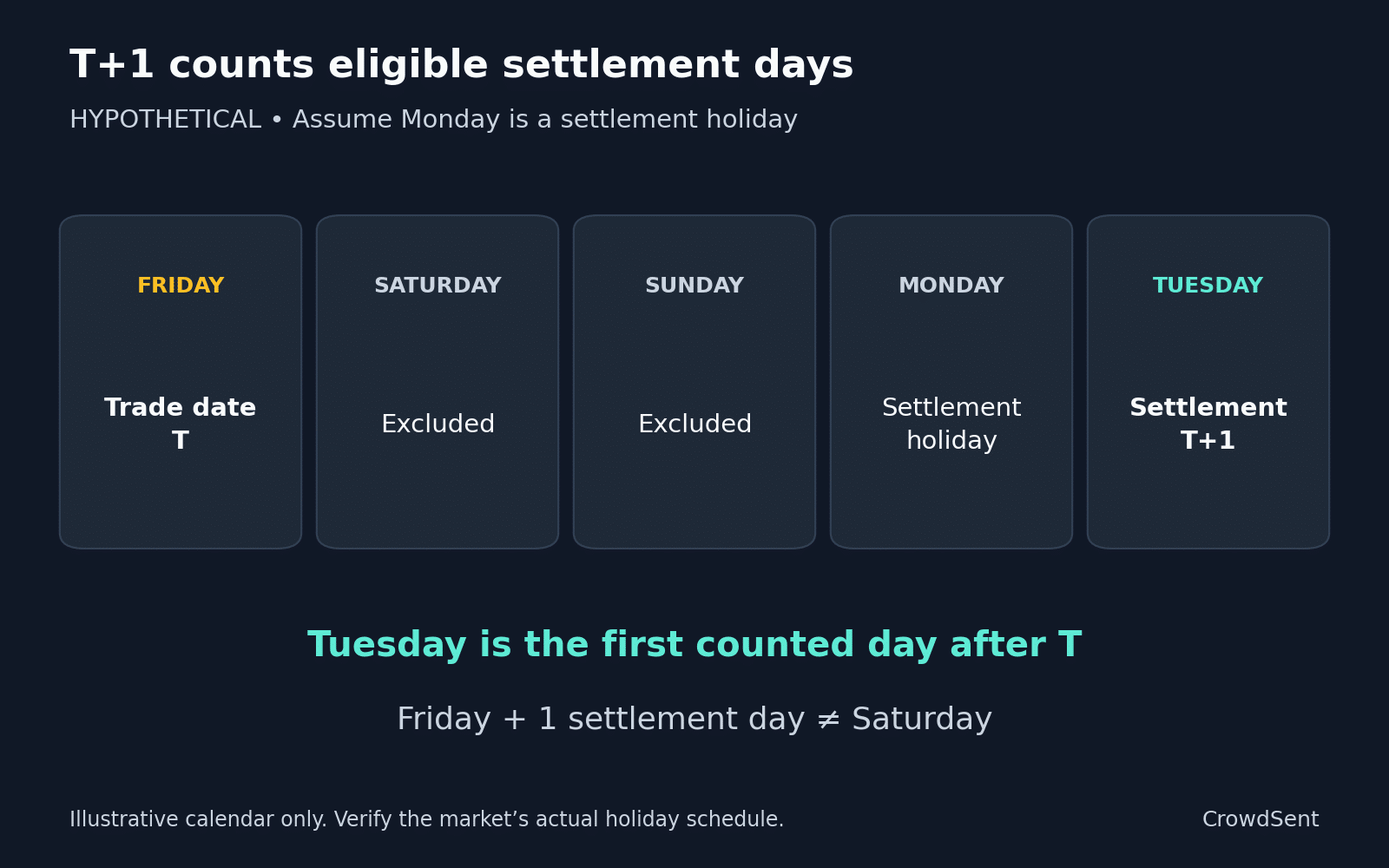
Hypothetical holiday week: keep the same Friday trade, but assume Monday is a settlement holiday. Saturday, Sunday and Monday do not count. Tuesday becomes T+1. Under T+2 with that same assumed calendar, Wednesday would be the intended settlement date.
These are classroom calendars, not claims about a particular country’s upcoming holidays. The point is to preserve the eligibility test. A business day in the reader’s home city may not be a settlement day for the security or cash leg being studied.
For example, a market might accept trades on a day when a relevant banking or settlement service is closed. Therefore, a trading calendar alone may not establish the settlement calendar. Check the clearing agency’s dates and any instrument-specific exceptions.
Time zones introduce a different issue. A US execution viewed after midnight in India or Pakistan can retain the US market’s trade date even though the viewer’s local calendar has advanced. Do not replace the official trade date with the date displayed on the reader’s phone.
Check T+1 separately for the US, India and Pakistan
United States: the SEC’s T+1 investor bulletin describes the standard one-business-day cycle introduced on 28 May 2024 for most broker-dealer securities transactions. Its listed coverage includes stocks, bonds, municipal securities and exchange-traded funds, with product-specific qualifications. The word “most” matters; the bulletin is not a settlement specification for every asset worldwide.
India: NSE Clearing’s capital-market settlement page describes T+1 rolling settlement and excludes intervening bank holidays, NSE holidays, Saturdays and Sundays when determining settlement day. Use the applicable segment and schedule rather than deriving the answer from a generic weekday calculator.
India also has an optional same-day framework alongside T+1. NSE’s T+0 page links the eligible securities, participating members and detailed mechanism. Its existence does not make every transaction T+0. The actual order, series and participation conditions must identify which cycle applies.
Pakistan: NCCPL’s transition notice confirms successful implementation of the move from T+2 to T+1 on 9 February 2026. Describing current covered Pakistan-market transactions as universally T+2 would therefore rely on an outdated assumption. Confirm the particular market and trade’s settlement terms.
The three references illustrate a shared notation with different operational details. They do not establish identical banking cutoffs, broker displays, product coverage or failure-handling rules. A cross-market spreadsheet needs a rule and calendar for each row, even where several rows happen to use T+1.
Settlement, buying power and withdrawal are different labels
An account might show a newly executed sale, an unsettled cash receivable, an amount available for a new purchase and a smaller amount available to withdraw. Those labels can refer to distinct permissions and processing stages. Their amounts need not match immediately after execution.
Consider an invented sale of 40 shares at 500, with a fictional total transaction charge of 30. Gross proceeds are 20,000 and expected net proceeds are 19,970. A screen might recognise that receivable on trade date without having completed settlement. Neither number alone establishes when an external bank transfer can complete.
Keep three questions separate: has the trade settled, what does the account permit using its balances, and has a requested withdrawal cleared its own processing steps? A faster settlement cycle does not remove every bank-transfer cutoff or account restriction.
Account type also matters. The SEC’s cash-account bulletin, updated in August 2026, explains payment requirements and risks associated with selling a purchase before it has been paid for. It should not be reduced to a blanket instruction that every displayed balance can be freely reused.
This article does not determine a reader’s permissions from a screenshot. For a particular account, compare the broker’s definitions, settlement status and relevant restrictions. A balance labelled “available” needs its full label and governing conditions.
Intended settlement and actual completion can diverge
A scheduled date is the expected date under the trade terms and calendar. A settlement failure or short delivery means an obligation was not completed as intended. That creates a separate status and follow-on process; it does not mean no trade ever occurred.
NSE Clearing’s cited page, for example, describes a buy-in auction process for short deliveries in its normal segment and a different treatment for another segment. This illustrates why the ordinary T+1 label cannot answer every question about a failed delivery. The applicable failure procedure must be read separately.
Do not infer a failure simply because the account interface updated later than expected. The display could be delayed, while the underlying process completed; alternatively, a real exception may exist. Seek the status record rather than choosing either explanation without evidence.
Partial execution introduces another distinction. If an order for 100 shares executes 60 today and 40 on the next trading date, it contains separate executions that may have different settlement dates. An order-submission date is not a substitute for each fill’s official trade date.
Corporate actions can interact with settlement timing, but entitlement comes from the particular event’s ex-date, record date and applicable rules. Do not turn this settlement overview into a universal dividend cutoff formula. Likewise, accounting and tax reports may require a specific recognition basis that needs independent confirmation.
Reconcile a trade record in a fixed sequence
Begin with instrument identifier, exchange or market, security type and settlement cycle. Find the execution’s trade date and quantity, then copy the intended settlement date shown on the confirmation. Recalculate the calendar only after obtaining the relevant holiday and exception schedule.
Next reconcile money: quantity times execution price gives gross consideration; separately identified fees and other adjustments produce the net amount. Keep the transaction currency attached. A home-currency estimate can change with an exchange rate without changing the security’s original settlement amount.
For the fictional 80-share purchase, record 80 shares, price 250 and gross 20,000, followed by each adjustment actually specified in the exercise. If no fee information was supplied, mark net consideration unknown rather than assuming gross equals the account debit.
Finally separate intended settlement, actual settlement status and withdrawal status. If a field is unavailable, retain that state using the principles in missing data versus zero. A blank completion timestamp is not proof of either successful settlement or failure.
For cross-currency research, the base and quote currency guide helps preserve quotation direction. Keep the transaction confirmation, calendar version and unresolved questions in a research journal. This makes a later correction traceable to the exact input that changed.
Frequently asked questions
1. What is the difference between trade date and settlement date?
Trade date identifies execution under the relevant market’s rules. Settlement date identifies when delivery and payment are due under the settlement arrangement. Actual completion should be verified separately if an exception or delay matters.
2. Does T+1 mean settlement exactly 24 hours later?
No. It counts one eligible business day after trade date. Weekends, relevant holidays and market-specific processing schedules can make the elapsed calendar time longer than 24 hours.
3. When does a Friday T+1 trade settle?
On the next eligible settlement day. In the ordinary fictional calendar that is Monday; if Monday is an excluded settlement holiday, it is Tuesday. The actual market calendar decides.
4. Is Pakistan still using T+2 as its current standard?
NCCPL confirms implementation of the transition to T+1 on 9 February 2026. Check the specific transaction’s coverage and terms rather than reusing a pre-transition T+2 description.
5. Does India’s T+0 framework replace T+1 for every trade?
No. NSE describes an optional framework with eligibility and participation details alongside the existing cycle. Identify the actual security, series and transaction arrangement before assigning same-day settlement.
6. Does settlement guarantee immediate withdrawal to a bank?
No universal timing follows from settlement alone. Account restrictions and the withdrawal process can involve separate availability conditions and banking cutoffs. Use the broker’s full balance labels and transfer status.
7. Does the trade price change on settlement day?
A later market quote does not rewrite the original execution price. Keep valuation changes separate from the transaction record; a genuine correction or cancellation needs its own documented event.
8. Can one order have more than one settlement date?
Yes, if its fills occur on different trade dates or under different applicable arrangements. Reconcile the individual executions instead of assigning every fill the original submission date.
9. Is a missed settlement date the same as an unexecuted order?
No. An unexecuted order has not produced that trade. A settlement exception concerns an already executed transaction’s delivery or payment obligations and follows the relevant market’s procedures.
10. Which dates should a transaction export preserve?
Keep submission and execution timestamps where available, the official trade date, intended settlement date, actual completion status and any relevant withdrawal dates. Label their time zones and sources so distinct milestones remain distinct.
Continue your market research at CrowdSent.
Educational information only. Worked examples are hypothetical. This article does not provide investment, legal or tax advice.