

CrowdSent Blog Team · Currency-quote literacy
Base currency vs quote currency describes the order of a currency pair. The base currency is the first currency named; the quote currency is the second. A pair value tells you how many units of the quote currency correspond to one unit of the base currency under that quotation’s stated conditions.
For example, a hypothetical USD/INR reference of 90 means INR 90 per USD 1. USD is the base, INR is the quote. Reversing the order to INR/USD requires the reciprocal, approximately USD 0.011111 per INR 1. Reusing 90 after reversing the labels would change the meaning completely.
This guide develops seven reading checks for currency pair direction, conversion arithmetic and percentage changes. Every numerical rate below is invented for education. The INR and PKR examples help readers in India and Pakistan interpret units; they say nothing about product access, actual exchange offers or what anyone should transact.
1. Read base currency vs quote currency as a sentence
Turn every pair into a sentence: “One unit of the first currency is quoted in units of the second.” This works whether the display uses a slash, a dash or a compact symbol, provided the provider identifies that order. Check the instrument description if the symbol is abbreviated or unfamiliar.
CME Group’s guide to FX quote conventions identifies the first currency as the base and the second as the quote or terms currency. It also cautions that futures and spot conventions can differ. A familiar currency name is therefore not enough to establish the direction of an unfamiliar contract’s quotation.
For a hypothetical USD/PKR value of 300, write “300 Pakistani rupees per US dollar.” For a hypothetical EUR/USD value of 1.08, write “1.08 US dollars per euro.” The dollar changes position between these examples. The rule follows the pair order rather than treating USD as permanently first or permanently second.
Preserve the three-letter codes. “Rupee rate” could refer to different currencies, while “Rs” leaves the distinction unresolved. INR and PKR make the Indian and Pakistani contexts explicit. Similarly, a dollar symbol without a code may not identify which country’s dollar a source means.
Add the provider, timestamp and quote type after the sentence. “90 INR per USD, hypothetical midpoint at a stated time” conveys more than “USD is 90.” The extra fields become essential when you compare two screenshots or check a calculation from an article.
2. Describe a change in the pair without reversing the meaning
A rise in the numerical A/B rate means more units of B are quoted per unit of A. Under the same quotation basis, A has strengthened relative to B over that interval, and B has weakened relative to A. This is a relative comparison between two currencies, not a claim about all currencies or domestic purchasing power.
Hypothetical INR example: USD/INR rises from 90 to 99. Each dollar is now associated with more rupees in the invented reference. Describing this as “the rupee rose because the chart rose” reverses the pair’s meaning. The chart displays rupees per dollar, not the dollar value of a rupee.
Hypothetical PKR example: USD/PKR falls from 300 to 285. The reference now uses fewer Pakistani rupees per dollar. Keep the relative statement explicit: the dollar weakened against the rupee in this example. The observation does not establish why the change occurred or what happened against another currency.
For a headline, record both the pair and the endpoints before paraphrasing its direction. The market-news verification checklist can help you trace a vague statement about a currency to the actual series. If the pair or time window is absent, leave the direction claim unresolved until those details are found.
Avoid inferring economic wellbeing from the sign of a pair chart. A relative exchange-rate change and a broader assessment of an economy answer different questions. This article’s calculations establish the first kind of relationship only.
3. Convert an amount by cancelling the currency units
When the rate is quote currency per base currency, multiplying a base-currency amount by the rate gives a quote-currency reference amount. Dividing a quote-currency amount by that rate gives the corresponding base-currency reference amount. Write the units next to the multiplication or division so the intended cancellation is visible.
Hypothetical calculation: USD 250 multiplied by INR 90 per USD gives INR 22,500. Reversing the calculation, INR 22,500 divided by INR 90 per USD gives USD 250. This is a mathematical conversion at an assumed reference, without fees, a bid-ask distinction or a promise that the rate is available.
For a second hypothetical exercise, PKR 60,000 divided by PKR 300 per USD gives USD 200. Multiplying that result by the same rate returns PKR 60,000. A round-trip check like this can catch an accidental multiplication where division was required.
The European Central Bank’s reference-rate page explicitly labels the euro as its base currency and describes its rates as informational references. This is a useful source-reading example: a reference table’s definition matters even before you use any of its numbers. No actual ECB rates are used in this guide.
Keep fees or product-specific terms outside the reference conversion until you have their definitions. A fixed charge, a percentage charge and a different quoted rate affect a calculation in different ways. Guessing an adjustment to force two totals to match makes the comparison less reliable.
4. Invert the rate and calculate percentage changes separately
For a positive single-value reference R, the reciprocal exchange rate is one divided by R. The units reverse with the number. If R is INR per USD, its reciprocal is USD per INR. Copying only the inverted number while leaving the original unit label creates another type of error.
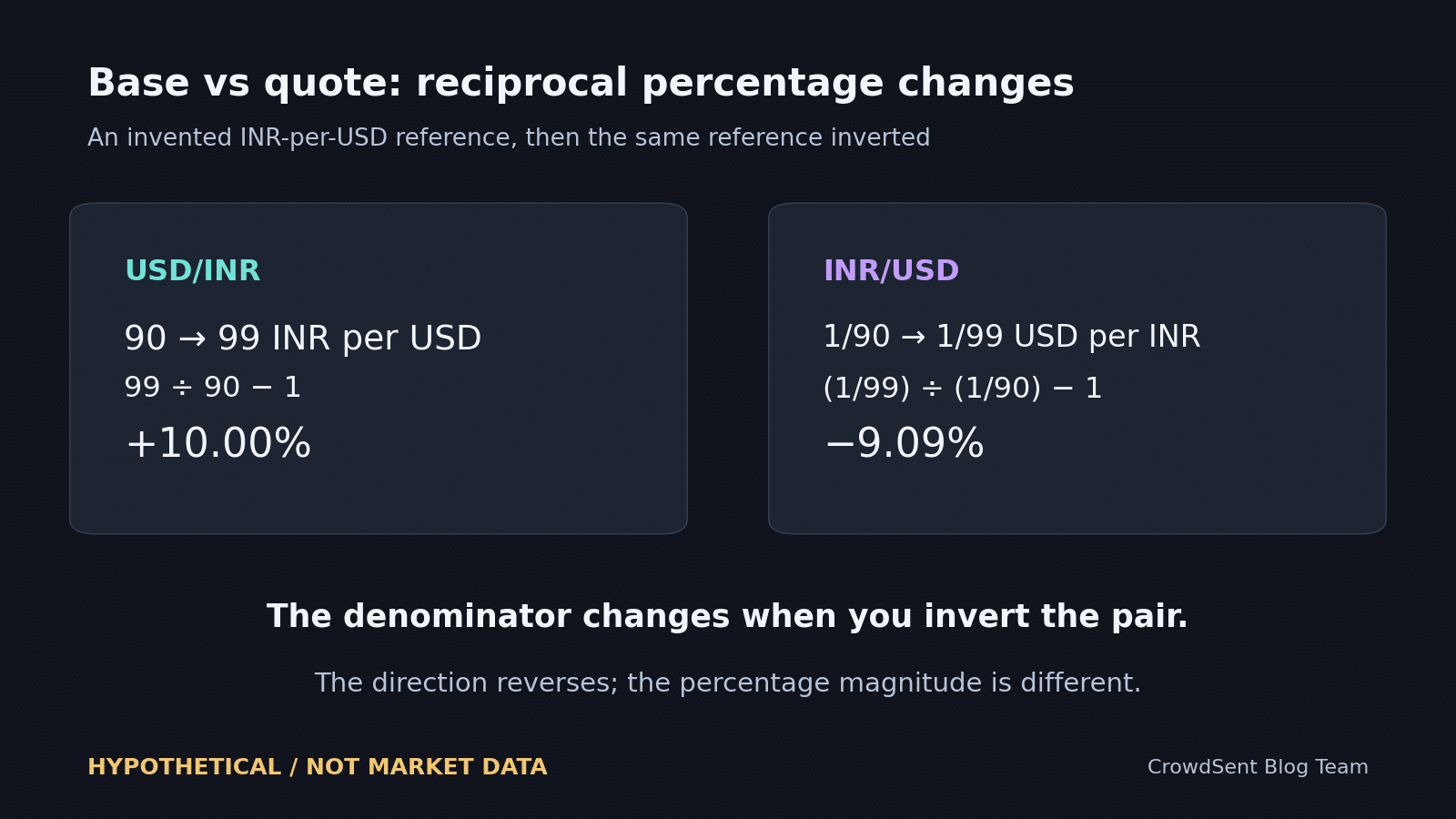
Using the hypothetical USD/INR move from 90 to 99, the direct rate rises by 99 divided by 90, minus one, or 10%. The reciprocal moves from 1/90 to 1/99. Its percentage change is 90 divided by 99, minus one, or approximately negative 9.09%.
The directions reverse, but the percentage magnitudes differ because each calculation uses its own starting value. A 10% rise in a positive rate is therefore associated with about a 9.09% fall in its reciprocal, not a 10% fall. This is arithmetic, not a special feature of the rupee.
A compact general rule is: if the direct rate changes by decimal fraction g, the reciprocal changes by 1 divided by (1 plus g), minus one. The rule requires positive starting and ending rates. Calculate from unrounded values and round only the final display.
The hypothetical USD/PKR fall from 300 to 285 is 5%. The reciprocal PKR/USD rises by 300 divided by 285, minus one, or about 5.26%. Keeping both examples in a worksheet is a useful test that an inversion formula handles increases and decreases correctly.
5. Preserve quote type when reversing a two-sided quotation
A single midpoint can be inverted directly. A bid-and-ask pair needs an additional check because inversion reverses the sides. Under the same two-sided quotation, the reciprocal bid is one divided by the original ask, and the reciprocal ask is one divided by the original bid. This preserves the lower-bid, higher-ask ordering.
Hypothetical arithmetic with deliberately wide numbers: suppose USD/INR is labelled bid 90 and ask 92. The inverse INR/USD bid is 1/92, approximately 0.010870, and its ask is 1/90, approximately 0.011111. These are invented references used only to make the ordering visible.
Simply inverting each number and keeping its original side would produce a bid above the ask. That is a warning that the labels were not transformed correctly. Write the original and inverse side names explicitly rather than relying on the order of cells in a spreadsheet.
A related subtlety concerns midpoints. Inverting the midpoint of a two-sided rate generally differs from averaging the two inverted sides. In this fictional example, 1/91 differs from the average of 1/92 and 1/90. Label which convention you used if precision matters to the comparison.
The purpose here is to interpret a displayed quote, not to construct an executable transaction. A provider’s actual terms, costs and timing remain separate evidence. When those fields are absent, a reciprocal calculation should be described as a mathematical reference rather than a completed offer comparison.
For the underlying quote-side definitions, see the bid–ask spread guide.
6. Build cross-rates with a visible cancellation path
A cross-rate combines compatible references through a shared currency. Use units to decide whether to multiply or divide. For a hypothetical EUR/USD value of 1.08 and USD/INR value of 90, multiplying 1.08 USD per EUR by 90 INR per USD gives 97.20 INR per EUR.
The intermediate USD unit cancels, leaving INR per EUR, which corresponds to EUR/INR. Check the resulting label before saving the answer. Reversing that label would require another reciprocal; the same numerical result cannot be used for both directions.
For a hypothetical India–Pakistan comparison, assume INR 90 per USD and PKR 300 per USD at matching times and on compatible reference bases. Dividing 300 PKR per USD by 90 INR per USD gives approximately 3.333333 PKR per INR. This is an INR/PKR reference under the invented inputs.
A hypothetical INR 900 then corresponds mathematically to PKR 3,000 at that cross-reference. The same result follows through the intermediate currency: INR 900 divided by 90 gives USD 10, then multiplied by 300 gives PKR 3,000. Agreement between the two paths checks the arithmetic.
It does not demonstrate that a particular service offers either path, that any transfer is permitted or that the reference can be obtained. Keep those questions outside the calculation. Also reject mismatched input times or quote types if your research requires a simultaneous cross-reference.
Record the two source observations and the formula. If one input later changes, you should be able to identify which leg caused the revised calculated cross-rate without rebuilding the entire note from memory.
7. Keep chart labels and research records consistent
For a chart, put the full pair and units on the axis or caption. “USD/INR, INR per USD” prevents a reader from mistaking a rising line for a stronger rupee. Include observation frequency, source and whether the values are midpoints, reference rates, settlements or another defined type.
If you invert a historical series, invert every underlying observation before calculating its derived statistics. The reciprocal of an average generally differs from the average of reciprocals. Decide which quantity answers your question and name the method, especially when comparing a chart with a monthly summary table.
A data-quality check should test a simple reference, its inverse and a round-trip amount conversion. Confirm that multiplying the unrounded direct and inverse references gives one, allowing for numerical precision. Do not treat a missing or zero input as a valid rate for reciprocal arithmetic.
When reading a discussion or sentiment score, keep its pair direction alongside the interpretation. The guide to sentiment-score meaning explains why a label needs a definition and source context. A phrase such as “positive for the dollar” still requires the particular pair and observation window before it can be compared with a chart.
Save the full calculation with the market research journal template. A finished note should identify the input records, units, transformation, rounding and remaining limitations. The goal is that another reader can reproduce the result without guessing which currency was first or which rate convention you intended.
Frequently asked questions
Is the base currency always the US dollar?
No. The base is whichever currency appears first in the identified pair. In USD/INR it is USD; in EUR/USD it is EUR. Read the order and provider definition each time instead of relying on familiarity with one currency. The same currency can be the base in one quotation and the quote in another.
Does USD/INR at 90 mean one rupee equals 90 dollars?
Under the conventional pair order used here, it means 90 Indian rupees per US dollar. One rupee’s dollar reference is the reciprocal, 1/90, or approximately USD 0.011111. The example is hypothetical. Writing a complete sentence with both currency codes is a useful check before converting an amount or describing a movement.
Why does a higher USD/PKR number describe a weaker rupee?
The displayed number measures Pakistani rupees per US dollar. A higher value means more rupees correspond to the same dollar unit under that reference. It describes a relative change between those currencies. It does not by itself measure domestic inflation, explain the cause of the movement or establish a broader judgement about economic conditions.
When should I multiply and when should I divide?
Use the units as the test. A base-currency amount multiplied by quote currency per base currency leaves a quote-currency amount. A quote-currency amount divided by that rate leaves a base-currency amount. Write the unit cancellation and perform a reverse check with the same hypothetical reference. This is safer than memorising a rule without the rate’s direction.
Why is the reciprocal percentage change not just the negative of the original?
The reciprocal uses a different starting denominator. In the invented 90-to-99 example, the direct rate rises 10%, while its reciprocal falls about 9.09%. Compute each percentage from its own starting and ending values. Negating the first percentage gives an approximation for very small moves, but it is not the exact general result.
Can I keep the same bid and ask labels after taking reciprocals?
The sides reverse. The inverse bid comes from the original ask, and the inverse ask comes from the original bid under the same quotation. Otherwise the displayed bid can end up above the ask. Preserve the original source and quote type, and remember that the resulting arithmetic alone does not establish a currently available offer.
Is a published reference rate the amount a provider will actually use?
A reference has the purpose and conditions stated by its publisher. A provider’s own quotation may have a different time, side, pricing basis or charges. Compare those fields before expecting identical totals. The ECB example illustrates an explicitly informational reference; none of the invented rates in this article is a transaction quotation.
Can I derive INR/PKR from two dollar references?
Mathematically, compatible PKR-per-USD and INR-per-USD references can be divided to obtain PKR per INR. Match observation times and quote bases, and keep enough precision. This produces a calculated cross-reference only. It does not establish a payment route, an available financial product, transaction costs or any local permission to use a service.
What if a data source gives a rate per 100 currency units?
Record the scaling factor before interpreting the pair. A value per 100 base units must be divided by 100 to obtain the comparable quote-per-one-base-unit reference. Keep both the original and normalised figures in the record. Ignoring the factor creates a hundredfold error even if the base and quote currency labels are otherwise correct.
How many decimal places should I keep when inverting a rate?
Retain sufficient precision for the intended calculation and round only the presented result. Small reciprocal values can lose meaningful information when rounded too early. Check that the unrounded direct rate multiplied by its reciprocal is approximately one. The suitable display precision depends on the input precision and research purpose, rather than a universal decimal-place rule.
Source documentation checked 7 October 2026. Educational research guidance from the CrowdSent Blog Team. All hypothetical examples are invented and are not current market data. This article does not provide investment recommendations.