

By CrowdSent Blog Team
Total value locked, usually shortened to TVL, is the marked value of assets included within a defined protocol or group of protocols. It is generally calculated by multiplying eligible token quantities by their prices and adding the results. The definition of eligible assets is part of the metric.
TVL is widely used to describe the scale of decentralized-finance activity, but its movement mixes several effects. Token prices can change, quantities can change, and the measurement boundary can change. A rising dollar total does not identify which of those happened.
This guide explains how to read TVL as an accounting measurement. It uses a hypothetical balance sheet, separates price changes from deposits and shows why receipts, protocol versions and dashboard settings need attention.
What belongs inside a TVL figure?
Start with the scope: one pool, one protocol version, a protocol family, a chain or a broader ecosystem. Each scope covers a different collection of contracts and assets. Two figures with the same TVL label can therefore measure different things.
Within that scope, a data provider applies inclusion rules. DefiLlama’s data definitions, for example, distinguish core TVL from separately tracked categories and describe adjustments for repeated claims on underlying capital. Those conventions are a documented methodology, rather than a universal accounting standard used identically everywhere.
A useful reading of “Protocol X has $Y in TVL” consequently includes an unstated sentence: according to this source, at this time, under these inclusion settings. Restoring that sentence makes comparisons more defensible.
TVL is also a stock measured at an observation point. Deposits, withdrawals, fees and trading activity are events or flows over an interval. Confusing the stock with one of those flows can turn an accurate total into an inaccurate story.
How total value locked is calculated
For each eligible asset, multiply its quantity by a compatible price. Add the component values. A dollar-denominated total therefore depends on both the balance data and the valuation data.
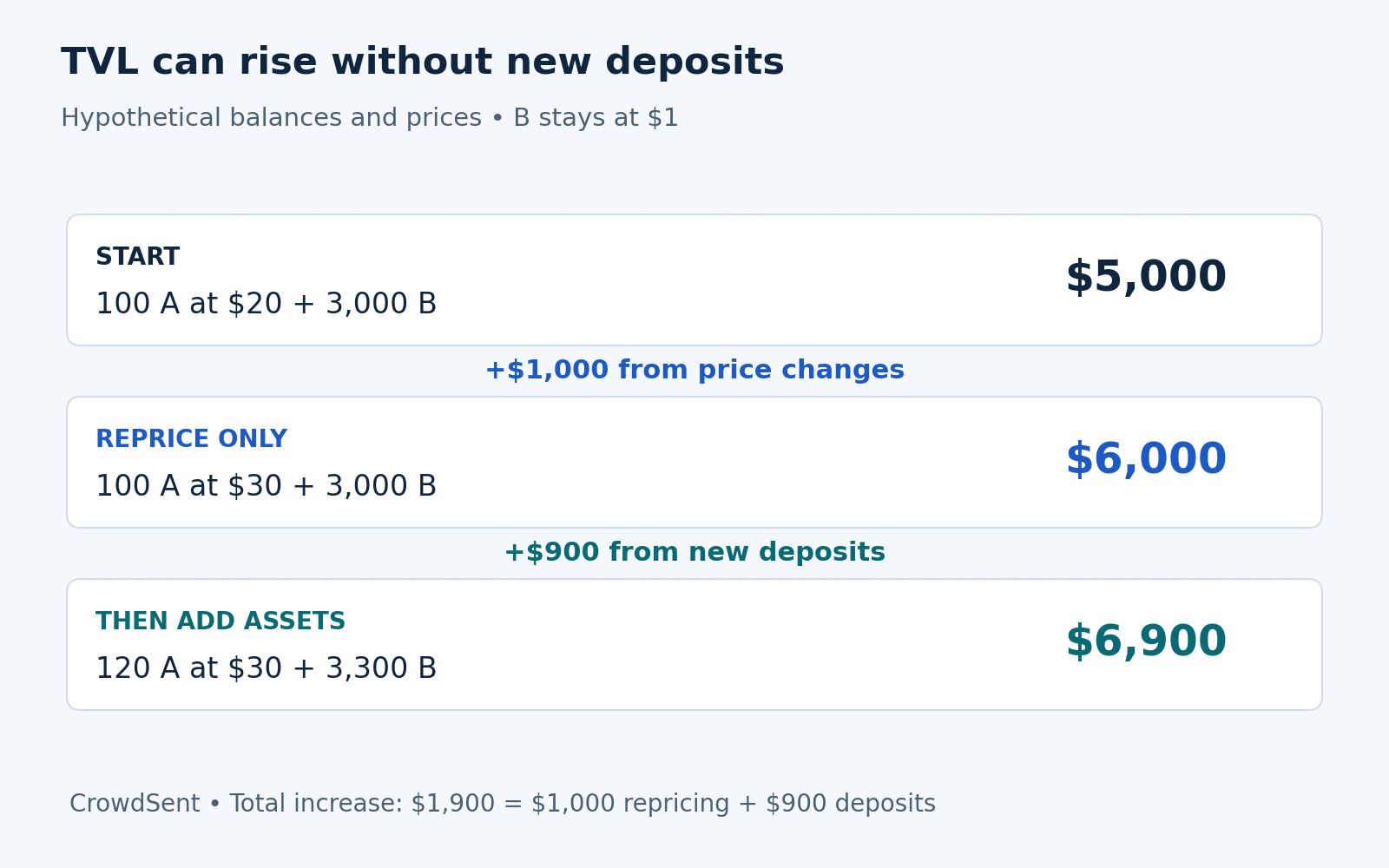
Suppose a hypothetical protocol includes 100 A and 3,000 B. Assume A is priced at $20 and B at $1. The A component is $2,000, the B component is $3,000, and TVL is $5,000.
The calculation is simple after the inputs are settled. The difficult questions are often upstream: which contracts count, which assets they hold, whether a token is a receipt for something already counted, and which price should value it.
DefiLlama’s adapter documentation describes the basic data pipeline: balances are obtained for an observation time and chain state, then converted into dollar values. That separation helps explain why a balance-reading issue and a price-reading issue can produce different errors in the same headline number.
A worked example: TVL can rise without a deposit
Keep the hypothetical balances unchanged at 100 A and 3,000 B. Now let A’s valuation price rise from $20 to $30, while B remains at $1.
The A component becomes $3,000 and the B component stays $3,000. TVL is now $6,000. The $1,000 increase, or 20%, came entirely from repricing. No additional token entered the protocol in this example.
A statement that “users deposited $1,000” would be wrong. A statement that “the included assets gained $1,000 in marked value” matches the arithmetic. The distinction matters whenever a dashboard chart is used to make claims about adoption or capital movement.
Add a genuine quantity change
Next, suppose users deposit another 20 A and 300 B while the prices remain at $30 and $1. Balances become 120 A and 3,300 B. TVL rises to $6,900.
This second step adds $900 at the assumed prices: $600 of A plus $300 of B. Across both steps, TVL increased by $1,900, or 38% from the original $5,000. The story contains $1,000 of repricing and $900 of deposits.
The example intentionally puts repricing and deposits in separate steps so their contributions are unambiguous. In real data they can happen together, alongside trading, interest accrual and other balance changes. A provider’s flow metric needs its own construction method; subtracting yesterday’s TVL from today’s does not isolate deposits.
If the underlying balances change through a swap rather than a deposit, those quantity changes have a different explanation again. A careful analysis identifies the event type before labeling every balance increase as new external capital.
Why the word “locked” can mislead
The label does not by itself establish a fixed lockup period. Different protocols have different withdrawal mechanics, conditions and constraints. A deposited asset can be counted while remaining withdrawable under the relevant contract rules.
Conversely, some restricted tokens can be outside a provider’s core TVL measure. DefiLlama’s inclusion guidance identifies categories such as vesting and distinguishes approved spending from actual deposits. A locked allocation and an asset deposited into productive protocol activity need not be classified together.
The research question should therefore be specific. “What value is included in this dashboard?” and “When can these assets be accessed?” require different evidence. TVL is not a substitute for reading withdrawal or restriction rules.
Receipts and the risk of counting the same capital twice
Imagine a participant deposits $100 of underlying assets into protocol A and receives a receipt representing that claim. The participant then places the receipt into protocol B.
At the individual-contract level, A holds the underlying assets and B holds the receipt. Adding $100 from each produces $200 of gross recorded claims. Yet the simplified example still began with $100 of external underlying capital.
Neither individual balance necessarily contains an arithmetic error. The problem emerges when the two are aggregated as if they were independent capital. A combined measure needs a rule for removing overlaps or an explicit label that it is counting gross claims.
This is why protocol-level totals cannot always be added into a chain total by hand. The relevant methodology can exclude or flag repeated claims. A headline sum without that adjustment may describe a different object from the dashboard’s own aggregate.
Borrowing and redepositing can produce further layers. Understanding those layers does not require assuming that every large number is manipulated. It requires identifying what the number counts before interpreting its size.
TVL does not measure usable liquidity at every price
A pool can have substantial total asset value while offering less capacity for a specific exchange than the total suggests. Asset composition, the pool’s mathematical rule and the distribution of liquidity all matter.
In concentrated-liquidity designs, some positions may be outside the current price range. Uniswap’s concentrated-liquidity documentation explains that those positions are inactive until price returns to their interval. Their existence helps show why a pool-wide dollar amount is not a map of active liquidity.
Consider two hypothetical pools each valued at $1 million. Equal TVL does not establish equal exchange capacity if their assets, ranges or fee arrangements differ. A sensible comparison first specifies the exchange being examined and then studies the relevant liquidity.
CrowdSent’s guide to liquidity versus volume extends this distinction. TVL describes included asset value; volume describes recorded exchanges over time; liquidity describes capacity under particular conditions.
Compare like-for-like scopes and dates
A protocol may operate several versions on several networks. One dashboard might show a parent total while another shows a single deployment. If assets migrate between versions, the old version’s TVL can fall even when the combined family total is unchanged.
For example, a move of $200 from version A to version B creates a $200 decline in A and a $200 increase in B, assuming prices and everything else stay constant. Calling the decline “capital leaving the protocol” would depend on defining the protocol as version A alone.
Observation times matter too. A chart updated before a large transaction and another updated after it can disagree without either using a faulty formula. Match the timestamp, time zone and snapshot interval before investigating a numerical discrepancy.
Methodology revisions add another complication. If a source changes its eligible contracts or removes an unsupported asset, the series can move without an equivalent on-chain withdrawal. Record revisions as revisions rather than automatically attributing them to user behavior.
What TVL can and cannot establish
TVL can help describe the scale and composition of included protocol assets. With consistent definitions, it can also show how that measured stock changes over time. It is a useful starting point for more specific questions.
It cannot independently establish security, profitability, the number of users or demand for a protocol token. A small number of large deposits can create a high total. A highly valued asset can dominate the figure even if its quantity barely changes.
Market capitalization is another separate valuation measure. CrowdSent’s market-cap and price explanation gives the basic context. Dividing a token valuation by TVL creates a ratio, but does not establish ownership of deposited assets or a claim on their income.
Where a component lacks a reliable valuation or balance, the uncertainty should remain visible. CrowdSent’s guide to missing market data versus zero explains why missing observations should not silently become economic conclusions.
Frequently asked questions about total value locked
1. Is TVL the amount of money deposited today?
No. It is a marked stock of included assets at a point in time. Today’s deposit flow is an interval measurement. Price changes, withdrawals, fees and scope adjustments can all alter TVL, so a daily difference is not automatically the day’s deposits.
2. Can TVL fall while users add more assets?
Yes. A fall in the prices of existing assets can exceed the value of additional deposits. Separating asset quantities from their valuation prices is necessary before describing a falling dollar total as evidence that users withdrew capital.
3. Does “locked” mean withdrawals are impossible?
The label does not specify withdrawal conditions. Those depend on the protocol and position. Some assets counted in TVL can be withdrawn under ordinary contract rules, while others have restrictions. The metric’s name should not be treated as a contractual lockup description.
4. Why do two TVL websites disagree?
They may use different contracts, asset categories, prices, timestamps or duplicate-counting rules. Start by matching the scope and methodology. A difference can be explainable even when both sources have accurately applied their own definitions.
5. Are vested or restricted tokens always included?
No. Inclusion depends on the provider’s rules and selected categories. Some methodologies track vesting separately from core TVL. Read the setting and underlying definition rather than assuming that every token held in a contract contributes to the main total.
6. Can I add every protocol’s TVL to calculate a chain total?
Only if their scopes and overlap adjustments support that aggregation. Receipt tokens and layered positions can represent the same underlying capital more than once. A simple sum may produce gross claims rather than the adjusted total intended by the data provider.
7. Does high TVL make a protocol safe?
No. It identifies a quantity of measured asset value, not a guarantee about code, controls or recoverability. Security requires different evidence. The fact that other capital is present does not remove the need to understand technical and economic dependencies.
8. Is TVL the protocol’s revenue?
No. Deposited asset value and income earned over a period are different accounting categories. A protocol can hold a large measured asset stock while generating limited fees. Revenue also depends on how fees are allocated between providers and the protocol.
9. Does higher TVL mean better swap execution?
Not by itself. Execution depends on the specific assets, active range liquidity, pricing rule, fees and exchange size. TVL can provide context, but it cannot replace a price-specific examination of the pool or route being analyzed.
10. What should accompany a TVL chart in research?
Include the data source, scope, timestamp, denomination, category settings and relevant methodology changes. Where possible, show token quantities or a separately defined flow measure. These details make the chart’s movement interpretable instead of leaving the reader to guess its cause.
Conclusion: separate quantity, price and scope
Total value locked is most useful when its boundaries are explicit. Read the underlying quantities, valuation prices and aggregation rules before explaining a change. That approach distinguishes new deposits from repricing, avoids repeated claims and keeps TVL in its proper role as one measurement of protocol activity.
Keep the three-part question of quantity, price and scope beside any TVL comparison.
Source documentation checked 11 October 2026. Educational explanation from the CrowdSent Blog Team. Numerical examples are hypothetical unless explicitly identified otherwise. This article does not provide investment recommendations.