

Time-weighted vs money-weighted return explains why two valid performance figures can differ for the same account. A time-weighted return links investment returns after adjusting for external contributions and withdrawals. A money-weighted return also reflects how much money was invested and when it entered or left.
The distinction becomes important whenever the account value changes because of both market performance and external cash flows. A deposit increases the balance, but the deposit itself is not an investment gain. This guide follows one hypothetical account through both calculations and keeps the reporting horizon explicit.
Define the account boundary before measuring performance
An external cash flow crosses the boundary of the portfolio being measured. A new contribution from the owner is external to that portfolio. Selling one security and retaining the proceeds inside the same portfolio is an internal transaction.
The boundary matters when several accounts are involved. Moving cash between two accounts is external to each individual account, but internal to a combined portfolio containing both. The return calculation should follow the scope named on the report.
Income also needs careful treatment. A dividend retained in the account contributes to investment performance; it is not a fresh contribution from the owner. If that cash is subsequently withdrawn, the withdrawal is a separate external event. Record the investment income and the cash movement distinctly.
How time-weighted return links the investment periods
For a true time-weighted calculation, establish valuations around each external cash flow. Calculate the investment return for each interval between flows, then multiply the growth factors:
Time-weighted return = (1 + r1) × (1 + r2) × … × (1 + rn) − 1.
Within a subperiod that contains no external flow, the return is ending value divided by beginning value, minus one. The next subperiod starts with the value after the boundary cash flow. This prevents the contribution itself from being counted as a gain.
The GIPS Standards Handbook for Firms explains geometric linking and distinguishes a true cash-flow-boundary calculation from approximations used when all needed valuations are unavailable.
Despite the name, time-weighted return is not a simple average of the subperiod percentages. Linking captures compounding. Two successive returns of +20% and −10% give 1.20 × 0.90 − 1 = +8%, rather than +10%.
Money-weighted return includes the size and timing of flows
A common money-weighted method is the internal rate of return, or IRR. It finds the rate that makes the discounted value of the investor’s contributions equal the discounted value of withdrawals and the ending portfolio value.
From the investor’s perspective, money paid into the portfolio is negative and money received is positive. The ending value is included as a positive terminal amount for the calculation even if the investor does not actually liquidate the portfolio.
For equally spaced annual observations, a cash flow one year away is discounted by 1 + r, and a cash flow two years away by (1 + r)2. The unknown r is solved from the complete cash-flow equation.
CFA Institute’s performance-reporting discussion explains the different questions answered by these methods: money-weighting retains the impact of contributions and withdrawals, while time-weighting removes their direct effect from the measured investment return.
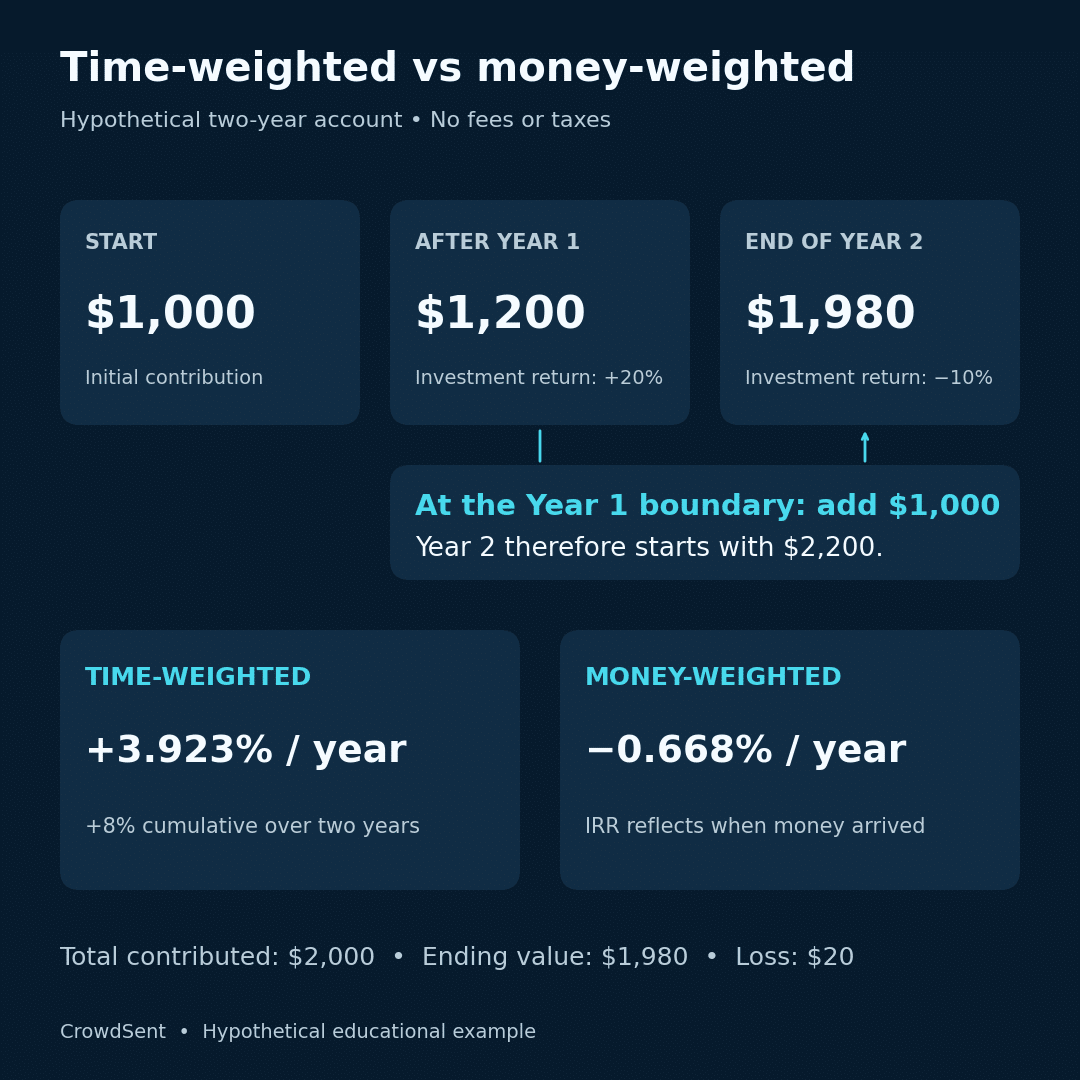
Hypothetical example: more money arrives before the losing year
Assume one account, one currency, no fees or taxes, two exact annual periods and a contribution at the boundary between them. The sequence is:
- Beginning of Year 1: invest $1,000.
- Year 1 investment return: +20%, bringing the account to $1,200.
- Immediately after Year 1: contribute another $1,000, bringing the account to $2,200.
- Year 2 investment return: −10%, leaving $1,980 at the end.
First reconcile the dollars. Total contributions are $2,000. The terminal value is $1,980, so the investment result is a $20 loss. Year 1 gained $200; Year 2 lost $220 because more capital was exposed during that second year.
The time-weighted result uses the two subperiod returns: 1.20 × 0.90 − 1 = +8% over two years. Its annualized equivalent is the square root of 1.08 minus one, approximately +3.923% a year.
The money-weighted equation, from the investor’s perspective, is:
−1,000 − 1,000/(1 + r) + 1,980/(1 + r)2 = 0.
Multiplying through gives 1,000(1 + r)2 + 1,000(1 + r) = 1,980. Solving for the economically relevant root gives r approximately −0.668% a year.
Thus the investment path has a positive time-weighted return while the cash-flow-weighted result is negative. More money experienced the losing year. The difference is an explanation of the arithmetic, not evidence that one calculation is dishonest.
Match horizons before comparing the answers
The +8% time-weighted figure is cumulative over two years. The −0.668% IRR is an annual rate. Placing them side by side without those labels would mix horizons.
A matched annual comparison is approximately +3.923% time-weighted versus −0.668% money-weighted. Alternatively, disclose the cumulative time-weighted result and the annual IRR with clear labels rather than pretending they share the same scale.
As a cross-check, remove the second $1,000 contribution from the hypothetical account. The original $1,000 becomes $1,200 and then $1,080. The time-weighted two-year return remains +8%, and the annual IRR becomes approximately +3.923%. With no intermediate external flow, the two calculations now align on the same annualized basis.
Dividing the original account’s $20 loss by $2,000 of contributions gives −1%. That simple gain-to-contributions ratio does not account for the fact that the second contribution was invested for only one of the two years. It is not the IRR.
Use actual dates when flows are irregular
Real deposits rarely arrive at evenly spaced annual intervals. A date-aware IRR method uses the timing of each cash flow instead of treating all gaps as identical.
Microsoft’s XIRR documentation specifies date-based cash flows and a 365-day discounting basis. It requires at least one positive and one negative value. Those are tool-specific details worth preserving when reproducing an Excel result in another application.
A spreadsheet failure is not a zero return. Check cash-flow signs, matching dates, the terminal value, duplicate rows and the solver’s starting guess. Different day-count or annualization conventions can also create small discrepancies between systems.
Unusual cash-flow patterns can have multiple IRRs. For example, the hypothetical annual sequence −100, +230, −132 has both 10% and 20% solutions. Substituting either into the discounted cash-flow equation gives zero. A solver returning one solution does not prove that it is unique.
Valuations and fees can change the interpretation
Time-weighting depends on the quality and timing of intermediate valuations. If a large deposit arrives between stale valuations, assigning all movement to the correct side of the deposit can be difficult. A result based on an approximation should identify that method.
Modified Dietz is one approach that weights external flows by time invested. It is useful to recognize its name on a report, but its weighted-flow arithmetic is not identical to a true valuation-at-every-flow calculation. State what was actually computed.
Cost treatment belongs beside either return measure. A report intended to show net-of-fee performance should not neutralize a management charge as though it were simply an owner withdrawal. Keep transaction costs, management fees, taxes and genuine external flows separately identifiable, following the report’s declared methodology.
Also keep missing valuations visibly missing. CrowdSent’s guide to missing market data explains why a blank observation should not quietly become a zero.
A practical return-reconciliation checklist
- Name the measured portfolio, currency and exact dates.
- List contributions, withdrawals and their timestamps.
- Separate internal transactions, income and fees from external flows.
- Reconcile beginning value plus flows plus investment result to ending value.
- Identify TWR, IRR, XIRR or the actual approximation used.
- Match cumulative and annualized horizons before comparing results.
- Record valuation limitations and any unresolved solver issue.
A market research journal provides a place to retain those definitions. For multi-currency records, the base- and quote-currency guide helps clarify the conversion inputs before returns are combined.
Frequently asked questions
1. Can an account lose dollars while its time-weighted return is positive?
Yes. The example earns 20% on $1,000 and then loses 10% on $2,200. Linked returns are positive, but the larger second-year exposure creates a $20 overall loss.
2. Does a deposit count as investment performance?
No. It changes the capital inside the account. Return methods need to distinguish that external contribution from value changes caused by investment outcomes.
3. Is time-weighted return an average of monthly returns?
It geometrically links subperiod growth factors. A simple arithmetic average of monthly percentages answers a different question and does not reproduce cumulative investment growth.
4. Is money-weighted return always an IRR?
IRR is a common money-weighted method. Reports may use other cash-flow-weighted approaches, so obtain the stated formula rather than relying only on the broad label.
5. Why include an unsold portfolio as a terminal cash flow?
Its ending value represents the wealth remaining at the measurement date. Including it closes the valuation equation; it does not claim that a sale actually occurred.
6. Are dividends external contributions?
Dividends earned by investments are investment income. Retained income stays within the portfolio. A later payment out to the investor is recorded separately as an external withdrawal.
7. What distinguishes IRR from XIRR in a spreadsheet?
Ordinary IRR assumes regularly spaced cash flows. XIRR uses supplied dates for irregular timing. Its documented day-count convention and annualized output should remain visible in the report.
8. Why might two account reports disagree slightly?
Check valuation timing, cash-flow timing, fee treatment, day-count conventions, rounding and calculation method. Differences can arise before any disagreement about the underlying market prices.
9. Is a money-weighted result a measure of manager skill?
It can reflect cash-flow decisions outside the manager’s control. Interpretation depends on who determined the flows and the investment mandate, rather than on the return label alone.
10. What should accompany either headline return?
Include dates, currency, cumulative or annualized status, cost basis and calculation method. For money-weighting, retain the dated cash-flow schedule; for time-weighting, retain the subperiod valuations.
To explore the workspace and its membership options, open CrowdSent.
Educational note: All account figures are hypothetical. This article explains performance measurement and does not provide individualized investment or tax advice.