

A stablecoin is a digital token designed to track a reference value, often one unit of a currency such as the US dollar. The design can make a price easier to interpret, but the word “stable” does not establish the quality of its reserves or a holder’s ability to redeem it.
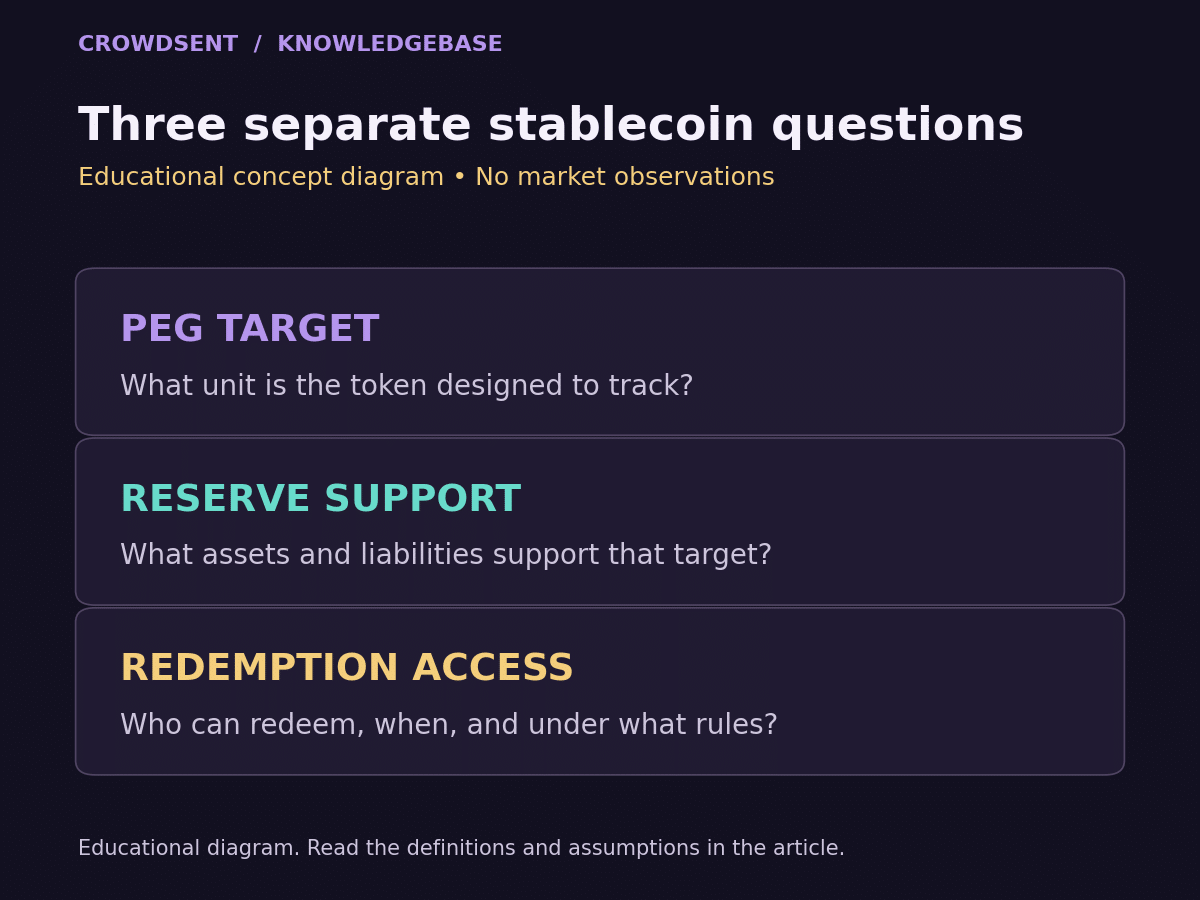
A useful stablecoin explanation follows three separate questions: What value is the token trying to track? What supports that value? How can a holder actually exchange the token for the reference asset? Keeping those questions separate makes reserve announcements, price deviations and redemption claims much easier to read.
This guide explains the mechanics for educational research. It does not recommend a stablecoin, platform or transaction.
Stablecoin meaning: what does the peg describe?
A peg is the value a token aims to maintain relative to a specified reference. A dollar-referenced token might target one US dollar per token. Another token might track a different currency, a basket, or a quantity of a commodity. The reference must be identified before “stable” has a useful meaning.
The peg is a target. The market price is the price available in a particular market at a particular time. A token can have a one-dollar target while trading above or below one dollar. Transaction costs, fragmented markets, uncertainty and restrictions on moving funds can all affect the observed price.
The reserve is a separate concept: assets or collateral intended to support the arrangement. Redemption is the process by which eligible holders exchange tokens under the relevant rules. A screenshot showing a price of $1.00 answers none of the important questions about reserve ownership, custody or redemption access.
For a reader measuring wealth or expenses in Indian rupees or Pakistani rupees, dollar stability also leaves exchange-rate exposure. A token that tracks the dollar closely can still change value in INR or PKR as the dollar exchange rate changes. This is a currency comparison, not a statement about local access or rules.
How do different stablecoin mechanisms work?
Stablecoins are easier to understand by examining the support mechanism than by assuming every token with a currency symbol works alike. The BIS discussion of stablecoin arrangements describes fiat-asset backing, crypto collateral and algorithmic designs. Actual projects can combine elements of more than one model.
Fiat-reserve arrangements hold assets outside the token’s blockchain, such as bank deposits or short-term securities. An issuer or associated organisation manages issuance, custody and redemption. The research questions concern the asset mix, the institutions holding it, the reserve liabilities and the holder’s contractual rights. A currency-denominated reserve need not consist entirely of physical cash or money immediately available in a bank account.
Crypto-collateral arrangements use cryptoassets to support token issuance, often through smart contracts. Extra collateral can provide a buffer against changes in its market value. The buffer depends on valuation, liquidation mechanisms, network functioning and the ability to sell collateral under stress. A visibly large collateral balance can still be vulnerable if its value falls quickly or it cannot be sold efficiently.
Algorithmic or incentive-based arrangements try to influence supply and demand using rules, conversions or linked tokens. The important question is where the economic support comes from when demand weakens. If support depends heavily on another token whose value also falls during stress, confidence and collateral value can deteriorate together. The presence of software rules alone does not establish a dependable redemption asset.
Commodity-linked arrangements refer to a quantity of an asset such as gold. Their price can be relatively stable against that commodity while moving substantially against a currency. Custody, physical allocation, verification, minimum redemption sizes and delivery costs become central questions. The name of the commodity does not establish the exact legal claim represented by the token.
These are research categories. They are not rankings of individual assets, and a project’s self-description should be checked against its operative documentation.
How should reserve information be read?
Begin with the date and scope. A reserve report describes evidence for a defined period or point in time. It may not describe what is held now, every entity in a corporate group, or every obligation associated with a token ecosystem.
Then separate asset quantity from asset quality. A reserve can appear large enough in total value while containing assets that take time to sell, depend on a particular counterparty, or change value during a market disruption. Currency matching matters too: assets measured in another currency can create an additional source of fluctuation.
As an issuer-specific example, Circle’s transparency page describes reserve categories and provides reporting for its stablecoins. Those disclosures are evidence about that issuer’s stated arrangement. They should be read with the applicable terms rather than treated as a guarantee for every token using the same currency reference.
Look at what an independent report actually tests. A reserve attestation may address specified management assertions at stated dates. That does not automatically make it a full financial-statement audit or a review of every operational risk. The report’s scope, accounting basis, exceptions and signatory matter more than a promotional label saying “verified.”
A practical note should record the token, issuing entity, report date, assets covered, obligations covered and unresolved questions. If the liabilities are unclear, an impressive-looking asset total is incomplete evidence.
A hypothetical example: the peg holds while access changes
Imagine a fictional token called Example Dollar, targeting $1 per token. There are 10 million tokens outstanding and a reserve report lists assets worth $10 million. The report shows $2 million in bank deposits and $8 million in short-term securities. These figures are invented to explain the distinction.
On an ordinary day, a market price of $1.00 is consistent with the target. It does not tell a small holder whether they may redeem directly, whether an intermediary must do so, or how quickly funds arrive.
Now suppose one banking channel becomes temporarily unavailable. The reported assets have not necessarily disappeared, yet some redemption requests may take longer. Market participants who need immediate liquidity may accept $0.99. That deviation is evidence of a market discount; further investigation is needed to identify its cause.
Alternatively, suppose a new report values reserve assets at $9.6 million against the same 10 million-token obligation. That creates a different question about asset coverage. Both situations can produce concern about the peg, but a processing delay and a reserve shortfall are different mechanisms.
The example shows why “it traded below a dollar” and “the reserve is insufficient” cannot be used interchangeably without evidence. It also shows why full reported coverage does not establish immediate redemption for every holder.
Why redemption terms matter as much as the chart
The route from a token to a bank balance can contain several steps: blockchain transfer, acceptance by a platform or issuer, redemption processing, and payment through a banking channel. Each step has its own conditions and potential interruptions.
Direct issuer redemption and selling a token on an exchange are different events. In a market sale, another participant buys the token at an available price. In redemption, tokens are exchanged through the issuer’s or protocol’s specified mechanism. A liquid market can help holders transact, but its existence does not prove that they personally have direct redemption rights.
For example, Circle’s USDC terms attach direct redemption to eligibility, registration and other conditions. The terms also distinguish token ownership from entitlement to income earned on reserve assets. This illustrates why the applicable contract needs to be read alongside marketing descriptions.
A research checklist should include who may redeem, accepted networks, minimums, fees, operating conditions, suspension provisions and the receiving asset. Avoid assuming that a process described for one customer category applies to another.
What can weaken a stablecoin arrangement?
Reserve losses, difficulty turning assets into cash, custody problems, operational failures and loss of confidence can interact. A period of heavy redemptions can make the quality and accessibility of reserve assets especially important. The Federal Reserve discussion of stablecoin risks explains why non-cash reserves can create vulnerability under stress.
There are also risks outside the reserve portfolio. A smart-contract flaw can affect transfers or collateral. A bridge can introduce additional dependencies when a token representation moves between networks. A custodial platform can restrict access to a customer’s balance even if the underlying token continues functioning elsewhere.
Check the exact token contract and network. Identical tickers or logos are weak evidence of identity. A native issuer token and a bridged representation may rely on different arrangements. It is possible to be correct about a brand and still misunderstand the asset held on a particular chain.
Finally, network costs are separate from peg behaviour. A transfer can involve a volatile network fee even when the token’s quoted price remains close to its reference. CrowdSent’s guide to Ethereum gas fees explains that separate cost layer.
Building a clear stablecoin research note
A short note can be more useful than a collection of reassuring slogans. Record the reference currency or asset, mechanism, issuer or protocol, exact network, reserve evidence and redemption route. Add the timestamp and currency of any observed market price.
If a crypto pair uses a stablecoin as its quote asset, retain that detail. A price expressed in USDT or another token is not automatically a directly observed US-dollar price. The BTC/USD versus BTC/USDT guide explains how the quote asset changes the comparison.
Label an unresolved point as unresolved. If a reserve report cannot be located, do not replace it with a social post asserting that reserves are “safe.” For a repeatable approach to announcements and original documents, use the market-news verification checklist.
Frequently asked questions
1. Is a stablecoin always worth one dollar?
No. One dollar may be its target, and some stablecoins target something else entirely. The executable market price can differ from the reference value. The target, the latest trade and the price available for a particular transaction are separate observations.
2. Does “fully backed” mean all reserves are cash?
Not necessarily. It may describe the stated value of reserve assets relative to token obligations. The reserve could include bank deposits, securities or other assets. Its composition, valuation date, accessibility and relevant liabilities need separate examination.
3. Can a stablecoin depeg without a reserve loss?
Yes. Market liquidity, delayed processing, uncertainty or restricted access can affect trading prices even before any reserve loss is established. A price deviation is a reason to investigate the mechanism and evidence, not proof of a particular cause.
4. Are stablecoins the same as bank deposits?
The token label does not establish a bank-deposit claim or deposit-insurance protection. Rights depend on the arrangement and applicable terms. An issuer holding reserves at a bank does not by itself establish that every token holder has the same rights as that bank’s depositor.
5. Does a dollar peg remove currency risk for INR or PKR users?
It removes neither the need to identify the reference currency nor the effect of exchange-rate changes. Even perfect tracking of one US dollar leaves the token’s INR or PKR value dependent on the dollar’s exchange rate against those currencies.
6. Is an attestation the same as an audit?
Those labels can refer to engagements with different scopes. Read the actual report to identify what was examined, the period covered, the criteria used and any qualifications. A summary badge cannot substitute for those details.
7. Do stablecoin holders automatically receive reserve interest?
No automatic entitlement follows from the name stablecoin. Some reserves may earn income, but who receives it depends on the arrangement. A separate yield product introduces its own terms and risks; its advertised return should not be treated as part of the peg.
8. Why might the same stablecoin have different prices on two platforms?
Platforms can have different order books, transfer conditions, fees and access constraints. Quotes may also come from different times or use different currencies. A valid comparison aligns the exact token, market, quote asset and timestamp first.
9. Does holding the token mean I can redeem with its issuer?
That depends on the issuer’s terms and eligibility rules. Some holders rely on secondary markets or intermediaries rather than direct redemption. The relevant evidence is the documented right and process for that holder category.
10. What should a stablecoin explanation establish first?
Identify the reference value, the support mechanism and the redemption path. Then examine reserves, operational dependencies and observed market behaviour. This order keeps a familiar-looking price from doing the work of a proper explanation.
A stablecoin is best understood as an arrangement with a target, supporting assets or incentives, and rules for access.