

CrowdSent Blog Team · Bitcoin quote research
BTC/USD vs BTC/USDT is a comparison of quote currencies as well as Bitcoin prices. BTC/USD expresses a Bitcoin quotation in US dollars. BTC/USDT expresses it in USDT tokens. The similar labels can hide differences in the instrument, provider, observation time and measurement method, so a larger displayed number needs investigation before interpretation.
This guide gives you seven checks for comparing the records fairly. You will work through an invented conversion, see how an INR or PKR reporting layer changes the arithmetic, and build a note another reader can reproduce. The purpose is to understand what each quotation means, without choosing a pair to trade or assuming that any displayed difference can be captured.
1. Start BTC/USD vs BTC/USDT with the quote currency
The first asset is the base asset; the second is the quote asset. Coinbase’s market trading rules use BTC/USD to illustrate this convention: BTC is the base and USD is the quote. On that basis, a price describes quote-asset units for one unit of the base asset. That naming convention identifies the units, rather than a universal Bitcoin price.
Read “60,000 USD per BTC” differently from “60,000 USDT per BTC”, even when the numerals match. Treating the second as dollars silently introduces an exchange-rate assumption. Write the assumption explicitly or obtain a time-matched conversion observation. This small habit prevents a currency substitution from disappearing inside a spreadsheet column named only “price”.
Tether’s official FAQ describes USD₮ as a token pegged to the US dollar and explains that its tokens operate on multiple blockchains. A stated peg is relevant background; a specific comparison still needs the observed conversion value and its source. The token name alone does not supply that measurement.
Keep three labels separate in your notes: the Bitcoin amount, the asset used to quote it, and any currency selected for reporting. A reader in India can report an observation in INR while the original instrument remains BTC/USDT. A reader in Pakistan can retain a USD quotation while writing commentary in English. Presentation choices do not redefine the source instrument.
2. Identify the instrument behind the ticker
A symbol is a starting point for a lookup. Open the provider’s instrument description and retain the full product identifier. BTCUSD, BTC-USD and BTC/USD might be different display styles, but similar spelling alone cannot prove that two records describe the same market. Record the venue or data provider, product category and any contract identifier alongside the symbol.
Coinbase’s product-reference documentation shows separate fields for product ID, base currency, quote currency and display name. This is a useful example of why a readable label and a machine identifier should both be retained. It is documentation of that provider’s fields, rather than evidence that another provider uses the same mapping.
For each record, ask whether you are reading an actual spot market, a derivative contract, an index or a calculated display conversion. If it is a contract, obtain the specification before comparing its price with a spot observation. The quote asset, collateral asset and settlement terms should be separate entries wherever the documentation distinguishes them.
- Save the provider’s exact symbol rather than replacing it with a preferred shorthand.
- Record whether the page describes one market or combines observations from several sources.
- Keep unknown fields visibly marked “unverified”; do not let a familiar ticker fill them in.
For example, two fictional files labelled “Bitcoin USD” might contain a spot last-trade series and a daily reference calculation. Renaming both to BTC/USD would erase the distinction. A useful comparison begins by preserving it.
3. Align the time and the type of price
Choose comparable fields before comparing values. A last transaction, an advertised bid, an advertised ask and a calculated midpoint answer different questions. Save the field’s documented meaning and whether the provider describes a delay. A screenshot captured now can still contain an older observation.
Use two timestamp fields: when the source says the observation occurred, and when you retrieved it. Add the date and timezone to both. A page-refresh time, article-publication time and market-observation time should not be silently exchanged. If a necessary timestamp is absent, the result remains an approximate comparison with an explicit limitation.
Hypothetical time check: Record A has observation time 10:00 UTC. Record B shows 15:30 in Asia/Kolkata, while Record C shows 15:00 in Asia/Karachi, all on the same stated day. Those represent the same instant under the stated offsets, UTC+05:30 and UTC+05:00 respectively. A record saying only “15:00 local” lacks enough information for that conclusion.
Next inspect freshness. If A is a transaction reported at 10:00 but B is a transaction from 09:57 displayed on a page updated at 10:00, they are not synchronized observations. Retain the three-minute gap instead of presenting the figures as simultaneous. The market news verification guide offers the same discipline for distinguishing when an event occurred from when someone wrote about it.
4. Convert BTC/USDT into a comparable USD reference
Every market value and provider in this example is hypothetical. Assume three time-matched indicative records on one fictional study day: Provider A shows BTC/USD at USD 60,000 per BTC; Provider B shows BTC/USDT at 60,600 USDT per BTC; Provider C shows USDT/USD at USD 0.9900 per USDT. Assume the stated instruments and price fields are comparable for this arithmetic exercise.
The first two displayed numbers differ by 600, but their units differ too. Convert Provider B’s observation by multiplying 60,600 USDT per BTC by USD 0.9900 per USDT. The USDT units cancel, leaving USD 59,994 per BTC. Compare that figure with Provider A’s USD 60,000 per BTC: the converted difference is negative USD 6 per BTC, or negative 0.01% of A’s reference.
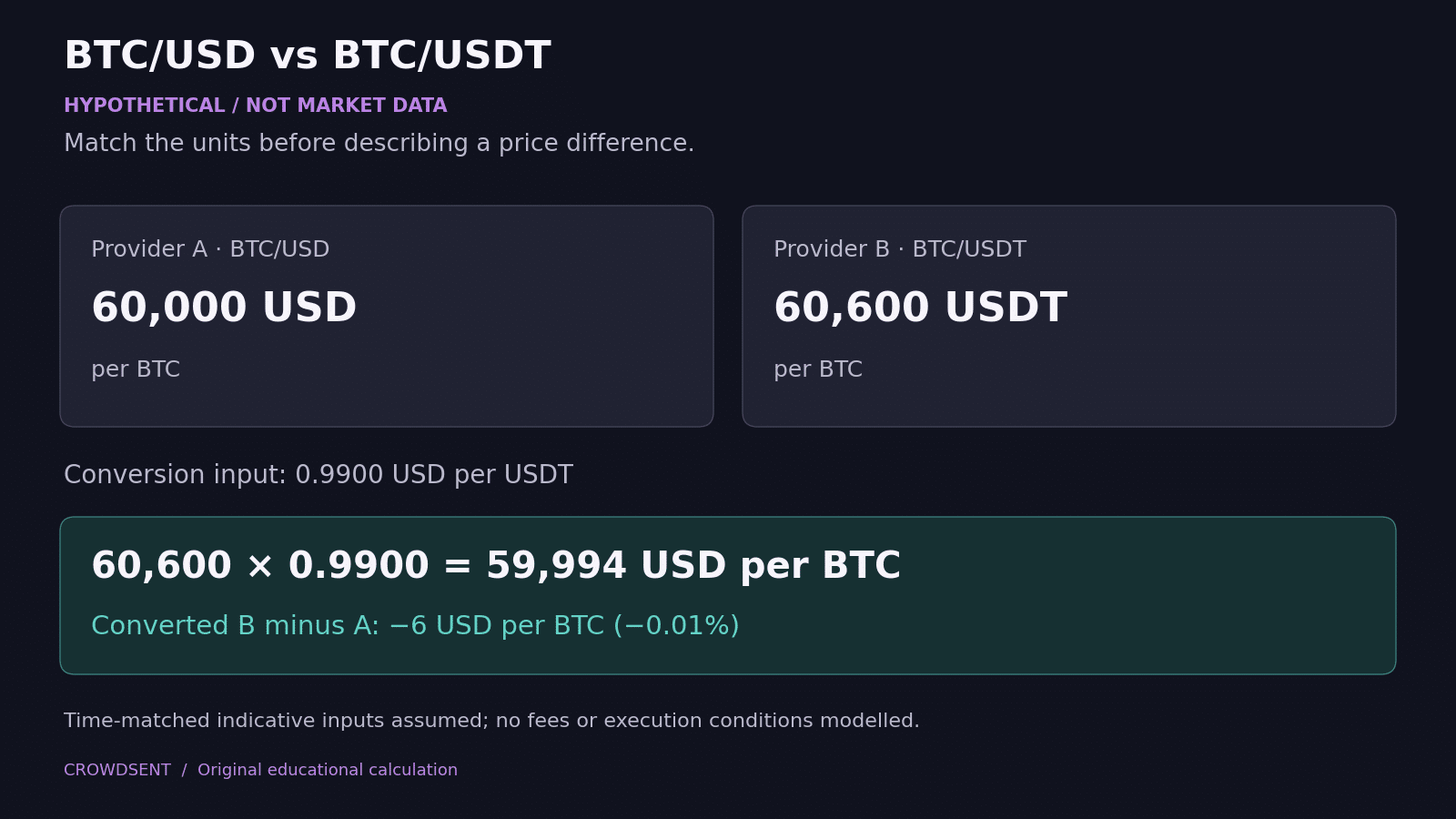
This result changes the description of the records. The unconverted number is numerically larger; the converted reference is slightly smaller. The calculation does not explain why those observations exist, prove that Provider C’s conversion was available for a particular transaction, or account for charges. It establishes what follows from the inputs you explicitly supplied.
Check the direction of the conversion
If a conversion is quoted as USDT per USD instead, divide by that rate. For this example the reciprocal is approximately 1.010101 USDT per USD. Dividing 60,600 by that unrounded reciprocal produces the same USD 59,994 result. Multiplying by the reciprocal would reverse the intended conversion and introduce an error.
Retain full precision during the calculation and round only the displayed answer. Then test sensitivity rather than pretending a missing input is known. Holding 60,600 USDT per BTC constant, a hypothetical rate of USD 1.0000 per USDT gives USD 60,600 per BTC. A rate of USD 0.9900 gives USD 59,994. These are two stated assumptions, not a forecast for the token.
5. Check candle boundaries, volume units and missing records
Historical comparisons add another layer. A daily candle is an aggregation over a defined interval; “daily” alone does not specify the opening and closing boundary. Keep each provider’s timezone, timestamp convention and treatment of missing observations. A rolling 24-hour change and a calendar-day change need separate labels even if both appear beside the same ticker.
Hypothetical data-quality example: Series A covers 00:00–23:59 UTC. Series B uses a local calendar day beginning at 00:00 in Asia/Kolkata. The intervals overlap, but their boundaries differ by five hours and thirty minutes. Before discussing different daily percentage changes, realign the underlying observations or explain why a like-for-like calculation cannot be made.
Read the unit attached to volume as carefully as the price unit. Does the file report BTC quantity, quote-asset amount, contract count or an aggregated estimate? A column containing 10,000 should not be compared with another column containing 10,000 until both definitions are known. Also record whether the same transactions could appear in overlapping aggregated sources.
For sentiment comparisons, use the same observation window and preserve changes in source coverage. The guide to reading historical sentiment helps frame those checks. A difference between two discussion samples cannot repair a missing candle or identify the correct quote currency. Price, activity and discussion records each need their own documented construction.
6. Make the INR or PKR reporting layer explicit
Use INR for Indian rupees and PKR for Pakistani rupees. Avoid “Rs” when readers could reasonably interpret either currency. A local-currency research reference requires another stated conversion, and that conversion should match the intended timestamp and unit.
Hypothetical INR example: take the converted USD 59,994 per BTC from the worked example and a fictional reporting input of INR 90 per USD. Multiplication gives INR 5,399,460 per BTC, written as INR 53,99,460 in Indian digit grouping. The digit grouping changes readability; it does not change the amount. For an illustrative quantity of 0.01 BTC, the corresponding arithmetic reference is INR 53,994.60.
Hypothetical PKR example: using the same USD 59,994 reference and a separate fictional input of PKR 280 per USD gives PKR 16,798,320 per BTC. These round conversion inputs are invented for teaching. They are not current currency rates, local offers, or evidence that a particular payment route is available.
If you instead start from a directly observed BTC/INR or BTC/PKR quotation, retain that observation as its own source record. Compare it with your converted reference only after checking instrument, timing and any included charges. Do not overwrite it with the conversion or describe an unexplained residual as a regional premium without supporting evidence.
7. Close with a comparison someone else can reproduce
A useful BTC/USD vs BTC/USDT note ends with the inputs and limits that matter. You should be able to hand the note to another reader without explaining undocumented assumptions. Use the market research journal template to keep observations, calculations and interpretation visibly separate.
- Question: which two records are being compared, and why?
- Identity: provider, exact symbol, product category and quote asset.
- Timing: observation time, retrieval time, timezone and known delay.
- Calculation: conversion source, unit direction, arithmetic and rounding.
- Conclusion: what the aligned records show, and which uncertainties remain.
Save an untouched copy of the source values before making corrections. If you later discover that one symbol represented a derivative, mark the original conclusion as needing revision and record the reason. Quietly replacing the input would make the research history harder to audit.
When a community post describes the gap as an obvious opportunity, first test whether it includes the same identification and conversion checks. The guide to evaluating trading community discussions can help you inspect the claim without inheriting its confidence. A comparison is complete when its conclusion matches the evidence, including a conclusion that the available records are insufficient.
Frequently asked questions about BTC/USD vs BTC/USDT
Are BTC/USD and BTC/USDT the same thing?
They share BTC as the named base asset, while their quote assets differ. Keep USD and USDT in separate fields and check the provider’s product description. If you want a common reporting unit, document the conversion rather than changing the label. Similar-looking values do not establish that the underlying instruments are interchangeable.
Does USDT always equal exactly one US dollar?
Do not hard-code exact equality into a measurement merely because the token has a dollar peg. For a specific comparison, obtain the relevant observed conversion and record its timestamp. If your exercise assumes equality for simplicity, label it an assumption and explain how a different conversion would change the result.
Why can BTC/USDT display a higher number than BTC/USD?
Start with the denomination and the time-matched conversion, then inspect the instruments and price fields. The worked example shows how a numerically higher token quotation can convert into a slightly lower dollar reference. Any remaining difference needs further evidence; the larger displayed number alone does not identify its cause.
Is BTCUSD always a spot Bitcoin market?
The compact symbol alone is insufficient. Look for the provider’s full instrument specification and product category. Preserve any contract identifier and distinguish price quotation from settlement terms. If the available documentation does not resolve the instrument type, keep that field unverified and limit your comparison accordingly.
Can I compare percentage changes without converting currencies?
You can report each series’ own change with its original unit clearly stated, but do not treat the two percentages as an identical dollar comparison. In a hypothetical example, a 2% increase in a token-denominated series combined with a 1% decline in its dollar conversion gives 1.02 multiplied by 0.99, or a 0.98% dollar increase.
Which price field should I record?
Choose the field that answers the research question and use the same definition on both sides where possible. A recent transaction and an advertised asking price describe different observations. Record the field name, timestamp and any delay, and do not silently switch fields simply because another figure is easier to find.
Does a BTC/USDT ticker tell me which blockchain USDT uses?
The ticker is not enough to identify a transfer network. Record network information separately if it is relevant to your research, using the actual platform documentation. Avoid assuming that a quote-currency label also supplies an address format, transport protocol or compatibility guarantee. Those are separate questions from comparing displayed prices.
Does a difference between two quotations prove an achievable gain?
No. The comparison may involve unlike units, stale observations, non-executable references or unmatched instrument types. Even a properly normalized difference leaves conditions outside this article’s arithmetic untested. Report the observed gap and the unresolved inputs without turning a research calculation into a statement about an available outcome.
How should readers in India or Pakistan record the local value?
Choose INR or PKR explicitly and keep the local-currency calculation as a separate reporting layer. Save the conversion direction and timestamp, and distinguish a calculated reference from a directly observed local quotation. Use consistent digit grouping and retain the original full-precision inputs so another reader can reproduce the arithmetic.
What if my data provider does not explain its ticker mapping?
Treat the missing mapping as a material limitation. Save the provider’s description, the exact visible symbol and the fields you can verify, then ask for the missing specification through its documented support route if needed. Until the mapping is resolved, avoid claiming that two feeds represent the same pair or market.
Source documentation checked 7 October 2026. Educational research guidance from the CrowdSent Blog Team. Hypothetical examples are invented and are not current market observations. This article does not provide investment recommendations.