

By CrowdSent Blog Team
A real interest rate adjusts a nominal interest rate for inflation. The useful question is how much the ending money can buy. This guide follows one hypothetical amount through three price scenarios and shows why the inflation input needs a clear date and definition.
What does a real interest rate measure?
A nominal interest rate describes a money payment relative to an amount borrowed or lent over a stated period. A real interest rate adjusts that money growth for a stated inflation measure. The ECB’s explanation of interest rates uses purchasing power to distinguish the concepts.
“Real” here means inflation-adjusted. It does not mean verified, risk-free, after tax, or guaranteed. A carefully calculated real rate can still depend on an uncertain inflation assumption or describe a contract with other risks.
Think of two separate questions. First, how many currency units are there at the end? Second, how much of the chosen basket can those units buy relative to the beginning? The nominal calculation answers the first. The real calculation addresses the second.
The basket is part of the answer. A broad consumer-price index, an individual household’s expenses, and prices in another country need not change equally. Before reading a real-rate number, find the inflation series, geography, horizon, and whether the inflation input was expected or already observed.
Use growth factors for the exact calculation
For a single period with compatible inputs, the exact relationship is: real growth factor = nominal growth factor divided by price growth factor. In rate form, real rate = (1 + nominal rate) ÷ (1 + inflation rate) − 1. Enter rates as decimals in this formula.
The FRED explanation of real-rate construction provides this relationship and distinguishes it from the common approximation of nominal rate minus inflation. It also distinguishes an expected, or ex ante, measure from a realized, or ex post, measure.
Why divide? Suppose money becomes 1.08 times its starting amount while the price of a fixed basket becomes 1.05 times its starting price. Dividing the two factors asks how many starting-period baskets the new money amount can buy. Subtraction is only a shortcut to that ratio.
The exact rate can also be written as (nominal rate − inflation rate) ÷ (1 + inflation rate). This rearrangement makes the approximation visible: simple subtraction leaves out the denominator. At modest inflation rates the numerical gap may be small; large rates make it harder to ignore.
Always compare rates over the same period. A one-year nominal return and one month’s unannualized inflation are not compatible simply because both appear as percentages.
Worked example: more money, a smaller real gain
Imagine a one-year contract that turns 10,000 currency units into 10,800. Assume a single beginning payment, a single ending payment, no intermediate cash flows, no fees, no taxes, and no default. This is a classroom example, not a product offer in India, Pakistan, or the United States.
A representative basket costs 100 at the start and 105 at the end. Initially, 10,000 buys 100 basket units. At the end, 10,800 ÷ 105 buys approximately 102.857 basket units. Purchasing power has increased by approximately 2.857%.
- Nominal gain: 10,800 ÷ 10,000 − 1 = 8%.
- Inflation: 105 ÷ 100 − 1 = 5%.
- Exact real gain: 1.08 ÷ 1.05 − 1 ≈ 2.857%.
- Subtraction approximation: 8% − 5% = 3%.
The difference between 3% and 2.857% is about 0.143 percentage point. That gap is a property of the arithmetic, not an extra charge taken from the account. A nominal statement would still show 10,800 under our assumptions.
To see the meaning another way, deflate the ending amount into starting-period purchasing power: 10,800 ÷ 1.05 ≈ 10,285.71. Relative to the initial 10,000, that is a real increase of 285.71 currency units measured at the starting price scale.
Do not compare the deflated 10,285.71 with an end-period bill without restoring matching price units. The calculation deliberately expresses an end-period amount in an earlier purchasing-power scale.
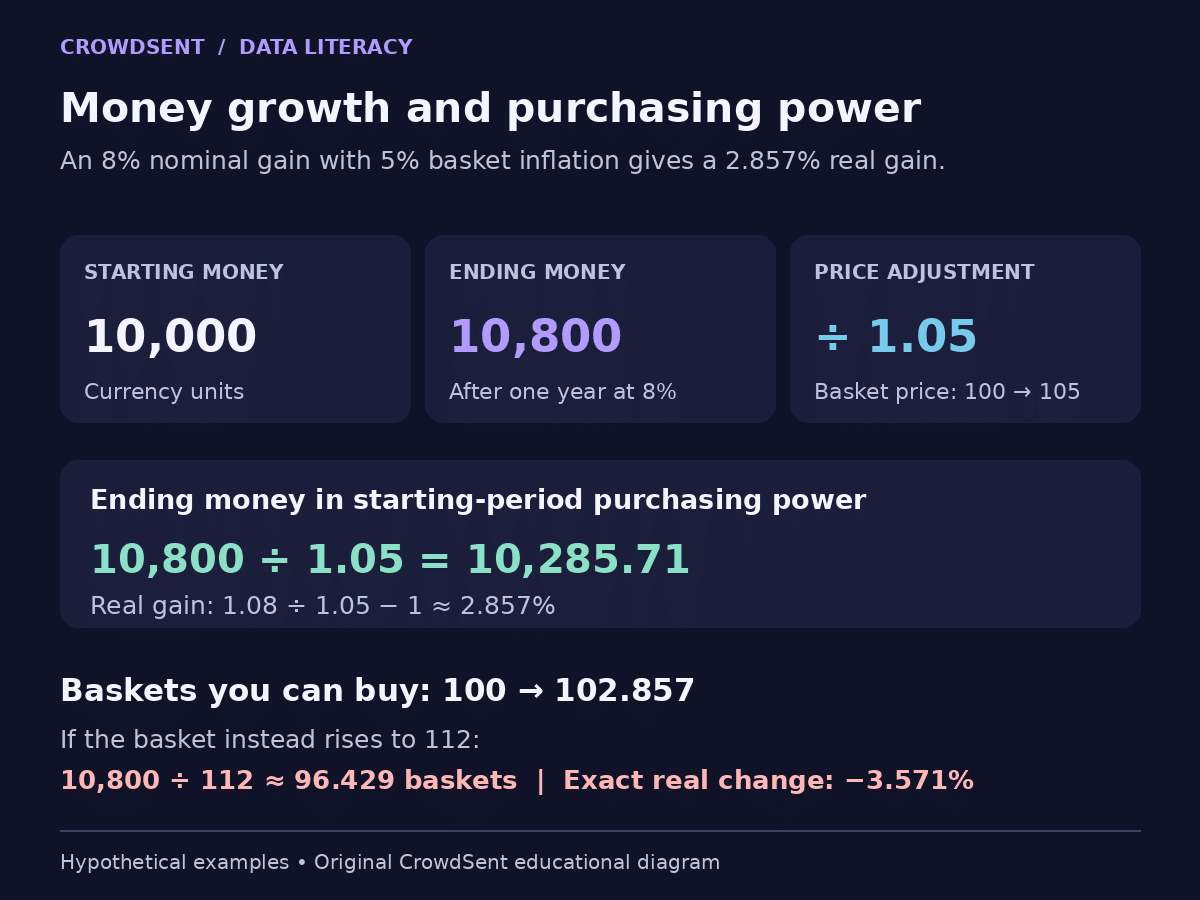
How a positive nominal rate becomes negative in real terms
Keep the same 8% nominal return, but let the basket rise from 100 to 112. The end balance remains 10,800. It now buys 10,800 ÷ 112, or approximately 96.429 basket units, compared with 100 initially.
The exact real rate is 1.08 ÷ 1.12 − 1 ≈ −3.571%. The account gained currency units while losing purchasing power against this basket. A negative real rate does not require a negative nominal rate.
Nor does it mean a fixed nominal debt balance is automatically reduced. If the contract requires payment of 10,800, inflation does not rewrite that amount. The real comparison describes its purchasing-power value. Whether payment becomes easier for a borrower depends on income and other circumstances outside this calculation.
The reverse arithmetic is also worth testing. If the basket falls 2% while the money amount earns 1%, the real change is 1.01 ÷ 0.98 − 1 ≈ 3.061%. Falling prices raise the basket-buying power of a given money amount in this simplified example.
These scenarios isolate price adjustment. They do not establish which contract to choose, whether a borrower can repay, or how any asset should move.
Keep expected and realized inflation on separate lines
At the beginning of the original contract, suppose someone assumes 4% inflation for the coming year. The calculation using that assumption is 1.08 ÷ 1.04 − 1 ≈ 3.846%. Label it a scenario based on expected inflation.
If realized inflation over the year is 5%, the same contract produces the 2.857% ex post result from our example. The nominal payment did not change. The price-growth input changed from an expectation to an observation.
For an analysis made today, the latest twelve-month inflation release describes a past interval. Subtracting it from a forward-looking annual yield creates a particular backward-looking adjustment, not automatically an expected real rate for the coming year.
Write the dates explicitly: contract start, contract end, inflation observation interval, and expectation collection date. An expectation for the next twelve months and a ten-year yield have different horizons, even if both series are updated today.
Future inflation is uncertain. Plugging a single forecast into the exact ratio is a transparent scenario calculation; it need not equal a full statistical expectation of future purchasing power across all possible inflation outcomes. For an introductory worksheet, state the assumed inflation path rather than pretending the input is known.
Match currency, costs, and the meaning of the quote
“Nominal” can also appear in discussions of annual quotation and compounding conventions. In this article, it specifically means not adjusted for inflation. Before using a quoted annual rate, establish the actual growth factor for the period and payment pattern you are analysing.
Our 8% is an effective one-year change under the stated single-payment setup. A monthly-compounded quotation, a loan with repayments during the year, or an account with deposits and withdrawals needs its own cash-flow calculation. The simple end-balance ratio is insufficient if extra money was added midway.
Likewise, after-inflation does not mean after-cost. If charges reduce the end amount, use an appropriately defined net nominal outcome before adjusting for inflation. Keep costs explicit; do not silently subtract an assumed tax rate or imply that one country’s rules apply to all readers.
For India and Pakistan, currency conversion is a separate step from inflation adjustment. A US-dollar return paired with US inflation describes a dollar purchasing-power comparison. It does not by itself measure a return in Indian or Pakistani rupees. The base and quote currency guide helps keep exchange-rate units clear when a separate conversion is required.
Read an inflation-linked yield with its own definition
A published real yield can refer to an inflation-linked security rather than a nominal rate from which a reader has subtracted the latest inflation release. In the US, TreasuryDirect’s TIPS explanation describes principal that adjusts with an official consumer-price measure and interest paid on that adjusted principal.
The contract’s indexation rules and the market yield calculation belong together. Do not subtract inflation again from a quoted real yield merely because the word “yield” appears. First establish whether the published figure has already been defined in inflation-adjusted terms.
Also avoid treating any real-rate observation as a complete market explanation. A discussion of factors affecting gold prices can involve several influences; a real-rate statistic alone does not prove the cause of a particular price move.
A reproducible research journal entry needs the nominal input or real-yield series, horizon, inflation input, source date, method, and excluded costs. Finish with the narrow result: “Under 8% nominal growth and 5% basket inflation, the exact one-year real gain is about 2.857%.” That statement says precisely what the arithmetic supports.
Frequently asked questions
What is the difference between nominal and real interest rates?
Nominal describes money growth or borrowing cost before an inflation adjustment. Real relates that growth to a stated price measure. Always retain the time period and inflation definition; otherwise, two real-rate numbers can describe different comparisons.
Is nominal interest minus inflation an exact formula?
It is a common approximation. For our single-period setup, the exact rate is (1 + nominal rate) divided by (1 + inflation rate), minus one. With 8% and 5%, the exact result is about 2.857%, rather than 3%.
Can the real rate be negative if interest is positive?
Yes. In our second case, an 8% money gain is smaller than a 12% basket-price increase. The ending money buys fewer basket units, producing an exact real change of about −3.571%.
Does a negative real rate reduce my nominal loan payment?
It does not change the contract by itself. A fixed payment remains the stated number of currency units. Real-rate arithmetic changes how that amount is expressed in purchasing-power terms, not the payment instruction.
What do ex ante and ex post mean?
Ex ante uses an expectation formed before the relevant outcome; ex post uses realized inflation over the period. They can differ for the same contract. Keep both inputs and their dates instead of replacing an earlier expectation without explanation.
Can I use last year’s inflation for a forward-looking rate?
You can calculate and label that backward-looking adjustment. It should not silently become a forecast of next year’s inflation. A forward-looking scenario requires an explicit expectation for the appropriate future period.
Is a real rate always an after-tax rate?
No. Inflation adjustment and taxes are separate issues. Our examples exclude taxes and fees. A calculation intended to describe an actual net outcome needs the applicable cash flows before its purchasing power can be assessed.
What happens if prices fall?
Use a negative inflation rate in the same compatible-period formula. In our example, 1% nominal growth and a 2% price decline produce about 3.061% real growth. This is arithmetic under the scenario, not a prediction of deflation.
Should inflation be subtracted again from a TIPS real yield?
First read the yield’s definition. A figure already quoted as a real yield should not automatically receive another inflation subtraction. The security’s indexation and pricing conventions need to be understood before comparing it with a nominal benchmark.
Does a US real interest rate measure purchasing power in rupees?
No. The currency and price basket matter. A dollar-based calculation using US inflation does not incorporate a conversion to Indian or Pakistani rupees or the relevant local price changes. Those require separate, clearly matched inputs.
Educational information only. All worked-example figures are hypothetical and do not describe current market conditions. This article does not provide financial advice or forecasts.