

An options contract gives its holder a defined right connected to an underlying asset. Reading it accurately means identifying what the right covers, when it can be used and what the other side must deliver. The premium is only one part of that description.
This overview uses hypothetical standard US equity options. Other products can have different multipliers, exercise rules and settlement methods. The examples explain contract mechanics; they do not identify a suitable investment or predict a return.
Start with the underlying, type and strike
A call gives its holder the right to buy the underlying at the strike price under the contract’s exercise rules. A put gives its holder the right to sell. Someone who writes an option assumes the corresponding obligation if assigned. OIC’s contract introduction explains these different rights and obligations.
Consider a fictional company, ExampleCo. An options contract description might specify ExampleCo shares, a call, a $60 strike and an expiration date. Those fields identify the right. They do not tell us the premium, whether an available quote can be executed, or whether the holder has enough cash for a subsequent share purchase.
Translate the quotation into contract dollars
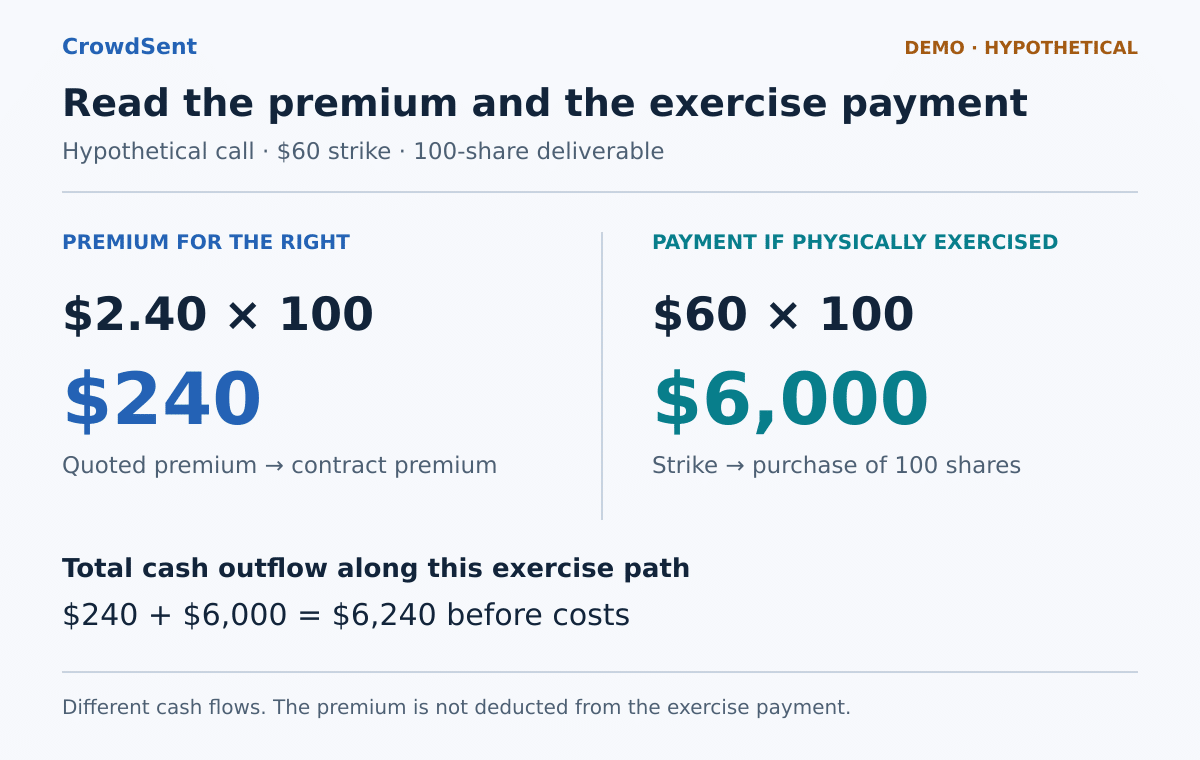
Assume the options contract represents 100 shares and its premium is quoted at $2.40 per share. One contract therefore has a $240 premium before fees: $2.40 multiplied by 100. Two otherwise identical contracts represent a $480 premium. The multiplier must be checked rather than silently assumed, particularly after corporate actions.
The $60 strike answers a different cash-flow question. Exercising this physically settled call would require paying $6,000 for 100 shares. The earlier $240 premium does not become a deposit against that $6,000 purchase. Together, they describe $6,240 of cash outflow before fees if that particular exercise path occurs.
OIC’s options basics provides the standard contract framework. A compact options contract record should retain the underlying, call or put, expiration, strike, deliverable, multiplier and premium units. Omitting any of these can make two apparently similar quotations incomparable.
Follow a hypothetical expiration outcome
Suppose the options contract’s relevant expiration share price is $63. The call’s intrinsic value is $3 per share, or $300 for the stated deliverable. Against the $240 premium, that produces a simplified $60 economic gain before costs. An in-the-money outcome alone does not describe the final result: at a $61 share price, $100 of intrinsic value would be less than the original $240 premium.
Now change the example to a put with a $60 strike. At a $56 share price, its intrinsic value is $4 per share. The right concerns selling shares at $60, rather than buying them. Calculating $400 of intrinsic value still does not establish profit without the put’s own premium and costs.
These calculations describe one contract at expiration using stipulated prices. They do not give a pre-expiration market quote. They also omit funding, taxes, execution differences and any subsequent movement in shares created or delivered through exercise.
Separate exercise style from settlement method
American-style options allow exercise before expiration under applicable rules. European-style options restrict exercise to expiration. These labels describe timing, not the location of the exchange. Physical settlement transfers the specified underlying deliverable; cash settlement uses the contract’s settlement calculation. OIC’s equity and index comparison explains why the terms cannot be inferred from an option’s name alone.
For the ExampleCo call, physical delivery can turn an option holding into share ownership. A cash-settled index option follows different mechanics, even if its quoted strike looks familiar. Likewise, an option on futures may create a futures position. Each resulting exposure has its own funding and risk characteristics.
Know which event a record describes
A closing transaction, exercise, assignment and expiration are different events. A holder may close an option through the market if a suitable counterparty and price are available. Exercising uses the contractual right. Assignment tells a writer to meet the obligation. Expiration ends the contract, subject to its exercise and settlement procedures.
Broker deadlines can differ from exchange or clearing deadlines. Automatic exercise procedures do not remove the need to understand the account’s instructions, available funds and relevant cutoff. OIC’s exercise FAQ is a useful reference, alongside the broker’s own current procedures.
Questions about options contracts
1. Does one option always cover 100 shares?
No. That is common for standard US equity options, but adjusted contracts and other products can have different deliverables or multipliers. Read the actual specifications.
2. Is the premium the same as the strike price?
No. In the example, $2.40 is the quoted price of the right, while $60 determines the share price used if the right is exercised.
3. Does holding a call make me a shareholder?
The option itself does not confer share ownership. In a physically settled contract, exercising a call can lead to ownership of the specified shares.
4. Does in the money mean profitable?
No. It describes the relationship between strike and underlying price. The premium and costs must also be included when calculating an economic result.
5. Can a European-style option trade before expiration?
Its exercise restriction does not, by itself, prohibit secondary-market trading. Actual trading availability depends on the product, market and liquidity.
6. Can an option writer decline assignment?
An assigned writer is required to meet the contract obligation. The premium received does not purchase discretion to refuse delivery or payment.
7. Does expiration always happen at the market close?
Check the product rules. Last trading time, exercise cutoff and the calculation of a settlement value can occur at different times.
8. What changes after a stock split?
An adjustment may alter the deliverable or other contract terms. Use the official adjustment notice instead of extrapolating from a standard 100-share contract.
9. Can losses exceed the premium?
A purchased option can lose its entire premium. Written options can have much larger losses, and exercise can create an underlying position with additional risk.
10. What belongs beside a saved option quote?
Record its timestamp, bid and ask, complete contract identity, multiplier and settlement terms. A premium number without this context cannot reconstruct the original comparison.
Educational note: This article is for education, not investment advice. Options involve risk, including loss of the premium and potentially larger losses for some written positions. Examples exclude fees, taxes and financing unless stated.
Explore CrowdSent membership.
For the quotation units behind these examples, read pips, lots and contract size. To compare a selected market quote, see bid and ask spreads.