

Option theta time decay describes how an option’s theoretical value changes as time passes, with other pricing inputs held constant. A daily theta figure is a local estimate under a model’s conventions. It does not deduct cash from an account, guarantee a price decline or determine the complete result of holding a position.
Understanding that boundary is useful when a quote barely moves overnight, drops by more than its displayed theta, or behaves differently near expiration. The examples here use invented premiums and explicitly stated assumptions.
Translate option theta into a daily decay estimate
Suppose a hypothetical long call has a $2.80 per-share premium and daily theta of negative $0.04 per share. Holding the other model inputs fixed, a one-day local estimate is $2.76. For one contract representing 100 shares, that is an estimated $4 reduction in theoretical value.
For three such contracts, position theta becomes negative $12 per day. This scaling does not tell us how much cash will leave the account tomorrow. It describes a change in modeled position value attributable to the passage of time alone.
OIC’s theta guide explains both the daily convention and the importance of holding other factors constant. Check the platform documentation: a number shown per contract, per year or as an unsigned decay magnitude requires a different interpretation.
Separate time decay from the observed price change
Now imagine the call’s selected premium is $2.92 the next day. Its observed change is positive $0.12, even though the earlier theta estimate was negative $0.04. In a simplified attribution, the remaining inputs and approximation error would collectively account for positive $0.16.
That residual is an accounting illustration, not proof that implied volatility increased by a particular amount. The underlying may have moved, the selected bid or ask may have changed, or the data may be asynchronous. OIC’s price-behavior discussion explains how several inputs can offset one another.
Consider a second hypothetical day with a $0.18 decrease from the same $2.80 starting premium. Subtracting the negative $0.04 time estimate leaves a negative $0.14 residual. The two scenarios show why the observed premium difference and theta cannot be used interchangeably.
Why option theta is not a fixed decay schedule
Multiplying negative $0.04 by ten days gives negative $0.40, but that assumes the daily sensitivity remains unchanged. It generally will not. Theta evolves with time remaining, underlying price, volatility and the contract’s position relative to its strike.
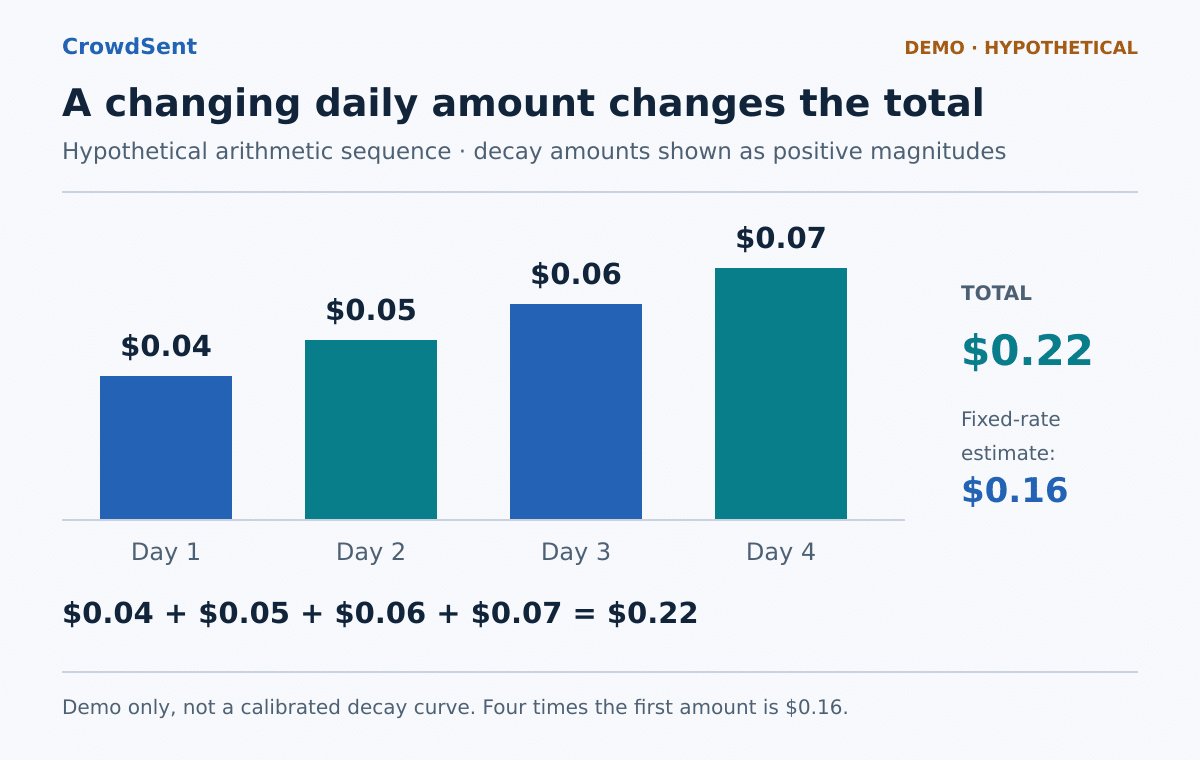
For a deliberately simple illustration, imagine a sequence of four one-day theoretical changes: negative $0.04, negative $0.05, negative $0.06 and negative $0.07. Their total is negative $0.22. Repeating the first estimate four times gives negative $0.16. The six-cent difference comes entirely from the stipulated changing daily amounts.
This sequence is not a pricing model or a typical forecast. It is a demonstration of the arithmetic consequence of a variable rate. A model-based multi-day scenario should revalue the option with the new time input rather than assume today’s theta stays fixed.
Recognize where decay can become concentrated
Near-the-money options often show more pronounced time-value erosion as expiration approaches. The pattern does not mean every option loses the most dollars on its final day. A far-out-of-the-money option may already have very little premium remaining. CME’s theta lesson distinguishes the changing behavior across moneyness.
For example, compare two invented contracts with daily theta of negative $0.03. If one premium is $0.60 and the other is $3.00, the estimate represents 5% and 1% of premium respectively. Equal dollar theta does not imply equal percentage sensitivity. Neither percentage states the complete risk of either contract.
Likewise, a $0.10 option cannot lose $0.20 of value solely because an old daily estimate is extrapolated past its useful range. The absurd result signals that the linear approximation has been stretched too far.
Handle weekends and scheduled events carefully
Pricing models account for the passage of nontrading days, but providers do not all allocate time identically. A Friday-to-Monday change therefore cannot safely be interpreted as exactly three times Friday’s displayed theta. Prices can already reflect an expected quiet period, and new information can arrive while a particular market is closed.
A scheduled earnings release adds another complication: uncertainty is not necessarily distributed evenly across calendar days. A sharp post-event premium change may include a repricing of implied volatility. OIC’s pricing FAQ discusses how declining volatility can outweigh an underlying-price move.
For a reproducible comparison, save the model convention, timestamp and event calendar alongside the Greek. Describe the change as a hypothetical time-only estimate until actual observations and the other inputs support a fuller explanation.
Questions about option theta and time decay
1. Is theta usually negative for a purchased option?
For ordinary long vanilla options, it commonly is. Product structure, exercise rules and carry can create exceptions, so avoid treating the sign as universal.
2. Is theta a brokerage charge?
No. It is a modeled sensitivity of option value. Commissions, financing charges and other account costs are separate items.
3. Does theta apply only on trading days?
Time passes through weekends and holidays. Models account for that passage using their own conventions; observed market repricing need not follow a uniform daily schedule.
4. Can a long option rise despite negative theta?
Yes. Movement in the underlying or implied volatility can outweigh the time-only effect. A market quote combines multiple influences.
5. Does positive position theta guarantee income?
No. A favorable isolated time sensitivity can coexist with larger adverse price or volatility moves and assignment-related obligations.
6. Is the last month always the fastest decay period?
There is no universal calendar threshold. The behavior depends on moneyness, volatility, product terms and the amount of value still remaining.
7. Why can two platforms report different theta?
They may use different price inputs, models, day-count methods or units. Those conventions should be reconciled before comparing values.
8. Can theta be added across several positions?
Compatible values can be summed after applying signed quantities and multipliers. The total is still a local sensitivity rather than a forecast of portfolio return.
9. What does zero extrinsic value at expiration imply?
For a conventional vanilla payoff, no remaining optional time is left. Any intrinsic settlement amount and actual exercise procedures still depend on the contract.
10. What is the simplest useful theta note?
Write the contract, daily units, multiplier, timestamp and fixed-input assumptions. For a hypothetical calculation, label it clearly and keep it separate from observed returns.
Educational note: This article is for education, not investment advice. Options involve risk, including loss of the premium and potentially larger losses for some written positions. Examples exclude fees, taxes and financing unless stated.
Explore CrowdSent membership.
For the quotation units behind these examples, read pips, lots and contract size. To compare a selected market quote, see bid and ask spreads.