

Intrinsic vs extrinsic value separates an option premium into two components. Intrinsic value describes how far an option is in the money. Extrinsic value is the premium remaining after that intrinsic amount is subtracted. The distinction helps explain a quote without treating every dollar of premium as the same kind of value.
The worked examples below use ordinary, hypothetical equity options with stated multipliers. Every premium is illustrative. A decomposition can explain what a selected quote contains; it cannot establish that the quote is executable or that an option is attractively priced.
Calculate intrinsic vs extrinsic value for calls and puts
For a call, intrinsic value per share is the greater of underlying price minus strike or zero. For a put, it is the greater of strike minus underlying price or zero. OIC’s options-pricing overview explains these components and the relationship with moneyness.
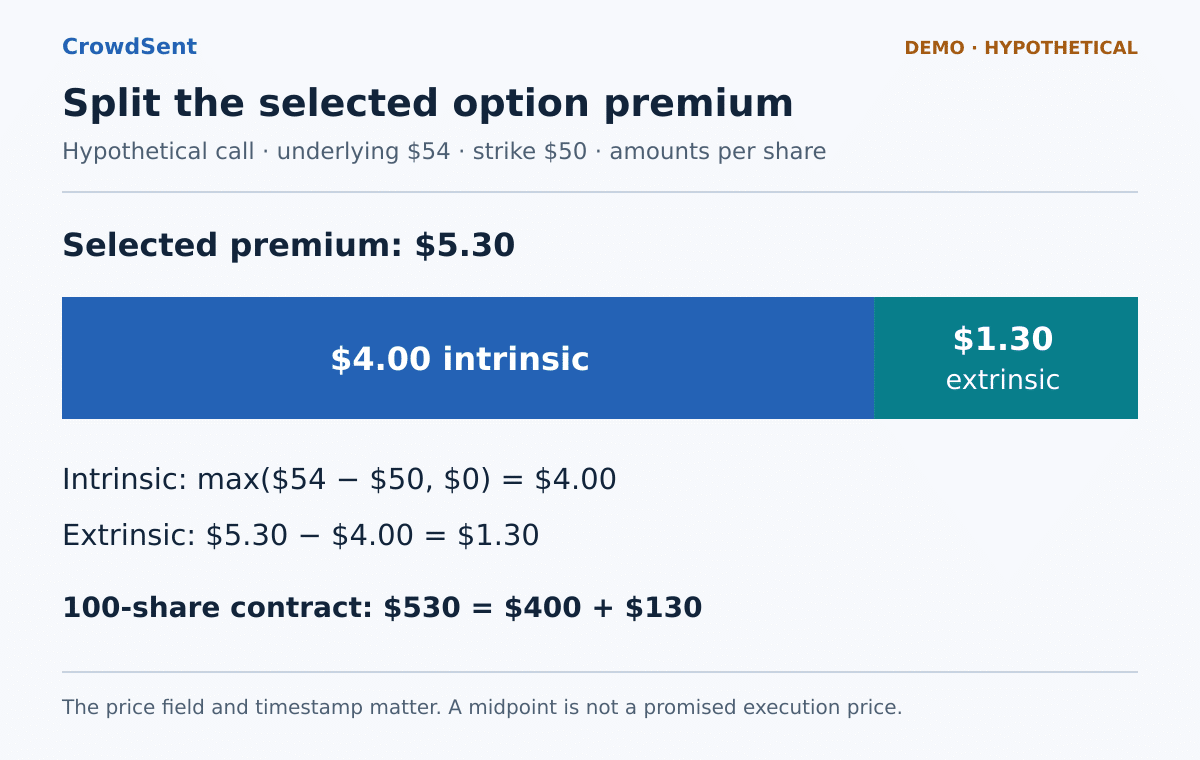
Suppose ExampleCo trades at $54 and a call has a $50 strike. Its intrinsic value is $4 per share. If its selected premium is $5.30, the extrinsic portion is $1.30. With a 100-share multiplier, the $530 total separates into $400 intrinsic and $130 extrinsic.
Now keep the stock at $54 but examine a $58-strike put quoted at $5.10. The put has $4 intrinsic value because its right is to sell at $58. Its $1.10 extrinsic component produces $110 per 100-share contract. Using the call subtraction order would give the wrong result for this put.
Keep moneyness separate from the total premium
A $57-strike call with the same $54 underlying has zero intrinsic value. If its premium is $0.85, that entire selected premium is extrinsic. The zero does not mean the option must currently have a zero market price. It means the contractual exercise relationship has no positive intrinsic amount at that underlying price.
At expiration, a conventional vanilla option’s payoff is determined by its intrinsic-value relationship using the contract’s relevant settlement price. Before expiration, remaining uncertainty matters. CFA Institute’s option-valuation reading distinguishes exercise value, moneyness and time value as separate concepts.
For the $50 call, suppose the expiration share price is $52. Its $2 payoff per share is positive, but smaller than the earlier $5.30 premium. The hypothetical premium-to-payoff difference is a $3.30 loss per share before costs. Calling the option in the money would be correct; calling that outcome profitable would not.
Use one observation time and one price convention
Imagine a current bid of $5.10 and ask of $5.50 for the $50 call, with the underlying still at $54. Bid-based extrinsic value is $1.10, ask-based extrinsic value is $1.50 and midpoint-based extrinsic value is $1.30. All three calculations are arithmetically consistent, but they describe different price fields.
A last trade of $4.90 from an earlier observation would produce $0.90 if combined with today’s $4 intrinsic value. That calculation mixes times. It is not directly comparable with the current bid-ask decomposition. A midpoint also remains a reference calculation rather than a promised fill.
The useful record is therefore more specific than “extrinsic value equals $1.30.” It says which option, which underlying price, which timestamp, which premium field and which multiplier produced the number. This makes later comparisons reproducible.
Understand changes in intrinsic vs extrinsic value
Time remaining, implied volatility, interest rates and dividend assumptions influence theoretical premiums. They do not appear as separate cash balances inside the option. OIC’s price-behavior FAQ explains why a call’s market value can decline even while its underlying rises.
For an arithmetic illustration, let the stock rise from $54 to $55 while the call premium moves from $5.30 to $5.70. Intrinsic value rises from $4 to $5; the calculated extrinsic remainder falls from $1.30 to $0.70. Total premium rises $0.40 despite a $0.60 decline in the residual. These invented snapshots show why tracking only one component misses the complete change.
They do not identify which input caused that residual to shrink. Establishing a cause would require information about the elapsed time, volatility, quotes and valuation assumptions. Several inputs can move together.
Respect the boundaries of the simple calculation
The arithmetic above uses spot intrinsic value and uncomplicated equity contracts. Exercise restrictions, carry and adjusted deliverables can complicate broader comparisons. A surprising negative residual deserves investigation of product terms and synchronized quotes; it is not automatically evidence of a risk-free opportunity. OIC’s put-call parity explanation shows why financing and contractual rights matter to valuation relationships.
Keep the exercise decision separate from the decomposition. Exercising an option does not itself collect its remaining extrinsic premium. Actual alternatives depend on the option terms, bid-ask market, costs and account circumstances.
Questions about intrinsic vs extrinsic value
1. Can a call and put have the same intrinsic value?
Yes. At a $54 underlying, a $50 call and a $58 put each have $4 of intrinsic value. Their premiums can still differ.
2. Is extrinsic value quoted per contract?
It depends on the display. In these examples, subtract per-share values first and then multiply by 100 to obtain the contract amount.
3. What happens at exactly the strike?
The simple spot intrinsic-value calculation is zero for both a call and a put. Before expiration, either can still have a positive premium.
4. Does more intrinsic value mean a better option?
The number alone cannot establish suitability or value. Different contracts have different premiums, sensitivities, expirations and obligations.
5. Is time value another name for extrinsic value?
It is commonly used that way in introductory options material. The residual reflects more than the calendar, including volatility and carry assumptions.
6. Why can two screens show different extrinsic values?
They may use different timestamps, underlying prices, premium fields or multipliers. Reconcile those inputs before interpreting a difference economically.
7. Does the residual measure expected profit?
No. Premium minus intrinsic value is a price decomposition. It contains no calculation of future trading costs or a realized investment return.
8. Can extrinsic value rise while time passes?
Yes, observed premiums reflect several changing inputs. A rise in implied volatility can outweigh the isolated effect associated with less time remaining.
9. Should stale last trades be used?
Label them clearly if used. A stale option trade paired with a current stock price can create a misleading component calculation.
10. What should I save with this calculation?
Save the complete contract, synchronized prices, chosen quote field, multiplier and arithmetic. Keep the hypothetical or observed status explicit.
Educational note: This article is for education, not investment advice. Options involve risk, including loss of the premium and potentially larger losses for some written positions. Examples exclude fees, taxes and financing unless stated.
Explore CrowdSent membership.
For the quotation units behind these examples, read pips, lots and contract size. To compare a selected market quote, see bid and ask spreads.