

Option delta vs gamma compares two related sensitivities. Delta describes how an option’s theoretical value responds to a small move in its underlying. Gamma describes how delta changes as that underlying moves. Looking at both explains why an option’s sensitivity need not remain constant.
This article uses hypothetical plain-vanilla equity options and dollar-per-share quotations. The arithmetic is a teaching approximation, not a forecast of the next market price. Time, implied volatility and other inputs are held constant unless explicitly changed.
Read option delta with its units attached
A delta of 0.45 means an estimated $0.45 change in option value for a $1 rise in the underlying, with other inputs fixed. For a $0.20 rise, the first-order estimate is $0.09: 0.45 multiplied by $0.20. OIC’s delta explanation sets out this sensitivity and the usual call and put signs.
Suppose a call is quoted at $3.20 and has a model delta of 0.45. A $1 upward move produces a delta-only estimate of $3.65. A $1 downward move produces $2.75. These are two separate scenarios from the same starting point. They are not successive observed transactions.
Delta is not a percentage return on the premium. The estimated $0.45 rise is about 14.1% of a $3.20 premium, while a $1 stock move is a different percentage of the underlying price. Confusing those denominators can exaggerate what the delta number says.
Use gamma to update option delta
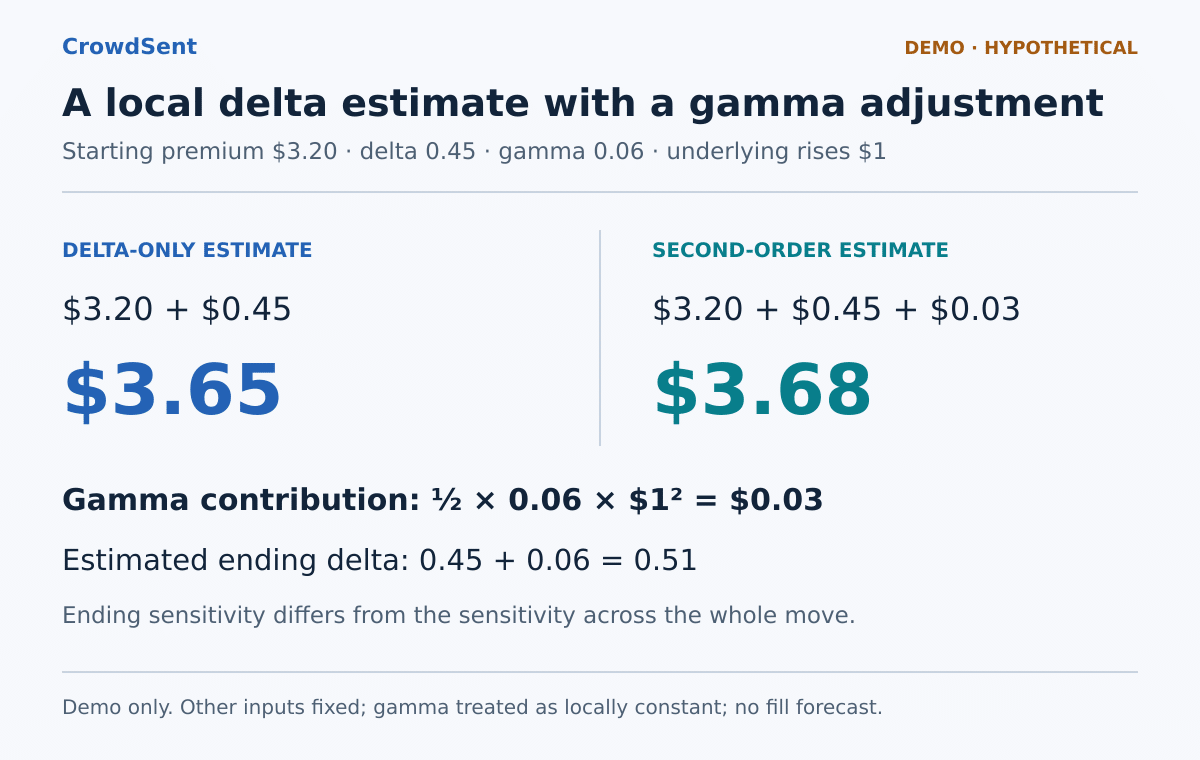
Give the same hypothetical call a gamma of 0.06 per $1 move. A local estimate of delta after a $1 underlying rise is 0.51. After a $1 fall, it is 0.39. Gamma enters with the direction of the underlying move. OIC’s gamma guide explains this relationship.
The updated 0.51 is the estimated sensitivity near the new price. Multiplying the entire earlier $1 move by 0.51 would apply the ending sensitivity to the whole interval. That overstates the simple curved-path adjustment when delta increased gradually from 0.45.
A second-order approximation uses initial delta times the price move, plus one-half of gamma times the squared move. For the $1 rise, the estimated change is $0.45 plus $0.03, or $0.48. The illustrative option value becomes $3.68. For a $1 fall, the change is negative $0.45 plus $0.03, giving $2.78.
This arithmetic treats gamma as locally constant. CME’s combined-Greeks example illustrates the related idea of using changing delta across a price interval. Neither method promises an executable price.
Check the position sign and contract size
For a plain long call, delta is usually positive; for a plain long put, it is negative. Long vanilla calls and puts have positive gamma under standard models. Reversing the position reverses its Greek exposure. A short call therefore has negative position delta and gamma, even if a chain displays the corresponding long-option values.
For two long calls with the stated 100-share multiplier, position delta is 0.45 multiplied by 100 multiplied by two, or 90 share-equivalents. Position gamma is 0.06 multiplied by 100 multiplied by two, or six share-equivalents of delta change per $1 underlying move.
With the same local assumptions, the $0.48 per-share estimate becomes $96 across the two contracts. A worksheet that multiplied delta by 100 but forgot to scale the option-price change would mix contract and share units.
See how a put fits the same relationship
Consider a separate put with delta of negative 0.40 and gamma of positive 0.05. After a $1 rise in the underlying, estimated delta becomes negative 0.35. After a $1 fall, it becomes negative 0.45. Positive gamma means delta rises numerically when the underlying rises, including when delta begins below zero.
This is why “the put delta increases” can be ambiguous. Someone might mean its numerical value, from negative 0.40 to negative 0.35, or its absolute magnitude, from 0.40 to 0.45. Write the signed numbers instead of relying on an unclear verbal description.
Know when the approximation becomes fragile
Gamma commonly becomes more concentrated near the strike as expiration approaches. A small starting delta can therefore change quickly. CME’s gamma lesson emphasizes that gamma itself moves as the underlying changes.
Large jumps, changing volatility, elapsed time and wide spreads weaken a simple local calculation. OIC’s Greeks overview treats these measures as theoretical sensitivities. They do not establish the probability of a profitable outcome or reveal an entire market’s positioning.
Questions about option delta and gamma
1. Why is gamma sometimes called curvature?
Delta is the local slope of option value against the underlying price. Gamma measures how that slope changes, creating a curved rather than straight price relationship.
2. Can two options have the same delta but different gamma?
Yes. A snapshot can show equal first-order sensitivity but different rates of sensitivity change. Their behavior can diverge after the underlying moves.
3. Is a delta of 0.50 a 50% profit probability?
No. Delta is a price sensitivity. Some probability shorthand is model-dependent and does not incorporate the premium-based threshold for profitability.
4. Does positive gamma guarantee a gain?
No. It describes curvature with respect to the underlying. Time decay, volatility changes, premium paid and costs remain relevant to the result.
5. Why does the example include one-half of gamma?
The second-order term accounts for a gradually changing slope across the interval. Adding the full ending delta change to the whole move would overstate that adjustment.
6. Can I extend the same gamma over a large move?
That becomes unreliable because gamma changes with price and other inputs. The example is deliberately local, with its constant-gamma assumption stated.
7. Are chain Greeks already multiplied by 100?
Displays differ. Confirm whether each value is per option unit, per contract or for the whole position before calculating dollar exposure.
8. Can a short put have positive delta?
Yes. Its position sign reverses the negative delta of a long put. Its position gamma reverses too and is normally negative.
9. Does near-zero position delta mean little risk?
It only describes one local sensitivity. Gamma and other exposures can remain material, and the net delta can change after a market move.
10. What should accompany a Greek snapshot?
Include the full contract, timestamp, model or provider, units, position quantity and assumed inputs. Those details make comparisons more meaningful.
Educational note: This article is for education, not investment advice. Options involve risk, including loss of the premium and potentially larger losses for some written positions. Examples exclude fees, taxes and financing unless stated.
For the quotation units behind these examples, read pips, lots and contract size. To compare a selected market quote, see bid and ask spreads.