

Look-ahead bias occurs when a historical decision uses information that would not yet have been available at that decision time. The mistake can be as small as reading a completed candle too early or as broad as using revised economic data throughout an old simulation.
A dataset may be correctly dated and still be unsuitable for the decision being simulated. The essential question is: what could this research process actually have known at that moment? This guide turns that question into a practical timestamp audit.
Look-ahead bias starts with the meaning of a timestamp
Several dates can describe the same piece of information. An earnings figure might relate to a quarter ending in March, be announced in May and appear in a particular data feed shortly afterward. A corrected version might arrive later still. Joining that figure to March because March is its accounting period gives a March strategy information from May.
Keep the distinctions explicit:
- Observation time: the event or period the value describes.
- Publication time: when the source released that version.
- Availability time: when the chosen research system could access it.
- Decision time: when the strategy generated an instruction.
- Execution time: when the order could next be filled under the stated model.
As an audit rule, an input’s availability time must be no later than the decision that uses it. Execution must also respect the sequence of the decision and order submission. A date-only file often needs more information before it can support an intraday test.
A worked hypothetical example: one release, two histories
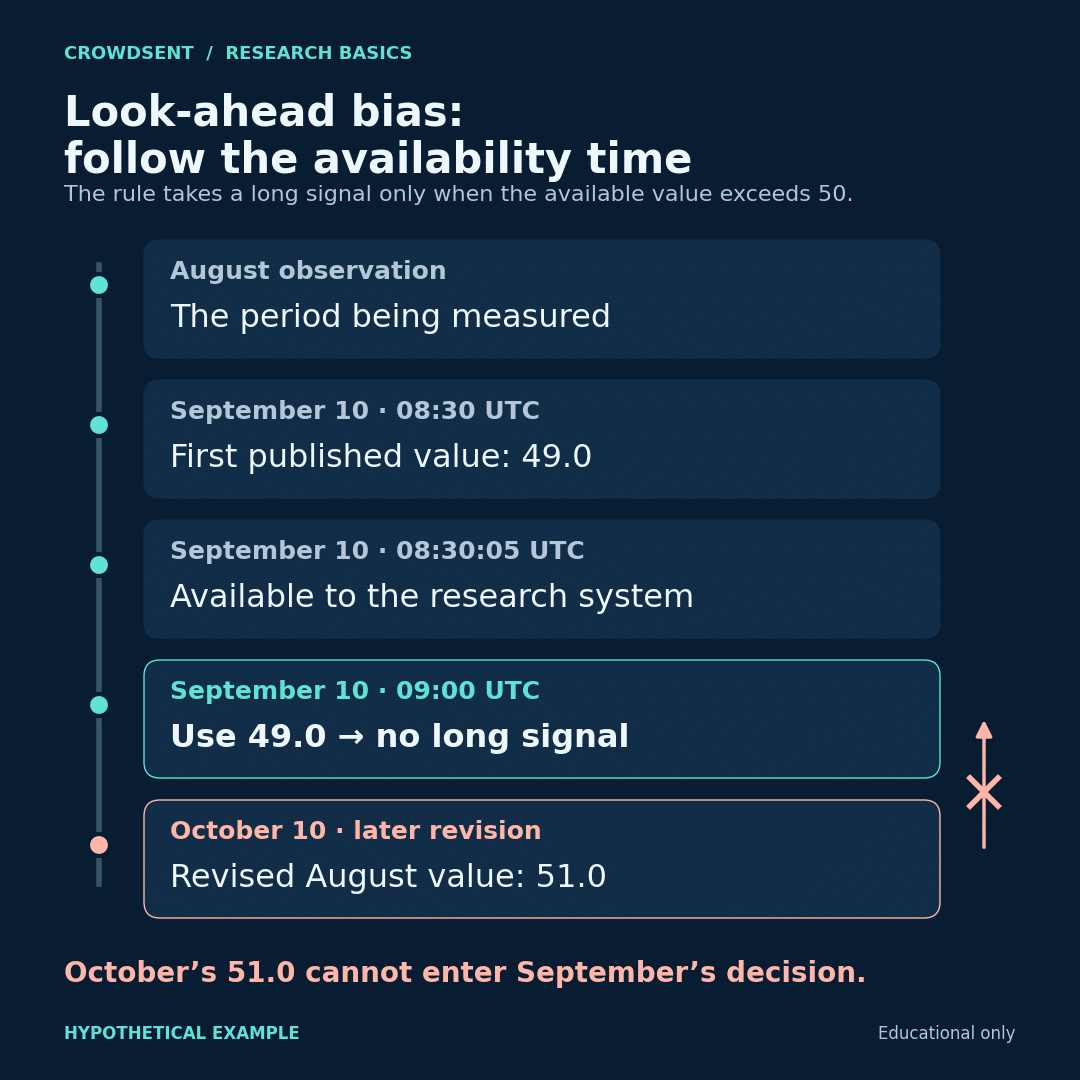
Imagine a fictional monthly economic indicator. Its August observation is first published on September 10 at 08:30 UTC with a value of 49.0. The researcher receives it at 08:30:05. On October 10, the source revises the August value to 51.0.
The strategy’s rule is simple: at 09:00 on a release day, take a hypothetical long position if the latest available value exceeds 50. Ignore transaction mechanics for the moment; this example isolates data timing.
- At 09:00 on September 10, the available August value is 49.0. The rule generates no long signal.
- A researcher downloading the latest series in November may see August recorded as 51.0.
- If the backtest assigns 51.0 to September 10, it creates a signal using the October revision.
- The corrected replay retrieves the version available by the September decision, so it uses 49.0 and records no signal.
There is a second potential error. Assigning either value to August 31 because the series is labeled “August” moves the announcement even further into the past. Correct values alone cannot fix incorrect availability dates.
The St. Louis Fed’s real-time-period documentation explains how ALFRED distinguishes information known during past periods from the latest information available today. Vintage data can help reconstruct historical knowledge. For intraday decisions, also verify whether the source supplies adequate release-time and delivery-time detail.
Inspect candle timing before adding a one-bar delay
A candle labeled 10:00 may summarize the interval beginning at 10:00. Its final close, high, low and volume are not all known at the interval’s start. If a strategy uses the completed candle, its decision must occur after the necessary information exists.
For example, suppose a five-minute bar runs from 10:00 to 10:05. A historical rule cannot use the final 10:05 close and assume it bought at 10:00. It also should not assume an exact 10:05 closing-price fill merely because the signal becomes calculable around that boundary. The order model must describe a feasible sequence.
MetaQuotes documents that CopyBuffer starting position zero refers to the current bar. That is a useful implementation detail, not proof that every use of the current bar leaks information. A live rule can legitimately use the current bar’s value as observed at that instant; it cannot secretly substitute the bar’s later final value.
Shifting a signal one bar may repair one timing mismatch. It will not repair future revisions, a later-trained model or a daily value joined to intraday rows before publication. Apply a delay that matches the information process, rather than a universal offset.
Check transformations as carefully as raw inputs
Leakage can enter after data collection. If a researcher standardizes an entire dataset using its full-period average and then splits it into earlier training and later testing, the earlier model has been influenced by later observations.
The scikit-learn leakage guidance recommends learning preprocessing transformations from training data only. The fitted transformation can then be applied to the reserved observations. Feature selection and missing-value imputation deserve the same care.
There is a useful distinction between historical context and fitted information. Computing a trailing average from prices already known before a test decision can be valid. Choosing that average’s window after inspecting the test result compromises the evaluation in a different way.
For news or sentiment research, preserve the text version, capture time and analysis method. A corrected headline or a model introduced years later can change a retrospective score. Such a study may still answer a clearly defined research question, but it should not be presented as a reconstruction of signals that existed at the original date.
Build a compact availability audit
Choose several decisions, including one near a release, a session boundary and a data outage. For every input, record the following fields in a small audit ledger:
- Source identifier and exact stored version
- Observation period and source timezone
- Publication timestamp, if known
- Timestamp when the strategy could access the record
- Transformation or indicator used, including its fitting window
- Decision timestamp and earliest permitted order time
- Reason for excluding or delaying an uncertain record
Then replay the decision using only the permitted information. When possible, compare the output against a saved real-time snapshot. A mismatch is a reason to investigate versioning, joins and timing before interpreting profitability.
Read how to read historical sentiment for the surrounding timeframe and coverage questions. If unavailable values have been silently filled, use the distinction between missing market data and zero to avoid giving absence a meaning it does not support.
What a clean audit can and cannot establish
Fixing timing makes the simulation more faithful to its stated information rules. It does not validate the trading idea, establish realistic transaction costs or eliminate overfitting. Keep those questions separate so a successful timestamp check does not become an all-purpose endorsement.
If the required publication or version history is unavailable, narrow the claim. A retrospective association study can be honestly labeled as such. Inventing a convenient delay does not turn uncertain historical availability into verified evidence.
Frequently asked questions
1. How does look-ahead bias differ from overfitting?
Look-ahead bias gives a decision information from its future. Overfitting occurs when a rule is adapted too closely to the particular observations used in development. A test can suffer from either problem or both, and removing one does not automatically remove the other.
2. Is using adjusted price history automatically leakage?
No. Adjusted series can be useful for particular return calculations. Problems arise when later adjustments change a historical input in a way the intended decision process could not reproduce, especially absolute price thresholds. Document the adjustment method and check its effect on the actual rule.
3. Can the current candle be used safely?
Yes, when the rule uses only the value actually observable at that instant and the simulator recreates that information sequence. Using a current candle’s eventual high, low or close before it occurs is a different operation and introduces unavailable information.
4. Does entering at the next open solve the problem?
It can solve a close-to-entry sequencing issue when the signal was genuinely available before that open. It cannot fix a revised economic series, future index membership or a preprocessing step fitted on later data. Audit every input, not just the execution timestamp.
5. Is a news article’s publication date enough?
Usually not for precise intraday research. You may need the original timestamp, timezone, text version and delivery delay. A page updated later can preserve an earlier date while containing new information. Save contemporaneous copies when the research question depends on original content.
6. What if I know the release date but not the time?
Avoid assuming the value was available at the start of that day. Investigate the source’s release schedule and historical records. If precise timing remains uncertain, use a defensible coarser research design and disclose its limits rather than claiming exact intraday reproducibility.
7. Can interpolation introduce future information?
Yes. Filling a missing value using observations on both sides can incorporate a later observation. Whether that is acceptable depends on the research purpose. A historical decision simulation needs a filling rule that could have been carried out using information available then.
8. Is reading an earlier bar always safe?
No. The indicator attached to that bar may later repaint or be recalculated with new information. Also check which instrument, session and timezone the bar represents. The historical location of a plotted value does not by itself establish when the value was known.
9. Can a machine-learning model leak information without future input rows?
Yes. Its weights, selected features or preprocessing may have been learned from later observations. Check the fitting cutoff and all upstream steps. For a historical reconstruction, the model itself must meet the information constraints specified by the experiment.
10. What should I do when I discover leakage?
Preserve the original run, document the cause and invalidate the affected performance interpretation. Correct the pipeline and rerun the relevant tests. Compare decisions as well as totals so you can explain how the unavailable information changed the result.
Keep the information trail visible
To explore the workspace and its membership options, open CrowdSent.
Educational information only, not financial or investment advice. The release and trading examples are hypothetical. Cleaner historical research does not guarantee future performance or prevent trading losses.