

By CrowdSent Blog Team
Liquidity pool tokens are accounting claims on assets held in a pool. In a common fungible-share design, the number of LP tokens someone holds, divided by the relevant total supply, determines their proportional claim. The claim changes in value as the pool’s assets and accounting change.
The LP token balance alone tells only part of the story. One hundred units can represent a large or small position, depending on the pool and its share supply. The underlying claim can also change composition even while the number of LP tokens stays the same.
This article follows a hypothetical pool through a new deposit, a changing ownership percentage and a valuation. It then explains where this simple share model stops working, particularly for concentrated-liquidity positions.
What liquidity pool tokens represent
Imagine a shared container holding two assets. A fungible LP token records a proportional entitlement under the pool’s contract rules. Two identical units from the same pool normally represent the same type of claim; units from different pools do not become equivalent just because both are called LP tokens.
In the Uniswap v2 model, pool tokens are issued when liquidity is added and redeemed against a share of pool assets when liquidity is removed. The official v2 pool documentation describes this relationship and the transferability of the receipt.
The pool assets and their receipt should therefore be tracked together. Treating the receipt as an unrelated token can conceal the exposure it represents. Treating it as an additional pile of underlying assets can double-count the same economic claim.
An LP receipt also differs from a governance token issued by a protocol. A familiar protocol name in both labels does not establish identical rights. The contract-defined claim is more informative than the ticker or a token’s appearance in an interface.
Calculate the ownership fraction with the right denominator
For a straightforward proportional pool, the ownership fraction is LP units held divided by total LP units outstanding. Both measurements must describe the same pool and the same observation point.
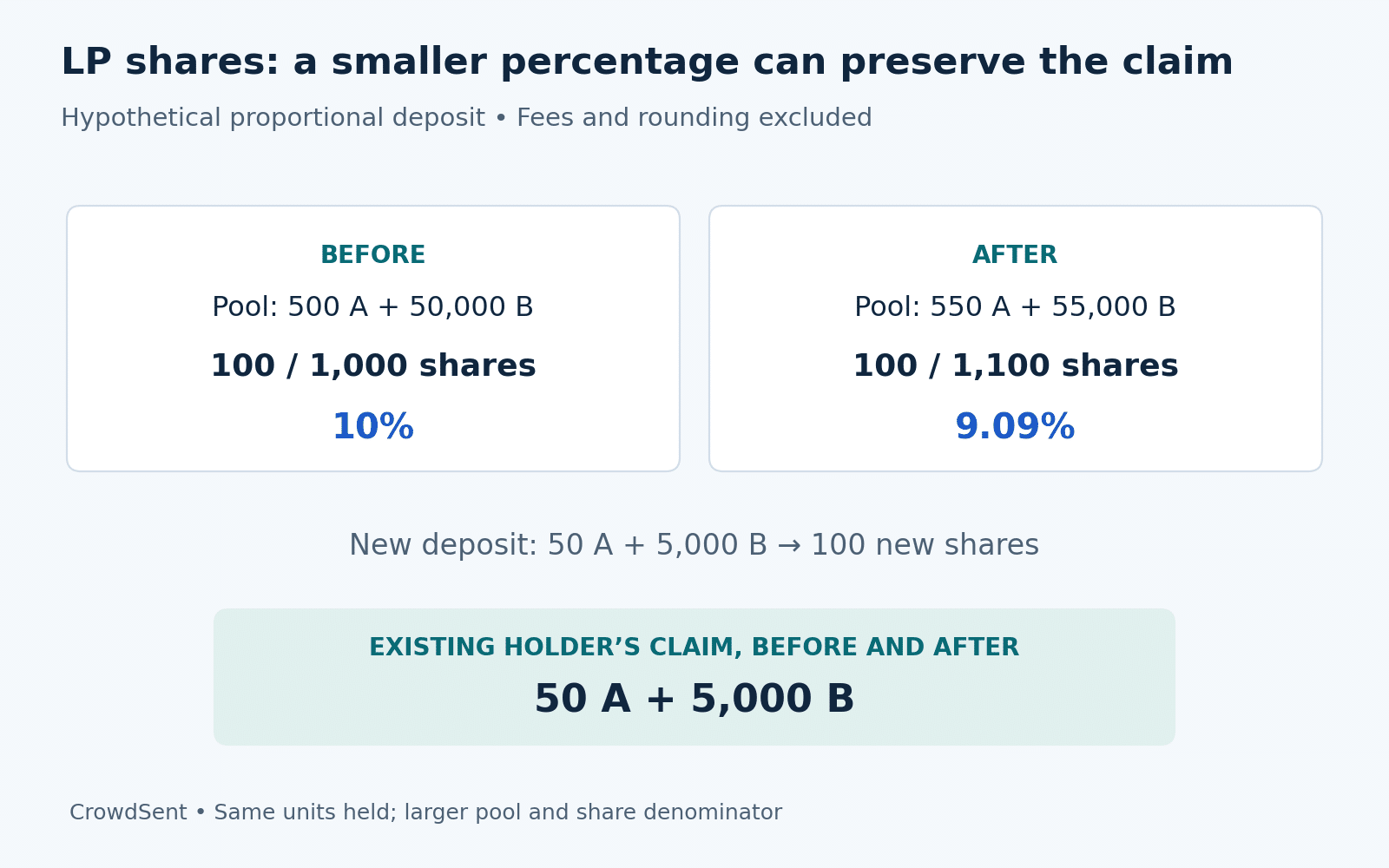
Suppose a pool holds 500 A and 50,000 B, with 1,000 LP units outstanding. An existing holder owns 100 LP units. Their fraction is 100 divided by 1,000, or 10%, corresponding to 50 A and 5,000 B before costs and any special contract adjustments.
The scale of the LP unit is arbitrary for this calculation. A pool could represent the same economic shares with a different unit count. What matters is consistency between the holder’s balance and the applicable total.
Why a smaller percentage need not mean economic dilution
Now a second participant adds 50 A and 5,000 B in the existing proportion. In this simplified example, the pool issues 100 new LP units. Reserves rise to 550 A and 55,000 B, and total LP supply rises to 1,100.
The original holder still owns 100 units. Their percentage falls to about 9.09%, but 9.09% of 550 A remains 50 A, and 9.09% of 55,000 B remains 5,000 B. The smaller ownership fraction applies to a proportionately larger asset base.
The new participant’s share is also approximately 9.09%. Dividing the new deposit by the old pool value and calling the result their final ownership percentage would incorrectly give 10%. Their contribution belongs in both the numerator and the enlarged post-deposit denominator.
This example excludes initial minimum-liquidity rules, rounding, fees and nonstandard token behavior. It explains proportional share issuance, not the exact mint calculation for every deployed pool. A production result needs its own contract accounting.
Translate the underlying claim into a valuation
To value a simple LP position, first identify the asset quantities represented by its share. Then apply consistent prices at the same timestamp. For multiple assets, add the value of each component.
Continue with the enlarged pool. Assume a hypothetical observation where A is valued at $100 and B at $1. The 550 A is worth $55,000 and the 55,000 B another $55,000. Total marked value is $110,000; divided by 1,100 LP units, that is $100 per unit.
The original holder’s 100 LP units consequently have a marked value of $10,000. The same result follows from valuing their 50 A and 5,000 B directly. Agreement between these two routes is a useful arithmetic check.
Dollar valuation adds assumptions that an asset-quantity claim does not need. A quoted price can be stale, drawn from a thin market or unavailable. The calculation should say where the prices came from and whether the result is a mark, an estimated redemption amount or an observed exchange value.
The broader distinction between a token’s unit price and an aggregate measure is discussed in CrowdSent’s crypto market-cap and price guide. Here, the relevant aggregate is the value of assets backing the LP claim.
Why the assets behind a fixed LP balance change
Swaps alter the pool’s composition. If traders exchange A for B, the pool generally receives A and gives up B. A holder can retain the same LP-unit balance and ownership fraction while their indirect quantities of A and B change.
Fee accounting can also change the claim. In Uniswap v2, trading fees enter pool reserves; protocol-fee mechanics affect what ultimately belongs to liquidity providers. In v3 and v4, accrued fees are accounted for separately from the active position. The official Uniswap fee documentation distinguishes these version-specific treatments.
Consider a separate simplified snapshot where the same 1,100 shares represent 550 A and 55,550 B. At the assumed prices above, total value is $110,550, or $100.50 per share. One hundred shares represent $10,050. This snapshot illustrates valuation arithmetic only; it does not attribute the change to fees or predict future earnings.
Attribution requires the events between snapshots. Trades, fees, new shares, redemptions and other adjustments can occur together. A higher value per share is an observation to explain, rather than proof of one particular source of growth.
Fungible LP tokens and position NFTs use different accounting
A single pool-wide ownership fraction is suitable only when the claims are interchangeable under the relevant design. Concentrated-liquidity positions can have different lower and upper price boundaries, different active liquidity and different accrued fees.
Uniswap v3’s standard position manager represents positions with ERC-721 NFTs. Its liquidity-management documentation identifies positions by token ID and associates them with liquidity and underlying tokens.
Owning one of ten position NFTs therefore does not establish ownership of 10% of pool assets. The NFTs can describe very different positions. The relevant question is what quantities and fees belong to that particular position at the observed price.
A wrapper can place several positions inside another structure and issue fungible shares of that structure. Those shares introduce another accounting layer. Their denominator belongs to the wrapper, while the wrapper’s assets depend on its underlying positions and management rules.
Follow the claim through each additional layer
An LP receipt may be held directly, placed in another contract or used inside a strategy. That changes how the holder’s claim is represented and may add dependencies. A missing direct LP balance does not automatically mean that the economic exposure disappeared.
For research purposes, map the chain of claims in words: the holder has a receipt from a wrapper; the wrapper controls an LP position; the LP position represents underlying pool assets. Then attach quantities to each step instead of adding every displayed balance together.
This is an accounting exercise, not a reason to interact with those contracts. Extra layers can add technical and administrative risks. Ethereum’s smart-contract security guidance explains why code and dependent interactions need scrutiny even when their accounting is visible.
Available liquidity remains a separate consideration from the marked value of a claim. CrowdSent’s liquidity versus volume explanation helps keep asset value, exchange capacity and past activity distinct.
Build a reproducible LP-token observation
A useful record identifies the network, pool contract, receipt contract or position ID, timestamp and relevant balances. It then states the share denominator, asset quantities, valuation prices and whether fees are included or separate.
Where a value cannot be established, label the gap. A missing price is different from a zero-value asset, and a missing position is different from a position with no liquidity. CrowdSent’s guide to missing market data versus zero explains why this distinction matters.
The resulting note should allow another reader to reproduce the marked value and understand its limits. It need not turn into a long transaction history unless the purpose is to explain how the position changed over time.
Frequently asked questions about liquidity pool tokens
1. Is an LP token a guarantee of my original deposit?
No. It represents a claim defined by the pool’s current accounting. Trading can change the quantities of underlying assets, and those assets can change in value. A receipt for a share of a pool does not guarantee the original token mix or original dollar amount.
2. Why is my LP-token balance unchanged while its value moves?
The unit count and value per unit are separate. Reserve quantities, asset prices and applicable fees can change the value behind each unit. A position can therefore gain or lose marked value without a transfer of additional LP tokens to its holder.
3. Does a new provider dilute every existing provider?
A correctly proportional addition enlarges both pool assets and LP supply. Existing holders own a smaller percentage of a larger pool, leaving their immediate underlying quantities unchanged in the simplified model. Unbalanced additions or special fee mechanics need separate analysis.
4. Can two LP tokens with the same symbol be compared directly?
A symbol is not enough. Confirm the network, contract, underlying assets and accounting design. Even two pools containing the same asset pair can have different reserve compositions, share scales and fee arrangements, so their LP unit prices may have no direct relationship.
5. Are LP tokens always fungible?
No. Some pools issue interchangeable receipt tokens, while concentrated-liquidity positions can be represented individually. Uniswap v3’s standard position manager uses NFTs because positions may have different ranges and accounting. Count-based ownership percentages do not work across such distinct positions.
6. Is an LP token the same as a reward token?
An LP token records a claim on pool liquidity. A reward token may be distributed under a separate incentive program. Their roles can coexist, but reward quantities do not replace the calculation of the underlying LP claim or establish its value.
7. Does every fee automatically increase my active liquidity?
No. Fee accounting depends on the implementation. Some fees accumulate within reserves; others remain separately claimable. A displayed fee balance should not be added to both the active position and the total position value, because that would count it twice.
8. Why can a displayed LP valuation differ from an exchange price?
A marked valuation multiplies underlying quantities by selected prices. An exchange price also depends on liquidity, costs and the terms of the actual transaction. A theoretically calculated claim value does not guarantee that an independent market will exchange the receipt at that value.
9. What happens to an LP token when liquidity is redeemed?
In a basic fungible-share model, the redeemed receipt units are removed from supply as underlying assets are released under the contract’s rules. The exact process differs for individual position NFTs, where changing liquidity and collecting assets can be separate accounting operations.
10. What is the most common LP accounting mistake?
Using an LP-unit balance without its denominator is a frequent source of confusion. Another is counting both the receipt and all its backing as separate assets. Start with the claim, identify the underlying quantities and value the resulting exposure only once.
Conclusion: read the claim behind the token
Liquidity pool tokens become easier to understand when the receipt, ownership fraction and underlying assets are kept visible. The same unit balance can represent changing asset quantities, and a smaller percentage can preserve the same claim after a proportional addition. Position-specific designs require their own accounting rather than a pool-wide shortcut.
Use the accounting principles here to read LP-token claims with clearer assumptions and fewer double counts.
Source documentation checked 11 October 2026. Educational explanation from the CrowdSent Blog Team. Numerical examples are hypothetical unless explicitly identified otherwise. This article does not provide investment recommendations.