

Initial margin is the collateral requirement associated with establishing a futures position. Maintenance margin is the requirement used to assess whether an existing position remains adequately supported. If account equity breaches the applicable threshold, the broker may require additional funds or take other action under its rules.
The initial amount is often higher than maintenance, but that relationship is not universal. Both requirements can change, and the broker’s customer requirements can differ from exchange minimums. A quoted margin figure therefore needs a product, account category, effective time and source.
This guide uses hypothetical account arithmetic to explain the relationship. A minimum requirement is not a recommended account size and does not cap the possible loss.
Initial margin is collateral, not the contract’s purchase price
A futures margin deposit supports contractual obligations. It is not a down payment that buys ownership of a fraction of the underlying commodity. The contract’s price exposure is determined by its terms and size, while the margin requirement is a separate amount.
The CFTC’s explanation of futures market mechanics distinguishes performance-bond margin from purchase financing and notes that futures commission merchants can require more than an exchange specifies.
Hypothetical unit example: a fictional contract quoted at 1,000 points with a $100 value per point has a $100,000 price-times-multiplier amount. A $10,000 margin requirement does not reduce the effect of a one-point move to $10. One point still corresponds to $100 for one contract.
This simple multiplier example does not describe every futures product’s notional-value convention. Always use the actual specification. Our pips, lots and contract size guide shows why the quote unit belongs in every calculation.
Initial margin vs maintenance margin in an account ledger
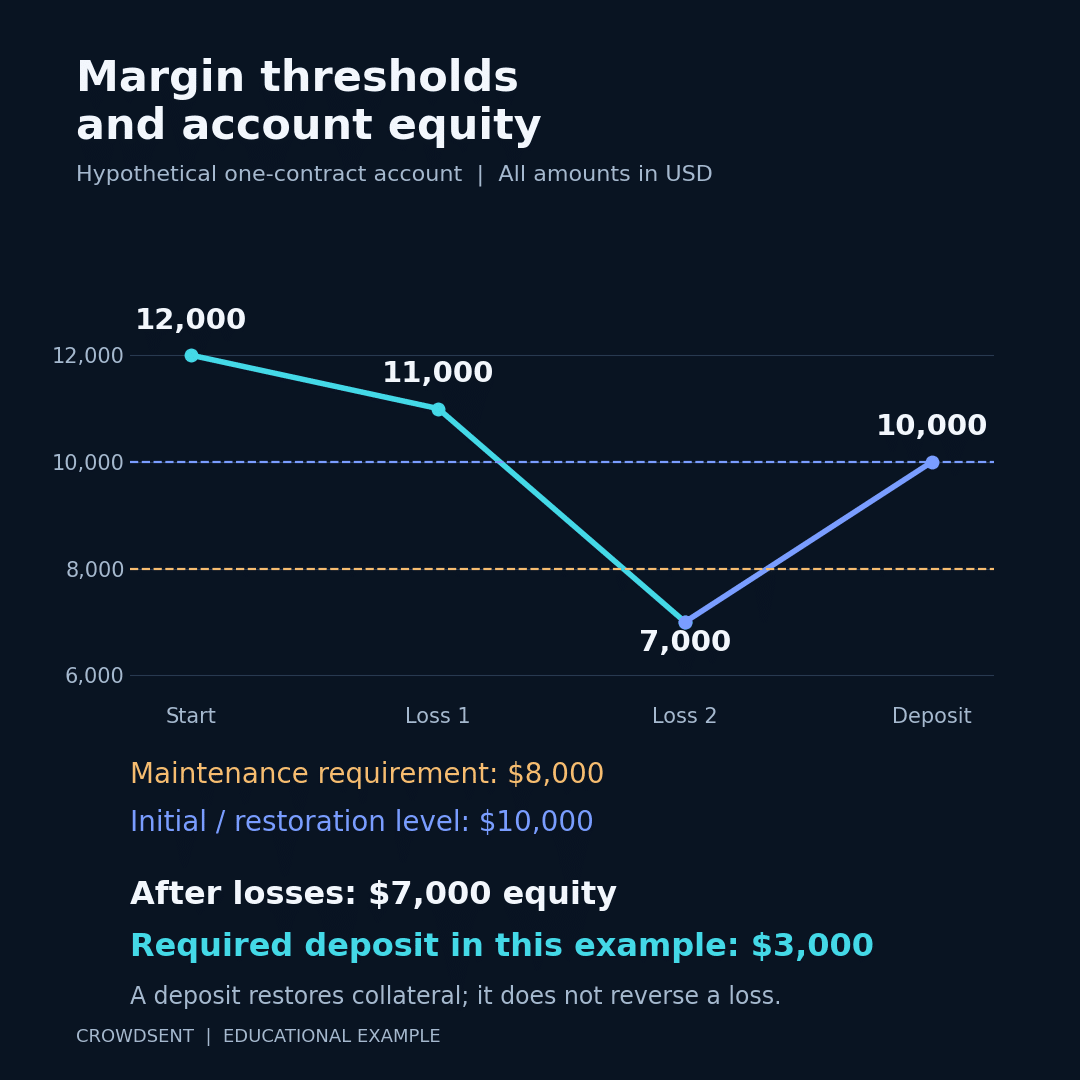
Hypothetical assumptions: one long contract, a $10,000 initial requirement, an $8,000 maintenance requirement and $12,000 of starting cash equity. The contract’s value is $100 per point, and its entry price is 1,000. Ignore fees, interest, other positions and any noncash collateral.
The first settlement is 990. The ten-point decline produces a $1,000 loss, leaving equity at $11,000. That remains above the assumed maintenance threshold.
The next settlement is 950. The additional 40-point decline produces a $4,000 loss, leaving equity at $7,000. Total losses since entry are $5,000, consistent with (950 − 1,000) × $100.
Under an assumed rule requiring restoration to initial margin after a breach, the required top-up is $10,000 − $7,000 = $3,000. Adding only $1,000 would restore equity to the $8,000 maintenance amount, not to the $10,000 initial amount specified by that rule.
After a $3,000 deposit, the equity is $10,000. The deposit did not erase the $5,000 loss. Starting cash of $12,000 plus new cash of $3,000 minus the loss of $5,000 equals the remaining $10,000.
CME’s margin education guide describes restoration to initial margin and the possibility of automatic liquidation. The timing and action in a real account depend on its governing requirements, not on the leisurely sequence in a teaching example.
Variation margin is the moving cash-flow component
Daily gains and losses are recognized through settlement variation, often called variation margin. Initial and maintenance requirements instead describe collateral thresholds. The names share “margin,” but they are not interchangeable entries in a calculation.
In the example, the $1,000 and $4,000 losses are variation amounts. The $8,000 maintenance figure is a threshold. The subsequent $3,000 funding transfer restores equity under the stated rule. Keeping those lines separate prevents the same loss from being subtracted twice.
Cash movements and available margin can also differ from the account’s total reported value. A broker may apply eligibility rules or valuation discounts to noncash collateral. The cash-only example deliberately leaves those additional calculations out.
Use a statement’s definitions to identify cash balance, account equity, collateral value and available funds. A number labeled “buying power” may embed assumptions that are not obvious from the label alone.
Why the thresholds can move
Margin requirements respond to risk conditions and the applicable methodology. CME’s discussion of margin changes explains the role of market volatility and portfolio risk. A requirement should be treated as an effective-dated figure, not a permanent property of a contract.
Separate hypothetical example: an account has $10,500 of eligible equity, and its prior maintenance requirement is $8,000. Assume a newly effective schedule sets maintenance at $11,000 and the required restoration level at $12,000. Even with no price loss, equity is now below the new maintenance amount.
Under those assumptions, restoring the account to $12,000 requires $1,500. The shortfall arose from a changed requirement rather than a changed contract price. Combining both events in one vague “margin loss” would obscure the cause.
Initial margin also need not be strictly above maintenance. CME’s performance-bond framework includes account risk classifications with different initial-to-maintenance relationships. Check the applicable classification rather than memorizing one percentage for every account.
The broker’s rules are part of the answer
An exchange schedule is only one layer. Customer requirements may depend on the broker, position type, trading session, account conditions or concentration. A broker can impose additional requirements and define when it reduces or liquidates positions.
A lower intraday amount, where offered, applies only under specified conditions. It should not be carried into an overnight calculation without checking the cutoff and the requirement that becomes effective. Nor should an advertised minimum account deposit be confused with the collateral needed for a particular open position.
Do not assume there will be a phone call, a fixed grace period or a chance to wait for a price rebound. The relevant agreement and published risk rules determine the process. Liquidation also does not guarantee that the remaining account balance will be positive.
Portfolio treatment needs its own calculation
The one-contract example is intentionally narrow. With several positions, risk offsets may reduce a combined requirement, while concentration or additional risk charges can increase it. Multiplying one headline figure by the contract count may therefore fail to reproduce a portfolio calculation.
An offset is a feature of the margin methodology, not proof that the positions cannot lose money together. For research, retain the portfolio composition and the effective methodology alongside the reported result.
If a broker’s calculator and a published exchange table disagree, first ask whether both refer to the same account class, product month, session and portfolio. A difference may be explainable without either number being erroneous.
A practical margin-document checklist
- Record the precise contract, maturity, quantity and multiplier.
- Identify initial and maintenance amounts, their currency and effective time.
- Distinguish exchange requirements from the broker’s customer rules.
- Check intraday cutoffs, overnight treatment and delivery-related restrictions.
- Read collateral eligibility, funding deadlines and liquidation provisions.
- Separate market losses, collateral deposits, fees and requirement changes.
- Use the actual portfolio calculation if offsets or add-ons apply.
Preserve the dated source in a market research journal. If a current requirement cannot be confirmed, label the value unavailable rather than carrying forward an old figure as if it were current.
Frequently asked questions
1. Is initial margin always greater than maintenance margin?
No. The two can be equal under some frameworks or account classifications. Other schedules set initial above maintenance. Read the current applicable requirements instead of assuming one fixed ratio.
2. Is the margin deposit my maximum possible loss?
No. Margin supports a larger contractual exposure and does not cap losses. Adverse price moves can create obligations exceeding the original deposit, including a deficit after a position is liquidated.
3. Does adding funds restore a losing position’s profit and loss?
No. A deposit increases account equity but does not reverse the market loss. Keep funding transfers separate from trading gains and losses so the account reconciliation remains accurate.
4. Why might a call require more than the maintenance shortfall?
The applicable rule may require restoration to initial margin or another specified level. In the worked example, equity is $1,000 below maintenance but $3,000 below the assumed restoration target.
5. Can a requirement increase without a loss?
Yes. A changed risk schedule or broker requirement can increase needed collateral even if the position’s price is unchanged. Compare the old and new requirements as well as the account’s equity.
6. Can an account be liquidated before I respond?
Potentially. Brokers can have real-time risk controls and immediate liquidation provisions. Do not infer a grace period from a simplified example or another customer’s experience; check the rules governing the actual account.
7. Is intraday margin an overnight requirement?
Usually the labels describe different conditions, where those arrangements are offered. Check the session cutoff and the amount required after it. The lower quoted amount cannot be assumed to apply throughout the contract’s life.
8. Do both long and short futures positions require margin?
Both can create losses and collateral obligations. The applicable amount follows the product, portfolio and account rules. A short position should not be assumed to require no collateral merely because it begins with a sale.
9. Can I calculate portfolio margin by adding individual requirements?
That may be only an approximation. Recognized offsets and additional charges can change the combined amount. Use the relevant portfolio methodology and retain its assumptions when comparing calculations.
10. Is an old margin screenshot useful?
It can document what was displayed at that time. It cannot establish today’s requirement without verification. Record its date, product, account category and source so historical evidence is not mistaken for a live rule.
Keep the research process consistent
To explore the workspace and its membership options, open CrowdSent.
Educational note: This article explains market concepts for research. It is not investment advice or a recommendation to trade. Futures involve leverage and can produce losses greater than the amount initially deposited.