

Futures settlement can refer to the recurring process that recognizes gains and losses, or to the procedure that completes an expiring contract. Daily settlement establishes a reference price for marking positions to market. Final settlement at expiry follows the contract’s specified cash-settlement or delivery mechanism.
The distinction matters because an open position can generate cash payments before it expires. It also matters when a data file labels a daily price “final”: that label may mean the day’s price has been finalized, not that the contract has reached its last day.
This guide follows a simple cash-flow ledger, then explains which documents identify the relevant prices and dates. It does not recommend holding a futures position through expiry.
Daily futures settlement and the mark-to-market process
A daily settlement price is an exchange-determined reference produced under a product’s published procedures. It need not equal the last trade visible on a chart. Depending on the contract and available activity, the methodology can use a defined trading window, market quotes, spreads or other specified inputs.
For an existing futures position, the change from the previous settlement is used in marking it to market. For a new trade, the relevant starting point is its execution price. CME’s money-calculation guidance describes these components and the product-specific rounding involved.
The resulting gains or losses are settlement variation, also called variation margin. This is a cash-flow process, distinct from the collateral requirement that supports an open position.
A hypothetical ledger from entry to expiry
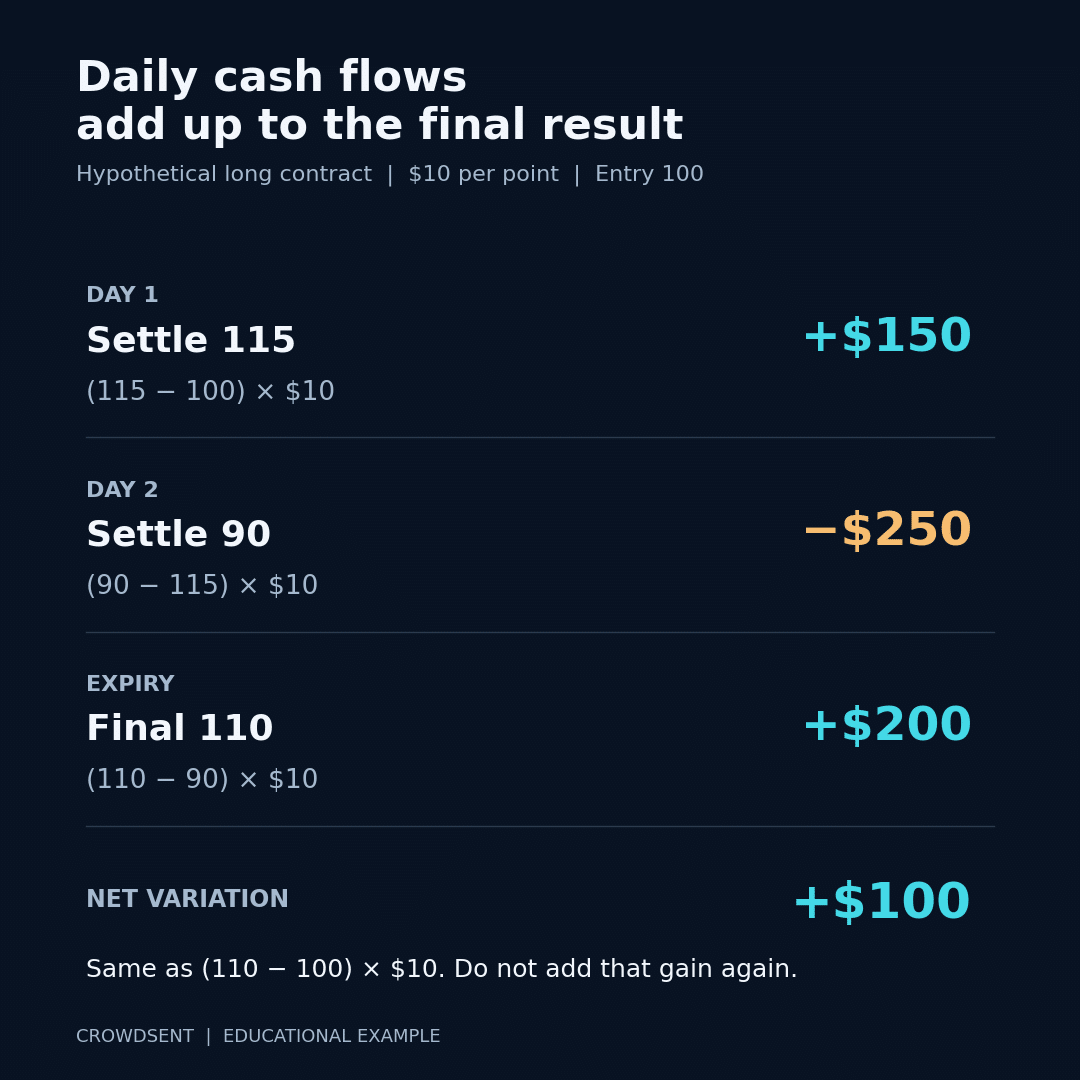
Hypothetical example: assume one long, cash-settled futures contract with a value of $10 per price point. It is entered at 100. Ignore fees, interest, currency conversion and rounding. The values below are invented to isolate the settlement arithmetic.
- First daily settlement at 115: (115 − 100) × $10 = a $150 gain.
- Next daily settlement at 90: (90 − 115) × $10 = a $250 loss.
- Expiry final settlement at 110: (110 − 90) × $10 = a $200 gain.
The net variation is $150 − $250 + $200 = $100. This agrees with the overall price change: (110 − 100) × $10 = $100.
The final $200 is the remaining change since the previous settlement. Adding another $100 because the contract finished ten points above entry would count part of the result twice.
The route matters for cash availability even though the net arithmetic telescopes neatly. In this example, the position generates a $250 debit before its last gain. A later favorable final price does not remove an earlier funding obligation.
For a short position with the same entry, dates and size, the signs reverse. This is an accounting illustration; actual account statements may contain additional transactions and use their own presentation conventions.
Why a daily cash payment does not close the position
After a daily mark, the contract can remain open. Its next price change creates another variation amount. The daily transfer recognizes the change already incurred while exposure to later changes continues.
Initial and maintenance margin concern required collateral or account equity. Variation concerns gains and losses from repricing. A statement can therefore show a variation debit and, separately, a requirement to provide funds to restore adequate collateral.
Do not read a daily settlement credit as proof that all funds are available for withdrawal. Other positions, collateral requirements, broker policies and settlement timing may still affect the account.
CME’s settlement overview describes scheduled intraday and end-of-day clearing cycles, with additional cycles possible when warranted. “Daily” should not be taken to mean that cash obligations can arise only once per calendar day. Customer-account timing must be checked with the relevant broker.
Final settlement follows the expiring contract’s rules
For a cash-settled contract, the expiry reference determines the remaining settlement amount under the product’s methodology. The reference may be an index calculation, a benchmark observation or another prescribed value. It need not be the final displayed futures trade.
For a physically delivered contract, remaining positions can enter a delivery process. The applicable rules define what can be delivered, where, when and how obligations are matched. A daily cash mark does not turn a deliverable contract into a cash-settled one.
CME’s cash settlement and physical delivery overview also highlights that delivery eligibility can begin before expiration in relevant products. This is why first notice or first position dates can matter alongside the last trading day.
A product family may contain different sizes or variants with different settlement rules. Verify the exact symbol and contract specification instead of extending one product’s mechanism to everything carrying the same asset name.
Read “final” in its data context
There are two questions to separate: Has today’s settlement price finished its publication process? Has this contract completed its expiry settlement?
A daily file can progress from preliminary values to finalized values while the contract still has months left to run. Conversely, an expiring contract may use a special final-settlement calculation that differs from its ordinary daily methodology.
CME’s daily settlement procedures notes that preliminary and final published values can differ. Read the field description, trade date and contract maturity together. A status label without those details is insufficient.
For research, distinguish at least four fields: last traded price, chart close, daily settlement and expiry final settlement. If a provider maps two of them to the same value, that is a property to verify rather than a general assumption.
Three ways a reconciliation can go wrong
Comparing different contracts. A front-month chart may have rolled while a statement still refers to the original maturity. The apparent mismatch may come from the selection rule rather than settlement arithmetic.
Using the wrong unit. A quoted one-point move must be translated using the correct contract value factor. Some products quote fractions or cents, and settlement calculations can apply defined rounding. Our contract-size guide explains the importance of preserving units.
Mixing observation dates. A file downloaded after midnight may describe the prior trade date. An account posting date can also differ from the date associated with the price calculation. Record the trade date, timezone and posting convention instead of matching calendar dates by eye.
A settlement-reading checklist
- Identify the exchange, product code, maturity and position quantity.
- Read the contract multiplier and quote format.
- Separate new trades from positions carried into the session.
- Obtain the appropriate settlement prices and their publication status.
- Reconcile variation without adding the total entry-to-exit result again.
- Check the expiry mechanism, notice dates and last trading time.
- Keep collateral movements, fees and other cash items on separate lines.
- Record anything unresolved rather than substituting a guessed value.
Keep the source documents with a market research journal. A blank settlement field should remain unresolved until checked; see missing market data vs zero for why a fabricated zero can corrupt the entire ledger.
Frequently asked questions
1. Is settlement always the last trade of the session?
No. The published product procedure determines the settlement reference. The last trade may occur at another time or reflect a different price. Read the actual method before using a chart’s close in a cash-flow calculation.
2. Does daily settlement mean the contract expires every day?
No. Daily marking can occur throughout the contract’s life while the position remains open. Expiry is a separate event with its own date and mechanism.
3. Are variation margin and maintenance margin the same amount?
No. Variation is the cash gain or loss from marking a position. Maintenance is a collateral or equity threshold. Variation can change the account balance and thereby affect whether that threshold is met.
4. Is the entire gain paid again at final settlement?
Not in the simple daily cash-settled example. Earlier variation has already recognized earlier changes. The final mark settles the remaining difference, so adding the full entry-to-final gain again would double count.
5. Can there be a cash loss before an eventual net gain?
Yes. The example includes a $250 debit on the way to a $100 net gain. A final outcome does not describe the timing or size of intermediate cash obligations.
6. Can physical delivery start before the last trading day?
For some products, delivery-related eligibility begins earlier. The exact first notice, first position and delivery rules matter. Do not assume the expiration date is the only operational deadline.
7. Does a cash-settled contract eliminate all operational risk?
No. It avoids delivery of the underlying asset, but still has price risk, cash obligations, benchmark rules and deadlines. The final reference can also differ from a casual observation of the market.
8. What does a “final” daily settlement file mean?
It may indicate the publication status of that day’s settlement values. It does not necessarily indicate contract expiration. Check the provider’s schema and the maturity date before assigning an expiry meaning to the label.
9. What happens if a position is offset before expiry?
An offsetting trade closes the relevant exposure, subject to normal clearing and account processing. Its execution price matters for the remaining gain or loss. The contract’s later expiry value is not the closing price of that already-offset position.
10. Where should I check an unexplained statement difference?
Start with contract identity, quantity, entry trades, prior settlement, current settlement and multiplier. Then check rounding, fees, currency and posting dates. A broker’s statement definitions are needed before treating a difference as an error.
Keep the research process consistent
To explore the workspace and its membership options, open CrowdSent.
Educational note: This article explains market concepts for research. It is not investment advice or a recommendation to trade. Futures involve leverage and can produce losses greater than the amount initially deposited.