

By CrowdSent Blog Team
A crypto memo or destination tag can tell a receiving service which customer account a payment belongs to. The blockchain address may identify a shared account controlled by the service, while the extra identifier supplies its internal routing information.
That creates two separate records to understand: the payment recorded on a blockchain and the credit recorded in a service’s customer database. A transaction can be visible in the first without its intended customer credit being established in the second.
This guide explains the fields and how to compare existing records. It does not recommend sending a transaction, choosing a network or attempting a recovery. Any unresolved deposit belongs with the receiving service’s verified support process.
What a destination tag adds to an address
Think of a shared receiving address as a building and the routing identifier as a room reference. The analogy is useful only up to a point: a blockchain does not necessarily understand whether the room reference matches a real customer. The service maintains that mapping.
The XRP Ledger’s source and destination tag documentation describes destination tags as information identifying the beneficiary or purpose of a payment. They are unsigned 32-bit integers, and their customer-account meaning exists in the receiving business’s systems.
A tag is not a second wallet with its own XRP balance. Several customers can be assigned different tags while payments arrive at the same on-ledger account. A personal account and a hosted customer account can therefore have different identification requirements even on the same network.
The receiving service’s current instructions determine its supported arrangement. An old screenshot, another customer’s tag or an identifier copied from unrelated transaction history does not establish the instructions for a particular account today.
Memos and tags are not universal equivalents
Different networks have different data fields. On Stellar, a transaction memo can be text, an integer ID or one of the supported hash forms. The Stellar transaction reference describes these types and their encoding limits.
The type matters as well as the visible content. The text “12345” and an integer memo ID of 12345 are different typed fields. A receiving service may expect one specific form, so matching only the characters can overlook a routing mismatch.
Stellar also supports muxed account addresses, which incorporate an identifier with the underlying account. XRP has an X-address format that can encode a classic address and tag together. Support for these formats varies by service and interface; a combined address format should not be assumed to work everywhere.
Even within XRP Ledger terminology, the DestinationTag field and the optional Memos structure are different fields. A generic note box in an application may not populate the field the receiving service expects. The label shown by the sending interface needs to be understood in its network context.
Hypothetical example: one address, two customer records
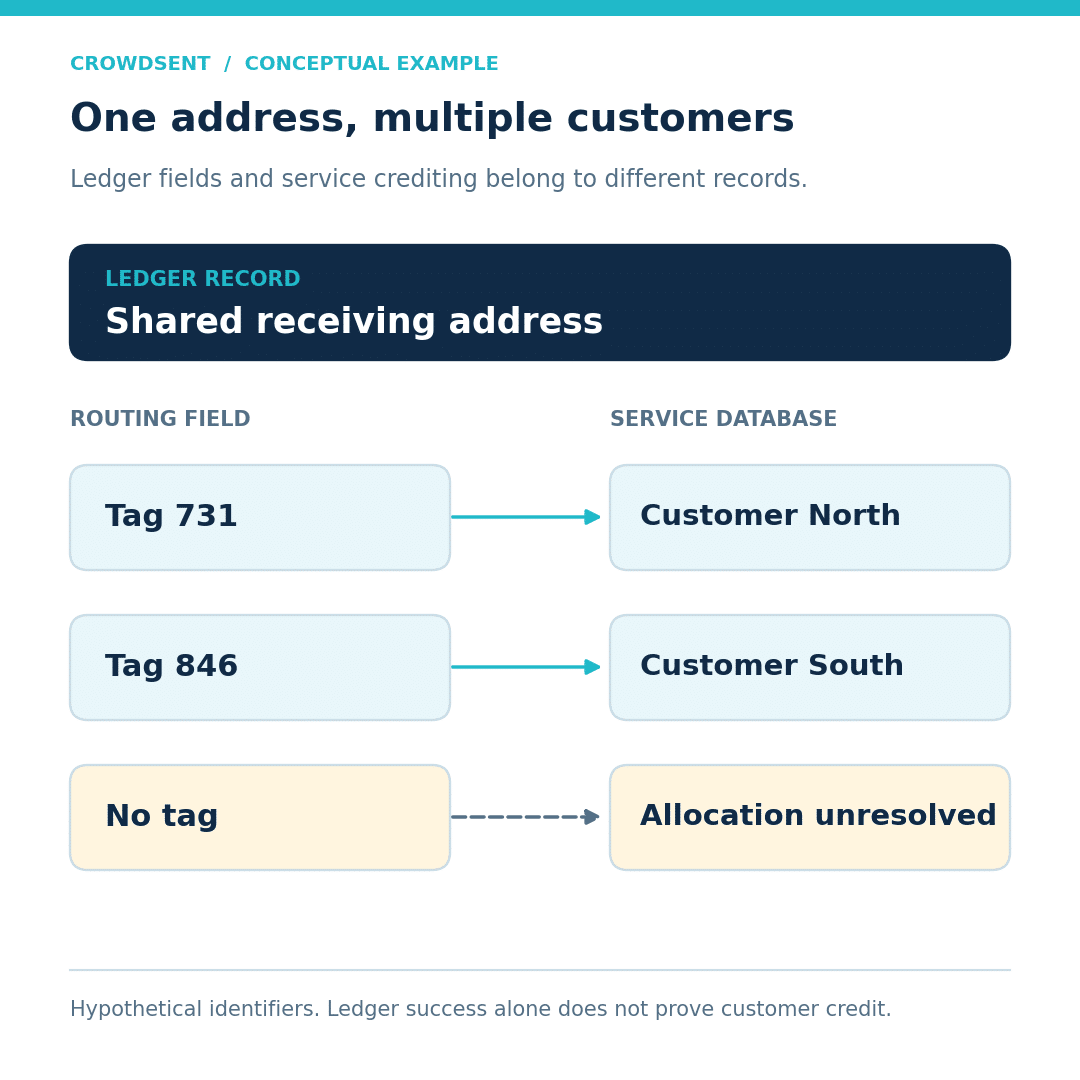
Suppose a fictional service uses a shared ledger address. Its internal record associates tag 731 with Customer North and tag 846 with Customer South. The identifiers are invented and must not be used as real deposit instructions.
A historical transaction shows the shared address and tag 731. That supports a narrow observation: the transaction contains the address and identifier the service assigned to North in this example. It does not independently show that the service credited North, because that result belongs to a separate system.
Now suppose another historical payment shows the shared address but no tag. The address alone cannot tell the reader which of the two customers was intended. A service may need additional records to investigate. The blockchain does not infer the missing customer identity from a familiar amount.
Finally, suppose the payment carries tag 846 when the sender’s records refer to North. A syntactically valid identifier can still disagree with the intended customer. Ledger acceptance and correct internal routing are separate tests.
Required fields do not prove correct fields
XRP Ledger accounts can enable a Require Destination Tag setting. The official Require Destination Tags documentation explains that this rejects payments lacking the tag when the setting applies.
The same documentation makes an important limitation clear: the ledger cannot determine whether a particular tag is correct in the service’s customer database. Requiring the presence of a field cannot validate its off-ledger meaning.
This distinction is common in records work. A form can require a reference number and accept a correctly formatted entry while that entry still points to the wrong invoice. A required field protects against one class of omission, not every possible mismatch.
Separate the stages of evidence
First, establish what the ledger records. Depending on the network, that may include a validated transaction result, destination, asset, delivered amount and routing field. Use the network’s documented result definitions; a submission acknowledgement is not necessarily a final result.
Second, establish what the service records. Its deposit history may show pending review, credited status or another account-processing state. A difference between the two records is a question to investigate, not evidence that the blockchain can revise a completed payment.
Third, preserve the instructions relevant to the existing record, including the source and time. A service may change its supported networks or deposit arrangements. A present-day page and an older transaction can refer to different operational conditions.
CrowdSent’s explanations of Bitcoin’s network and Ethereum’s network and applications offer background on different ledger systems. A routing convention from one system should never be assumed to apply to all the others.
A read-only comparison checklist
- Identify the service, asset and exact blockchain named in the existing deposit instructions.
- Record the full destination address without relying on an abbreviated display.
- Check whether the instructions specify a separate tag, memo type, memo value or combined address format.
- Compare the corresponding field in the historical transaction with the instructions, keeping field names and types intact.
- Distinguish the ledger result from the service’s account-crediting status.
- Preserve the public transaction identifier, timestamps and a concise description of any discrepancy.
Keep these records private where possible. Public transaction data can still reveal relationships between an address, a routing identifier and a person when combined with other information. A public forum is rarely the right place for an unredacted customer-account screenshot.
How to frame an unresolved record
A useful factual summary says which fields agree and which do not. For example: “The ledger record shows the expected shared address, but the DestinationTag field differs from the account’s saved instructions.” That describes evidence without claiming an outcome the records cannot prove.
Only the receiving service can explain its customer mapping and current investigation policy. Assistance, eligibility, costs and timing can vary, and recovery is not guaranteed. Someone outside that service cannot establish a customer credit merely by recognizing a transaction hash.
Never disclose a seed phrase, private key or authentication code to interpret a tag. A request to “synchronize” a wallet or send another payment is not part of reading these public fields. The appropriate next question is about the records and the official process, not a promise of automatic recovery.
Frequently asked questions
Is a destination tag a password?
No. It is routing information carried with a transaction, rather than a secret that grants control of an account. It can nevertheless become privacy-sensitive when linked to someone’s identity or transaction history, so avoid unnecessary public disclosure.
Does every crypto deposit need a memo?
No. Requirements depend on the network, address arrangement and receiving service. The relevant reference is that service’s current instructions for the exact asset and network, rather than a general rule based only on the asset’s ticker.
Can I infer my tag from a previous transaction?
A historical field records what was used then. It does not establish your current assigned identifier or whether the old payment was correctly routed. Comparing with verified service records is safer than treating history as an authoritative directory.
Are memo text and memo ID interchangeable?
No. They can be different protocol types even when their displayed characters look identical. Preserve both type and value when comparing records. A numeric-looking text entry should not automatically be described as an integer memo ID.
What does an XRP Require Destination Tag flag establish?
It requires the destination-tag field for applicable payments to that account. It does not establish that a supplied tag belongs to the intended customer. The service must interpret the value in its own mapping system.
Can an X-address already contain a destination tag?
Yes. XRP’s X-address format can combine the classic account address and a tag. That does not establish that every service supports the format. Read the specific service’s documentation rather than adding or removing fields based on appearance.
Why might a Stellar address start with M instead of G?
An M-address can represent a muxed account, which combines an underlying Stellar account with an identifier. The underlying shared account exists on the ledger, while the service uses the identifier to distinguish customers or purposes.
Does a successful on-chain payment prove correct customer credit?
No. A ledger result and a service’s customer balance are separate records. A payment can reach a shared address while an absent or mismatched routing identifier leaves the intended internal allocation unresolved.
Can a finalized transaction’s memo be edited afterward?
A completed ledger record cannot simply be rewritten by editing a wallet label. A service may have an investigation or account-adjustment process, but its availability and result depend on that service and the circumstances.
What information belongs in a support request?
Use the verified service channel and provide relevant transaction identifiers, network, timestamps and the specific mismatch requested by its process. Avoid unrelated financial records and never provide wallet recovery phrases, private keys or account authentication codes.
Keep learning with CrowdSent
To explore the workspace and its membership options, open CrowdSent.
Educational note: This article explains concepts and evidence checks. It is not investment, legal, tax or personalized transaction advice. Examples are hypothetical, and protocol features and service policies can change.