
CrowdSent vs Santiment vs LunarCrush: 5 Checks Before You Choose
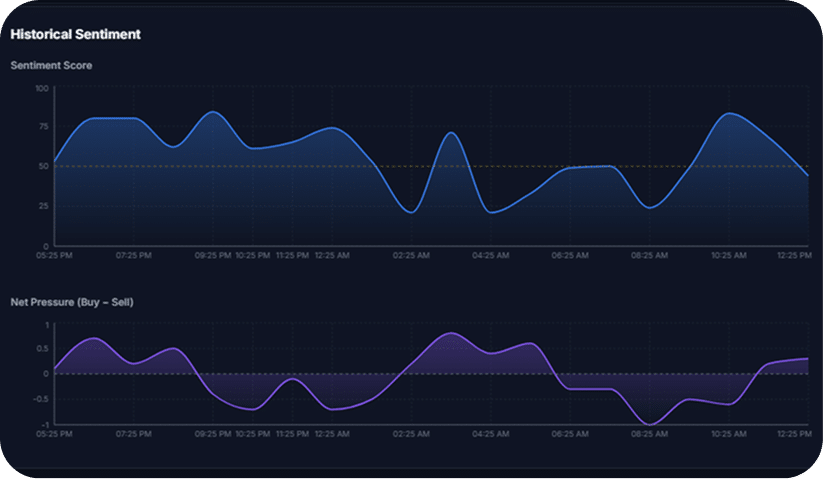
CrowdSent vs Santiment vs LunarCrush is a comparison of research tools with different evidence behind their outputs. The useful starting point is your question: are you studying blockchain activity, public conversation, or a defined sample of market positioning? A shared “sentiment” label can hide substantial differences.
This guide explains five checks for choosing a tool without confusing attention with exposure or a dashboard with a tested trading advantage. It is published by the CrowdSent Blog Team, so CrowdSent has a commercial interest in the comparison. Product documentation was checked on 7 October 2026. This is a documentation-based review, not a hands-on performance benchmark.
Santiment: crypto datasets and metric-level research
Santiment documents on-chain, social and development data, with a GraphQL API for programmatic research. Its documentation also describes custom SQL queries. That makes it a candidate when your question involves cryptocurrency activity across several data types. See Santiment’s developer documentation.
The practical limit is specificity: verify the asset, metric and subscription together. A platform’s broad coverage does not establish that every metric exists for every token. Santiment explains that restricted access depends on both product and plan; access through Sanbase can differ from SanAPI. Check its metric-access documentation against your intended workflow.
LunarCrush: social intelligence across financial topics
LunarCrush describes monitoring social activity around crypto, stocks and broader financial topics, accessed through its website, REST API or MCP connection. It is a candidate for researching attention, conversation and narrative changes. That documented scope is broader than a crypto-only description. See LunarCrush’s product overview.
LunarCrush also maintains an owned blog with analysis and tutorials. Its social coverage should still be evaluated separately from broker positioning or executed transactions. Coverage of a currency-related discussion would not, by itself, establish access to a dedicated foreign-exchange positioning dataset.
CrowdSent: evaluate the membership against your research needs
CrowdSent membership is available through the current pricing page. Before purchasing, match the included tools to the instruments, source definitions and history you actually need. This comparison does not establish a broker count, guaranteed refresh interval, current API entitlement or predictive advantage for CrowdSent. Those details require specific product documentation.
Our recommendation is to apply the same evidence standard to all three products. A useful interface can make research easier, but a product description alone cannot establish the accuracy, completeness or profitability of a signal.
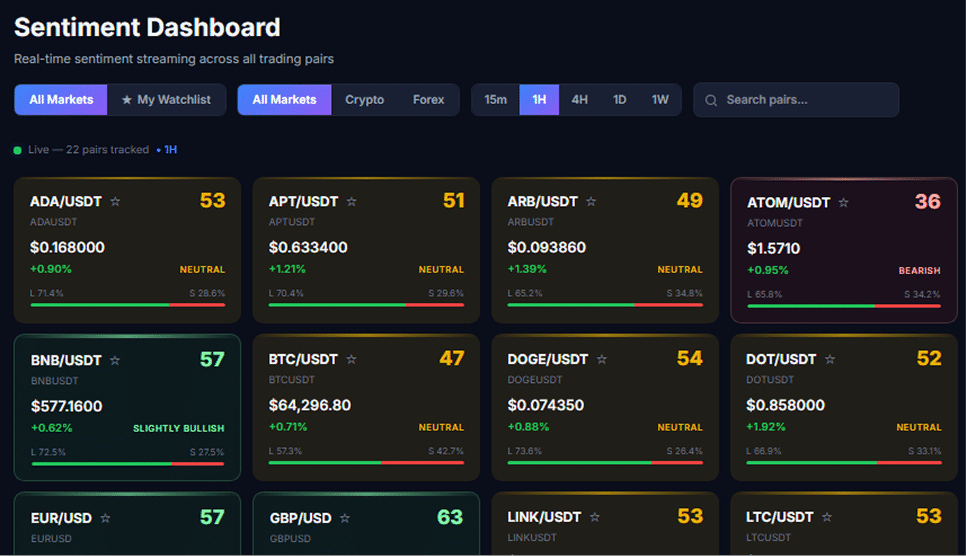
5 checks for CrowdSent vs Santiment vs LunarCrush
1. Define the question and the measurement
Write one research question before comparing features. “Is discussion of this asset accelerating?” calls for attention data. “Are participants in this sample predominantly long?” calls for a documented positioning measure. “Are network balances changing?” requires an appropriate on-chain metric. These questions may complement one another, but they use different evidence.
Accounts, positions and capital are separate units. In an illustrative sample, 70 long accounts out of 100 eligible accounts means 70% long accounts. It says nothing about each account’s position size. A snapshot of holdings is a stock of exposure; executed transactions over a period are flows. Read our long/short ratio guide before comparing unlike denominators.
2. Check the population and asset coverage
Ask who or what enters the dataset: which venues, networks, accounts, languages or social sources? Then ask what is excluded. A large collection can still represent a narrow group. A ticker label also needs checking because a spot asset, futures contract and broker-specific instrument can have different participants.
Santiment’s documented crypto focus and LunarCrush’s broader social-topic scope describe different research starting points. They do not establish universal coverage or a missing feature across an entire competitor. For CrowdSent, apply the same instrument-by-instrument check. Mark an undocumented field as “unconfirmed” rather than silently treating it as included or absent.
CrowdSent vs Santiment vs LunarCrush: final checks
3. Separate refresh speed from research usefulness
Record the observation timestamp, publication timestamp and aggregation window. A chart can refresh frequently while displaying a longer measurement window. A social count and a positioning snapshot taken at different times can appear to disagree simply because their clocks differ.
Also ask whether history is revised. Santiment’s Social Volume documentation explains that source or label changes can trigger historical recalculation. That matters when reconstructing what a researcher could actually have known earlier. Faster delivery and predictive value are separate claims; either requires evidence appropriate to the claim.
4. Verify access, cost and practical constraints
Compare the complete workflow: dashboard access, historical depth, exports, API allowance and any restrictions relevant to your use. Do not assume a visible chart includes a downloadable series, or that a subscription includes every integration. Avoid buying extra access until the required fields and limits are clear.
For readers in India and Pakistan, compare the displayed billing currency and payment amount rather than assuming local-currency pricing. If your research uses a US benchmark, record its instrument, session and timezone separately. None of these choices establishes regional service availability or permission to trade a particular product.
5. Evaluate a repeatable research task
Choose a task with an observable outcome: reconstruct an attention spike, explain a score change or compare a positioning reading with its own history. Use the same instrument and time window wherever comparable data exists. Record missing data instead of substituting a vaguely similar series.
A successful test produces traceable evidence and clearly stated uncertainty. It does not need to produce a trading signal. Our sentiment score guide helps separate an index’s scale from the probability of a future price move.
A small research test you can repeat
Here is an illustrative exercise, not observed market data. A fictional asset’s social-document count rises from 200 to 400 while 70% of accounts in a separate sample remain long. First check the social window and eligible account population. The doubled document count does not mean doubled buying, and the unchanged account share does not prove unchanged capital.
Next, record the headline, original source and publication time using the market-news verification checklist. Save each reading in a research journal. The best fit is the product that supplies the evidence your question needs with limitations you can explain. To assess the available CrowdSent membership, review the plans and purchase access.
Educational information only. Trading involves risk of loss. Product access and documentation can change; verify the details relevant to your intended use.
Frequently Asked Questions
1. Which platform is best for a beginner?
Start with one question and a small number of understandable measures. Check whether you can explain the source, denominator, timestamp and limitations without relying on a colored score. The best beginner fit depends on that clarity, the required assets and the access included in the plan.
2. What is Santiment designed to help research?
Santiment’s documentation describes cryptocurrency research using on-chain, social and development data. It also documents programmatic access. That breadth can support questions spanning several data types, provided the particular asset and metric are available under the selected product and subscription. Coverage should be checked at that level.
3. Does LunarCrush only cover cryptocurrency?
No. Its official overview includes crypto, stocks and broader financial topics. The important qualification is the measurement: monitoring social discussion about a topic does not automatically provide brokerage positions, exchange transactions or institutional exposure in that market. Match the specific field to the question being asked.
4. Does LunarCrush publish its own analysis?
Yes. LunarCrush has an owned blog containing analysis and product tutorials. Readers can use those examples to understand possible workflows, then inspect the underlying definitions. An engaging example is useful context, but it should not substitute for checking data coverage and testing a claim independently.
5. Can these tools answer every forex question?
No single category label establishes that. Forex research can involve macroeconomic releases, social conversation, futures positioning or broker-specific accounts. Identify the required instrument and measure, then check the provider’s current documentation. An unverified capability should remain unconfirmed rather than becoming a blanket claim that coverage exists or is absent.
6. Is a long-account percentage the share of money invested?
No. An account-count percentage counts eligible accounts under the provider’s rules. Differently sized accounts may receive equal weight, and one account can hold several positions. Capital-weighted exposure needs size information and an explicit weighting method. Check those definitions before interpreting a majority as dominant buying power.
7. Does frequent updating make a signal more predictive?
Frequent updates can reduce the age of a displayed observation. They do not establish whether it predicts subsequent prices. Predictive claims require a defined outcome, suitable historical tests and realistic costs. Keep refresh frequency, publication delay and evidence of forecasting value as separate items in your comparison.
8. Can I compare sentiment scores directly across vendors?
Only after checking how each score is constructed. Scales can combine different inputs, populations and windows. The same number may mean different things across products. Compare each reading with its own methodology and history before attempting normalization, and document any assumptions that make a cross-vendor comparison possible.
9. Should I subscribe to more than one platform?
Additional subscriptions make sense only when they answer distinct research questions you regularly use. Overlapping charts can add expense without adding independent evidence. List the required datasets first, run a small comparable task, and assess whether a second product resolves a meaningful gap in the first.
10. Where can I purchase CrowdSent membership?
Use CrowdSent’s pricing page to review the current membership and proceed with a purchase. Confirm the included access and billing details there before committing. This article is an educational comparison, and membership should be evaluated as a research expense rather than an assurance of trading results.
Educational information only. Trading involves risk of loss. Product access and documentation can change; verify the details relevant to your intended use.

Market sentiment tools and educational resources for clearer research.
Contact: info@crowdsent.ai
Disclaimer: Trading involves substantial risk of loss and is not suitable for all investors. Past performance is not indicative of future results. CrowdSent.ai provides information and tools for educational purposes only and does not provide investment advice. Always conduct your own research and consult with a qualified financial advisor before making trading decisions.
- Blogs
- Policy (coming soon)