

A bond credit spread compares a bond yield with a specified benchmark yield, often expressed in basis points. Interpreting it requires retaining both inputs. A corporate yield can fall while its spread widens if the benchmark yield falls by more.
The original example below separates those movements without using live bond data. It then distinguishes a simple yield subtraction from an option-adjusted index measure. The calculations describe observations and measurement choices; they do not identify a security to buy or predict default.
A bond credit spread needs two identified yields
FINRA’s explanation of bond spreads describes a corporate-versus-comparable-Treasury comparison and distinguishes it from differences across maturities on a yield curve. It also explains that either side of the comparison can affect the spread.
For our fictional pair, specify the same currency, matched remaining maturity, fixed payments and no embedded options. Use consistently calculated annual yields observed at the same reference time on each date. These assumptions define the exercise; matching maturity alone would not establish all of them.
Call the two fields “corporate yield” and “benchmark yield.” Then calculate corporate minus benchmark. “Spread” without the identities, method and units leaves the reader unable to tell which relationship is being measured.
Calculate the bond credit spread at each date
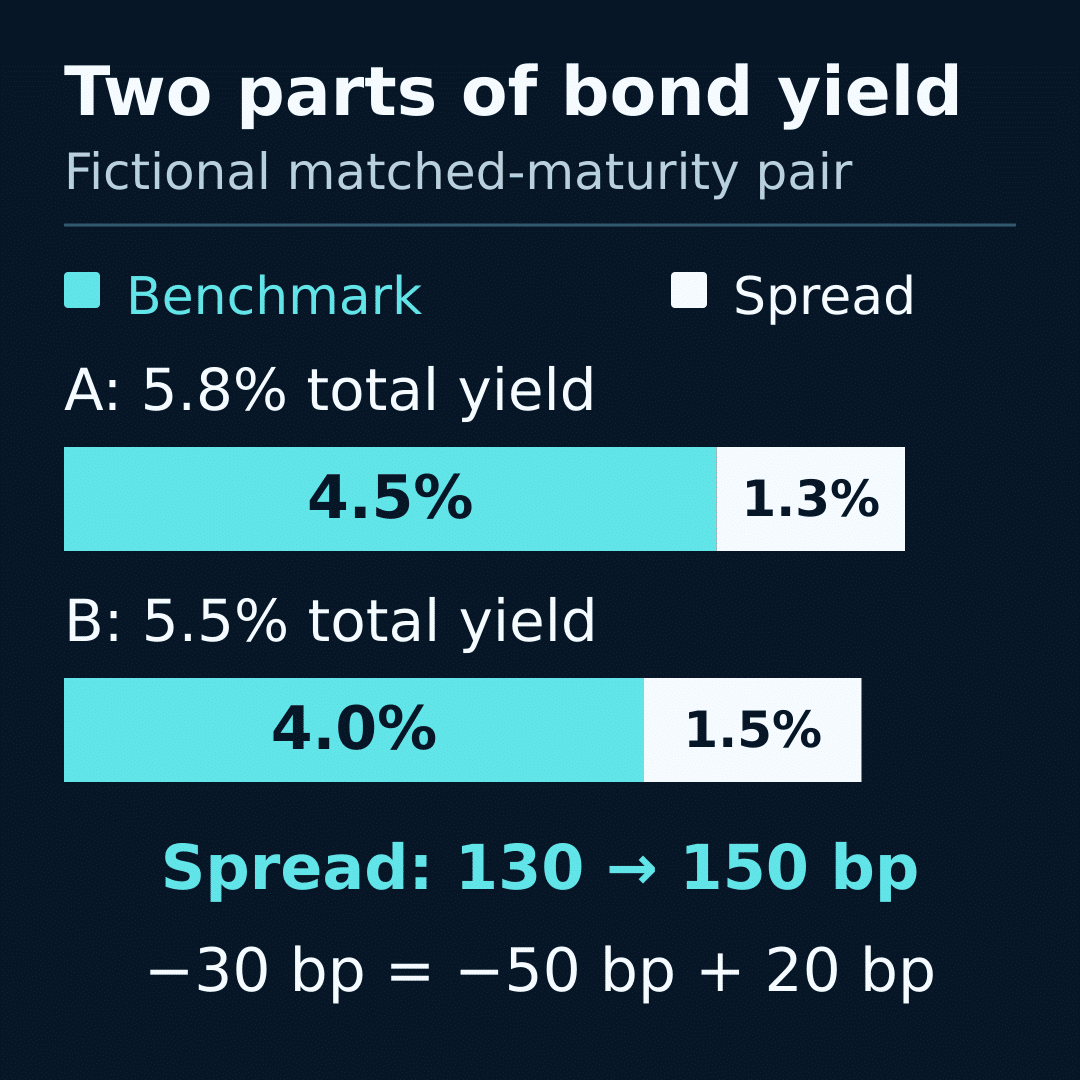
At date A, the hypothetical corporate yield is 5.80% and the benchmark yield is 4.50%. Subtracting gives 1.30 percentage points. One percentage point contains 100 basis points, so the spread is 130 basis points.
At date B, the corporate yield is 5.50% and the benchmark is 4.00%. The bond credit spread is 1.50 percentage points, or 150 basis points. The corporate yield has declined, but its distance above the benchmark has increased.
On a narrow screen, scroll the table sideways to read every column.
| Observation | Corporate yield | Benchmark yield | Simple spread |
|---|---|---|---|
| Date A | 5.80% | 4.50% | 130 bp |
| Date B | 5.50% | 4.00% | 150 bp |
| B minus A | −30 bp | −50 bp | +20 bp |
Check each row by reconstructing the corporate yield. At A, 4.50% plus 1.30 percentage points gives 5.80%. At B, 4.00% plus 1.50 percentage points gives 5.50%. Writing the spread in percentage points for this addition prevents mixing 150 basis points with a percentage-form yield.
Separate the benchmark move from the spread move
Because corporate yield equals benchmark yield plus the defined spread, the changes satisfy the same identity. Our numbers give −30 basis points = −50 basis points + 20 basis points. The benchmark’s decline more than offsets the widening spread.
A note saying only “spreads widened” leaves out the falling corporate yield. A note saying only “corporate yields fell” leaves out their wider distance from the benchmark. Both observations belong in the same comparison when the task is to explain the arithmetic movement.
Now create alternative date C instead of B. Let corporate yield rise from 5.80% to 6.00%, and benchmark yield rise from 4.50% to 4.70%. Both increase by 20 basis points, leaving the spread unchanged at 130. An unchanged gap does not imply unchanged underlying yields.
Try a timing error as a further test. Combining B’s corporate yield of 5.50% with A’s benchmark yield of 4.50% gives 100 basis points. The subtraction is correct, but it describes a cross-date comparison. It cannot replace B’s matched-time 150-basis-point observation.
Finally, suppose a separate bond credit spread calculation at B uses a different benchmark yield of 4.20%. Its spread becomes 130 basis points. That result changes because the benchmark changed. Label it as a new comparison rather than presenting it as a correction to the original 150.
A bond credit spread does not isolate default probability
The Federal Reserve’s May 2021 financial-stability discussion, footnote 5, connects corporate spreads with compensation for default and liquidity risks. Its excess-bond-premium measure is separately modeled. We use that historical document for this conceptual distinction, not as evidence about current conditions.
Our subtraction uses two yields. It supplies no assumed recovery amount, probability horizon or model mapping credit events into cash losses. Relabeling the 150-basis-point result as a 1.5% default probability would introduce a conclusion that none of the worksheet inputs establishes.
The same restraint applies to causes. Date B shows a wider relative gap; it does not reveal how much came from a changed credit assessment, liquidity conditions or other pricing influences. The arithmetic identity decomposes the observed yield movement, not the economic cause of that movement.
Option-adjusted spread requires its own methodology
The FRED notes for the ICE BofA US Corporate Index option-adjusted spread describe a measure using constituent option-adjusted spreads, market-capitalization weighting and a spot Treasury curve. That method differs from subtracting two convenient headline yields. No index observations or source charts are reproduced here.
A separate invented weighted-average exercise illustrates why composition matters. Give hypothetical component X a spread of 100 basis points and component Y a spread of 200. Weights of 75% and 25% yield 125 basis points. Reverse the weights to 25% and 75%, and the average becomes 175, although both component spreads stay fixed.
This two-component arithmetic is not a reproduction of the cited index methodology. It simply demonstrates why an aggregate’s changing membership or weights deserves investigation. A movement in an index statistic does not, by itself, establish that every underlying bond moved by that amount.
Save the benchmark alongside the conclusion
Keep both instrument identifiers, currency, yield convention, maturity information, timestamps, quote side and spread method. Use source verification to resolve whether a quoted number is a single-bond subtraction or a published index statistic.
A complete note for date B reads: “Hypothetical corporate yield fell 30 basis points to 5.50%; benchmark yield fell 50 to 4.00%; the simple matched spread widened 20 to 150.” Preserve the inputs in a research journal. The note explains the comparison without adding a valuation recommendation.
Frequently asked questions
Can a credit spread widen while the bond yield falls?
Yes. In our example, corporate yield falls 30 basis points while the benchmark falls 50. The corporate-minus-benchmark gap therefore widens by 20. Keep both yield changes with the spread change so the relationship is visible.
Can both yields rise without the spread changing?
Alternative date C raises corporate yield to 6.00% and benchmark yield to 4.70%. Both increases are 20 basis points, leaving their difference at 130. The unchanged spread records equal movements rather than an absence of movement.
Does 150 basis points imply a 1.5% default probability?
It means a 1.50-percentage-point yield difference in this worksheet. A default-probability calculation needs additional assumptions and a model. None is supplied here, so converting units does not transform the spread into a probability.
How does this differ from a yield-curve spread?
This exercise compares a corporate yield with a specified benchmark at matched maturity. A yield-curve comparison can instead compare maturities within a defined issuer or benchmark family. Identify the instruments before interpreting the shared word “spread.”
Is this the same as a bid-ask spread?
No. Our subtraction compares yields from two instruments. A bid-ask spread compares buying and selling quote sides. Keeping their units and inputs separate prevents one measure from being used as a substitute for the other.
Why keep both yields in the same currency?
Changing currencies adds another difference to what the comparison represents. Our example deliberately holds that field constant. Preserve the currency labels rather than assuming two percentage-form yields automatically have comparable economic meaning.
Does matching maturity remove every other difference?
It fixes one field. Payment structure, embedded options, quote timing and yield calculation can still differ. Our fictional setup states those assumptions separately so a reader can see what has been held constant and what a real comparison must verify.
Can I calculate an option-adjusted index spread from two headlines?
The cited index has a defined constituent and curve methodology. A corporate headline yield minus a selected Treasury headline is a different calculation. Use the provider’s documented measure and label rather than applying its name to an unrelated subtraction.
Can composition alone change an aggregate spread?
Our invented 100-and-200-basis-point components show that it can. Reversing 75/25 weights to 25/75 raises the weighted average from 125 to 175 without changing either component. Investigate the actual aggregation method before attributing a published change.
Does a wider spread establish that a bond is undervalued?
The worksheet establishes a larger relative yield gap. It contains no fair-value model or evidence that the additional compensation is sufficient. A wider number alone cannot determine future performance or whether a particular instrument fits someone’s needs.
Educational explanation by the CrowdSent Blog Team. Sources checked 13 October 2026. All worked values are invented; no licensed index observations are republished.