

CrowdSent Blog Team · Reviewed 25 October 2026 · Blockchain literacy
A blockchain oracle supplies information that a smart contract needs but cannot establish solely from its own execution. Price feeds are a familiar example. Other oracle systems provide event outcomes, external computations or information used to coordinate actions beyond the chain.
The important question is how an external observation becomes an input the contract accepts. A value recorded on a blockchain can be authentic to its reporting system while still being delayed, poorly defined or unsuitable for a particular application. Recording a number and establishing what that number means are separate jobs.
This guide follows a price input from its source through aggregation, publication and use. The examples are invented. They illustrate unit conversion, freshness and weighting without treating any feed as an executable quote or recommending an oracle provider.
Why a blockchain oracle is needed
Ethereum contract execution must produce the same result for participants evaluating the same state and inputs. An ordinary contract therefore cannot independently fetch whichever website response happens to be available during execution. An oracle arrangement brings the relevant information into the contract’s usable environment under defined rules.
Ethereum’s oracle documentation describes this boundary and distinguishes data sources, trust models and delivery designs. Some systems publish recurring updates; others answer requests or deliver a signed report when an application needs it.
Imagine a contract whose rule depends on whether a scheduled shipment arrived before noon. The blockchain can check the contract’s computation. It cannot infer a physical delivery merely because all validators agree that a report was recorded. The reporting method still needs to explain who observed the delivery, which time zone applied and how disputes are handled.
For a price feed, replace those questions with the asset, quote currency, market coverage, timestamp and calculation method. The Ethereum introduction gives the surrounding smart-contract context; the oracle’s distinct responsibility is the information crossing that boundary.
Follow the data through four stages
A practical diagram begins with observation: a venue, publisher, sensor or other source measures something. Next comes processing, which can include filtering and aggregation. Publication then makes a report available to the chain or application. Finally, the consumer contract decides whether and how to use it.
A system can have multiple nodes but heavily overlapping underlying sources. It can also combine many independent observations through one operational publishing path. These are different kinds of concentration. A node count should not silently become a count of independent markets or independent measurements.
The Chainlink data-model documentation describes oracle operators, aggregation, proxy contracts and consumers. It also describes update triggers based on a deviation threshold or elapsed time. That is one implemented model, not a promise that every oracle publishes once per block.
For research, label the four stages with actual evidence. If a project discloses the publishing contract but omits the source methodology, record that gap. If the source is clear but the consumer’s acceptance rules are not, the missing piece sits at the other end of the chain.
Decode the value before interpreting it
Machine-readable feed values often use integers with a decimal scale or exponent. Their meaning also depends on the pair direction. An asset/USD feed and a USD/asset feed cannot be substituted without the correct conversion. The network and exact feed identifier belong beside the value.
Chainlink’s feed-interface reference documents fields such as decimals, answer and updatedAt. Other systems encode scale differently. Read the definition attached to the chosen interface rather than assuming that a number of digits has a universal meaning.
In a hypothetical feed, an answer of 12,345,000,000 with eight decimal places means 123.45 quote-currency units per asset unit: divide by 100,000,000. If the pair is Example Asset/USD, five asset units have a reference value of 617.25 USD under that observation.
Now imagine another field also displays 123.45, but its pair is Example Asset/Example Stablecoin. It is quoted in a different unit. Calling both figures USD without examining the stablecoin conversion introduces an additional assumption. The shared number does not remove the difference.
For the broader distinction between integer scaling and token quantity, see the token decimals versus supply guide. Here, the scale belongs to the particular feed response, not automatically to the token contract. A useful worksheet retains the raw integer, scale, decoded value, pair direction, timestamp and source identifier. That lets someone reproduce the interpretation. It also makes a decimal error easier to detect before it propagates into a much larger application calculation.
A recent block can contain an old observation
Distinguish when the underlying condition was observed, when the report was published and when the application read it. These times can differ. A timestamp named updatedAt identifies an update under the feed’s definition; it should not automatically be relabelled as the exact time of every underlying market observation.
Pyth’s integration guidance explains that market hours or outages can affect price availability and that applications need staleness checks. A successfully returned number is insufficient evidence that it is recent enough for every use.
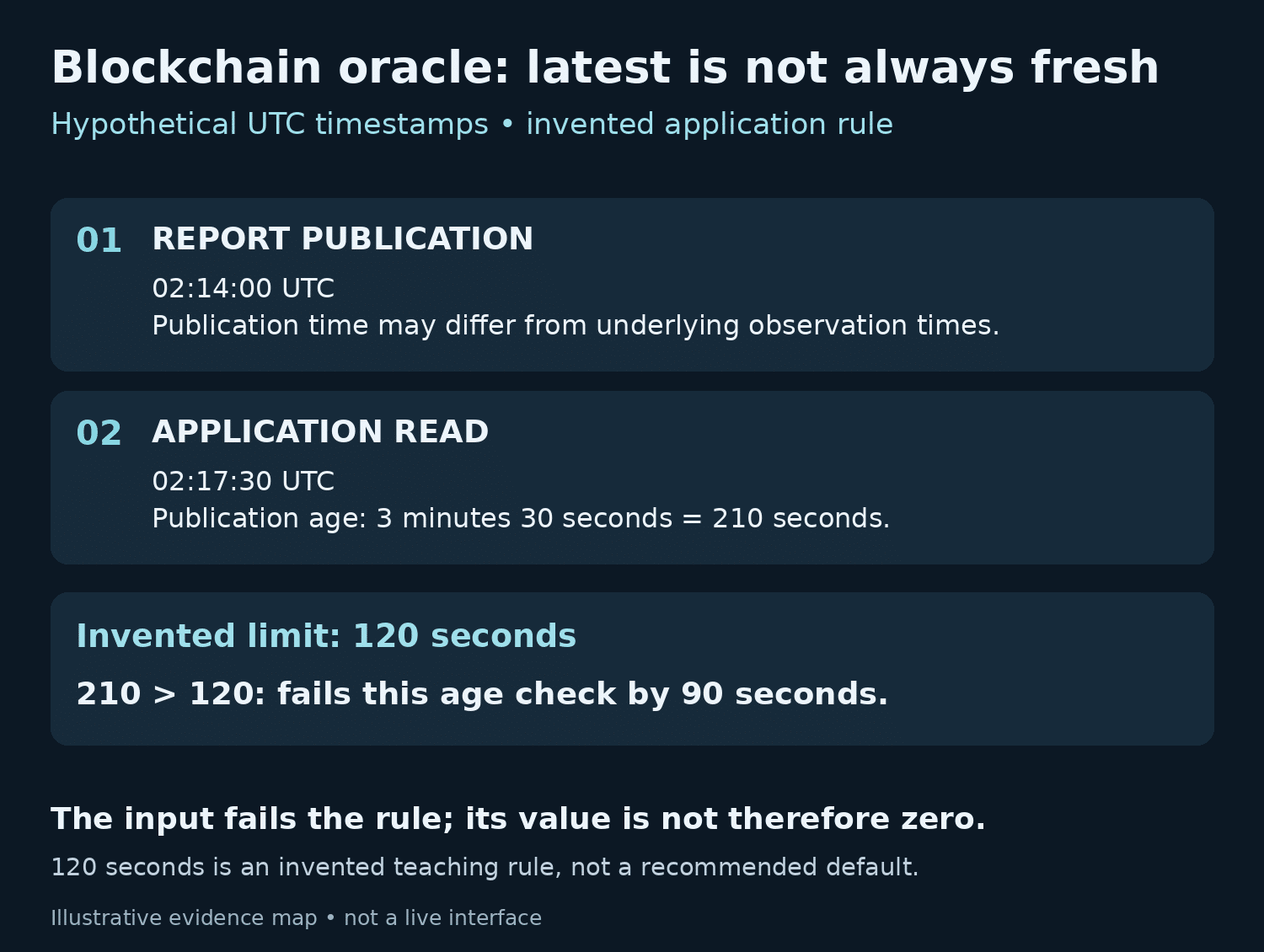
Suppose a fictional report has a publication timestamp of 02:14:00 UTC and an application reads it at 02:17:30 UTC. Its publication age is 210 seconds. If that hypothetical application’s stated limit is 120 seconds, the report fails that test by 90 seconds. The 120-second limit is an invented policy, not a recommended default.
The failure does not mean the reported price equals zero, nor does it establish a newer price. It means this input does not meet the defined freshness condition. The missing-data versus zero guide explains why replacing an unavailable observation with zero changes its meaning.
A heartbeat target can help describe intended update behavior, but it should not be presented as a guarantee that no operational delay will occur. Compare actual timestamps and the documented handling of missed updates.
Aggregation changes sensitivity, not the definition of truth
Aggregation can reduce the influence of an unusual individual report. Its usefulness depends on the input set and method. To make that concrete, take five invented simultaneous quotes for one identically defined asset: 99, 100, 101, 102 and 140 USD.
The median is 101. The arithmetic mean is 108.4 because the sum, 542, is divided by five. The single high observation has a larger influence on the mean. These calculations explain two methods; they do not establish which input is wrong or which aggregation method an actual protocol should use.
Now suppose all five publishers copied the same stale upstream source. Agreement would remain high even though the underlying information was old. Similarly, several observations from a manipulated or thin market could be mutually consistent. Independence, coverage and freshness still need examination.
Some feeds provide a confidence or uncertainty field. Interpret it according to that provider’s documented model. It is not automatically a statistical confidence level, a guarantee that execution will occur within a range or an application-wide safety score. Preserve the field’s own units and definition when displaying it.
An on-chain market can also supply an oracle input
An oracle input need not originate in an off-chain website. An application can use observations from an on-chain trading pool. The key issue is how that input measures the intended quantity and how susceptible the measurement is to distortion.
Uniswap v2’s oracle documentation describes accumulating prices over time. The difference between two cumulative observations, divided by elapsed time, yields a time-weighted average for the selected period. This is a version-specific example; other protocols and versions can use different constructions.
In a simplified arithmetic exercise, a price remains at 100 for ten minutes and 130 for twenty minutes. The thirty-minute time-weighted average is (100 × 10 + 130 × 20) ÷ 30 = 120. The final observed price is 130. Both numbers correctly describe different aspects of the invented interval.
A longer window can smooth a brief movement while making the result slower to reflect a lasting change. It does not create liquidity where little exists or make manipulation impossible. The relevant question is whether the measurement and its window fit the consuming application’s stated purpose.
The consuming application has its own responsibilities
Even a correctly transmitted report can be misused. An application might read the wrong feed, invert the pair, mishandle decimals, ignore age or continue through a known outage. The oracle’s delivery mechanism cannot automatically correct every mistake made after delivery.
Chainlink’s developer-responsibility guidance distinguishes market-integrity risks from application-code risks and discusses contingency logic. This is why “uses an oracle” is an incomplete description of an application’s protections.
On a layer-2 network, sequencer availability can also affect whether participants have timely access to an application. Chainlink’s sequencer-uptime documentation illustrates a separate status input and a post-recovery grace-period concept. The correct application behavior depends on its implementation; there is no universal grace period in this article.
A research conclusion can therefore be specific: “The selected contract reads Feed A, scales its answer by eight decimals and rejects publication ages over its documented threshold.” That establishes observable behavior. It does not establish that the market data is always correct or that the entire application is secure.
Save the feed definition and consumer rules beside the observation in a market research journal. Changes to either can explain a later difference without requiring a change in the underlying asset itself.
Frequently asked questions
1. Is a blockchain oracle itself a blockchain?
It is a system for supplying information to a blockchain application. Its components may include off-chain publishers, networks of operators and on-chain contracts. The word describes the information role, not one required infrastructure design.
2. Can blockchain consensus prove an external event happened?
Consensus can establish agreement on the recorded report and resulting execution. Whether a shipment arrived or a quoted market observation was accurate depends on the reporting arrangement. Agreement about a stored claim does not replace evidence for the claim.
3. Are oracle feeds always prices?
No. Applications can use event outcomes, reserve reports, computed results or other defined inputs. Each needs an appropriate source and interpretation. A timestamp or verification method suitable for one type of information may be unsuitable for another.
4. Does latest mean live?
Latest usually means the most recent report available through that interface. It may still be old. Compare its timestamp with the observation time and the application’s freshness rules, and investigate the documented update schedule and availability conditions.
5. Why does a feed show a very large integer?
The integer may represent a fixed-point value. In the worked example, 12,345,000,000 with eight decimals becomes 123.45. Retrieve the scale from the specific feed definition rather than guessing it from another asset or interface.
6. Does taking a median remove oracle risk?
It changes how individual inputs influence the result. It cannot independently fix a wrong asset definition, shared stale source or coordinated distortion. The example’s 101 median and 108.4 mean show method sensitivity, not a guarantee of correctness.
7. Is an oracle price an executable trade quote?
Usually it is a reference measurement under a defined methodology. Actual execution depends on the venue, size, available liquidity and transaction conditions. A feed value alone does not establish that any particular quantity can trade at that price.
8. Is a time-weighted average the current spot price?
It summarizes a selected historical interval. In the example, the average is 120 while the final observation is 130. Keep the averaging window visible and avoid presenting a smoothed value as the latest instantaneous observation.
9. Does a confidence field guarantee a price range?
No. Its meaning depends on the provider’s model and source data. It may communicate dispersion or uncertainty rather than a guaranteed bound. It also says nothing by itself about execution costs or the consumer application’s code.
10. What is the minimum useful oracle research record?
Record the network, feed identifier, measured quantity, units, scaling rule, timestamps and method. Add the consumer’s freshness and failure-handling rules when studying an application. Those fields make the conclusion reproducible without requiring a wallet connection.
Keep learning with CrowdSent
Continue exploring the CrowdSent knowledge base, or review the current CrowdSent membership. Use the concepts here to ask clearer questions about sources, units and uncertainty. This educational article does not imply that CrowdSent operates a blockchain, wallet, bridge or oracle service.
Source documentation reviewed 25 October 2026. Examples are hypothetical and explain mechanisms rather than current market conditions. This article is educational and does not provide investment recommendations.