

CrowdSent Blog Team · Reviewed 25 October 2026 · Blockchain literacy
A blockchain bridge connects activity across separate networks. It may relay a message, support a token transfer or trigger an application action on another chain. The bridge must establish what happened on the source network and what the destination is allowed to do in response.
“Moving a token” is convenient shorthand, but the underlying records can be quite different. One design locks the original asset and creates a representation elsewhere. Another destroys units on one network and authorizes new units on another. A liquidity-based route can pay the recipient from assets already on the destination.
Understanding the mechanism helps explain why a successful source transaction may coexist with a pending destination action. It also explains why two tokens with the same symbol can have different backing, redemption routes and risks. This guide follows the records without recommending a bridge or asking you to connect a wallet.
How a blockchain bridge verifies a message
Separate blockchains maintain their own records. A destination contract cannot simply assume that a claim about another network is true. The bridging system supplies evidence or attestations and defines how those are checked. Ethereum’s bridge overview describes the different mechanisms and trust models.
Imagine a message saying, “Release 25 Example Tokens to Recipient B because Event A occurred.” Before acting, the destination needs to establish the permitted source, the relevant event, the destination and the amount. It also needs protection against processing the same instruction repeatedly.
The relayer that carries a message and the mechanism that validates it can be different components. A system may let anyone deliver a proof while accepting only proofs that meet strict contract rules. Another may rely on signatures from a defined group. Counting relayers alone therefore says little about who can authorize a destination action.
For research, draw two separate arrows: one for information delivery and one for authorization. Write who or what controls each. A diagram with a single arrow labelled “bridge” hides the central question of why the destination should accept the message.
Lock-and-mint creates a representation
In a lock-and-mint design, original tokens enter an escrow arrangement on the source chain. A corresponding token is minted on the destination under the bridge’s rules. The return process commonly burns that representation and releases the original tokens.
The OP Stack Standard Bridge documentation provides a concrete example of lock-and-mint and burn-and-unlock. Its documentation also explains that different bridged representations of one original token are distinct tokens. The architecture described here is illustrative, not a claim that every bridge uses those contracts.
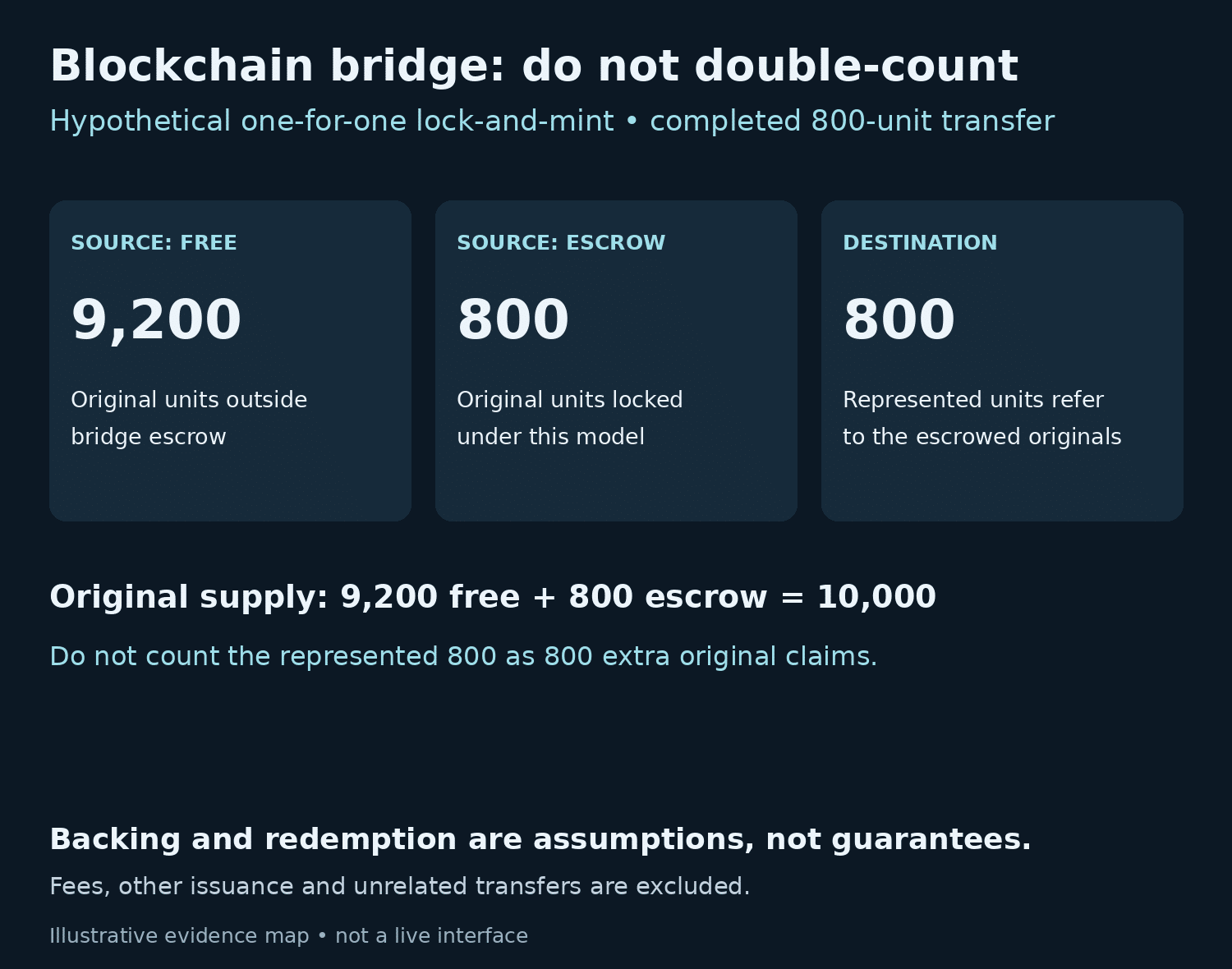
Consider a fictional source token with 10,000 units outstanding. Initially all 10,000 are outside the bridge escrow and no representation exists on Chain B. A user locks 800 units. Once the destination operation completes, escrow holds 800 original units, other source holders have 9,200 and Chain B has 800 represented units.
Adding 10,000 original units to 800 representations gives 10,800 token units across the two ledgers, but it double-counts the economic claim under this simplified one-for-one model. The 800 representations refer to the 800 escrowed units. The example does not establish a market price or guarantee that redemption will work.
Now return 300 represented units through the specified mechanism. After completion, represented supply is 500, escrow contains 500 and the freely held original quantity is 9,500. The check is 9,500 + 500 = 10,000 original-unit claims. Fees, other issuance and unrelated transfers are excluded explicitly so that the accounting is reproducible.
Burn-and-mint changes where native units are recorded
Some issuer-controlled cross-chain systems burn units on the source and authorize a mint on the destination. There need not be a separate escrow-backed wrapper for that transfer. The mechanism still depends on authenticating the burn and enforcing the issuer’s rules for minting.
Circle’s CCTP documentation describes a burn-and-mint model. Its existence should not be generalized to every token using a familiar symbol. Verify the named asset, network, protocol version and supported route before describing an observed transfer.
For an independent fictional example, suppose Chain A contains 6,000 units and Chain B contains 4,000 units of an issuer’s token. A completed 250-unit burn-and-mint transfer leaves 5,750 on A and 4,250 on B, assuming no fees deducted in token units and no other supply changes. The combined amount remains 10,000.
Between burning and minting, a snapshot can show only 9,750 live units across the two chains. The outstanding transfer message is relevant to explaining the temporary difference. It would be premature to label that observation a permanent reduction in the issuer’s intended cross-chain supply.
A statement about total supply therefore needs a time boundary and a treatment for in-flight messages. A bridge-related burn has a different accounting purpose from a standalone destruction event. The event name alone cannot determine the interpretation.
Liquidity routes use assets already on the destination
A cross-chain route can also lock assets on one side and release existing liquidity on the other. In a different arrangement, a service or solver may advance the destination amount and settle its reimbursement later. For either design, distinguish the recipient’s payout from the provider’s subsequent rebalancing or settlement.
The CCIP token-pool documentation describes a lock-and-release configuration in which destination liquidity must already exist. This is one technical illustration of why available liquidity matters; it is not evidence that all fast bridges follow the same design.
Suppose a hypothetical route receives 500 units on Chain A and promises 497 of the specified destination token on Chain B. The three-unit difference is meaningful only after the route explains its fees and conversion assumptions. If the destination asset is different, “three units lost” is not a valid calculation until the units have been reconciled.
Likewise, an immediately completed recipient payout does not show that the provider has finished settling every related obligation. A fast user-facing experience and the timing of the system’s underlying settlement can differ. Keep each completion claim attached to the party and operation it describes.
Token identity needs both networks and both contracts
The wrapped-token versus native-token guide explains the representation and backing distinction in more detail. Here the central question is how an authorized message connects changes on two networks. Symbols and logos are display labels. A blockchain bridge investigation needs the source network, source token identifier, destination network, destination token identifier and the documented relationship between them. On contract-based token networks, the token’s contract address is part of that identity.
Optimism’s bridged-token verification guide illustrates checking the paired token relationship. A token can claim a familiar name while having a different relationship or no authentic connection at all.
Use placeholders in a learning worksheet: Original Token A, Representation B1 and Representation B2. Give each representation a separate row. Even when B1 and B2 both refer to Original Token A, do not assume that one can be redeemed through the other’s bridge or accepted by the same application.
The Ethereum guide’s distinction between ETH and application tokens is useful here. Network membership does not make assets interchangeable. A balance with the right-looking ticker is insufficient evidence that the intended asset arrived.
Read blockchain bridge transfer status as a sequence
A cross-chain transfer can pass through initiation, source inclusion, the required source finality condition, message verification, destination execution and any additional claim step. The exact sequence varies. Some operations are automated; others require a later transaction.
OP Stack’s withdrawal-flow documentation distinguishes initiating, proving and finalizing a withdrawal. Circle’s CCTP technical guide separately identifies message fields and attestation thresholds. These examples show why “confirmed” needs a protocol-specific definition.
For a fictional record, write: “Source lock included; required verification pending; destination mint not yet observed.” That sentence conveys more than a single red or green status badge. Save the source transaction reference, message identifier where available, and destination transaction reference separately.
A failed destination call does not automatically undo a successful source-chain operation. The available retry, claim or recovery path depends on the protocol and the failure. Public investigation should begin with the official status information and exact records. A request from an unsolicited “recovery agent” is not part of that evidence.
What a bridge explanation should leave unresolved
Bridge risk can come from message verification, smart-contract defects, privileged upgrades, source-chain reorganizations, unavailable destination liquidity or operational interruption. Different designs distribute these dependencies differently. A successful historical transfer demonstrates that particular execution, not a guarantee about the next one.
Distinguish a fee estimate from a complete route cost. Source execution, destination execution, relaying, conversion and later claim operations can be separate items. The gas-fee guide explains execution charges, but a bridge’s entire cost may extend beyond that calculation.
When a bridge announcement makes a security or speed claim, use the source-verification guide to find the implemented design and dated documentation. An audit, familiar brand or attractive interface cannot fill a missing explanation of custody, verification or recovery conditions.
Blockchain bridge: frequently asked questions
1. Does a bridge physically move the same token between ledgers?
Each chain changes its own records. Depending on the design, those changes involve locking, releasing, burning or minting tokens. Follow both sides and the message connecting them rather than imagining a ledger entry travelling intact from one database to another.
2. Is every wrapped token created by a cross-chain bridge?
No. Wrapping can also occur within one network, such as creating a token representation with a particular interface. Identify what backs the representation and which contracts control conversion. “Wrapped” by itself does not specify a cross-chain mechanism.
3. Why should escrow and wrapped supply not simply be added?
In the worked lock-and-mint model, represented units refer to original units already held in escrow. Adding both as independent economic assets double-counts that relationship. A real analysis must first verify that the assumed backing and redemption relationship actually applies.
4. Is a native token always preferable to a bridged token?
The labels describe issuance or representation, not a complete assessment. Issuer powers, network operation, contract behavior and access conditions still matter. This article explains those distinctions without selecting an asset or a transfer route.
5. Can two bridges produce different tokens with the same ticker?
Yes. Separate contracts can use identical symbols. Preserve the destination contract identifier and documented source mapping. A ticker match does not establish common backing, shared redemption rights or acceptance by the same application.
6. Does source-chain success prove the destination payment finished?
No. It establishes only the source transaction’s recorded result. The message may still await verification or execution, or the destination action may require another step. Check the destination record and the protocol’s definition of completion.
7. Does a fast bridge remove every waiting period?
A provider can deliver destination liquidity before its own reimbursement settles. That changes the user-facing path and introduces its own assumptions. Compare the precise operation and endpoint rather than assuming that rapid payout changes the underlying protocol’s finality rules.
8. Are bridge fees always charged in the transferred token?
No universal rule applies. Network execution can require a native fee asset, while a route may deduct a separate service or conversion amount. Keep all currencies and token units explicit, including any later claim cost.
9. What does canonical bridge mean?
It generally identifies a network’s recognized native bridging route, but the term should be checked in that network’s documentation. It does not itself promise immediate exits, absence of upgrade authority or freedom from implementation risk.
10. Can this research be done without signing anything?
Yes. Documentation, public contracts and transaction records provide the evidence used here. Reading them does not require an allowance, live transfer or recovery phrase. Keep investigation separate from any later decision to use a bridge.
Keep learning with CrowdSent
Continue exploring the CrowdSent knowledge base, or review the current CrowdSent membership. Use the concepts here to ask clearer questions about sources, units and uncertainty. This educational article does not imply that CrowdSent operates a blockchain, wallet, bridge or oracle service.
Source documentation reviewed 25 October 2026. Examples are hypothetical and explain mechanisms rather than current market conditions. This article is educational and does not provide investment recommendations.