

Yield to worst vs yield to maturity compares conditional repayment calculations. Yield to maturity uses the scheduled payments through maturity. For a simple callable bond, yield to worst considers the applicable earlier redemption path as well and selects the lower modeled yield. The word “worst” does not establish a guaranteed minimum realized return.
Our original example has exactly one optional call date and annual payments. It shows how early repayment of a premium-priced bond can produce a lower yield even though its coupon rate never changes. No real issuer, security or market quote is used.
Read the repayment terms before the yield labels
FINRA’s callable-bond explanation describes optional redemption as an issuer right rather than an obligation. The applicable date, repayment price and payment terms determine the alternative cash-flow path. Real call provisions can differ substantially.
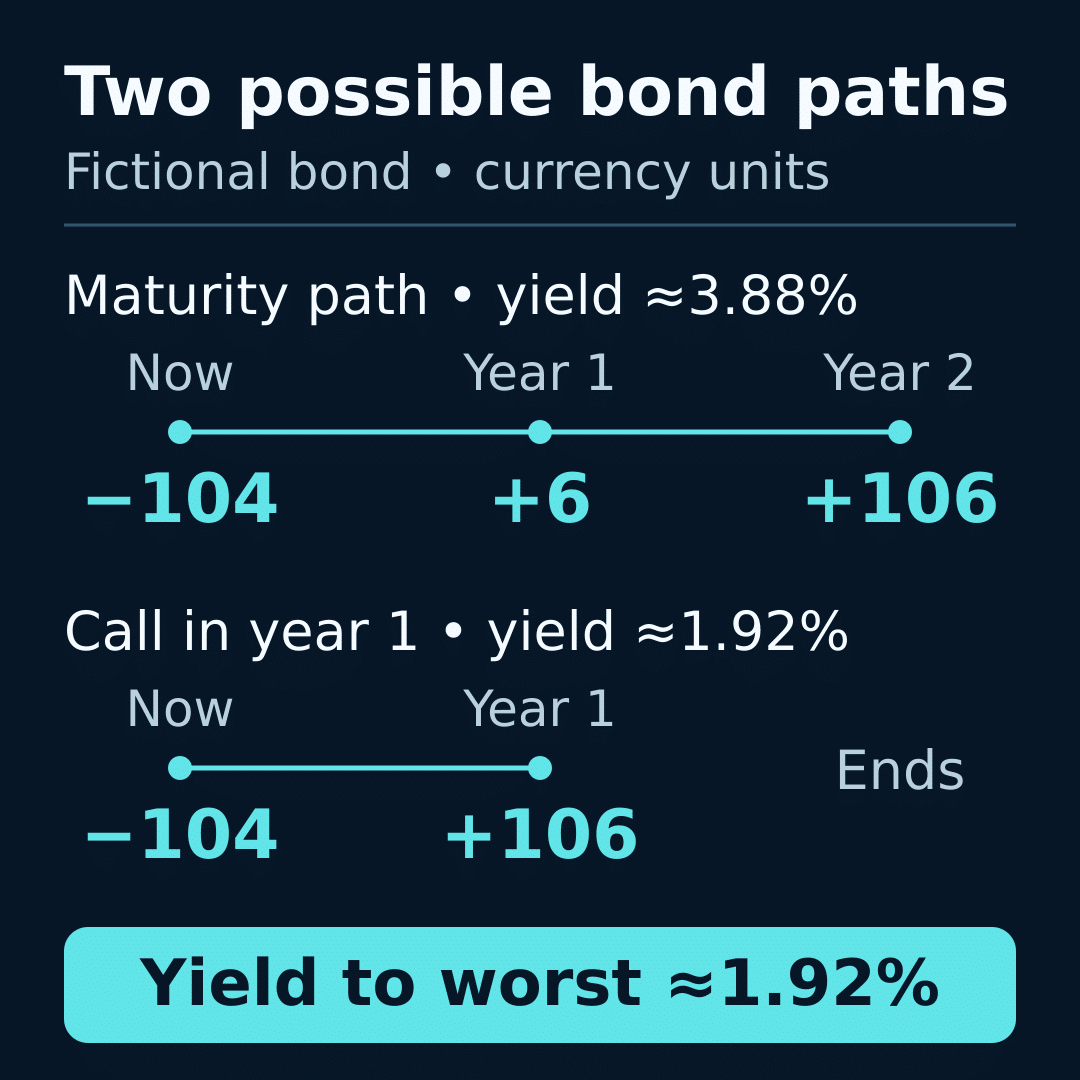
Set our fictional face value at 100 currency units and purchase price at 104. Purchase occurs immediately after a coupon payment, so no accrued interest is included. The fixed annual coupon is 6, and two years remain until scheduled maturity.
The issuer has exactly one option: call the bond one year from purchase at a price of 100, with that year’s coupon of 6 paid at the same time. There are no other call dates or clauses. The exercise excludes default, charges, taxes and currency changes.
On a narrow screen, scroll the table sideways to read every column.
| Time | No call: maturity path | Call exercised at year one |
|---|---|---|
| Purchase | Pay 104 | Pay 104 |
| End of year one | Receive 6 | Receive 106 |
| End of year two | Receive 106 | No remaining payment |
Each column is a complete conditional schedule. Do not combine the called bond’s 106 in year one with the maturity column’s 106 in year two. Doing so would repay the same principal twice and preserve a coupon that the stated call path removes.
Solve the scheduled-maturity calculation
FINRA’s yield explanation describes yield to maturity as the discount rate that equates scheduled future cash flows to the price. Yield to call substitutes the relevant call date and repayment amount. We use annual compounding for both calculations.
For the maturity path, find y in 104 = 6/(1 + y) + 106/(1 + y)². The first term discounts the year-one coupon; the second discounts the year-two coupon plus principal. Their different times prevent treating the total 112 as one immediate payment.
You can reproduce the answer with a rate solver or a quadratic equation. Let x equal 1 + y and multiply through by x². The equation becomes 104x² − 6x − 106 = 0. The positive root is x = (6 + √44,132) ÷ 208.
This gives x ≈ 1.0388277724, so y ≈ 0.0388277724, or a yield to maturity of 3.882777%. Keep the unrounded value for the reverse check rather than relying on a two-decimal displayed percentage.
At that rate, the present value of the first payment is approximately 5.775741. The present value of the second payment is 98.224259. Together they recover the original 104 price, providing an independent check of the equation’s solution.
Replace the later schedule with the stated call payment
If the issuer exercises the sole optional call, the holder receives 100 of principal and 6 of coupon after one year. The year-two payment disappears. The equation becomes 104 = 106/(1 + y), so yield to call is 106 ÷ 104 − 1 = 1.923077%.
A cash check reaches the same result. The modeled payment of 106 exceeds the original 104 by 2. Dividing 2 by 104 gives 1.923077% for this one-year interval. There are no intervening payments to compound in that path.
The 6 coupon has not been reduced. The difference comes from paying 4 above the 100 principal amount that is returned at the call. In the stated one-year cash flow, the 6 coupon exceeds that 4 premium by 2.
For a scale check, multiply every amount by 100: an initial 10,400 becomes a single 10,600 payment after one year. The difference is 200 and the yield is still 200 ÷ 10,400 = 1.923077%. Scaling the cash amounts does not change this conditional rate.
Yield to worst vs yield to maturity in the two-path ledger
For this deliberately limited structure, compare the 3.882777% maturity yield with the 1.923077% call yield. The lower is 1.923077%, which is the example’s yield to worst. The result follows from the modeled schedules and price, without predicting whether the issuer will call.
The coupon rate is a separate calculation: 6 divided by the 100 face amount is 6%. Using that coupon percentage as either path’s yield would ignore the 104 purchase price and repayment timing. Keep “coupon,” “YTM,” “YTC” and “YTW” as separate worksheet fields.
A useful validation record contains the price used, the cash-flow dates, the call price, the compounding convention, each computed rate and the price reconstructed from it. If a source reports a different yield, inspect those inputs before assuming the difference is only rounding.
Yield to worst vs yield to maturity: what the model leaves out
Both schedules assume the specified payments occur. “Worst” selects within that set; it does not evaluate every possible market or payment outcome. An early sale introduces a sale price and a different cash-flow record. Missing payments would also invalidate the supplied schedules.
The maturity path’s rate is an internal-rate calculation for its dated cash flows. A terminal-wealth calculation that reinvests the year-one coupon needs an explicit reinvestment assumption. Keeping that separate avoids turning the calculated YTM into a promise about future accumulated cash.
For a real bond, verify the original redemption terms. Multiple call dates, changing call prices and special clauses require the applicable methodology. Preserve the source and calculations in a research journal; this example’s one-call shortcut should remain attached to its one-call assumptions.
Frequently asked questions
Who decides whether the optional call happens?
In our stated contract, the issuer holds the option. The worksheet calculates the result if that option is exercised and the result if it is not. Computing both does not establish which choice the issuer will make.
Is a call date the same as the maturity date?
Our example makes them different: optional redemption is possible after one year, while scheduled maturity is after two. Keep both dates in the record. Replacing maturity with the call date without relabeling the calculation would hide the conditional assumption.
Why is yield to call below the 6% coupon rate?
The coupon rate uses 100 face as its base. The one-year call result starts with a 104 outlay and ends with 106. Its net increase is 2 on 104, so the conditional yield is about 1.9231%.
Must the call price equal the price paid for the bond?
The call price comes from the stated terms, while the purchase price comes from the transaction or valuation input. Our example sets them at 100 and 104 respectively. Equating them would erase the premium that helps explain the lower call yield.
Is yield to worst always identical to yield to call?
It is identical here because the sole call path has the lower yield. Do not generalize that outcome to different prices or redemption terms. Identify the applicable paths and the source’s methodology before attaching the YTW label to a reported yield.
Does yield to worst guarantee a minimum realized return?
No. Our calculation compares two specified nondefault schedules. It contains no early-sale price or missed-payment scenario. Those events can create different cash flows, so the lower of these two modeled rates cannot establish a floor for every outcome.
What happens to the year-two coupon if the bond is called?
It is absent from the call path. The fictional year-one payment of 106 completes the stated redemption. Adding a further year-two coupon would combine mutually exclusive schedules and overstate the cash received under the modeled call.
Why do additional call dates require further work?
Different dates or prices change the cash-flow schedule being discounted. Our example deliberately allows only one early-redemption date. A real schedule with more possibilities requires its documented calculation method rather than automatic reuse of this two-column comparison.
Why not compare only the total cash in each path?
The maturity path pays 112 across two years, while the call path pays 106 after one. The timing differs as well as the total. Discounted cash-flow equations keep both differences visible, avoiding a comparison that treats every payment as simultaneous.
Which price and assumptions should accompany the reported yields?
Record the full price basis, accrued-interest treatment, payment dates, call terms and compounding convention. For an observed quote, identify its bid or ask side too. The same yield label can otherwise conceal different input records.
Educational explanation by the CrowdSent Blog Team. Sources checked 13 October 2026. All figures are hypothetical and are not investment recommendations.