

Walk-forward analysis evaluates a research process that repeatedly learns from the past and then operates on a later period. The process advances through time: fit or select settings, freeze them, test the next block and repeat according to a schedule defined in advance.
The main question is whether the whole update procedure behaves sensibly. That includes the training window, selection rule and retraining frequency. A collection of attractive test windows selected afterward does not answer the same question.
Walk-forward analysis tests an update policy
A single parameter set might be evaluated once on a reserved period. Walk-forward research instead evaluates a rule for producing successive parameter sets. Each test block uses the settings that the scheduled procedure would have selected using information available before that block.
The statistical idea is related to rolling-origin forecast evaluation. In Forecasting: Principles and Practice, training observations precede each forecast origin, which then advances through the series. A trading application also needs position, cost and execution rules because prediction accuracy alone does not describe a trading account.
Write the policy as a reproducible instruction: at each quarter-end, use the permitted previous data, evaluate a predefined set of settings with the same criterion, select through a fixed rule and apply the result during the next quarter. This describes a process someone else can reconstruct.
Choose rolling or expanding training windows deliberately
A rolling window retains a fixed span of recent history as time advances. Earlier observations eventually leave the training sample. This gives a consistent lookback span, but it also discards potentially informative older conditions.
An expanding window keeps the same starting point and adds newly available observations. It retains more history, while allowing older periods to remain influential. Neither choice is universally superior; the selection should follow the research hypothesis and intended update process.
Window length, update frequency and test-block length are themselves research choices. Trying many schedules and publishing only the winner creates another selection problem. Retain the schedules tried and separate exploratory comparisons from the final evaluation.
A hypothetical three-window schedule
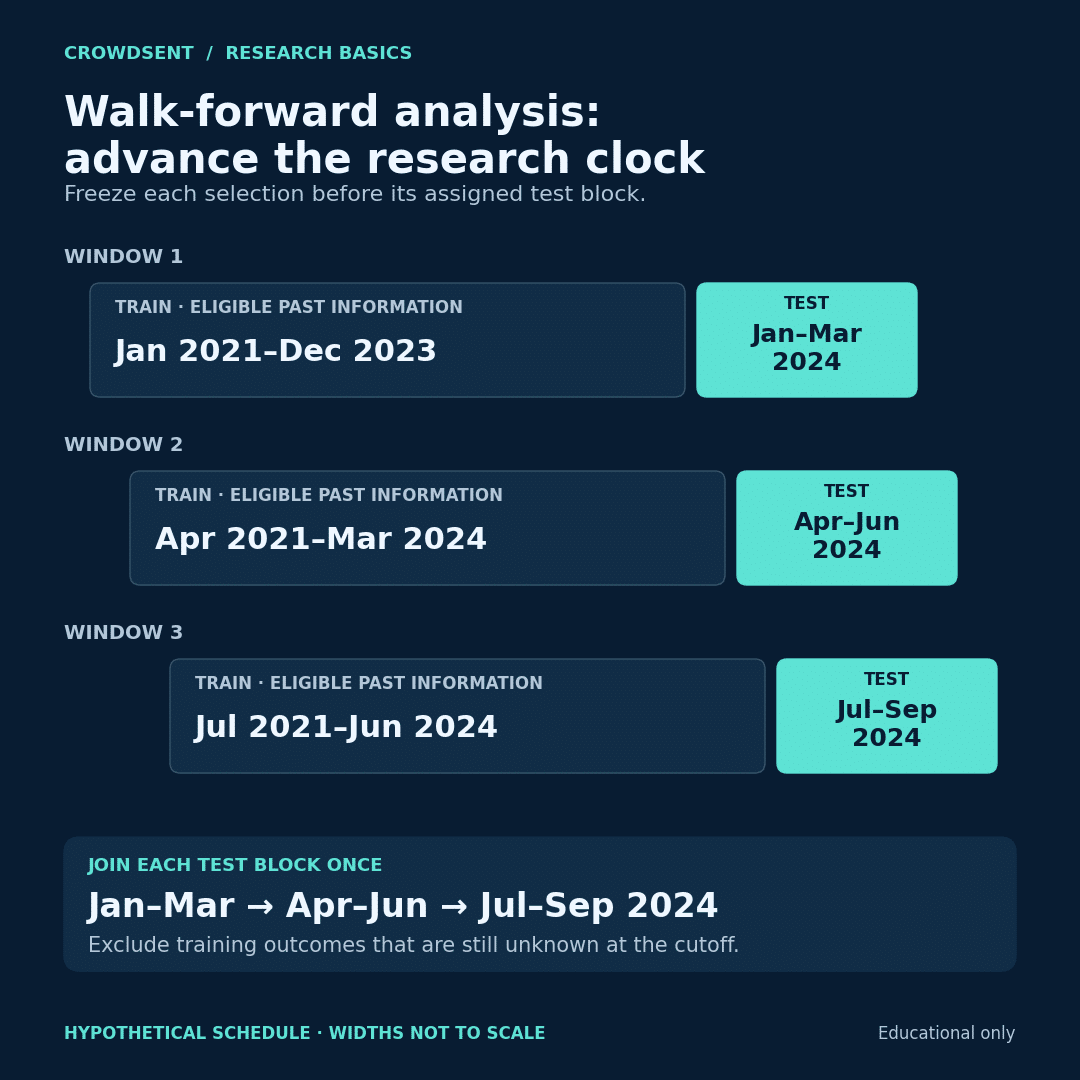
Consider a fictional strategy with three-year rolling training windows and quarterly updates. The schedule is fixed before its test results are inspected:
- Window 1: train on permitted observations from January 2021 through December 2023; freeze the selected settings; evaluate January through March 2024.
- Window 2: train from April 2021 through March 2024; freeze a newly selected set; evaluate April through June 2024.
- Window 3: train from July 2021 through June 2024; freeze again; evaluate July through September 2024.
The date ranges describe candidate training observations. Any observation whose required outcome is not yet known at the selection cutoff must be excluded or delayed. The schedule therefore needs an information-availability rule as well as calendar boundaries.
Training windows overlap, which is normal in this design. The three reported test blocks do not overlap. Once March has passed, its observations may become eligible for the next scheduled training run. That does not rewrite the settings that were used during March.
Suppose the selection procedure chooses lookbacks of 20, 24 and 18 sessions. The evaluation record must use those respective settings in their assigned quarters. Replacing all three with whichever setting later looked best would erase the process being tested.
Keep labels and preprocessing inside the cutoff
If the training target measures a return over the next five sessions, an observation dated immediately before the test boundary may depend on prices inside the test block. A chronological split of row dates alone does not prevent that overlap.
Identify each training observation’s full information interval. Exclude observations whose target is not yet observable at the fitting cutoff. The appropriate separation depends on the target horizon and data timing, rather than a standard percentage applied to every strategy.
The official TimeSeriesSplit documentation describes ordered splits, a maximum training size and a gap measured in samples. A sample gap is not automatically a calendar-time gap, particularly when observations are irregular. Check the actual timestamps and target endpoints.
Fit any scalers, thresholds or feature-selection procedures using only the eligible training observations for that window. Then keep them fixed while evaluating its test block. Past observations used to warm up a trailing indicator are a separate matter: they can be valid context when available at the decision time, provided they do not contribute hidden test outcomes to fitting.
Decide what happens at the boundary
Calendar divisions do not automatically close positions. A strategy may enter late in one test block and remain exposed after the next scheduled update. Decide the treatment before reading the result.
- Carry the position: specify whether its original exit parameters remain attached or new rules take over.
- Close at the update: model the actual closing trade and its costs, because this changes the strategy.
- Delay the update: if the policy waits until flat, record the resulting effective update time.
Also preserve cash, margin assumptions and accumulated account state consistently. Restarting each block with fresh capital while presenting the combined chart as one continuously managed account can hide constraints.
Include computation and operational timing. A model fitted after a session ends cannot generate an order earlier in that same session. If fitting would take long enough to miss the next opportunity, the simulation should represent that schedule.
Join the out-of-sample path without double counting
Construct one chronological record from the scheduled test decisions only. Do not insert the training returns, duplicate overlapping test dates or replace a difficult block with a better rerun.
For a simple hypothetical example, assume three consecutive, nonoverlapping test blocks produce net account returns of +2%, −1% and +3%, with consistent sizing and account-state treatment. Starting from 10,000, the sequence becomes 10,200, then 10,098, then 10,400.94. The compounded gain is approximately 4.01%, rather than the arithmetic sum of 4%.
The example is an accounting illustration, not a performance claim. For a real report, retain the underlying daily or trade-level path so drawdowns and exposure can be calculated across boundaries. Averaging the three maximum drawdowns does not give the maximum drawdown of the combined account.
Inspect each block as well as the aggregate. Record selected parameters, trade count, costs, exposure and data incidents. A favorable total driven by one unusual block deserves a different interpretation from broadly consistent behavior.
Keep the procedure from becoming another optimization target
Repeatedly changing window length, candidate settings or selection criteria after viewing test performance gradually adapts the procedure to those tests. The results remain useful for development, but their independence has changed.
MetaTrader 5’s optimization documentation describes checking selected optimization results on a later historical portion. A complete multi-window research design still requires explicit scheduling, repeated selection and consistent accounting across the sequence; do not infer those details from the word “forward” alone.
Preserve the update specification in a market research journal. If the inputs include sentiment, check historical sentiment coverage and timing separately. A sound split schedule cannot manufacture data that were unavailable.
Frequently asked questions
1. Does walk-forward analysis require machine learning?
No. The repeated selection step can choose a simple rule parameter, estimate a threshold or fit a statistical model. What matters is that the procedure uses eligible past information and is then evaluated on the later block assigned to that update.
2. Can the training windows overlap?
Yes. Rolling and expanding designs commonly reuse earlier training observations. The important distinction is that a reported decision must be evaluated using settings selected before that decision, and the combined performance record must not count the same exposure twice.
3. Can a previous test period become training data later?
Yes, once its information is available, if that is part of the scheduled policy. Preserve the original test decisions and results. Later learning from March does not authorize rewriting what the strategy supposedly knew or selected before March began.
4. How should I choose the training-window length?
Relate it to the hypothesis, observation frequency and amount of usable information. A short window may contain too few relevant events; a long window may give older conditions substantial influence. Treat comparisons among lengths as research trials that should be recorded.
5. Does a gap between windows prevent every kind of leakage?
No. A gap can help exclude observations with overlapping outcome intervals, but it cannot repair revised inputs or a feature selected using the full dataset. Check all information dependencies and determine the gap from those dependencies.
6. Must I throw away earlier data needed to initialize an indicator?
No. Earlier observations can supply legitimate warm-up context when they were already available. Separate that context from observations used to fit or select the model, and start the reported evaluation only when the stated indicator requirements are satisfied.
7. What if a position crosses the retraining date?
Follow a predefined boundary policy. You might retain its original exit settings, apply the new policy or close it with modeled costs. Each choice changes the experiment. Avoid silently closing or resetting positions merely because a reporting window ends.
8. Should I average returns across windows?
An average can be a descriptive statistic, but it does not reconstruct an account’s compounded performance. Build the time-ordered return path with consistent capital and exposure assumptions. Calculate path-dependent measures, including drawdown, from that joined record.
9. Is the best walk-forward schedule the one to deploy?
The best observed schedule may simply be the winner of a large search. Record how many designs were tried and preserve additional evaluation evidence when feasible. An attractive historical ranking is not by itself a decision to expose capital.
10. What makes the report reproducible?
Include each training and test interval, information cutoff, candidate set, selection criterion, chosen settings and boundary policy. Retain versioned data and decision logs. Another researcher should be able to reproduce both the selected configuration and its subsequent assigned test record.
Make the schedule as visible as the result
To explore the workspace and its membership options, open CrowdSent.
Educational information only, not financial or investment advice. Dates, parameters and returns in the worked examples are hypothetical. Walk-forward results do not guarantee future outcomes or eliminate trading risk.