

CrowdSent Blog Team · Blockchain literacy
A token burn is an operation intended to remove token units permanently from usable supply. The phrase can describe different mechanisms: a contract can reduce recorded supply, a protocol can destroy fees, or someone can transfer units to a destination described as inaccessible. These cases need different verification.
The important question is what the evidence establishes. A transfer labelled “burn” is a claim to inspect. A documented supply-reducing contract operation is stronger evidence for that specific accounting change. Neither alone establishes the direction of net supply over a longer period.
This guide follows an invented burn of 80,000 units and a separate mint of 30,000. It explains a verification method without recommending an asset, predicting a price or asking anyone to submit a burn transaction.
Token burn verification starts with the exact asset
Record the blockchain, token contract, quantity, unit and claimed event time. A token symbol is insufficient identification because unrelated contracts can use the same name or ticker. If an announcement refers to a native network asset rather than a contract token, write that distinction explicitly.
Also separate a proposal, a schedule and a completed event. “We will burn” establishes an announced intention. A successful transaction and the relevant state evidence are needed to describe completion. A screenshot without a verifiable network and identifier leaves the event unresolved.
Suppose a fictional announcement claims that Example Token has burned 80,000 units. A researcher first establishes which contract the issuer’s official documentation identifies. They then inspect the record for that contract rather than searching the ticker and accepting the first matching result.
The ERC-20 standard includes a total-supply interface and balance-related methods. It does not mandate one universal public burn function for every token. A contract’s name or familiar interface therefore cannot substitute for inspecting how its particular burn mechanism operates.
The result of this first step is an event identity, not an endorsement. It connects the claim to a specific record that another reader could investigate.
Check what the contract actually changes
A conventional supply-reducing burn decreases the relevant account balance and the contract’s recorded total supply. As a concrete implementation reference, OpenZeppelin’s ERC20 documentation describes a burn operation that destroys an amount, lowers total supply and emits a transfer event whose destination is the zero address.
That documentation describes the implementation. It does not prove that an arbitrary deployed token uses the same code unchanged. Verify the actual contract, any relevant implementation behind a proxy and the state changes produced by the claimed transaction.
Read the event alongside the operation and resulting state. An event is information emitted by a contract. A familiar event name alone cannot make a misleading implementation destroy units. The evidence is strongest when contract behaviour, balance changes and supply accounting agree.
A whole-block before-and-after comparison can include other transactions. If the research question concerns one operation, isolate its effects or account for every other supply-changing event in the interval. Otherwise, the observed difference can accidentally combine a burn with a mint.
Read-only inspection is sufficient for this task. Do not click a burn function or approve token spending to test whether the claim is true. An actual burn can be irreversible and is unnecessary for understanding a completed public record.
Distinguish destruction from a sink-address transfer
Some projects call a transfer to a supposedly inaccessible destination a burn. In such a case, the tokens may remain included in the contract’s totalSupply value even if a data provider excludes that balance from its own adjusted measure. Record both the mechanism and the accounting convention.
For a separate invented comparison, a token starts with 2,000,000 recorded units and transfers 80,000 to a destination labelled Burn Sink. If this operation only changes balances, the contract can still report 2,000,000 units. Calling the destination a sink does not make the arithmetic equivalent to a supply-reducing function.
Claims of permanent inaccessibility require their own basis. A label, an unusual-looking address or a long period without movement does not establish all possible spending or administrative conditions. Recovery powers, contract logic and the network’s rules may matter to the assessment.
Describe the finding at the level verified: “80,000 units transferred to the named sink under the project’s stated burn convention” is different from “the contract’s recorded total fell by 80,000.” If you cannot verify the stronger claim, preserve the narrower one.
Lost credentials and dormant balances present another evidence problem. Lack of visible activity is an observation. Permanent destruction is a much stronger conclusion. Do not silently subtract every inactive holding from a supply figure.
Reconcile gross burning with net supply change
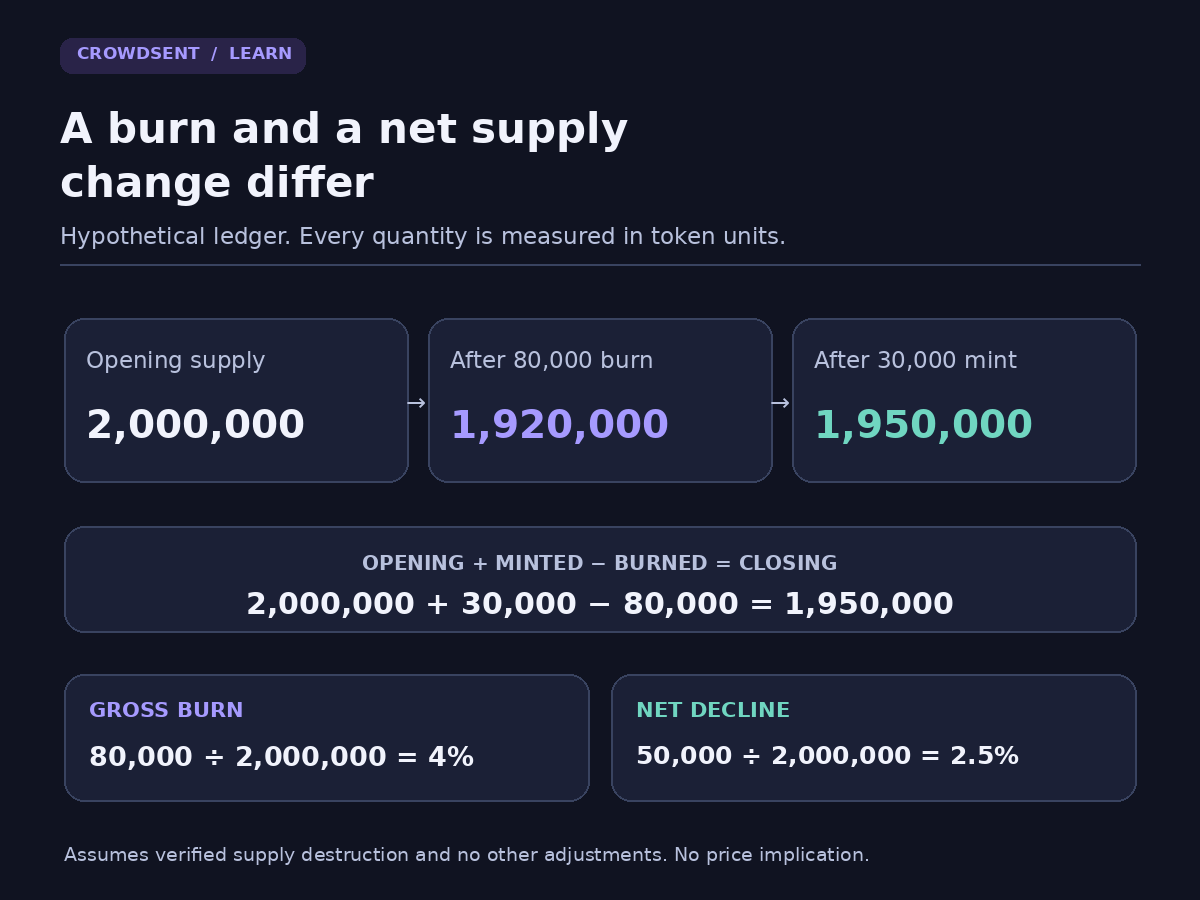
Return to the main worked example, which uses a verified supply-reducing operation. At the start of the observation window, fictional Example Token has 2,000,000 units outstanding under its contract’s accounting. A burn removes 80,000, leaving 1,920,000. A separate mint creates 30,000, leaving 1,950,000.
The ledger is opening supply + units minted − units burned = closing supply. Here that is 2,000,000 + 30,000 − 80,000 = 1,950,000. The gross burn equals 4% of opening supply. The net decline is 50,000 ÷ 2,000,000 = 2.5%.
A headline saying “supply fell 4%” would therefore overstate this window’s net change. Four percent accurately describes the burn relative to opening supply, while 2.5% describes the net decline after the separate mint. Both calculations need the same denominator and explicit labels.
This example assumes no rebases, migrations or additional supply-changing operations. Real reconciliation must include all applicable mechanisms rather than forcing every discrepancy into minting or burning. Check complete units before rounding a dashboard total to millions.
The broader market-cap and price guide explains why a supply input needs a defined boundary. Establishing this ledger does not establish a change in market price or justify holding price constant in a forecast.
Read native fee burning under its own rules
A protocol-level fee burn is different from a token contract’s burn function. Ethereum’s EIP-1559 specification burns the base-fee component of applicable execution fees. It is useful to keep the fee components separate rather than assuming every fee paid is destroyed.
For the broader mechanics and denomination arithmetic, see the Ethereum gas-fee guide. The narrow point here is asset identity: burning ETH as part of paying for a token transaction does not, by itself, prove that the separate token was burned.
Ethereum also has issuance. Its issuance and burning explanation treats these as opposing supply flows. The existence of a burn mechanism does not establish that every observation window has negative net issuance.
For a research note, preserve the period, the units issued, the units destroyed and any additional adjustments included by the source. A lifetime burn total cannot be compared directly with a one-day issuance figure. Align the windows before calculating a net change.
Likewise, avoid interpreting a fee-burn chart as direct evidence of token-holder profit, project revenue or a guaranteed economic benefit. Those are different claims with different accounting requirements.
Inspect future authority and the stated purpose
A completed burn can be real while future supply remains changeable. Ask whether the contract permits further minting, whether a supply cap constrains outstanding units or lifetime issuance, and whether administrative or upgrade permissions can alter the mechanism. A historical operation does not settle all future possibilities.
Be precise with “permanent.” Destroyed units can be permanently removed by the recorded operation while a permitted future mint creates new units. A claim that the supply can never return to its earlier level needs more than a receipt for one burn.
A buyback is also a different step from destruction. Acquiring tokens and holding them in a treasury can leave recorded supply unchanged. To support a completed buyback-and-burn claim, establish both components and the connection between them without inventing a purchase price or funding source.
Other burns may support redemption, migration or cross-network accounting. Removing units on one chain while issuing a corresponding representation elsewhere does not automatically reduce consolidated supply. Define whether the headline concerns one contract, one chain or the full arrangement.
These distinctions help explain purpose without treating the word burn as a universal measure of scarcity. They also prevent counting the same event twice: once as a provider’s already adjusted supply figure and again as an extra subtraction.
Write a conclusion that the evidence can support
A useful burn-verification note contains the exact asset, mechanism, event record, observation window, opening supply, all relevant changes and closing supply. Include the source of any exclusion for inaccessible balances, and preserve unresolved permissions or implementation questions.
For the main example, a finished statement is: “The verified operation removed 80,000 Example Token units. A separate 30,000-unit mint occurred in the same window. Recorded supply fell from 2,000,000 to 1,950,000, a net decline of 2.5%.” That wording keeps the event and the period result distinct.
If evidence is incomplete, specify the missing piece: contract identity, successful execution, supply effect or a complete period ledger. “Burn unverified” is more useful when it explains what would resolve the uncertainty. A promotional chart should not be used to fill that gap.
The market-news verification guide provides a complementary process for checking the announcement itself. Readers in India and Pakistan can use the same token-unit ledger; a rupee valuation is unnecessary for proving the quantity change. Keep any later INR or PKR conversion separate from the burn calculation.
Frequently asked questions
1. What does a token burn mean?
It refers to an operation intended to remove units permanently from usable supply. The mechanism matters: contract-level destruction, a protocol fee burn and a sink-address transfer can produce different records. State which one occurred before describing its effect on a reported supply figure.
2. Does a transfer to a burn-labelled address reduce totalSupply?
It depends on the contract’s behaviour. A plain transfer can leave the recorded total unchanged while moving units into a balance treated as inaccessible by a provider. Distinguish the contract value from an adjusted supply measure and verify the exclusion’s basis.
3. Is a Transfer event to the zero address sufficient proof?
It is evidence to inspect, particularly in conventional burn implementations. It is not a substitute for identifying the correct contract and checking its behaviour and state changes. A familiar-looking event from an unrelated or misleading token cannot authenticate the claimed asset.
4. Can supply rise during a period with burns?
Yes, if issuance or other upward adjustments exceed destruction in the defined period. Gross burning and net supply change answer different questions. Include all relevant flows over matching start and end points before describing the direction of supply.
5. Why is the worked example’s decline 2.5%, not 4%?
The 80,000-unit burn is 4% of the opening 2,000,000. A separate 30,000-unit mint offsets part of it. The net reduction is 50,000, which equals 2.5% of opening supply. The denominator stays fixed while the numerator changes with the question.
6. Does a burn make future minting impossible?
A completed destruction event does not by itself remove minting permissions or change a cap’s definition. Inspect the operative rules and authority. Future creation of new units may remain possible even when the historical burn itself is genuine and irreversible.
7. Is every Ethereum transaction fee burned?
The base-fee burn is one specified component of the fee mechanism. Other components have different treatment. Also distinguish ETH fees from the separate token involved in a contract interaction. Paying an ETH fee does not prove the token’s units were destroyed.
8. Is a buyback the same as a burn?
A buyback concerns acquiring tokens. A burn concerns their removal under a particular mechanism. Tokens held after acquisition can remain in supply. Verify both steps before repeating a claim that combines them, and do not infer a purchase price from a burn receipt.
9. Does burning guarantee a higher token price?
No quantity-changing operation alone establishes a future price. Demand, expectations and other conditions would require separate evidence. This guide verifies supply records and deliberately avoids translating a burn percentage into a return, price target or purchase rule.
10. Can I verify a burn without moving my tokens?
Yes. Inspect public documentation, the event’s transaction record, contract behaviour and the relevant supply values. No live burn, allowance approval, wallet signature or disclosure of recovery material is needed. Use hypothetical amounts when a real identifier is unnecessary for the explanation.
Prepared 9 October 2026. Examples are invented for education and contain no real wallet identifiers. This article explains evidence and terminology; it does not provide investment recommendations.