

Survivorship bias appears when research includes only the assets, funds or records that remain visible after the period being studied. In a backtest, that can mean applying today’s stock list to yesterday’s decisions and quietly excluding securities that were available then but later disappeared.
The error changes the population the strategy could have chosen from. Even perfectly accurate prices cannot repair an incomplete starting universe. This guide explains how to reconstruct eligibility, handle departures and describe remaining data limitations without inventing a convenient return history.
Survivorship bias is a universe problem
Suppose a rule is intended to select from all eligible stocks on each historical review date. A current screener export answers a different question: which stocks satisfy the screener today? Companies that failed, merged, changed listing or stopped meeting the screen may be absent.
Using only that current list conditions the sample on later events. In many familiar examples, weak outcomes disappear and results look better. The direction and size of the distortion depend on what was excluded and how the strategy works; a fixed percentage adjustment is not a general solution.
Historical index research has a related membership problem. The primary paper Look-Ahead Benchmark Bias in Portfolio Performance Evaluation studies the effect of using end-of-period benchmark constituents in historical tests. It is a reminder to ask when membership was known and when it became effective, rather than treating a current constituent list as timeless.
A hypothetical four-stock example
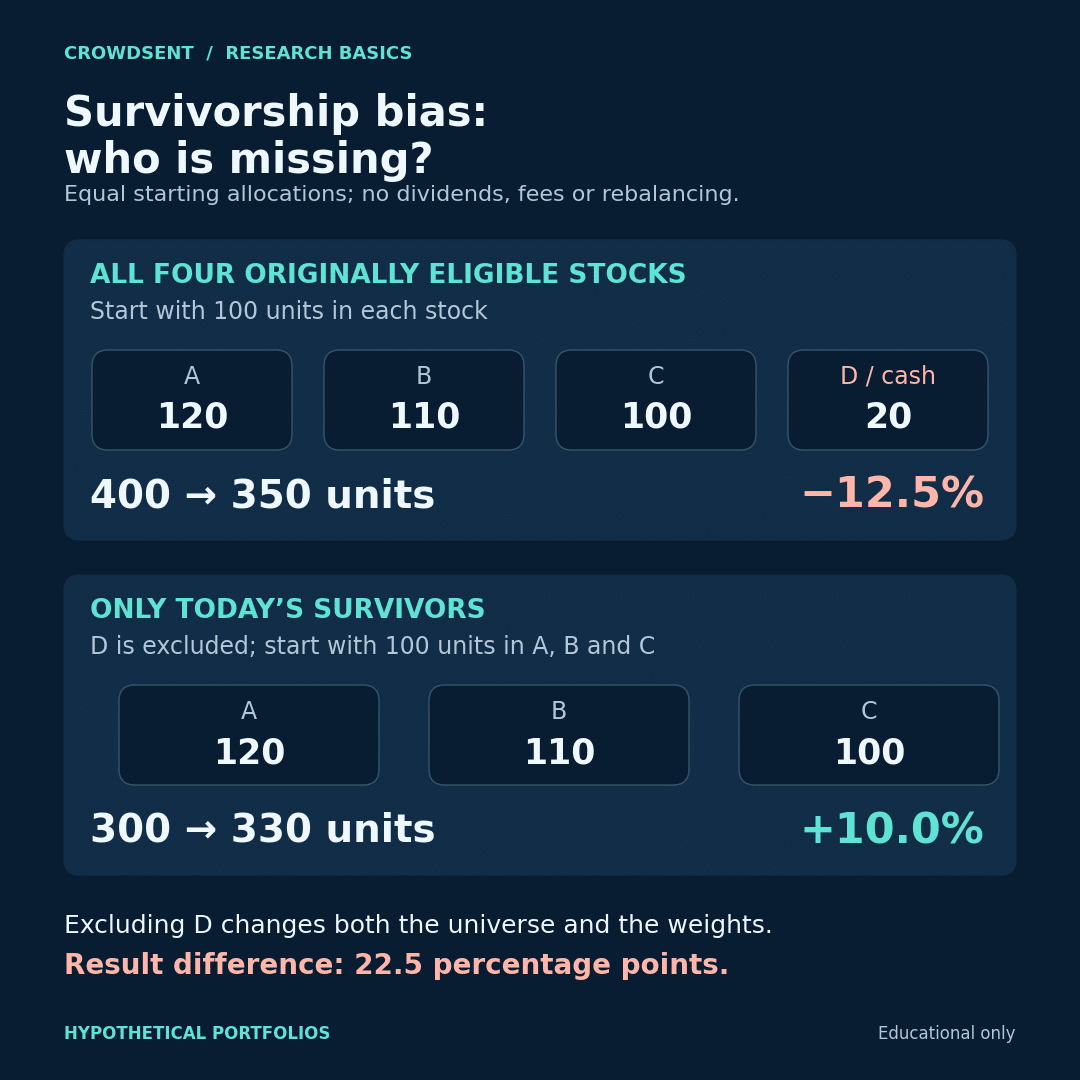
Imagine four stocks, A, B, C and D, all eligible at the start of a one-year study. The hypothetical strategy allocates 100 currency units to each and does not rebalance. Ignore dividends, fees and financing so the example isolates universe selection.
- Stock A gains 20%, ending at 120.
- Stock B gains 10%, ending at 110.
- Stock C is unchanged, ending at 100.
- Stock D leaves the exchange after an 80% loss. Its position realizes 20, which remains in cash until year-end.
The historically eligible portfolio starts with 400 and finishes with 350. Its return is 350 divided by 400, minus one: a loss of 12.5%.
Now imagine a current listing file contains only A, B and C. A researcher starts a new retrospective portfolio with 100 in each survivor. That portfolio rises from 300 to 330, a gain of 10%.
The difference is 22.5 percentage points. No price was fabricated. The result changed because one eligible investment and its loss were removed from the sample and the surviving names were reweighted.
This is an illustration, not an estimate of typical bias. A real reconstruction must account for the actual departure, proceeds, distributions, trading restrictions and reinvestment rule. The fictional 80% loss should never be used as a default delisting assumption.
Define eligibility before collecting the final sample
Write a rule that can be evaluated at each decision date. For example, a research universe might require a particular listing venue, security type and minimum trailing trading history. These are methodological choices, not recommendations to trade those assets.
Then preserve the information needed to evaluate the rule historically:
- Stable identity: a security identifier that can survive ticker changes.
- Entry dates: when the security became listed, available or eligible.
- Exit dates: when it ceased to meet the rule, with a recorded reason.
- Membership intervals: dated inclusion in any index or research group used.
- Historical screening inputs: the values available at that review date.
- Corporate events: information needed to handle mergers, distributions and security changes.
A permanent identifier does not solve every data problem, but it reduces reliance on a symbol that may change or be reused. CRSP’s official US stock-database description includes active and inactive securities, delisting information and permanent identifiers. Those are examples of the data fields to investigate when assessing a historical source, rather than a guarantee that any particular test is complete.
Including a delisted name is only the first step
A file can contain the failed company’s earlier prices and still omit the final investment outcome. Ending the position at its last convenient quote may leave a loss unaccounted for. Conversely, assigning every delisting a total loss ignores events such as acquisitions or moves to other markets.
Shumway and Warther’s primary study, The Delisting Bias in CRSP’s Nasdaq Data, documents how missing delisting returns affected historical research in its sample. Its findings concern a particular dataset and period. They do not justify applying one historical correction mechanically to all contemporary assets.
For each departure, document the event and the portfolio treatment. Was there a cash payment, an exchange into another security, an observable sale or an unresolved valuation? When could the strategy actually act? If the outcome is uncertain, report that uncertainty and test clearly labeled assumptions rather than replacing it silently with zero.
Keep an exception register. One unresolved event in a large holding can matter more than many clean records in small holdings. Coverage percentages should therefore be accompanied by the exposure affected.
Common filters that quietly reintroduce the bias
“Keep only assets with complete data for the whole study” can exclude both later entrants and earlier failures. It may be appropriate for a narrowly described balanced-panel analysis, but it changes the population and often requires knowledge of the future.
“Use today’s largest assets” selects on outcomes that developed during the study. “Drop funds that closed” removes part of the historical opportunity set. “Remove instruments with no current quote” can delete precisely the events that need investigation.
For crypto research, the same audit question applies to the selected venue and instrument: did the dataset preserve markets that stopped trading there? A current list from one venue should not be assumed to represent every market historically available. State the venue scope and archival coverage explicitly.
Missing observations deserve their own treatment. An asset temporarily lacking data is not necessarily ineligible, worthless or inactive. The guide to missing market data versus zero explains why those meanings should remain separate.
A practical historical-universe checklist
- State the population and eligibility rule before interpreting returns.
- Rebuild membership at each rebalance or decision date.
- Use contemporaneously available screening inputs.
- Retain eligible instruments even if they later disappear.
- Audit entry, exit and corporate-event handling.
- Distinguish missing prices from zero returns and genuine closures.
- Compare the reconstructed universe with a current-survivor version as a diagnostic.
- Disclose exclusions, unresolved events and their portfolio exposure.
The diagnostic comparison identifies sensitivity to sample construction; it does not prove the reconstructed version is perfect. Retain the universe snapshots and decisions in a market research journal so later revisions have a traceable explanation.
Frequently asked questions
1. Is survivorship bias the same as look-ahead bias?
They overlap when future survival or membership determines the historical sample. Survivorship bias focuses on which records remain included; look-ahead bias covers any unavailable future information used in a decision. Revised data can introduce look-ahead bias even when the universe is complete.
2. Does a current index list work for an old backtest?
Only for a question explicitly about the historical behavior of today’s constituents. It does not reconstruct a strategy that selected from the index as it existed then. For that claim, use dated membership and respect both announcement and effective-date timing.
3. Should every delisted stock receive a minus-100% return?
No. Delisting has different causes and outcomes. A security may be acquired, exchange into another instrument or continue trading elsewhere. Reconstruct the actual proceeds and trading constraints where possible; document uncertainty rather than treating every departure as identical.
4. Is a missing last price the same as a zero return?
No. It means the required observation is missing. Assuming zero can erase an economic event, while assuming a total loss can create one. Investigate the event and state any fallback valuation rule, including how much of the portfolio it affects.
5. Can a single-stock backtest have survivorship bias?
The trade simulation may involve only one stock, but choosing that stock because it became a famous survivor introduces selection into the research question. Describe why the instrument was chosen and avoid extending its experience to the population of stocks originally available.
6. How should newly listed assets enter the universe?
Follow the predefined eligibility rule using actual historical availability. An asset requiring a minimum amount of trailing data enters only when that requirement is met. Do not invent pre-listing observations or require future survival to decide whether it was eligible.
7. Are inactive fund records enough for fund research?
They are important, but also inspect termination dates, merger treatment, available returns and share-class identifiers. Multiple classes of the same portfolio can duplicate economic exposure if counted as independent funds. A complete list still needs an appropriate unit of analysis.
8. Is restricting the study to survivors ever legitimate?
Yes, for a clearly stated descriptive question about that survivor group. The limitation becomes serious when the result is presented as an implementable historical selection strategy or as representative of the original population. Keep the interpretation aligned with the sample.
9. Can I estimate away the problem without historical membership?
Usually there is no dependable universal correction. The missing names, their weights and their outcomes matter. You can report sensitivity under explicit hypothetical assumptions, but those scenarios should not be labeled a verified survivor-bias-free reconstruction.
10. What should a research report disclose?
Include the universe rule, membership source, identifier method, coverage dates, excluded records and treatment of departures. Explain whether selection used information available at the time. If important histories remain missing, state how that limits the conclusion.
Start with the denominator
To explore the workspace and its membership options, open CrowdSent.
Educational information only, not financial or investment advice. Portfolio figures are hypothetical and exclude real-world costs. Historical research cannot guarantee future returns, and trading involves risk of loss.