

Stock market time zones matter whenever you compare a local trading session, an overseas benchmark, a news release and a data timestamp. A clock label is only one part of the problem. You also need the date, the relevant session and an explanation of what the timestamp represents.
A reader in India or Pakistan can see a US market update on a different local clock, and sometimes on a different calendar day. That does not make the underlying event later or earlier. This guide explains how to align the records without relying on a fixed list of exchange opening hours. All example events and session labels below are hypothetical.
Stock market time zones: name the event and its clock
Keep three questions separate. When did the event happen? That is the instant you want to identify. How is that instant displayed? That depends on the chosen time zone. Which trading session does the record belong to? That depends on the exchange or data provider’s session rules.
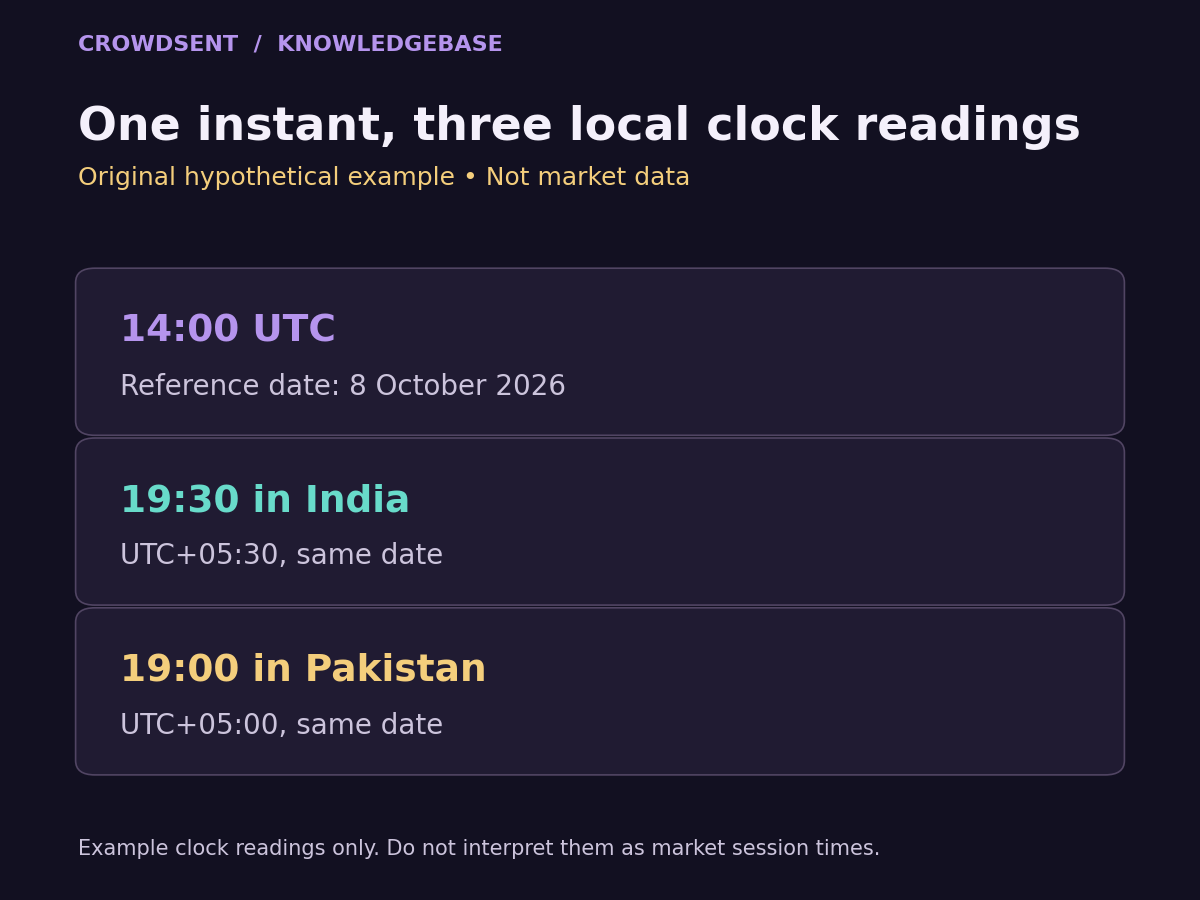
For example, a fictional transaction might occur at 14:00 UTC on 8 October. It could be displayed as 19:30 in India or 19:00 in Pakistan. If a platform stores that record under a particular exchange trading date, the date label may describe the session rather than the viewer’s local calendar.
Write the date alongside the time whenever you move a record between tools. “The update was at 19:30” is incomplete if a colleague cannot tell which date and zone you mean. “8 October, 19:30 India time, equivalent to 14:00 UTC” gives them something reproducible.
Use UTC as a shared reference
UTC gives you a common reference for matching records. To convert a time at UTC+05:30 into UTC, subtract five hours and thirty minutes. To display UTC in that local offset, add the same amount. A minus offset reverses that direction: UTC−05:00 is five hours behind UTC.
For India, CSIR–National Physical Laboratory describes Indian Standard Time as UTC(NPLI) plus 5 hours 30 minutes. The IANA time-zone data for Asia records Asia/Kolkata at +05:30 and the contemporary Asia/Karachi rules at +05:00. Both currently operate without a seasonal clock change; historical records still need their date-specific rules.
Our fictional 14:00 UTC event therefore appears at 19:30 in India and 19:00 in Pakistan on the same date. To check the arithmetic in reverse, subtract 05:30 from 19:30 or subtract 05:00 from 19:00. Both return 14:00.
A timestamp such as 2026-10-08T14:00:00+00:00 includes a date, a clock time and an explicit offset. You may also encounter a trailing Z to indicate UTC. A bare “14:00” lacks those safeguards. Preserve the original complete timestamp before converting it for a chart or note.
Why the US comparison can shift by one hour
An offset describes a relationship with UTC at a particular time. A named time zone can contain rules that change that offset across dates. That distinction matters when an overseas schedule is stated in local time rather than UTC.
The NIST local-time FAQ lists US Eastern Standard Time as UTC−05:00 and Eastern Daylight Time as UTC−04:00. “ET” is commonly used as an umbrella label for Eastern Time; treating every ET timestamp as EST can introduce a one-hour error. Verify the date and intended location before choosing an offset.
Imagine a fictional announcement scheduled for 09:00 in New York. Under the standard-time offset, it corresponds to 14:00 UTC, 19:30 in India and 19:00 in Pakistan. Under the daylight-time offset, the same 09:00 local appointment corresponds to 13:00 UTC, 18:30 in India and 18:00 in Pakistan.
The local appointment in New York has stayed at 09:00. Its UTC representation has changed. Conversely, an appointment fixed at 14:00 UTC would keep its India and Pakistan equivalents under the current rules, while its New York clock label would change with the Eastern offset.
For saved research, prefer a recognised zone identifier such as America/New_York alongside the date rather than a permanently hard-coded offset. The IANA Time Zone Database is maintained to reflect changes to offsets, boundaries and daylight-saving rules. A calendar conversion should use the rule that applies to the event’s date.
A correct conversion does not establish an open market
Time-zone arithmetic can tell you what one clock reading means elsewhere. It cannot tell you whether a venue is accepting a particular type of trade. A regular session, an opening auction, an extended session and an overnight derivatives session can have different rules.
For a stock-market comparison, identify the exchange, product, date and session category first. Then consult that exchange’s official calendar and notices for the applicable schedule. Holidays, shortened sessions, special openings and unscheduled interruptions require more than a conversion from a remembered time.
Consider a fictional schedule that identifies 10:00–16:00 as its main session. Converting those boundaries into your local zone explains when that stated session would occur for you. It does not establish that the schedule applies on a holiday, that all products share it, or that an extended-session observation belongs inside it.
A benchmark’s published close also needs its own definition. A US index level, a futures quote linked to it and a fund traded on another venue can update on different schedules. “The US market” is too broad a label to decide which timestamps should match.
When a data screen includes a last-update time outside the main session, inspect what changed. It might be a later publication of an earlier value, another session’s observation or an update to a related instrument. The timestamp alone does not establish fresh trading in the series you intended to study.
Crossing midnight changes the date as well as the hour
Suppose another fictional event occurs at 23:45 UTC on 8 October. Adding 05:30 produces 05:15 in India on 9 October. Adding 05:00 produces 04:45 in Pakistan on 9 October. A spreadsheet that retains 8 October while changing only the clock would place the local event on the wrong day.
This can make a news story appear to follow a market reaction that actually came afterward, or appear to lead a value already recorded earlier. When checking a sequence, convert complete date-time values and then sort them. Avoid sorting text labels or dates stripped of their original zone.
Daily labels deserve extra care. A “daily” sentiment summary might cover a UTC calendar day, while a price bar covers an exchange session. They can both bear the date 8 October without covering the same hours. Before comparing them, record the start and end instants of each interval.
If the two windows cannot be aligned, describe the mismatch instead of silently treating the values as simultaneous. The guide to reading historical sentiment explains why window definitions and coverage belong beside any comparison.
Distinguish observation, publication and reference time
A date-time field may identify when something was observed, when a provider received it or when a publication became available. A report can also describe an earlier reference period. Converting all of those fields into UTC helps place them on one clock, but it does not give them the same meaning.
Imagine a statistic about September activity that is published at a fictional 12:00 UTC on 8 October. A collector stores it at 12:02. September is the reference period; 12:00 is publication time; 12:02 is collection time. None should be substituted for another without explanation.
A research comparison asking what information was available at 12:01 must use the public release timing and the version available then. A later revision or a later-collected value may contain information unavailable at that moment. Verifying market news includes the related task of checking the original publication and its context.
Keep a reusable timestamp record
For each important observation, retain the source link, instrument or series, raw timestamp, zone or offset, converted UTC instant, session category and timestamp meaning. For an interval, keep both boundaries and note whether the label refers to its start or end.
A useful note might read: “Fictional series X; observed 8 October at 14:00 UTC; displayed locally as 19:30 India; main-session eligibility not checked; timestamp identifies the observation.” That final qualifier prevents a correct conversion from being mistaken for verified market availability.
If a zone is missing, mark it unresolved until the provider’s documentation supplies it. Do not infer it from the language of the website or your computer’s current clock. The market research journal guide offers a way to keep assumptions and later corrections attached to the evidence.
Frequently asked questions
What do stock market time zones affect?
They affect how session schedules, price observations and releases are displayed and compared. To align records, keep the full date-time, the applicable zone and the meaning of the timestamp. Session eligibility needs a separate exchange-calendar check.
What is 14:00 UTC in India and Pakistan?
Under their current offsets, it is 19:30 in India and 19:00 in Pakistan on the same date. This is a time conversion, not a statement that either stock exchange is open at that instant.
Are ET and EST interchangeable?
No. EST identifies the standard offset, UTC−05:00. ET may refer to the applicable Eastern local time, including daylight time at UTC−04:00. Use the date and location to resolve the intended offset.
Why can a US event move on my local calendar?
If the event stays at the same US local time while the applicable US offset changes, its UTC equivalent changes. Its clock time in India or Pakistan can therefore shift even though those countries have not changed their clocks.
Does UTC itself change for daylight saving?
UTC does not follow a seasonal daylight-saving clock adjustment. Local civil-time rules determine the offset used to display an instant. Keep UTC as the comparison reference and apply the relevant location’s date-specific conversion.
Can I infer opening hours from the exchange’s time zone?
No. You also need the specific venue, product, date and session schedule. Check the exchange’s official calendar and notices, including holidays and shortened sessions, before treating any converted time as a trading window.
Why do two daily charts show different closing values?
They may use different sessions, boundaries, price types or sources. Check those definitions before blaming the time zone. A display-zone change may only relabel a chart, while another setting may regroup its underlying observations.
Is a publication date the period measured by a report?
Often it is separate. A report published in October might describe September activity. Keep the reference period, release timestamp and collection timestamp in separate fields so the data does not appear available before it was released.
What should I do with a timestamp that has no zone?
Check the provider’s documentation or field description. Preserve the raw value and mark the zone as unknown while you investigate. Guessing a zone can introduce a plausible-looking error that survives later analysis.
Should I save a local time or UTC in research notes?
Retain the original timestamp and its zone, then add a UTC conversion. A local display can make the note convenient to read. Keeping both representations makes it easier to check conversions, date changes and historical rules.
The reliable sequence is simple: identify the event and session, preserve its full timestamp, apply the correct date-specific zone rule, and keep the original meaning attached. Once those pieces match, comparisons across India, Pakistan and overseas benchmarks become much easier to audit.