


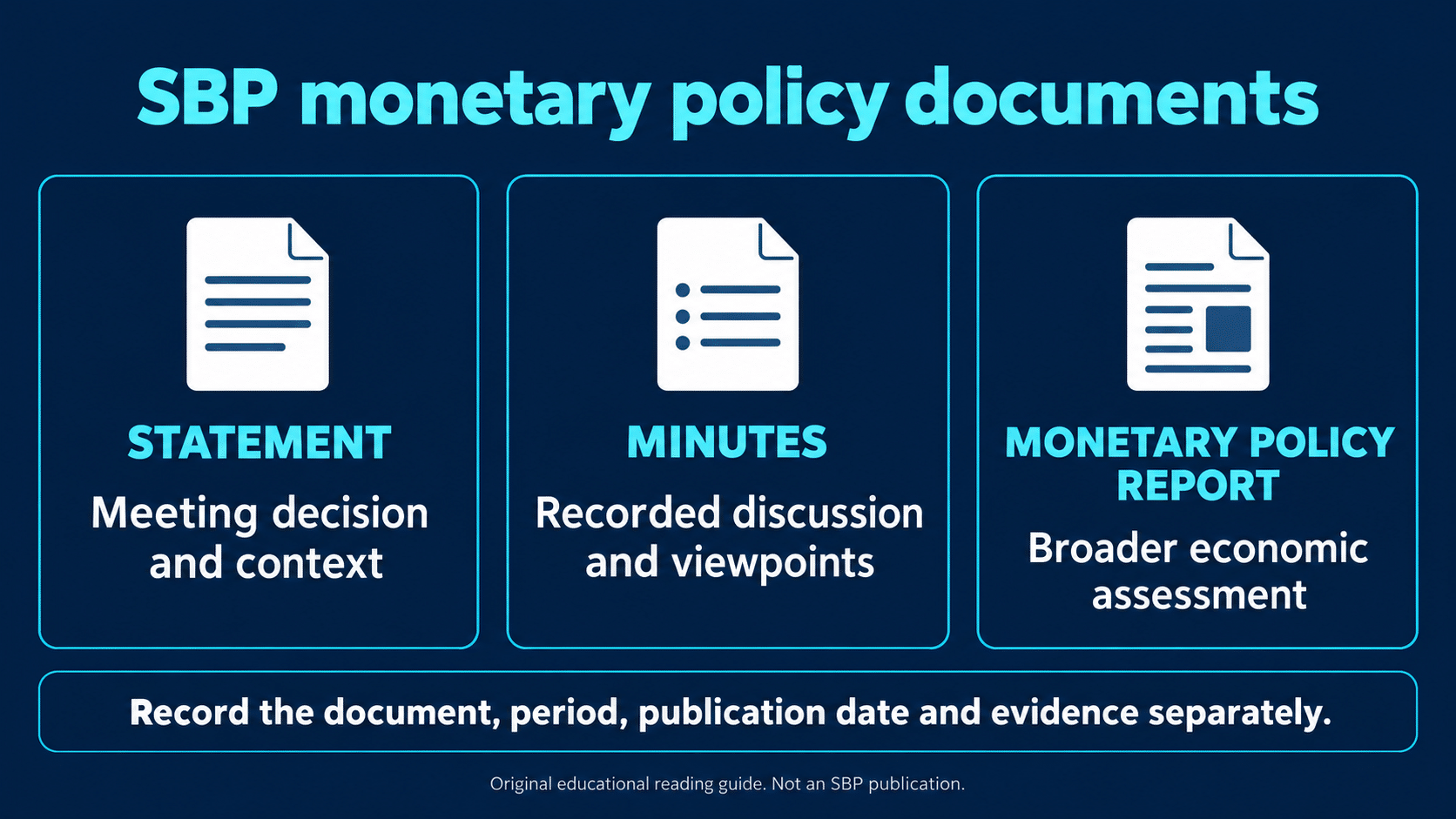
SBP monetary policy documents answer different questions. Start with the statement for a meeting’s announced decision, use the minutes to examine the recorded discussion, and consult the Monetary Policy Report for a broader assessment. Keep the meeting date separate from the date each document became available.
This guide explains how to build a traceable reading record for Pakistan’s central-bank communications. It uses July and August 2026 documents as a historical example, not as a description of today’s policy rate or a recommendation to trade. By CrowdSent Blog Team. Sources checked 22 October 2026.
SBP monetary policy documents: choose the right source
The State Bank of Pakistan’s communications overview distinguishes three publications. A Monetary Policy Statement follows an MPC meeting and explains the decision and its context. Minutes record the discussion and viewpoints considered. The Monetary Policy Report provides a more detailed economic assessment; the published framework describes reports following January and July meetings.
Use that distinction to set a reading order. If a headline announces a decision, find the corresponding statement first. If a commentary claims that the committee debated a particular risk, locate the relevant passage in the minutes. If your question concerns a broader economic outlook, identify the report edition before looking for its assumptions. A document can be useful without answering every question.
A dated example: match the statement to the meeting
The official 27 July 2026 statement identifies its institution, document type and date on its first page. Its two pages separate the opening decision from sections on the real sector, external sector, fiscal sector, money and credit, and inflation. These headings provide a practical route through the document without relying on a headline summary.
For this historical example, begin a note with the document title and URL. Then write the narrow question you are checking, such as “Which section discusses the external sector?” Record the page containing your evidence. Avoid copying every number into a general note: a figure without its period, unit or purpose can be harder to interpret than the original document.
Use minutes to trace context, not to invent a prediction
The matching minutes of the 27 July meeting identify that meeting on their first page. They include a staff review, a model-based assessment and a final decision section. This lets the reader distinguish the material presented during the meeting from its recorded outcome.
When annotating minutes, label who is being described: staff, the committee or another specifically identified speaker. Do not silently turn a conditional scenario into a committee promise. If you cannot find support for a commentator’s wording, write “not located in the document reviewed” rather than assuming either that the claim is true or that the source is fraudulent. For a wider verification routine, see how to verify market news.
Place the Monetary Policy Report on a separate timeline
The official release dated 10 August 2026 announces that month’s Monetary Policy Report. It describes a review of developments and the outlook underlying MPC decisions since the January meeting. This is a broader period than the single July meeting used above.
A release announcing a report is also different from the complete report. If you have only read the release, say so. Do not attribute a chart, detailed methodology or page number to the report without opening that material. This is especially important when a download is temporarily unavailable: a clear access limitation is more useful than a confident reconstruction from a search snippet.
Build a six-field source record
The following is an original editorial checklist, not an SBP form or a claimed CrowdSent platform feature. It is designed to make your own notes easy to revisit.
- Document identity: institution, exact title and source URL.
- Meeting or reference period: the event or period the document discusses.
- Publication evidence: the publication date shown by the source; mark an unavailable time as unknown.
- Access record: when you read it, including your timezone.
- Supported observation: a brief paraphrase and the section or page supporting it.
- Interpretation and limits: your own inference, questions and missing evidence, clearly separated.
For the July example, the meeting field is 27 July 2026. The statement’s displayed date is also 27 July. The minutes’ meeting date alone does not tell you the exact upload time. Keep that field separate rather than filling it with an assumption. A reusable structure is available in our market research journal guide.
Compare documents without mixing unlike facts
Before saying that two passages disagree, check whether they describe the same period and type of information. An observed value, a forecast, a target and an illustrative scenario are different categories. Also preserve the unit: a percentage, a percentage-point change and an amount of money cannot be compared merely because their numbers look similar.
If you return to the record later, append the new evidence with a new date. Keep the original reading intact so you can see what was known at the time. Our explanation of actual, forecast and previous values provides a companion check for economic releases.
For readers considering CrowdSent membership, review the current CrowdSent website and available offer before subscribing. This article does not claim a built-in SBP feed, document archive or research journal. It provides general educational information, not personal financial advice or a forecast of market returns.
Frequently asked questions
1. What does MPC mean in these documents?
It means Monetary Policy Committee. Confirm the institution as well as the abbreviation, because an MPC reference from another country is not an SBP document.
2. Which source should I use to check a policy-decision headline?
Start with the dated statement corresponding to the meeting in the headline. Match the title and event date before comparing the reported wording with the original.
3. Do meeting dates prove when minutes became public?
No. Record the meeting date and publication evidence separately. If the exact release time is unavailable, keep it unknown rather than treating a meeting timestamp as an upload timestamp.
4. Can I use a press release instead of the full report?
You can cite what the release itself says, identifying it as a release. It does not justify claims about unread report tables, methods or passages.
5. How should I record a forecast?
Label it as a forecast, retain its reference period and note any stated conditions. Do not rewrite it as an observed outcome or a guarantee.
6. What if two official documents seem inconsistent?
First compare their dates, periods, units and categories. Note the exact passages and leave the discrepancy unresolved if the available evidence does not explain it.
7. Should I replace my earlier note when new information appears?
Append a dated update instead. Preserving the earlier note makes it easier to distinguish a later correction from information available during the original reading.
8. Is this article a live SBP rate tracker?
No. The July and August documents are historical reading examples. Consult the current official source for a present decision; this guide does not supply a live rate.
9. Are the central-bank documents investment instructions?
This guide uses them to explain evidence and context. It does not translate their contents into a recommendation to buy, sell or hold an asset.
10. Does CrowdSent automatically store these source records?
No such functionality is claimed here. The six-field record is an editorial method you can maintain yourself; check the current product documentation for actual platform features.