

By CrowdSent Blog Team
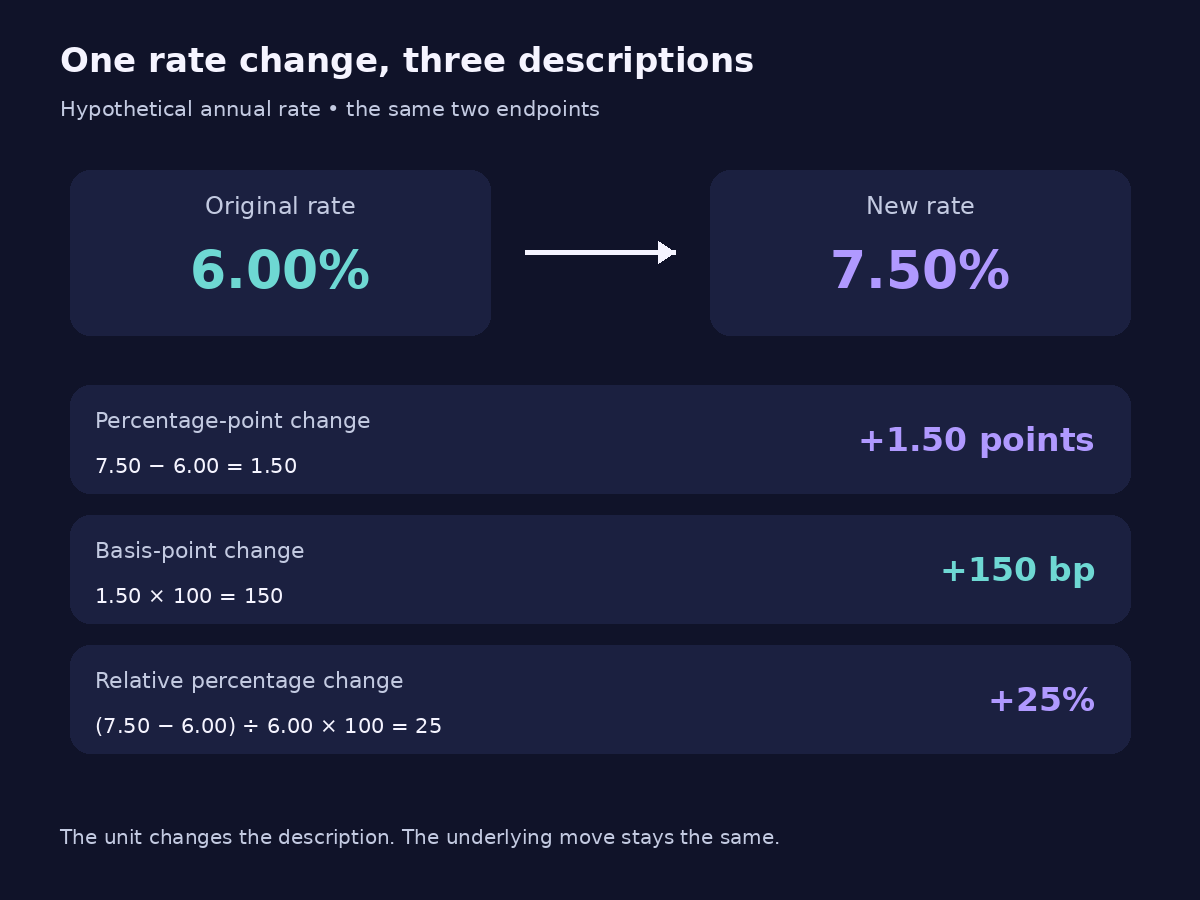
A fictional rate rises from 6% to 7.5%. You can describe the move as an increase of 1.5 percentage points, 150 basis points or 25% relative to the old rate. All three statements are correct. Each uses a different unit or comparison.
The distinction between percentage points vs percent becomes useful whenever a headline compares interest rates, growth rates, margins or survey shares. A reader should be able to reconstruct the original two values from the wording. This guide explains the arithmetic without attaching a market prediction to it.
Percentage points vs percent: three useful units
A percent expresses an amount per hundred. If 6 out of 100 comparable observations meet a stated condition, the share is 6%. A percentage point measures the difference between two percentages. Moving from 6% to 7.5% adds 1.5 percentage points.
A relative percentage change asks how large the difference is compared with the starting value. Divide 1.5 by 6 and multiply by 100: the original rate has increased by 25%. The denominator is the old rate, rather than an imaginary whole of 100.
The Office for National Statistics style guide defines percentage-point differences and distinguishes them from percentage changes. Its practical lesson is that a small wording change can alter the numerical claim.
A basis point is one-hundredth of a percentage point. The UK Debt Management Office glossary gives the corresponding unit as 0.01%. Thus 100 basis points equal 1 percentage point. In a sentence about a change, spell out the direction as well: up 150 basis points or down 150 basis points.
Work through a rate change from beginning to end
Use a fictional annual rate that changes from 6.00% to 7.50%. This is an invented measurement exercise, not a report about an Indian or Pakistani policy decision.
- Subtract the old percentage from the new percentage: 7.50 − 6.00 = 1.50 percentage points.
- Convert that difference into basis points: 1.50 × 100 = 150 basis points.
- Measure the difference relative to the old rate: (7.50 − 6.00) ÷ 6.00 × 100 = 25%.
Now check the result backwards. A 25% increase applied to 6% gives 6% × 1.25 = 7.5%. Adding 1.5 percentage points also gives 7.5%. Adding 150 basis points gives the same endpoint.
By contrast, a 1.5% relative increase applied to 6% gives 6.09%. That is an increase of only 0.09 percentage points, or 9 basis points. The phrase “rose 1.5%” cannot safely substitute for “rose 1.5 percentage points.”
A complete sentence is: “The hypothetical rate increased from 6% to 7.5%, a rise of 1.5 percentage points, equivalent to 150 basis points.” Add the 25% relative change only when that comparison answers a useful question.
The starting value controls the relative change
Consider two fictional changes: a share rises from 2% to 3%, while another rises from 20% to 21%. Each increases by 1 percentage point, or 100 basis points. Their relative increases are very different: 50% in the first case and 5% in the second.
That difference follows from the denominators. One additional point is half of 2, but only one-twentieth of 20. Neither description is inherently more honest. What matters is whether the stated comparison is clear and suitable for the question.
The Open University lesson on percentage points shows why headlines about rates need this distinction. When the original and final percentages are available, preserve them beside the calculated change. Readers can then judge scale without relying on one dramatic number.
The reverse move also changes the denominator. Falling from 7.5% to 6% is a decline of 1.5 percentage points, but the relative decline is 1.5 ÷ 7.5 = 20%. The earlier 25% increase and this 20% decrease bring the rate back to its starting level.
Convert basis points without losing a factor of 100
The safest conversion starts by stating how the input is stored. A rate shown as 6% may be stored in a worksheet as the decimal 0.06. A number stored as 6 is a different input unless the worksheet explicitly treats it as percentage-number units.
If the old and new rates are decimals 0.06 and 0.075, their difference is 0.015. Multiply that by 100 to obtain 1.5 percentage points. Multiply it by 10,000 to obtain 150 basis points. To obtain the relative change, divide 0.075 by 0.06, subtract one and express the result as 25%.
If the inputs are instead the numbers 6 and 7.5, their raw difference already represents 1.5 percentage points. Multiplying that difference by 10,000 would be a unit error. Write the storage convention above the calculation before applying a conversion.
For a quick reference, 25 basis points equal 0.25 percentage points; 50 equal 0.50; and 250 equal 2.50. These units describe a difference in rates. They do not tell you an amount of currency without an additional calculation and a specified base.
Keep rates separate from counts and scores
Suppose a fictional survey initially records 40 positive responses out of 100. A later survey records 45 out of 150. The positive count rises from 40 to 45, or 12.5%, while the positive share falls from 40% to 30%, a decline of 10 percentage points.
Both calculations are correct because the total number of responses changed. Saying “positive responses increased” leaves it unclear whether the writer means the count or the share. Include both numerator and denominator when a changing sample could affect interpretation.
A score introduces another boundary. A proprietary score moving from 40 to 45 has increased by five score units. It is not automatically a five-percentage-point rise. The scale may not represent a percentage at all. CrowdSent’s guide to what a sentiment score means explains why the definition of the measurement must come first.
Similarly, an index rising from 10,000 to 10,150 gains 150 index points and 1.5%. Those 150 index points are not 150 basis points. A shared word such as “points” does not make two units interchangeable.
Zero, negative values and rounding need care
Percentage-point subtraction still works when a rate starts at zero. A move from 0% to 2% is an increase of 2 percentage points. The ordinary relative-change formula cannot provide a finite percentage increase because it divides by zero.
Crossing zero is another reason to favour the two endpoints and the percentage-point change. A growth rate moving from −2% to +1% rises by 3 percentage points. Applying the usual relative formula mechanically gives (1 − (−2)) ÷ (−2) = −150%, a result that is easy to misread as deterioration. Do not hide the sign change behind that label.
Rounding can create a smaller but important discrepancy. Suppose unrounded rates are 5.24% and 5.26%. Their difference is 0.02 percentage points, or 2 basis points. Rounded to one decimal place, they display as 5.2% and 5.3%, whose displayed difference is 10 basis points.
Use the most precise reliable inputs available for the calculation, then round the result once. If only rounded figures are available, identify the calculation as approximate. Extra decimal places in the answer cannot restore precision that the input never supplied.
Turn an ambiguous headline into an auditable statement
Read “the rate rose by 2%” as an incomplete claim until you find the old and new rates. The original release may establish that the writer meant two percentage points, or it may support a genuine 2% relative increase. Guessing from what sounds familiar can change the meaning materially.
Use the market-news verification guide to trace the original data. Record what is measured, the two reference dates, the old and new values, and whether the quoted difference uses percent, percentage points or basis points.
Then check comparability. A monthly growth rate and an annual growth rate do not become comparable merely because both have percentage signs. Likewise, a survey share drawn from a new population may not support a clean claim about changing opinion.
Keep the arithmetic and the interpretation in separate sentences. The market research journal template can hold the original wording and your corrected numerical description. A reproducible comparison is usually more useful than an emphatic adjective about whether the move was large or small.
Frequently asked questions
What is the difference between percent and percentage points?
Percent expresses a proportion or a relative change. Percentage points express the subtraction of two percentages. A rate rising from 8% to 10% rises by 2 percentage points and by 25% relative to its old level.
How many basis points are in one percentage point?
There are 100 basis points in one percentage point. A basis point equals 0.01 percentage points. When describing a rate change, identify whether the move is upward or downward and preserve the two endpoints where possible.
Does a 50-basis-point increase mean a 50% increase?
No. It means the rate rises by 0.50 percentage points. From a starting rate of 5%, the new rate would be 5.5%; the relative increase in that particular example would be 10%.
Can I use percentage points to compare two market returns?
Yes, when the returns are percentages covering a meaningful, comparable period and basis. A 12% return exceeds an 8% return by 4 percentage points. That subtraction alone does not establish a fair comparison of risk, currency or costs.
Why are an increase and its reversal different percentages?
Relative changes use their respective starting values. Moving from 6% to 7.5% is a 25% relative rise; returning to 6% is a 20% relative fall. The percentage-point difference has the same magnitude in either direction.
Can percentage-point changes be negative?
Yes. New minus old gives a signed change. Moving from 9% to 8.25% produces −0.75 percentage points, or −75 basis points. In prose, “fell by 0.75 percentage points” communicates the same direction clearly.
What should I report when the starting rate is zero?
Give the starting and ending rates and the percentage-point difference. An ordinary relative percentage change is undefined with a zero denominator. Describing the increase as infinite is generally less informative than stating exactly what changed.
Are index points the same as percentage points?
No. Index points are units of a particular index level. Percentage points compare percentages. An index rising from 2,000 to 2,100 gains 100 index points and 5%, while the difference between two return rates needs percentage-point units.
Can rounding change a basis-point calculation?
Yes. The subtraction of rounded displayed rates may differ from the subtraction of their unrounded inputs. Calculate with reliable precision first and round at the end. If the underlying data are unavailable, label the result as an approximation.
What is the clearest wording for a rate change?
State the original rate, final rate and percentage-point difference. Add basis points when useful for the audience. If giving a relative percentage change too, explicitly say that it is relative to the original rate so readers know the denominator.
Educational information only. All worked numbers are hypothetical unless identified as a source definition. This article provides no forecast, recommendation or investment advice.