

Opening and closing auctions gather eligible orders and use an exchange-defined process to establish a session price. An opening auction helps begin trading in a security; a closing auction helps establish its official closing reference. Their shared single-price logic does not make their deadlines, eligible orders or fallback rules identical.
The practical research question is: which process produced the number on the screen? An indicative auction price, a last continuous-session trade and an official close can all differ without a data error. Knowing the field’s origin prevents a misleading comparison.
This guide compares an opening auction with a closing auction using an original example and exchange references checked on 25 October 2026. US, Indian and Pakistani sessions are identified separately. Always use the notice and timetable applying to the instrument and trading date.
How an opening auction differs from a closing auction
Continuous trading processes orders as they arrive under the market’s matching rules. A call auction collects eligible interest for a matching event. In a simple single-price auction, matched buyers and sellers transact at one discovered price, subject to the venue’s allocation and protection rules.
At the opening, the collected orders can reflect information that arrived while the relevant continuous session was closed. The previous close remains a historical reference; it is not a promise about the next opening price. A gap can arise because the auction receives a different balance of eligible demand and supply.
At the close, orders converge on an end-of-session reference. That reference can matter to measurements built around closing prices. However, “the close” is still a defined market-data field. A venue may have different methodologies for securities that participate in an auction and those that do not.
Opening and closing auctions also have different downstream states. After an opening match, continuous trading may begin. After a closing match, another session may follow under different rules. The existence of later transactions does not automatically replace the official closing price.
Opening auction and closing auction: a single-price matching example
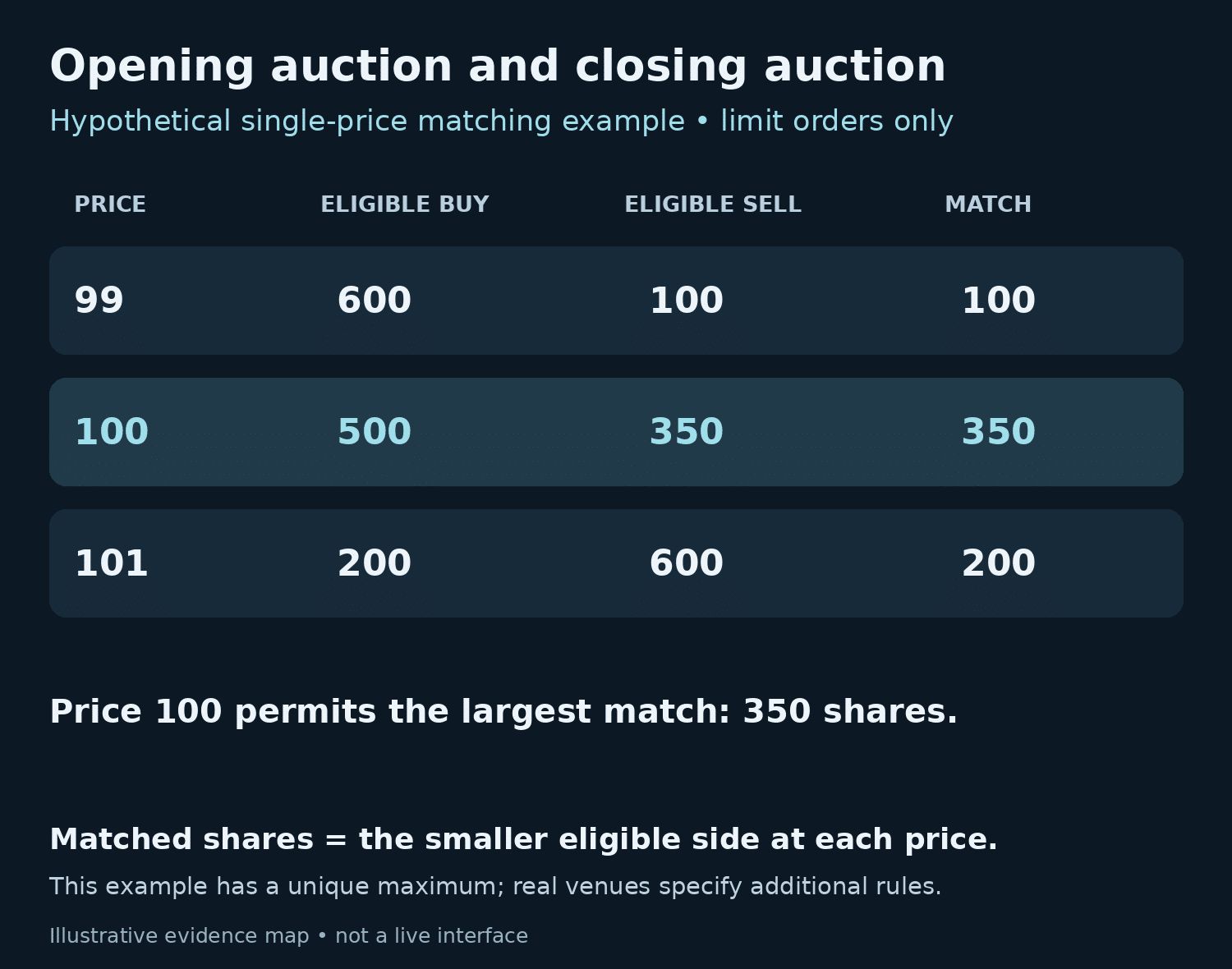
Consider an invented share with prices in unspecified currency units. All quantities are shares. There are only limit orders, no hidden quantities, no costs and no changes during matching. The hypothetical rule chooses the candidate price allowing the largest number of shares to trade.
- Buy orders: 200 shares with a limit of 101; 300 with a limit of 100; 100 with a limit of 99.
- Sell orders: 100 shares with a limit of 99; 250 with a limit of 100; 250 with a limit of 101.
At a candidate price of 99, all 600 buy shares are willing to pay that price, but only 100 sell shares accept it. The possible matched quantity is the smaller total: 100 shares.
At 100, the buyers limited to 101 and 100 remain eligible, supplying demand for 500 shares. Sellers limited to 99 and 100 supply 350. The possible match is 350 shares.
At 101, only the 200 buy shares limited to 101 remain eligible, while all 600 sell shares qualify. The possible match falls to 200 shares. Under our stated rule, 100 wins because 350 exceeds both 100 and 200.
All matched shares transact at 100 in this example. A buyer’s willingness to pay 101 does not mean that buyer pays 101 in the single-price match. Similarly, an eligible seller willing to accept 99 receives the auction price of 100.
At the selected price, 500 eligible buy shares face 350 eligible sell shares. There are 150 unmatched eligible buy shares. That is a buy imbalance under this example’s definition. It does not mean the complete book contains 150 more buy shares than sell shares: the full submitted totals are both 600.
Our maximum is unique, so no tie-break is needed. If several prices produced the same largest match, the venue might consider imbalance, a reference price or another prescribed rule. Do not invent the tie-break by averaging the candidate prices.
Indicative price, paired quantity and imbalance are different fields
The indicative price answers a conditional question: what price would the present eligible orders imply under the calculation? Paired quantity estimates the shares that can match under the defined conditions. Imbalance describes remaining interest on one side at a specified reference. Read the actual feed definitions because those references need not be identical.
The NYSE auction guide distinguishes indicative match price, paired quantity, reference price and imbalance, and gives different schedules for its markets. Its NYSE opening process begins at 9:30 a.m. Eastern Time, but a security can open later. An exchange-group name alone therefore does not identify one universal auction timetable.
Now alter our fictional book by adding a sell order for 200 shares at 100 before collection ends. Eligible supply at 100 rises from 350 to 550. Demand remains 500, so the possible match becomes 500 and the imbalance becomes 50 sell shares.
The earlier 150-share buy imbalance and later 50-share sell imbalance are both correct snapshots. The final outcome changed because the order set changed. A research claim based on the earlier indication should keep its timestamp instead of presenting it as the final result.
A raw imbalance also needs scale. A 500-share excess alongside a 50,000-share possible match has a different relative size from the same excess alongside a 600-share match. Any ratio must state its denominator, reference and treatment of a zero denominator. None of those descriptive calculations establishes a future price direction.
Venue rules matter: India, Pakistan and a US comparison
India: NSE’s Closing Auction Session specification currently describes Phase 1 for cash-market stocks with derivative contracts. It lists a 3:15–3:35 p.m. IST auction session with separate transition, order-entry and matching phases. It also distinguishes non-CAS securities and describes a reference-price calculation separate from the equilibrium-price selection.
That distinction is important for older explainers. A historical statement that every stock’s closing price simply follows the same end-of-day averaging process should not be reused without checking the security and rule date. Nor should a newly introduced auction methodology be applied retrospectively to older observations.
NSE’s pre-open specification separately describes a 9:00–9:15 a.m. IST process with collection, matching and buffer periods. The opening and closing workflows therefore need their own specifications even when both involve an equilibrium price.
Pakistan: the PSX trading-hours page distinguishes pre-open, order-matching and post-close states, with schedules that vary by day and segment. A period labelled “post-close” should not be treated as equivalent to an NYSE closing auction merely because it occurs near the end of the day.
For a specific PSX observation, record the named market state and consult the applicable rules before interpreting an indication as a completed transaction. Special schedules and notices can supersede ordinary hours. The timing on a screenshot is insufficient when the segment or trading date is missing.
United States: use the exact listing and auction venue, rather than assigning every US share one generic opening or closing process. Preserve Eastern Time and the actual date when converting an event for readers in IST or PKT; daylight-saving changes can alter the conversion even when the US local-time label stays the same.
Price discovery and order allocation are separate steps
Finding an auction price does not by itself tell you which individual orders receive every share. Our example identifies 350 matchable shares at 100, but it has 500 eligible buy shares. The allocation rule determines how that limited supply is assigned among eligible buyers.
Price priority, time priority and special auction-order treatment can matter. An aggregate imbalance display does not necessarily expose enough detail to reconstruct an individual order’s outcome. Keep the equilibrium calculation separate from claims about a particular participant’s fill.
Likewise, submission, acceptance and execution are distinct events. An instruction can miss the relevant cutoff, be ineligible for the session or remain unmatched. The general label “auction order” does not establish how a broker handles a request or whether an exchange accepted it.
When no valid price can be discovered, the exchange’s fallback or extension rules become central. A blank official field should stay unresolved until those rules and the eventual publication are checked. Substituting the most recent indication makes an incomplete record look falsely final.
Use auction data without misreading the chart
Suppose the last continuous trade is 250.20, an earlier closing indication is 249.80 and the final auction price is 250.05. These invented values describe three observations. A chart using the final auction close and a feed showing the last continuous trade are not necessarily inconsistent.
Also check whether auction volume is included in the daily volume total. Adding it again to a total that already contains it double-counts activity. Conversely, a feed restricted to continuous trading may omit it. The distinction between activity and available quantities is covered in liquidity versus volume.
For an event study, preserve four times where available: source indication, collection cutoff, actual match and publication or receipt. A delayed screen capture should not be assigned the time at which the underlying match occurred unless that event time is explicitly present.
Save the field definitions and methodological change date with a research journal entry. If a widely shared claim relies on an auction screenshot, use the market-news verification checklist to locate the original exchange evidence before interpreting its price or imbalance.
Opening and closing auctions: frequently asked questions
1. What is the main difference between opening and closing auctions?
They establish references at different session boundaries. The opening auction precedes a security’s continuous session; the closing auction supports its closing reference. Their order eligibility, cutoffs, price rules and aftermath can differ.
2. Does an indicative auction price guarantee the final price?
No. It is conditional on the eligible information available at that point. New orders, permitted changes and the venue’s final checks can change the match before execution.
3. Why can a buyer limited to 101 pay 100?
In the fictional single-price match, 101 is the buyer’s maximum acceptable price. The discovered auction price is 100, so an eligible matched purchase occurs at 100 under the stated auction assumptions.
4. Is a buy imbalance the same as more total buy orders?
Not necessarily. Our complete book has equal total shares on both sides yet a buy imbalance at 100. The imbalance considers the eligible quantities and reference specified by its calculation.
5. Is every share fully matched if an auction price exists?
No. One side can have residual eligible interest, and some limits may exclude orders entirely. Finding a valid price and allocating the available matched quantity are separate operations.
6. Does NSE have a closing auction in 2026?
Its current specification describes a Closing Auction Session with Phase 1 coverage for cash-market stocks carrying derivative contracts. Check the security’s eligibility and rule date instead of assuming identical treatment for every NSE instrument.
7. Is a post-close session necessarily a closing auction?
No. A session name identifies a period, while its rules establish how transactions occur and prices are determined. Check the exchange’s definitions rather than importing another market’s meaning.
8. Can the official close differ from the last trade I saw?
Yes. Your screen may show a continuous-session trade, a delayed update or another venue’s observation. Identify the final official-price field and methodology before treating the difference as a data error.
9. Can I add auction volume to the daily total?
Only after checking whether the total already includes it. Keep the same venue, instrument, session and quantity units. Otherwise the sum can count the same matched shares twice.
10. What should an auction screenshot include?
Keep the instrument, venue, date, time zone, session state, field labels and source timestamp. Clearly label indicative versus final values and retain the applicable specification so another reader can interpret the image correctly.
For information about the wider service, review the current CrowdSent membership information. This educational guide does not claim that membership provides exchange data feeds or order-execution services.
Primary-source documentation reviewed 25 October 2026.
Educational information only. Worked examples are hypothetical. This article does not provide investment, legal or tax advice.