

By CrowdSent Blog Team
Index rebalancing updates weights or calculation inputs under a benchmark’s rules. Index reconstitution reviews which securities belong in the benchmark. A scheduled event can do both, and providers sometimes use rebalancing as an umbrella term for the entire review.
The practical question is therefore what changed: the members, their assigned quantities or factors, or both? Equally important is when the change enters the calculation. A published announcement, a reference-data date, and an effective date can refer to different stages of the same event.
The worked basket below is hypothetical and does not recommend a trade.
Read the distinction, the example, the review timeline, provider calendars, and the FAQs.
How do index rebalancing and reconstitution differ?
Rebalancing concerns the benchmark’s exposure and calculation inputs. An equal-weighted index may restore equal weights after price moves cause them to drift. A capped index may reapply its limits. A capitalization-weighted index may update shares or float factors under its maintenance policy.
Reconstitution concerns eligibility and membership. The provider reassesses the relevant universe and determines additions, deletions, or moves between segments. A company may change size categories, fail an eligibility test, or qualify after previously being excluded.
This distinction is useful for analysis, but it is not a universal naming rule. S&P DJI’s methodology explainer describes regular rebalancing as potentially including both component changes and reestablished weights. Read the provider’s actual notice before assuming its title identifies only one kind of change.
A weight change does not always mean a rebalance occurred
Weights can move naturally with prices. Suppose a fixed-quantity basket contains two securities worth 100 each. One rises to 120 while the other stays at 100. The first now represents about 54.55% of the 220 total, even though nobody reset either quantity.
This price-driven drift should be separated from an implemented rule change. A daily factsheet may show different weights because prices changed, while a review notice may change the quantities or factors used for subsequent calculations. Both alter exposure, but the underlying event is different.
For an uncapped market-cap-weighted basket with unchanged eligible share quantities, relative price movements naturally update weights. It does not need to reset every company to yesterday’s percentage. Doing so would impose a different weighting rule.
Worked example: reset the weights or replace a member
Start with a basket that has drifted
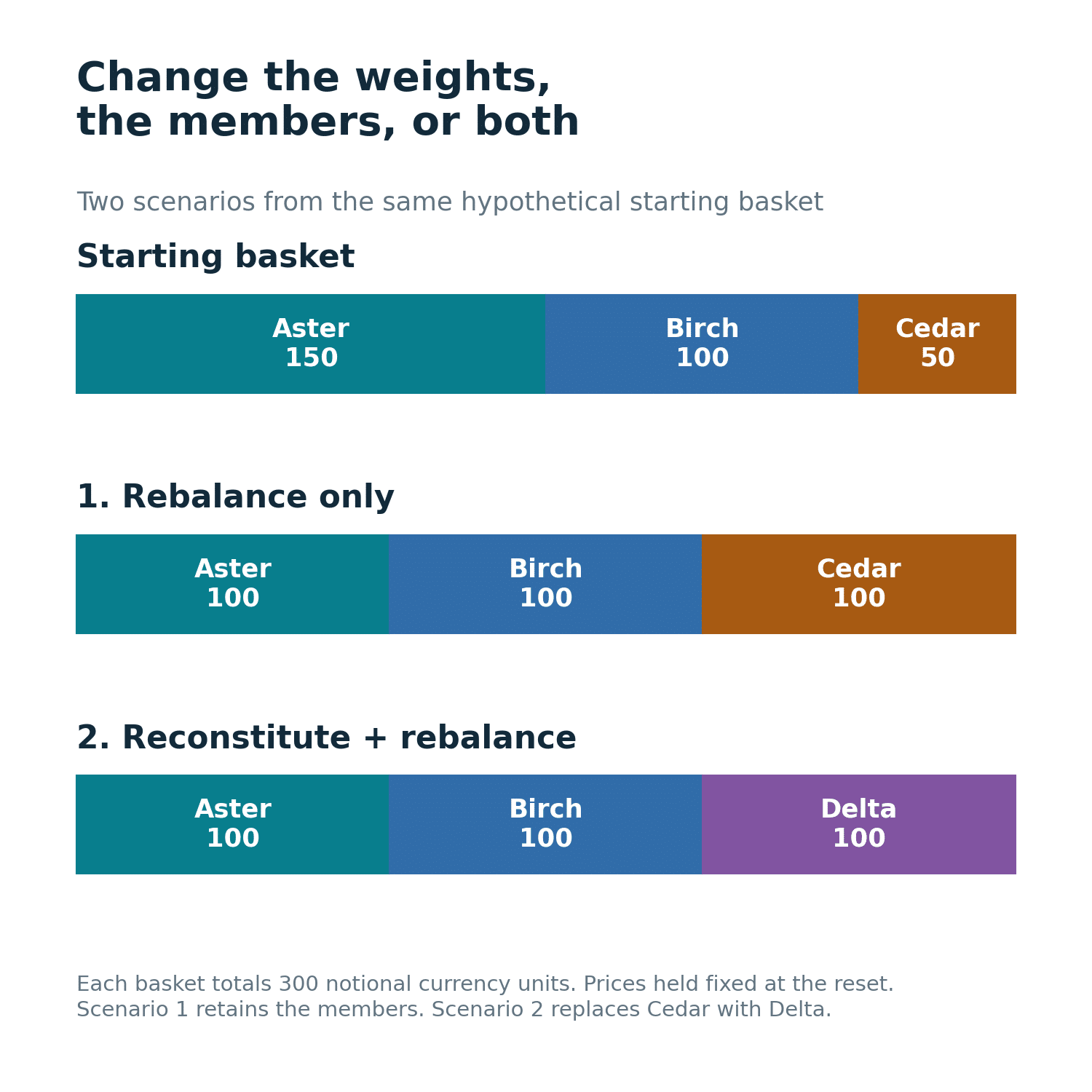
Imagine an equal-weighted index represented by a simplified notional basket. It originally allocated 100 currency units each to Aster, Birch, and Cedar. After price movements, their values are 150, 100, and 50, leaving the total at 300.
The weights are now 50%, approximately 33.33%, and approximately 16.67%. Membership has stayed the same. For the following calculations, assume prices are fixed at the implementation instant and ignore dealing costs, taxes, rounding, and cash timing.
Scenario one: rebalance without changing membership
The rule calls for each member to return to one-third of the basket. At a total value of 300, each target is 100. Reduce Aster’s notional holding by 50, leave Birch unchanged, and increase Cedar’s by 50.
The three names remain Aster, Birch, and Cedar. Only their quantities and weights are reset. An index provider expresses the corresponding change through calculation inputs; a fund tracking the benchmark must decide how to implement its own portfolio changes.
The target-setting arithmetic creates no instant 50-unit gain. Value is redistributed within the hypothetical basket. Subsequent returns will differ from an unrebalanced basket because the amounts exposed to future price movements are different.
Scenario two: reconstitute and rebalance together
Return to the same drifted starting basket of 150, 100, and 50. This time Cedar no longer qualifies, and Delta is selected. The new index should contain Aster, Birch, and Delta at equal weights.
Reduce Aster from 150 to 100, keep Birch at 100, remove Cedar’s 50, and allocate 100 to Delta. The 50 reduction in Aster plus the 50 removed from Cedar funds the new 100 allocation, under the simplified assumptions.
The event changes both membership and weights. Calling it only a constituent replacement would miss the adjustment to Aster. Calling it only a weight reset would miss Cedar’s removal and Delta’s arrival. A clear event record lists both changes.
Which dates matter in an index review?
The reference or ranking date fixes specified observations used in the review, such as capitalization or eligibility data. It is the date of the measurement inputs, not necessarily the date the public first learns the outcome.
The announcement date is when a provider communicates proposed or final changes. Some processes release preliminary lists and later revisions. A draft or provisional list needs its status preserved in a research record, because membership can change before implementation.
The effective date is when the revised basket enters the index. A change described as effective after Friday’s close can appear in the following trading session’s composition. A phrase such as effective Monday is incomplete unless the notice specifies the relevant session or calculation point.
There can also be a separate reference date for prices or factors. Do not force every number in a notice onto one timestamp. Read the schedule and the implementation instructions together, especially around market holidays and time-zone differences.
A reference-price target can drift before implementation
A short hypothetical example shows why the price-reference date deserves its own field. Suppose a review rule fixes new calculation quantities on Wednesday using equal notional allocations of 50 to two members. At reference prices of 10 for Aster and 20 for Birch, those quantities are five Aster units and 2.5 Birch units.
Assume the stated rule keeps those quantities fixed until Friday’s implementation. By then, Aster’s price is 12 while Birch remains at 20. The new basket’s reference values at implementation are therefore 60 and 50, totaling 110. Its weights are approximately 54.55% and 45.45%, despite being derived from an equal-weight target on Wednesday.
This is an illustration of a specified rule, not a claim that every equal-weight index uses this timing. A different methodology could recalculate quantities using Friday’s prices and produce a different implementation weight. The notice must establish which convention applies.
The important distinction is between a target calculated on one date and the resulting weight at a later price snapshot. The difference need not be an error, a changed membership decision, or evidence that a tracking fund ignored its mandate. First reconcile the quantity-setting rule and the two price dates.
A practical event record can therefore preserve the target percentage, the prices used to derive quantities, the resulting quantities and the effective timestamp. Comparing only two percentages removes the information needed to explain a price-driven difference.
Why the current provider calendar matters
NSE Indices publishes an Index Reconstitution Calendar with schedules for individual index families and provision for additional reviews. Its broad-market table lists Nifty 50 changes semiannually on the last working day of March and September. Other families have different schedules.
PSX’s KSE-100 and KSE100PR brochure separates data-basis, notice, and implementation dates. Its regular recomposition schedule uses February and August observations and implementation in April and October. That is a useful reminder that the data month and the change month need not match.
For the US, the current Russell reconstitution page, checked October 11, 2026, describes semiannual June and December reviews. For December 2026 it lists October 30 as rank day, preliminary lists beginning November 13, and implementation after the December 11 market close. Check the page again for future events rather than copying dates from an older summary.
Why can review events matter for trading activity?
Funds seeking to follow a benchmark may need to alter holdings when the benchmark changes. Additions, deletions, and weight revisions can therefore create implementation needs around the effective date. But the size, timing, and market impact of those needs cannot be inferred from a constituent’s name appearing in an announcement.
Relevant questions include how much money actually tracks the affected series, what portfolios already hold, how the target weight is calculated, and whether changes are staged. Public estimates can differ because they use different assumptions about all of these inputs.
Higher activity also does not prove that every order is easy to execute. Use the distinction in liquidity versus volume when interpreting a busy session. An expected index change is not a guarantee of either a price rise or a price decline.
How to document a review without creating hindsight bias
Keep the original announcement and any replacement notice. Record when each became public and when its changes took effect. A backtest must use the membership known and effective at the historical point, rather than apply today’s constituent list to every earlier period.
Separate the provider’s confirmed change from a news report’s estimate of flows or price effects. Our guide to verifying market news explains how to trace a claim back to its underlying source. A predicted addition is not equivalent to a final index notice.
A compact research journal entry can contain the old members, new members, changed factors, effective session, and unresolved questions. This is more useful than saving a headline that says only that the index has been reshuffled.
Frequently asked questions
1. Can an index rebalance without adding or removing a company?
Yes. Resetting equal weights or updating a cap can change exposure while keeping membership intact. The first worked scenario does this: the three companies stay the same, while their notional allocations return to equal amounts.
2. Can reconstitution and rebalancing happen on the same day?
Yes. A provider can review members and set their new weights in one scheduled event. The second worked scenario combines both operations. The notice’s details matter more than treating the two terms as mutually exclusive labels.
3. Does reconstitution reset the index to its original base value?
No. Reconstitution changes the underlying composition while continuity rules preserve the historical series. The index does not return to 100 or 1,000 simply because its members change. A rebased presentation is a separate operation.
4. Does an announcement immediately change index membership?
Usually the announcement specifies a later effective point, though event procedures vary. Until then, the current calculation can still use the existing basket. Check whether the notice is preliminary or final and when implementation occurs.
5. Are all review schedules quarterly?
No. Schedules vary by provider, family, and type of update. Some inputs can be reviewed more frequently than membership. A broad statement that an index rebalances quarterly may leave the reconstitution schedule unspecified.
6. Can a company leave between scheduled reviews?
Yes. Event policies can address mergers, delistings, suspensions, or other exceptional circumstances. A published regular calendar is not a promise that the basket remains unchanged until its next scheduled review.
7. Why might an index use eligibility buffers?
Buffers can reduce repeated membership changes when companies sit near a selection boundary. The precise rule varies. A small change in a ranking may therefore be insufficient to trigger entry or removal under the applicable methodology.
8. Does addition to an index guarantee buying or a price increase?
No. Tracking demand, existing holdings, market expectations, and other orders all matter. Even where some funds need to buy, the market price can move differently from a simple predicted-flow story. Inclusion itself is not an investment recommendation.
9. Must every tracking fund trade at exactly the same instant?
No. A fund’s implementation depends on its mandate and management approach. The benchmark’s effective calculation point and a particular fund’s actual transactions are separate records. Do not infer a fund’s trade timestamp from the index notice alone.
10. What is the most important check for historical research?
Use point-in-time membership, factors, and information availability. A later final list should not be treated as known before it was published. Preserving old notices helps distinguish a valid historical reconstruction from hindsight.
Conclusion: record the operation and its effective time
Rebalancing concerns exposure and inputs; reconstitution concerns the membership review. Real events often combine them. A careful reading identifies the actual changes, their source data, and the session when they take effect, without turning a methodology update into a price prediction.
This article is educational and does not provide financial advice.
Source documentation checked 11 October 2026. Educational explanation from the CrowdSent Blog Team. Numerical examples are hypothetical unless explicitly identified otherwise. This article does not provide investment recommendations.