

By CrowdSent Blog Team
Goodwill impairment is a reduction in the carrying amount of acquired goodwill when the applicable recoverability test no longer supports it. A large charge can reduce reported profit without requiring an equivalent new cash payment that period. That does not make the underlying change in expectations economically irrelevant.
The useful reading task is to connect three records: what the business originally acquired, how goodwill changed in the balance sheet, and what assumptions changed in the impairment test. This guide uses a simplified IFRS-based example. It is financial-statement education, not accounting advice or a recommendation about any company.
Start with how goodwill entered the accounts
The IFRS Foundation’s IFRS 3 overview explains acquisition accounting: consideration is allocated to identifiable acquired assets and liabilities, with a residual assigned to goodwill. Goodwill is therefore different from the everyday meaning of customer goodwill or a company’s self-described reputation.
Imagine a fictional buyer acquires all of a business for 150 million currency units. For this deliberately simple case, the fair value of identifiable assets is 140 million and assumed liabilities are 40 million. Identifiable net assets are 100 million. The residual is 50 million of goodwill.
The example excludes non-controlling interests, previously held interests, deferred-tax complications and other acquisition adjustments. It is a bridge for understanding the number, not a universal acquisition worksheet. In a real filing, read the purchase-price allocation and accounting-policy note rather than subtracting the target’s old book equity from the announced deal headline.
For the reporting boundary around acquired businesses, see consolidated versus standalone statements. A goodwill balance belongs to a specific reporting entity and statement set.
Goodwill impairment: identify the testing unit
Under IAS 36, acquired goodwill is assessed annually through the cash-generating units to which it is allocated. Recoverable amount is the higher of value in use and fair value less disposal costs. When a unit is impaired, goodwill absorbs the loss first. A recognised goodwill impairment is not subsequently reversed under IAS 36.
The testing unit matters because a corporate headline may describe a different boundary. A company-wide market capitalisation, a geographical segment and the unit in an impairment note are not automatically interchangeable. Record which businesses, assets and assumptions are included before comparing any two amounts.
Work through one hypothetical impairment bridge
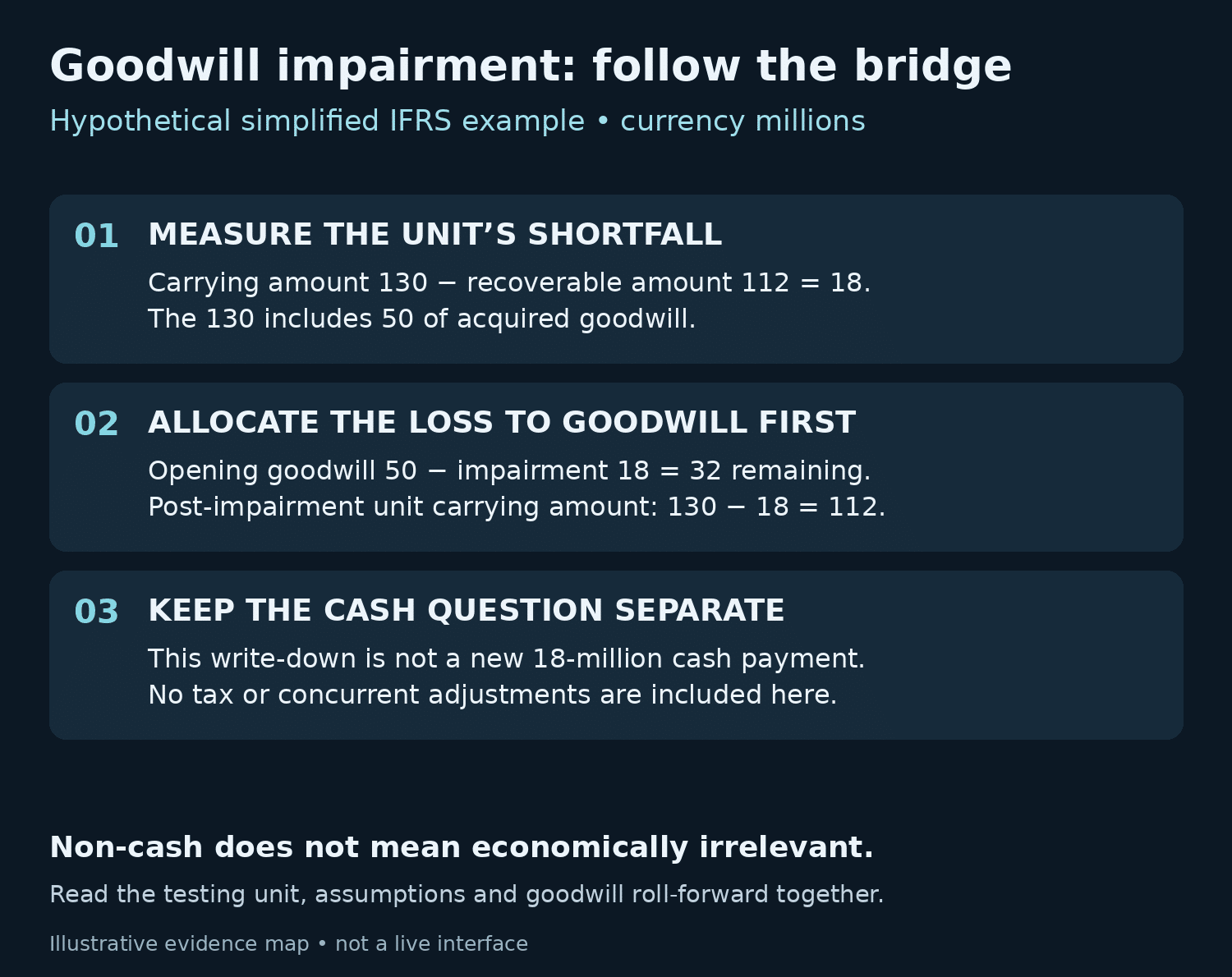
Return to the fictional acquisition. At a later test date, suppose the relevant unit has a carrying amount of 130 million, including 50 million of goodwill. Its assessed recoverable amount is 112 million. The shortfall is 18 million.
For this simple example, the entire 18 million is allocated against goodwill. The unit’s remaining carrying amount is 112 million, and goodwill falls from 50 million to 32 million. No tax or other concurrent adjustment is included. This makes the arithmetic transparent: 130 minus 18 equals 112, and 50 minus 18 equals 32.
Now change only the recoverable-amount assumption to 145 million. There is no shortfall in this invented test because 145 exceeds 130. The 15-million difference is headroom in the example, not additional goodwill to book automatically. A larger estimate is not the same thing as a recognised asset increase.
A second comparison helps separate the loss from a percentage headline. The 18-million charge equals 36% of the starting goodwill balance but approximately 13.85% of the unit’s carrying amount. Those descriptions refer to the same charge with different denominators. Neither percentage, by itself, tells the reader what happened to current-period sales or cash receipts.
Keep the cash question separate from the earnings question
The acquisition and the later write-down are separate events. Cash may have left when the business was purchased; an impairment later updates an accounting carrying amount. As a concrete filing example, LivePerson’s 2025 Form 10-K describes its goodwill impairment charge as non-cash. That issuer’s US-GAAP filing illustrates the cash distinction; it does not establish the IFRS test for every company.
In a hypothetical earnings reconciliation, assume profit before a goodwill charge is 25 million and the charge is 18 million, with taxes and other effects excluded. Reported profit becomes 7 million. Removing the charge in an adjusted presentation would restore 25 million mathematically, but it would not establish that the acquisition performed as originally expected.
Our operating cash flow versus net income guide explains why the cash-flow statement needs its own reconciliation. Do not add an impairment back to every cash-flow subtotal indiscriminately: inspect the actual statement method and the line items already included.
Read changes in assumptions, not just the final charge
Create a short before-and-after note using disclosed facts. Which unit was tested? What date was used? Did projected sales, margins, investment needs or the discount-rate assumptions change? Which figures are reported and which are unavailable? A useful record preserves the company’s wording as a source reference without treating management’s estimates as certain outcomes.
For example, two fictional units could each show 15 million of headroom. One might disclose substantial sensitivity to a small change in an assumption; the other might have a different risk profile. The identical headroom number does not make their uncertainty identical. If the disclosure gives no sensitivity information, label the gap rather than inventing a reassuring buffer.
Also reconcile the goodwill roll-forward. A lower closing balance need not be entirely impairment: acquisitions, disposals, currency translation and other disclosed movements may affect it. Begin with opening goodwill, apply each reported movement once, and check that the result matches closing goodwill.
A practical filing-reading checklist
Keep the acquisition note, goodwill roll-forward, impairment note and profit reconciliation together. Record the accounting framework and reporting period at the top. For readers comparing Indian, Pakistani or US companies, the framework stated in the actual filing matters more than a country label or an assumed universal rule.
Separate reported earnings from management’s adjusted presentation, using the reconciliation rather than the headline label. The non-GAAP earnings guide covers that distinction. Neither retaining nor excluding a goodwill charge automatically supplies the one correct view of future performance.
Goodwill can rise in a year that includes an impairment
Consider a separate fictional group with opening goodwill of 110 million currency units. It acquires another business and adds 30 of goodwill, records an impairment of 18, removes 7 relating to a disposal, and reports a positive currency-translation movement of 5. Assume no other changes. All entries use the same reporting currency. Closing goodwill is 110 + 30 − 18 − 7 + 5 = 120 million.
The net increase of 10 does not establish that there was no impairment. The impairment charge is 18, while the reported balance reflects several movements with different causes. Conversely, reading the change from 110 to 120 as a ten-million acquisition addition would miss both the actual addition and the offsetting reductions. A balance-sheet comparison needs the movement note before it can support a causal explanation.
Keep a source reference against each row. The acquisition note supports the new goodwill; the disposal note explains the removed business; the impairment note identifies the charge and testing boundary. Currency translation changes the reported amount under this fictional example without establishing new purchase consideration or an additional charge. Do not merge those categories merely because they affect the same closing balance.
For a real example of a movement note containing both impairment and foreign-exchange adjustments, see Note 5 of LivePerson’s 2025 Form 10-K. Its actual figures and US-GAAP policy belong to that issuer and period. The fictional 110-to-120 bridge above is not drawn from its accounts.
Do not select only the lower valuation estimate
Under the IFRS framework used in this guide, the IAS 36 overview defines recoverable amount using the higher of value in use and fair value less disposal costs. That choice is important when a research note contains two different estimates. Taking their average or automatically choosing the lower one would be a different calculation.
Imagine a simplified unit with a carrying amount of 115 million. Its value in use is estimated at 105, while fair value less disposal costs is estimated at 120. The recoverable amount in this example is 120, producing five of headroom against the carrying amount. The lower 105 estimate alone does not establish a ten-million impairment.
In a separate hypothetical later test, suppose the two relevant estimates are 100 and 110, with the carrying amount still 115. Recoverable amount is now 110, giving a shortfall of five. If the unit contains eight of goodwill and the simplified allocation conditions apply, the five reduces goodwill to three. This example excludes other asset adjustments and taxes; it illustrates the selection rule, not a complete impairment model.
When only one estimate is disclosed, preserve what the filing actually says about its method. Do not manufacture a second amount to complete a diagram. Also check whether values concern the same unit, date and currency before comparing them. A current market value for a different reporting boundary cannot simply replace a missing input.
Separate test date, recognition period and publication date
A filing published after year-end can describe several assessments performed at different dates. These dates belong in separate fields. The assessment date tells you which conditions were evaluated; the reporting period identifies where a charge is recognized; the publication date tells you when the information became publicly available.
LivePerson’s cited 2025 filing provides a useful historical illustration: its annual October assessment identified no impairment, while a later December assessment resulted in a charge. This is not an inconsistency merely because both findings appear in one annual report. The note describes different evaluation dates and circumstances. It does not establish that an October reader could have known the later result.
For a reproducible research record, retain each assessment separately and attach its disclosed assumptions. If a later filing revises expectations, add the new observation rather than overwriting the earlier one. That preserves the difference between information available at the time and an explanation constructed with hindsight.
Frequently asked questions
1. Is goodwill the same as a brand name?
No. The acquisition allocation may recognise identifiable intangible assets separately. Goodwill is the remaining accounting residual in the simplified acquisition framework, not a general label for every valuable intangible.
2. Does a goodwill impairment mean cash disappeared that day?
Not necessarily. The charge reduces an accounting amount; the acquisition-related payment may have occurred earlier. Read the period’s cash-flow statement to identify actual cash movements.
3. Does a non-cash charge have no economic meaning?
That conclusion does not follow. The charge can reflect changed expectations about an acquired operation. Investigate the reason and assumptions rather than ignoring the item because it is non-cash.
4. Can I calculate impairment from a falling share price alone?
No. A share-price observation does not supply the full testing boundary, carrying amount or recoverability assessment. Use it as context, not as a replacement for the disclosed test.
5. Is impairment the same as scheduled amortisation?
No. A scheduled allocation over a useful life and a recoverability write-down answer different questions. Check the framework and policy for the particular asset instead of applying one treatment to every intangible balance.
6. Why can the charge be large relative to annual profit?
The carrying amount can relate to acquisitions from earlier years, while annual profit covers one reporting period. Comparing them without recognising those different histories can make the headline misleading.
7. What is headroom in the example?
It is the amount by which the assessed recoverable amount exceeds the carrying amount. In our second scenario, 145 million less 130 million gives 15 million. It is an estimate-based difference, not cash on hand.
8. Does lower goodwill always prove an impairment?
No. Reconcile the movement note. A disposal or currency movement can also change the balance, and several movements may occur in the same reporting period.
9. Can an adjusted-profit figure erase the earlier acquisition cost?
No. An earnings adjustment changes the displayed performance measure. It does not reverse historical consideration paid or establish that the acquired business met its original expectations.
10. What should a research note preserve?
Save the filing link, period, framework, testing-unit name, opening and closing goodwill, disclosed charge and stated explanation. Separate exact facts from your interpretation and mark missing assumptions explicitly.
Put the disclosure in context
Use a market-research journal to keep the original filing and your interpretation separate. Explore CrowdSent and its current membership information for your broader market-research workflow.
Educational information only, not investment, accounting or financial advice. All worked numbers are hypothetical.