

A fund expense ratio expresses specified annual fund operating expenses relative to average net assets. It is a cost measure attached to a defined fund or share class and reporting period. Understanding which expenses it includes helps explain why a published NAV can reflect costs without a separate debit appearing in a personal account.
This guide uses an original annual expense table and a separate one-date NAV ledger. Keeping those illustrations separate avoids pretending that an annual percentage directly determines every day’s accrual or every investor’s exact cash cost.
Calculate a fund expense ratio from its stated inputs
The SEC’s fund-fees bulletin describes annual operating expenses as a percentage of average net assets in its US disclosure context. The included cost categories and any adjustments need to be read from the applicable document.
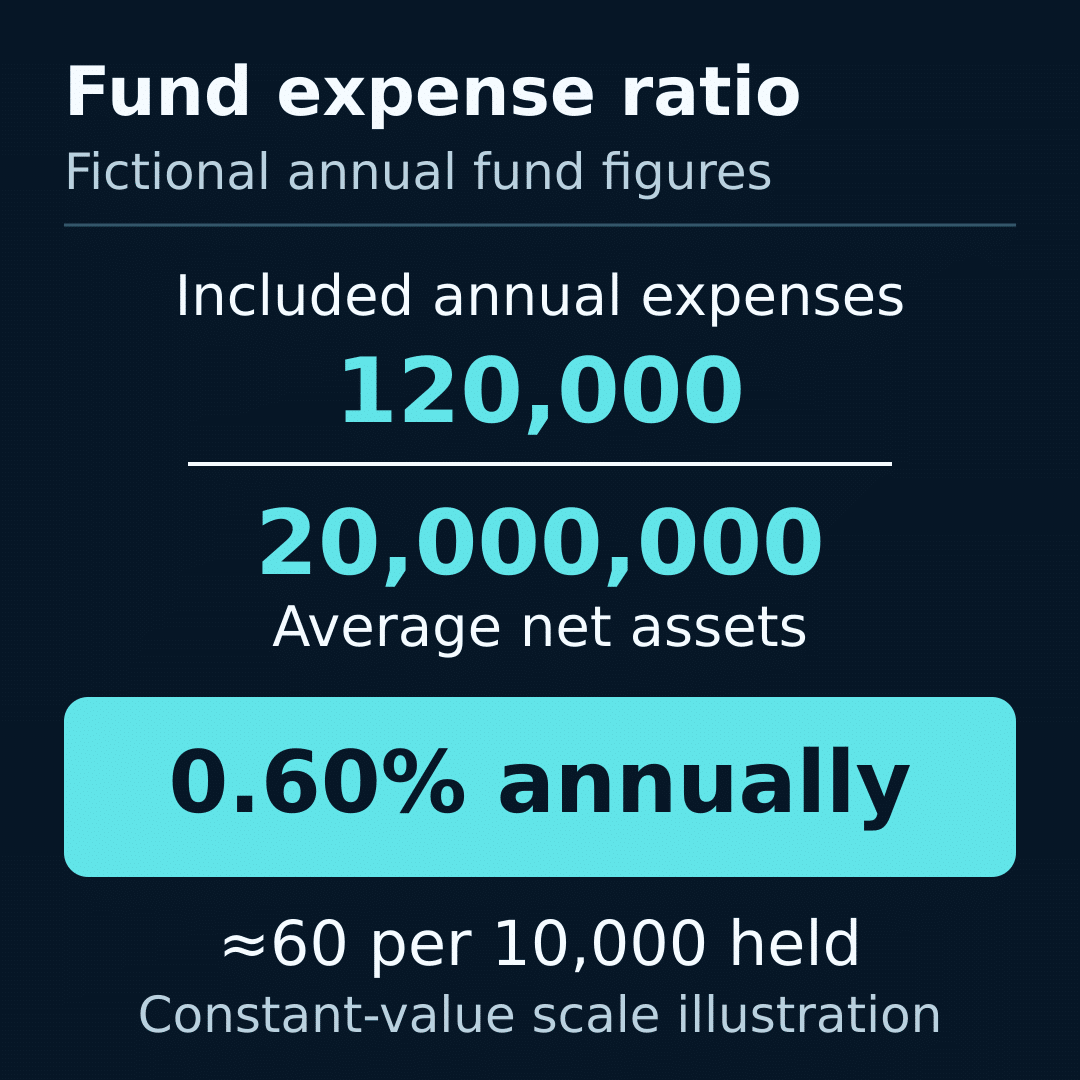
Our fictional annual table includes 80,000 currency units for management and 40,000 for administration, custody and other specified operating expenses. The included total is 120,000. Average net assets over the same period are 20,000,000.
On a narrow screen, scroll the table sideways to read every column.
| Field | Currency units | Percentage of average net assets |
|---|---|---|
| Management expense | 80,000 | 0.40% |
| Other included operating expenses | 40,000 | 0.20% |
| Total included expenses | 120,000 | 0.60% |
| Average net assets | 20,000,000 | Calculation denominator |
Fund expense ratio = included annual expenses ÷ average net assets × 100. The calculation is 120,000 ÷ 20,000,000 × 100 = 0.60%. The 0.40% management component alone would omit the other 0.20 percentage point specified in this fictional table.
Suppose a nearby report also lists year-end net assets of 24,000,000. Using that convenient number would produce 0.50%, but it would replace the stated average denominator. Preserve the reporting-period average rather than silently substituting a different asset snapshot.
For scale, 0.60% of a hypothetical constant 10,000 balance is 60 per year. This illustration does not calculate an exact personal charge on a changing balance. The dates, asset values and applicable expense method would be needed for that separate task.
Follow an accrued operating expense into NAV
The Association of Mutual Funds in India’s expense-ratio explanation states that disclosed daily NAV is after expenses in its Indian mutual-fund context. The following invented accounting bridge shows how an expense liability can affect a per-unit value.
At one valuation point, assume portfolio and cash assets total 1,005,000, other liabilities equal 2,000, and 100,000 units are outstanding. Before recognizing our separate 300 operating-expense liability, net assets are 1,003,000 and NAV is 10.030 per unit.
Recognize that 300 liability while holding the other inputs fixed. Net assets become 1,005,000 − 2,000 − 300 = 1,002,700. Dividing by the unchanged 100,000 units gives 10.027. The expense reduces the modeled per-unit NAV by 0.003.
The unit count has not changed. The accounting adjustment occurs inside the fund ledger, so this exercise needs no removal of investor units or separate personal-account payment to explain the NAV difference.
Now assume the fund pays that already-recognized liability from cash. Assets fall by 300 to 1,004,700 and the operating-expense liability falls from 300 to zero. With other liabilities still 2,000, net assets remain 1,002,700 and NAV remains 10.027.
That second step settles an amount already recognized. Subtracting another 300 from net assets would count the same expense twice. The snapshot’s 300 is deliberately independent of the earlier annual table; it is not presented as one day’s accrual at a 0.60% rate.
Check the return basis before making another deduction
The same duplication risk appears when interpreting a return series. If its documented NAV figures already reflect the fund operating expenses, deducting the fund expense ratio again would impose another copy of those costs. First identify what is included in the return, its dates and its distribution treatment.
Our snapshot demonstrates the accounting problem directly: the final NAV is already 10.027 after the 300 expense recognition. Replacing it with 10.024 by removing another 0.003 would describe a second expense event that never occurred in the supplied ledger.
Separate transaction-related charges remain separate questions. A net fund series does not, by that label alone, establish every amount affecting a particular account. If reconciling an exchange purchase, preserve its actual bid-ask and execution context rather than inserting those differences into the expense-ratio line.
Fund expense ratio: reconcile gross expenses and reimbursement
Extend the fictional annual table with gross included expenses of 150,000 and a specified reimbursement of 30,000. Their difference is the earlier net total of 120,000. Keep average net assets at 20,000,000 for both calculations.
The gross fund expense ratio is 150,000 ÷ 20,000,000 × 100 = 0.75%. The reimbursement represents 0.15 percentage point, leaving a 0.60% net ratio. A table displaying both ratios is describing two expense boundaries rather than two contradictory answers.
The SEC bulletin discusses share-class differences. For an actual document, check which class and period each number describes, when an adjustment applies, and any stated limits. This fictional reimbursement has no assumed expiry or recoupment terms.
Record the fund expense ratio and its cost boundaries
Save the fund and class identifier, document date, reporting period, average-assets denominator, included components, gross ratio, net ratio and adjustment terms. A missing field should remain unresolved rather than filled with a familiar assumption from another fund.
US and Indian terminology should be read in the relevant source context. This guide does not treat a shared percentage label as proof that every jurisdiction includes identical cost categories. Compare the stated perimeter before comparing the numbers.
Verify the original fee document and keep the calculation with a reproducible research record. The goal is a cost description another reader can check, without a claim that a particular ratio predicts performance or identifies the right fund.
Frequently asked questions
Is a 0.60% expense ratio a percentage of profits?
Our formula uses average net assets, not profit. The fictional 120,000 expense total divided by 20,000,000 produces 0.60% without any profit input. Replacing the denominator with gains would define a different measure.
Why might my account show no separate expense-ratio debit?
Our NAV example recognizes the expense as a fund liability and reduces net assets per unit. It does not require a separate investor-account debit. Check the fund and account records before assuming that no visible debit means no fund expense was reflected.
Is the management fee the whole expense ratio?
Not in the supplied table: management contributes 0.40%, and other included operating expenses contribute 0.20%. Together they produce 0.60%. The actual document determines which components belong in its total.
Why does the asset denominator matter?
Dividing the same 120,000 by the stated 20,000,000 average gives 0.60%; using the invented 24,000,000 year-end value gives 0.50%. The numerator is unchanged. A different denominator alone can create an apparently different fee ratio.
Should I subtract the ratio again from a net NAV return?
First confirm the return definition. If the relevant operating expenses are already reflected, another deduction duplicates them. Our ledger shows the same error when an already-expensed 0.003 per unit is removed a second time without a second expense event.
Does a zero-expense label establish zero total personal costs?
A label only resolves the cost category it actually describes. Inspect the documented scope and any separate account or transaction items. Our bridge keeps fund expenses and separately recorded costs in different lines so their meanings remain visible.
How do gross and net expense ratios differ in the example?
The gross 0.75% reflects 150,000 of expenses. Subtracting the fictional 30,000 reimbursement leaves 120,000 and a 0.60% net ratio. Both use the same average-assets denominator, making the 0.15-percentage-point adjustment reproducible.
Can I assume a reimbursement continues indefinitely?
The invented example supplies an amount, not a perpetual commitment. For a real fund, read the applicable period and terms in its document. A current net figure alone does not establish what the ratio will be in a later period.
Can different share classes show different ratios?
The SEC discussion identifies class-specific expense differences. Record the exact class before comparing disclosures, even when the portfolio name looks the same. A ratio from one class should not be silently attached to another class’s return record.
Can ratios across countries be compared without checking the components?
The percentage arithmetic is only one part of the comparison. Verify that the categories, reporting periods and adjustments have compatible meanings. If those fields differ, explain the difference rather than presenting the smaller number as a complete cost conclusion.
Educational explanation by the CrowdSent Blog Team. Sources checked 13 October 2026. All figures are hypothetical; no fund or provider is recommended.